this week in lectures, signings, panel discussions, workshops, and Q&As

THE KILL TEAM

(photo by Dan Krauss)

Specialist Adam Winfield shares his frightening story in award-wining documentary THE KILL TEAM (photo by Dan Krauss)

THE KILL TEAM (Dan Krauss, 2013)
Film Society of Lincoln Center, Elinor Bunin Munroe Film Center
144 West 65th St. between Broadway & Amsterdam Ave.
July 25-31
212-875-5601
www.filmlinc.com
www.killteammovie.com

Ten years ago, Dan Krauss made the Oscar-nominated short The Death of Kevin Carter: Casualty of the Bang Bang Club, telling the harrowing story of a South African war photographer struggling with his decision to take a photo of a starving Sudanese girl being stalked by a vulture rather than trying to help her. In his feature debut, Krauss documents the emotional tale of another man at a crossroads in The Kill Team. Intrigued by the April 2011 New York Times Magazine article “A Beast in the Heart of Every Fighting Man” about a homicidal military platoon in Afghanistan, Krauss follows Specialist Adam Winfield as he faces one count of premeditated murder. After discovering that several of his fellow soldiers had purposely gone out looking to kill an innocent man, then drop a weapon to make it appear that the victim was a terrorist, Winfield sent an agonizing message to his father, a former Marine: “I want to do something about it. The only problem is I don’t feel safe here telling anyone.” Winfield went along on one of the kill missions, which were led by Staff Sergeant Calvin Gibbs, and eventually blew the whistle on Gibbs and the others, but his nightmare continued.

Staff Sergeant Calvin Gibbs hovers over documentary like an evil villain (photo by Max Becherer / Polaris)

Staff Sergeant Calvin Gibbs hovers over documentary like an evil villain (photo by Max Becherer / Polaris)

Krauss first became part of the defense team, shooting video pro bono for lawyer Eric Montalvo and filming his meetings with Winfield, his father, and his mother, Emma. Krauss also speaks with other members of the company, Corporal Jeremy Morlock, Private First Class Andrew Holmes, and another whistleblower, Private First Class Justin Stoner, all of whom were facing serious charges as well. Krauss shifts between Winfield’s trial preparation and the soldiers’ reconstruction of their wartime experience while also taking a look back at Winfield’s childhood. By refusing to participate in the film, Gibbs becomes a sort of mythic master villain, part William Calley Jr., part Colonel Kurtz. The Kill Team, which won the Grand Jury Prize at the 2013 Tribeca Film Festival, does an excellent job of making viewers wonder what they would do not only in Winfield’s position but in any situation that sets moral priorities against physical safety. However, Krauss is too manipulative of reality in favor of his desired narrative. When he interviews Morlock, Holmes, and Stoner, the outcome of their trials are already known, but he saves the details for the end, and he deleted a very different closing scene because it didn’t fit with the points he wanted to make, about the military justice system and moral injury. Still, The Kill Team is an important story about war, sacrifice, family, and the evil that men do. The seventy-nine-minute documentary is having an exclusive one-week theatrical run at the Elinor Bunin Munroe Film Center, with Krauss on hand for Q&As with journalist and Oscar-winning screenwriter Mark Boal (The Hurt Locker, Zero Dark Thirty) after the 7:15 screenings on July 25 and 26.

CHELSEA ART WALK SUMMER 2014

Churner and Churner will host live performances during opening reception for Ander Mikalson’s “Three’s Company for Eight Performers” during Chelsea Art Walk

Churner and Churner will host live performances during opening reception for Ander Mikalson’s “Three’s Company for Eight Performers” during Chelsea Art Walk

Multiple locations in Chelsea
Thursday, July 24, free, 5:00 – 8:00
www.artwalkchelsea.com

More than one hundred galleries from Sixteenth to Thirtieth Sts. between Ninth and Eleventh Aves. will keep their doors open until 8:00 tonight for the fifth annual Chelsea Art Walk. The evening includes open studios, artist talks, panel discussions, book signings, receptions, photo shoots, and other events. Below are some of our recommended highlights.

Agora Gallery
Wearable Art Photo Shoot: Everyone is invited to show up wearing some kind of self-made art (clothing, makeup, hair, nails), 530 West 25th St., 6:30 – 7:30

Bertrand Delacroix Gallery
Sneak peek at Federico Infante’s fall exhibition, “The Space Between,” including raffle of original Infante drawing, 535 West 25th St., 5:00 – 8:00

Churner and Churner
Performance and reception for opening of Ander Mikalson’s “Three’s Company for Eight Performers,” 205 Tenth Ave., three performances, 5:00 – 8:00

Dean Borghi — NBR Contemporary
Book reading, White Collar Slavery: Based on a Bit of Truth and a Few White Lies by Laurance Rassin and Tracy Memoil, 5:00; live music by Clusterfunk and short film Art Sharks, 6:00 – 8:00, 547 West 27th St.

Hauser & Wirth
Sterling Ruby “Sunrise Sunset” panel discussion with Michael Darling, Jeremy Strick, and Huma Bhabha, 511 West 18th St., 6:30

Onishi Project
Opening reception for group show “Summer Garden” featuring works by Osamu Kobayashi, Shinji Murakami, and Gail Stoicheff, with free special Mizu Shochu cocktails and live performance by Zander Padget at 7:00, 521 West 26th St.

Sragow Gallery
“The Art of Painting Portraits,” lecture by artist Alphonse van Woerkom, 115 West 30th St., 5:15

Yossi Milo Gallery
Book signing, Horizons by Sze Tsung Leong, 245 Tenth Ave., 6:00 – 8:00

AI WEIWEI: ACCORDING TO WHAT?

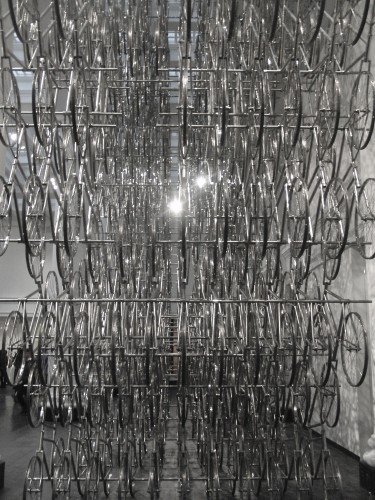
Ai Weiwei, “Stacked,” stainless-steel bicycles, 2014 (photo by twi-ny/mdr)

Ai Weiwei, “Stacked,” stainless-steel bicycles, 2014 (photo by twi-ny/mdr)

Brooklyn Museum
Morris A. and Meyer Schapiro Wing, fourth and fifth floors
200 Eastern Parkway at Washington St.
Wednesday – Sunday through August 10, $15
Art Off the Wall: “Ai Weiwei: According to What?,” July 24, $15, 6:00
718-638-5000
www.brooklynmuseum.org
www.aiweiwei.com

Over the last decade, Ai Weiwei has become the most famous, and arguably the most important, artist in the world. The multidisciplinary artist and activist, the son of a poet and activist father, helped design the National Olympic Stadium, aka the Bird’s Nest, for the 2008 Beijing Summer Games, was beaten by police in Chengdu in 2009, had his influential blog shut down by the Chinese government that same year, then was arrested in 2011, his whereabouts unknown for eighty-one days as people around the globe demanded his release. Through it all, Ai, who has been under house arrest since 2011, has remained steadfast in his dedication to challenge belief systems, question the status quo, and explore social issues in his art. All that and more is evident in the impressive “Ai Weiwei: According to What?,” a touring survey that is in the midst of its final stop at the Brooklyn Museum, where it continues through August 10. “Rather than thinking of my projects as art, they attempt to introduce a new condition, a new means of expression, or a new method of communicating,” Ai tells Kerry Brougher in a Q&A in the exhibition catalog, in which he references Ludwig Wittgenstein, Andy Warhol, Confucius, Donald Judd, and Sergei Eisenstein in a few short pages. “If these possibilities didn’t exist, I wouldn’t feel the need to be an artist.”
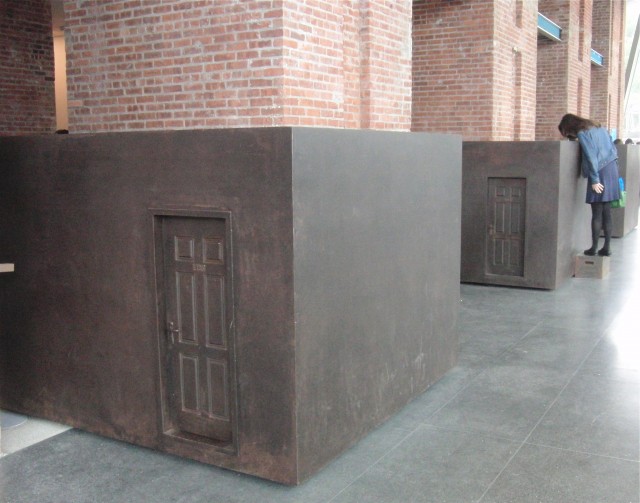
Ai Weiwei’s “S.A.C.R.E.D” invites visitors to see details of his eighty-one-day imprisonment (photo by twi-ny/mdr)

Ai Weiwei’s “S.A.C.R.E.D” invites visitors to see details of his eighty-one-day imprisonment (photo by twi-ny/mdr)

The exhibition began in 2009 at the Mori Art Museum in Tokyo but continued to morph as it made its way through North America toward Brooklyn, where several pieces have been added. Upon entering the Brooklyn Museum’s front lobby, visitors are greeted by “S.A.C.R.E.D.,” six iron boxes that contain detailed re-creations of scenes from Ai’s imprisonment — being led into his small cell by guards, being interrogated, eating, sleeping, using the bathroom, under constant surveillance — instantly turning the Beijing-based artist into a heroic, bigger-than-life figure. The rest of the show, spread across two upper floors, confirms that Ai is indeed a hero, his sculptures, photographs, films, repurposed found objects, and installations all having political, historical, and social relevance, dealing with individual freedom, human rights, and the search for the truth.
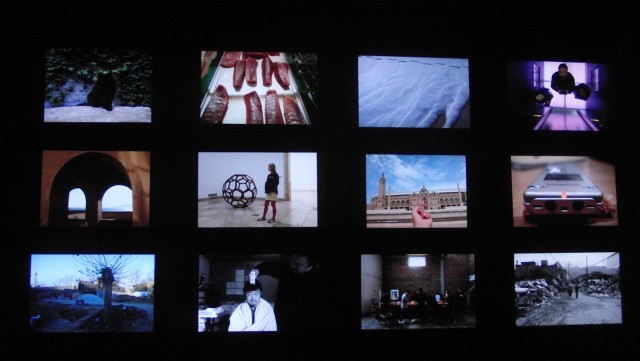
Video installations play a large role in Ai Weiwei exhibition (photo by twi-ny/mdr)

Video installations play a large role in Ai Weiwei exhibition (photo by twi-ny/mdr)

There is critical meaning behind every work, sometimes obvious, as in the marble “Surveillance Camera” and photographs in which Ai shoves his middle finger at Tiananmen and the White House, and often less clear at first, as in “He Xie,” a pile of more than three thousand porcelain crabs gathered at the center of a room. The piece references a dinner of river crabs that Ai, who could not attend because of his house arrest, organized shortly before his Shanghai studio was going to be torn down by the government; the title of the piece sounds like the word “harmonious,” which echoes the communist phrase “a harmonious society.” Ai consistently values people above material objects, mocking monetary worth. In “Dropping a Han Dynasty Urn,” three photographs depict him letting an ancient ceramic vase fall from his hands, smashing at his feet. “Stacked” consists of hundreds of silver bicycles in a dazzling array, not only evoking the popular means of transportation in China but the mass production of consumer goods, in this case made by a company called Forever.
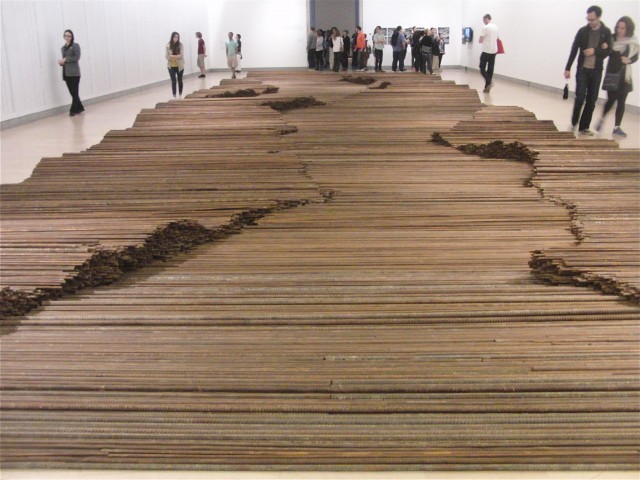
Ai Weiwei, “Straight,” seventy-five tons of steel rebar, 2008-12 (photo by twi-ny/mdr)

Ai Weiwei, “Straight,” seventy-five tons of steel rebar, 2008-12 (photo by twi-ny/mdr)

Ai has spent much of the last few years investigating the aftereffects of the 2008 Sichuan earthquake, in which poorly constructed buildings, including schools, resulted in approximately ninety thousand missing or dead men, women, and children. For “Straight,” Ai had workers take twisted steel rebar from the sites of the building collapses and pound them back into their original straight form, then laid them out in a vast landscape that appears unfinished, as more bodies need to be found and identified. The victims of the earthquake, who have been mostly ignored by the government, are given back their identities in “Sichuan Namelist,” an inkjet print listing casualties, and “Remembrance,” a nearly four-hour recording on which a voice reads the names of the students who died in the tragedy. The children are also memorialized in “Snake Ceiling,” in which hundreds of children’s backpacks form a serpentine figure lurking above.
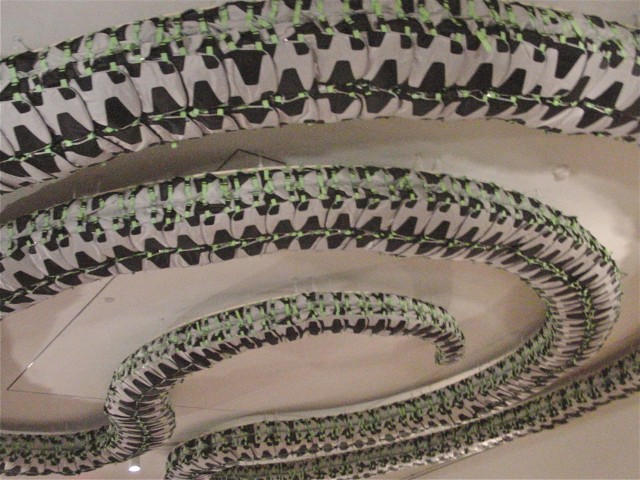
Ai Weiwei, “Snake Ceiling,” backpacks, 2009 (photo by twi-ny/mdr)

Ai Weiwei, “Snake Ceiling,” backpacks, 2009 (photo by twi-ny/mdr)

“Ai Weiwei: According to What?” also includes dozens of Ai’s photographs from his time in New York City; repurposed furniture that comments on Chinese tradition and the actual map of the country; his film Stay Home!, about a woman who contracted AIDS from a blood transfusion when she was a little girl; the installation “Ye Haiyan,” in which Ai has collected the belongings of a women’s rights activist who keeps getting evicted from her home; a video documenting his “Fairytale” project, in which he brought 1,001 Chinese people, from all classes, to Documenta in Kassel; and works that detail his brain injury suffered at the hands of police. The exhibition is splendidly curated by Sharon Matt Atkins, allowing plenty of space for contemplation of these bold, inspiring works by an artist who is not afraid to speak his mind, fully aware of what the consequences might be. “The relationship between thought and action is the most important source of human wisdom and joy,” Ai says at the end of the catalog interview. “With both, the process of turning art into reality is the path to happiness. It’s like a game. Only through this process can we understand who we are. So the game will continue.” The captivating exhibition — which is positive and delightfully engaging despite the serious nature of so much of its subject matter — makes you want to be part of that game. On Thursday, July 24, there will be a special evening “Art Off the Wall” program, consisting of a talk by Matt Atkins at 6:00, a presentation and workshop by the Asian American Oral History Collective at 6:30, Kelly Zen-Yie Tsai’s multimedia spoken-word piece “Ai Weiwei: The Seed” at 7:30, and a Chinese calligraphy workshop and DJ set at 8:30. (To see Ai answer questions from museum visitors, go here.)


CHAKAIA BOOKER: THE SENTINELS

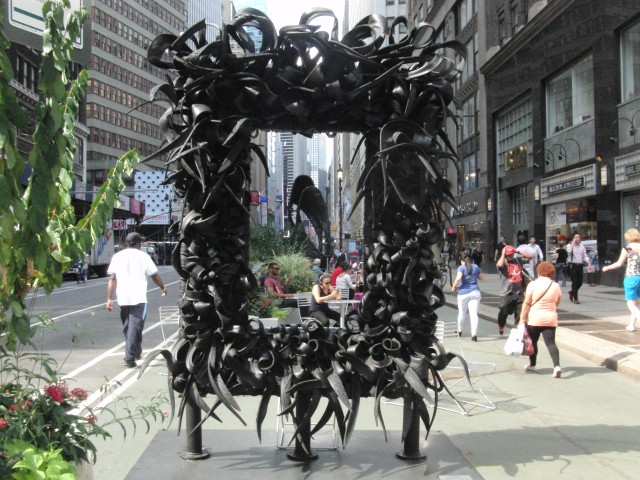
Chakaia Booker’s “Take Out” offers a new perspective in the Garment District (photo by twi-ny/mdr)

Chakaia Booker’s “Take Out” offers a new perspective in the Garment District (photo by twi-ny/mdr)

Broadway Public Art
Garment District Plazas
Broadway between 36th & 41st Sts.
Through mid-November 2014, free
www.garmentdistrictnyc.com
the sentinels slideshow

We feel a special affinity for Chakaia Booker’s new installation “The Sentinels,” five works that line Broadway’s Garment District Plazas just north of Macy’s. When we were growing up, our family ran a tire and auto repair business on Utica Ave. in Brooklyn, so the smell and touch of vulcanized rubber is in our veins. The project, sponsored by the Garment District Alliance and the New York City Department of Transportation, consists of five pieces that the Newark-born, New York City-based Booker, working with fabricator Alston Van Putten Jr., fashioned by first employing design software to come up with a scale model, then using stainless-steel tubing, recycled rubber tires, and power tools to put it all together. Situated along the pedestrian plazas on Broadway, the pieces evoke industrialism, labor, and environmentalism while honoring the African American experience; it also serves as a reminder that the area was formerly open to cars, but the only rubber currently allowed on that part of the street is Booker’s art.

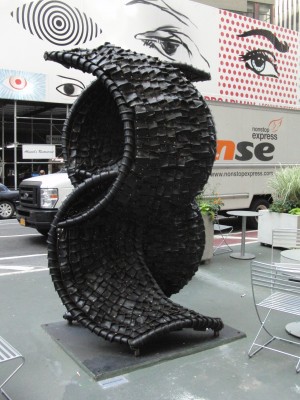
Chakaia Booker’s “The Sentinels” is quite a sight to see on Broadway pedestrian plaza (photo by twi-ny/mdr)

Chakaia Booker’s “The Sentinels” is quite a sight to see on Broadway pedestrian plaza (photo by twi-ny/mdr)

The five works — “Shapeshifter,” “Gridlock,” “Take Out,” “One Way,” and the brand-new “LBD Duty Free,” created for this installation — offer a welcoming presence that invites passersby to investigate their intricate details (though no touching is allowed), as Booker and Van Putten Jr. were able to turn the tires into all kinds of twisting shapes that recall sewing and patchwork quilts as well as a kind of unique playground (but no climbing allowed). Particularly effective is 2008’s “Take Out,” which recalls a wonderfully framed painting looking up or down bustling Broadway as well as a mirror that makes it feel like you’re looking at yourself. “Placing these sculptures in the Garment District suggests a cross pollination, and cultivation of current, past, and future behavior,” Booker explained in a statement. “I hope this installation helps create a sense of community progression, symbolizing how this neighborhood has grown into the vibrant, creative, and artistic center it is today.” The black and gray color palette is also quite a contrast to the artist herself, who wears colorful head wraps and dresses. When we were at the Domino Sugar Factory last month seeing Kara Walker’s spectacular Creative Time project “A Subtlety,” we suddenly found ourselves standing next to Booker, whose dazzling outfit provided a stark contrast to Walker’s central white “mammy” sculpture. (You can see a photo of Booker at the show here.) Booker, whose “Manipulating Fractions” was part of the recent “Fact of the Matter” off-site Socrates Sculpture Park exhibition at the 1285 Avenue of the Americas Art Gallery, will be at the actual Socrates park in Queens from July 28 to August 1 leading the children’s outdoor art workshop “Build a Meal,” in which participants will sculpt a balanced meal using clay and other materials; preregistration is highly advised at 718-956-1819.

JAPAN CUTS: WHY DON’T YOU PLAY IN HELL?

Sion Sono

Sexy Michiko (Fumi Nikaido) shows her dangerous side in Sion Sono’s outrageously fun WHY DON’T YOU PLAY IN HELL?

WHY DON’T YOU PLAY IN HELL? (JIGOKU DE NAZE WARUI) (Sion Sono, 2013)
Japan Society
333 East 47th St. at First Ave.
Thursday, July 10, 8:30
Festival runs July 10-20
212-715-1258
www.subwaycinema.com
www.japansociety.org

It might take a while for the two seemingly disparate narratives to come together in Sion Sono’s totally awesome Why Don’t You Play in Hell?, but when they do, watch out, because it all leads to one gloriously insane finale. As teenagers, the nerdy Fuck Bombers — director Hirata (Hiroki Hasegawa), camera operators Miki (Yuki Ishii) and Tanigawa (Haruki Mika), and future action star and Bruce Lee wannabe Sasaki (Tak Sakaguchi) — are determined to make a movie. Ten years later, they are still waiting to make their masterpiece. Meanwhile, Shizue (Tomochika), the wife of yakuza boss Taizo Muto (Jun Kunimura) and ambitious stage mother of toothpaste-commercial darling Michiko (Nanoka Hara), has been in prison for ten years for brutally killing three men while defending her home against an assassination attempt by the Ikegami yakuza clan, which only Ikegami (Shinichi Tsutsumi) himself survived. Ten years later, Shizue is scheduled to get out of prison in ten days, and Muto is scrambling to keep his promise to his wife that Michiko (now played by Fumi Nikaido) would be the star of a movie by the time Shizue was released. However, Michiko, who has become a bitter, dangerous young woman, is on the run, taking with her geeky innocent bystander Koji (Gen Hoshino) as her inept pretend boyfriend. When the plot lines intersect, the fun really begins, with blood and body parts battling it out for the biggest laughs.
Why Don’t You Play in Hell? is a riotous send-up of yakuza crime thrillers and a loving and downright silly homage to DIY filmmaking. Digging back into his past to adapt a screenplay he wrote back in the 1990s, Sono (Love Exposure, Cold Fish) lets it all fly, holding nothing back in this sweetly violent, reality-bending, severely twisted romantic comedy that actually has quite a big heart. And at the center of it all is Nikaido (Sono’s Himizu), splendidly portraying a sexy, black-clad ingénue/femme fatale who is capable of just about anything. Winner of the Toronto International Film Festival’s People’s Choice Midnight Madness Award, Why Don’t You Play in Hell? is screening July 10 at Japan Society’s Japan Cuts: The New York Festival of Contemporary Japanese Cinema, in conjunction with the fourteenth annual New York Asian Film Festival. Nikaido, who is receiving the NYAFF’s Screen International Rising Star Award, will be on hand to introduce the film and participate in a Q&A; the screening will be followed by the “Let’s Play in Hell” opening-night party with live music by New York-based Japanese punk band Gelatine.

FIRST SATURDAYS: BROOKLYN SUMMER

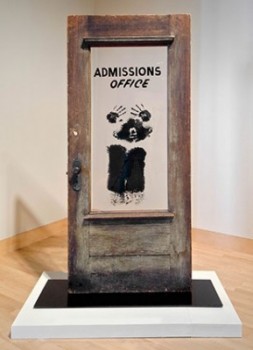
David Hammons, “The Door (Admissions Office),” wood, acrylic sheet, and pigment construction, 1969 (California African American Museum, Los Angeles, Collection of Friends, the Foundation of the California African American Museum / © David Hammons)

David Hammons, “The Door (Admissions Office),” wood, acrylic sheet, and pigment construction, 1969 (California African American Museum, Los Angeles, Collection of Friends, the Foundation of the California African American Museum / © David Hammons)

Brooklyn Museum
200 Eastern Parkway at Washington St.
Saturday, July 5, free, 5:00 – 11:00 ($10 discounted admission to “Ai Weiwei: According to What?”)
212-864-5400
www.brooklynmuseum.org

The Brooklyn Museum is throwing a summer party for its July free First Saturdays program, centered by a twenty-fifth-anniversary screening of Spike Lee’s Bed-Stuy classic, Do the Right Thing. In addition, there will be music from Matuto, Blitz the Ambassador, DJ Uhuru, and Nina Sky, a female comedy showcase hosted by Erica Watson, a talk and fashion show led by Afros: A Celebration of Natural Hair author Michael July, a sidewalk chalk drawing project organized by the City Kids, a hula hoop demonstration with Hula Nation, an art workshop in which participants will learn figure drawing with a live model, and an interactive talk with “Brooklyn in 3000 Stills” creators Paul Trillo and Landon Van Soest. In addition, you can check out the current quartet of exhibitions, all of which deal with activism through art: “Ai Weiwei: According to What?,” “Swoon: Submerged Motherlands,” “Chicago in L.A.: Judy Chicago’s Early Works, 1963–74,” and “Witness: Art and Civil Rights in the Sixties.”

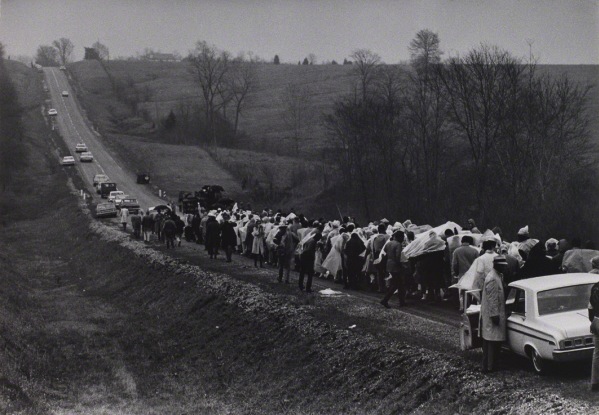
Moneta Sleet Jr., “Selma Marchers on road to Montgomery,” gelatin silver photograph, 1965 (courtesy Brooklyn Museum)

Moneta Sleet Jr., “Selma Marchers on road to Montgomery,” gelatin silver photograph, 1965 (courtesy Brooklyn Museum)

The powerful, wide-ranging “Witness,” which has just been extended through July 13 (the other three exhibits continue into August or September), is a traveling show being held in conjunction with the fiftieth anniversary of the passage of the Civil Rights Act of 1964. More than one hundred paintings, sculptures, photographs, and installations are on view, divided into eight thematic categories: “Integrate Educate,” “American Nightmare,” “Presenting Evidence,” “Politicizing Pop,” “Black Is Beautiful,” “Sisterhood,” “Global Liberation,” and “Beloved Community.” In Bruce Davidson’s “USA. Montgomery, Alabama. 1961,” a black Freedom Rider sits by a window on a bus being escorted by the National Guard. David Hammons’s “The Door (Admissions Office)” is not exactly a welcoming sight. Norman Rockwell’s “New Kids in the Neighborhood (Negro in the Suburbs)” depicts three white children and two black children stopped on a sidewalk, curiously looking at each other. Melvin Edwards’s “Chaino” evokes slavery and lynchings. A trio of cartoonish KKK members drive into town in Philip Guston’s “City Limits.” There are also works by Romare Bearden, Jacob Lawrence, Norman Lewis, Jack Whitten, Faith Ringgold, Ben Shahn, Betye Saar, Gordon Parks, Jim Dine, Yoko Ono, Barkley Hendricks, Robert Indiana, Richard Avedon, and others that examine the civil rights movement from multiple angles, displaying America’s continuing shame.

NEW YORK ASIAN FILM FESTIVAL 2014

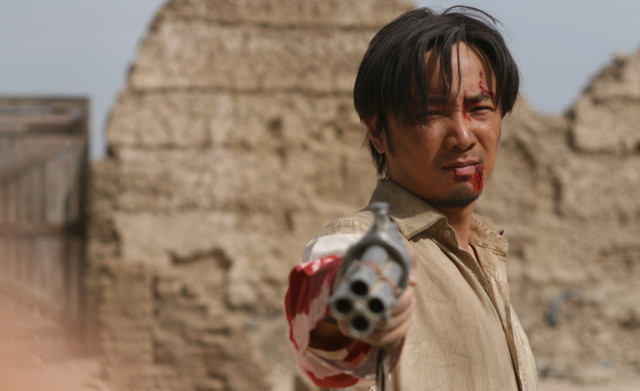
Ning Haos NO MANS LAND is finally making its North American premiere, at the NYAFF

Ning Hao’s NO MAN’S LAND is finally making its North American premiere, at the NYAFF

Film Society of Lincoln Center
Walter Reade Theater
144 West 65th St. between Broadway & Amsterdam Aves.
June 27 – July 10
212-875-5600
www.filmlinc.com
www.subwaycinema.com

Year after year, the New York Asian Film Festival screens the wildest, craziest, most wide-ranging collection of cinematic adventures from China, Japan, Taiwan, Korea, and Hong Kong, delighting fans with premieres from favorite directors, welcome dips into the past, celebrations of cult classics, and intriguing works from up-and-coming artists. The thirteenth annual NYAFF is no exception, consisting of forty-four films from across the spectrum, along with special tributes to Sandra Ng (Queen of Comedy Star Asia Award), Sol Kyung-gu (Star Asia Award), Park Joong-hoon (Celebrity Award), Fumi Nikaido (Screen International Rising Star Award), Lee Jung-jae (Korean Actor in Focus), and Jimmy Wong Yu (Lifetime Achievement Award). Also making appearances will be Alan Mak & Felix Chong, Moon So-ri, Anna Broinowski, Zishuo Ding, Fei Xing, Lee Sujin, Shin Yeon-shick, and Umin Boya. Looking for a sexy comedy? In 3D? Try Lee Kung-lok’s Naked Ambition. Want a peek into the filmmaking side of Dear Leader Kim Jong-il? There’s Anna Broinowski’s Aim High in Creation! In the mood for some Shaw Brothers? Then check out Roy Ward Baker and Change Cheh’s The Legend of the 7 Golden Vampires. You can’t leave out Zombies, so Sabu has that covered with Miss Zombie.

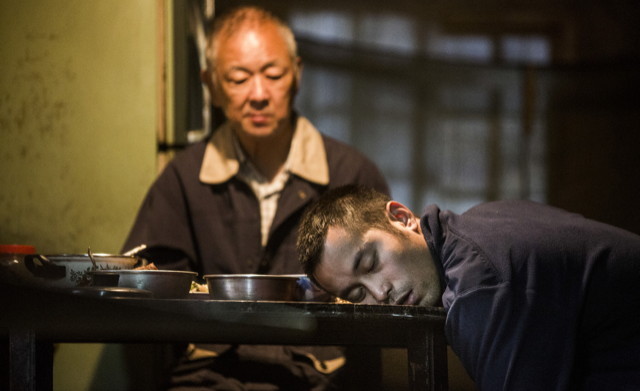
A chef decides to do a different kind of slicing and dicing in SOUL

A chef decides to do a different kind of slicing and dicing in SOUL

Hungry for a neo-spaghetti Eastern? Ning Hao is serving up No Man’s Land. How about the very first openhanded martial arts film? Jimmy Wang Yu’s 1970 The Chinese Boxer puts you in the middle of the action. You’ll also find new films by such familiar names as Kim Ki-duk, Hideo Nakata, and Kiyoshi Kurosawa and featuring such stars as Andy Lau, Chow Yun-fat, Simon Yam, Hitoshi Matsumoto, and Tadanobu Asano. The opening-night selection is Mak and Chong’s Overheard 3, the international premiere of the conclusion of the gangster trilogy. The centerpiece choice is Boya’s three-hour Kano, about a pioneer Taiwanese baseball team. In conjunction with the NYAFF, the always awesome Japan Cuts follows immediately, running July 10-24 at Japan Society, comprising more than two dozen contemporary films from Japan, only a few of which were also part of the NYAFF.