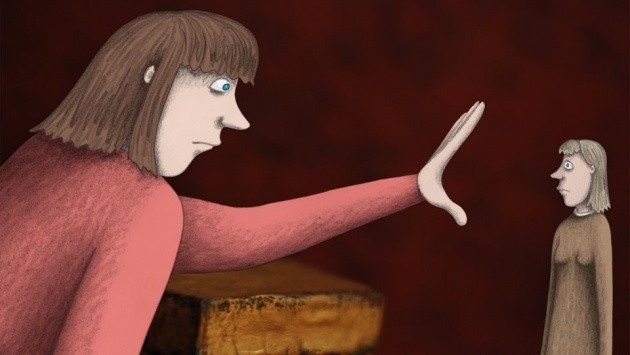
Signe Baumane examines her family history of suicide and depression in ROCKS IN MY POCKETS
ROCKS IN MY POCKETS: A CRAZY QUEST FOR SANITY (Signe Baumane, 2014)
IFC Center
323 Sixth Ave. at West Third St.
Opens Wednesday, September 3
212-924-7771
www.ifccenter.com
www.rocksinmypocketsmovie.com
 The recent suicide of Robin Williams shook the nation, once again pointing out that depression is no laughing matter. But Latvian-born, Brooklyn-based writer-director-producer-animator Signe Baumane takes a unique approach to depression and suicide in the darkly twisted animated film Rocks in My Pockets: A Crazy Quest for Sanity. Influenced by such animation giants as Jan Švankmajer and Bill Plympton in addition to Lithuanian-Polish illustrator Stasys Eidrigevicius and Russian animator Yuri Norstein, Baumane, a self-described “Master of Self Pity,” incorporates hand-drawn animation, papier-mâché constructions, and stop-motion animation in telling the story of her family’s long history of mental illness and suicide. Inspired by her own thoughts of ending it all, Baumane (Teat Beat of Sex), in her feature-length debut, divides the film into segments about her suicidal relatives. She narrates the tales of Indulis, an entrepreneur and failed counterfeiter with an “idea-generating brain”; Anna, a university graduate and secretary who falls in love with Indulis, her married boss; Miranda, who looks at the world as if everything were a work of art; Linda, a medical student with big dreams; Irbe, a lonely music teacher who hears voices in her head; and herself as they all experience various aspects of severe depression while facing the trials and tribulations of everyday life in a changing sociopolitical climate in Eastern Europe.
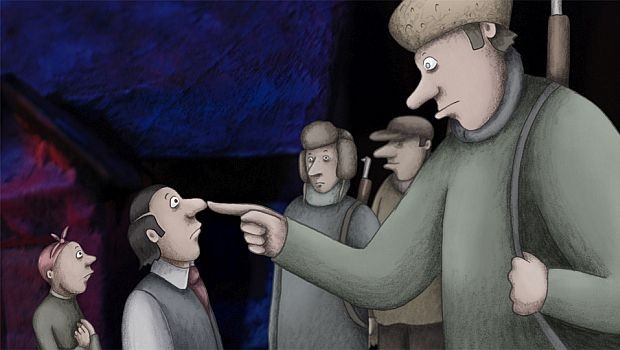
ROCKS IN MY POCKETS uses twisted humor to explore some very serious subjects
Despite the serious topics and events — and the regular appearance of nooses tempting the protagonists — Rocks in My Pockets is filled with clever jokes, imaginative visual puns, beautiful imagery, and a playful score by Kristian Sensini; Baumane refers to it as “a funny film about depression,” and that’s just what it is. The animated characters make their way through lush forests, across a real chess board, and past other colorful backgrounds as reality strikes them hard. The personal nature of the film is enhanced by Baumane’s own narration, in her thick Latvian accent. (Her mother attempted to talk her out of doing the narration, thinking it was a bad idea.) “I want to survive, but I don’t want to live,” Baumane says halfway through the film. “When my brain is idle, it starts eating itself.” Fearing that depression and suicide are part of her DNA, she’s unsure how she can get away from it — and prevent it from affecting future generations of her family. Winner of the International Critics (FIPRESCI) Prize at the 2014 Karlovy Vary Film Festival and financed in part by a Kickstarter campaign (where you can learn more about the making-of process), Rocks in My Pockets opens September 3 at the IFC Center, with Baumane taking part in Q&As following the 6:30 and 8:30 shows on Wednesday and Thursday, with more to be announced; in addition, original drawings from the film will be given away at select screenings.
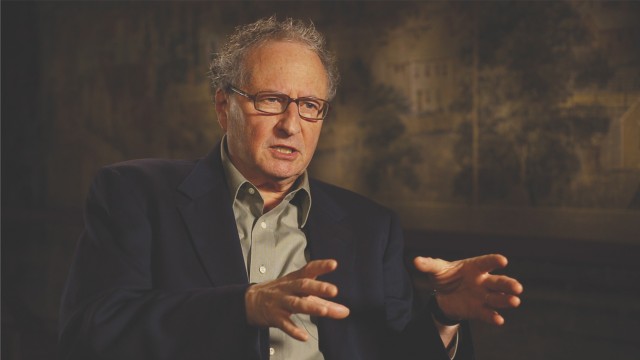
 At the beginning of Eric Merola’s Second Opinion: Laetrile at Sloan-Kettering, a 1970s news reporter says, “Dr. Robert Good, president of the Sloan Kettering Institute, one of the world’s biggest and richest cancer research centers, said Laetrile does not prevent cancer, nor cure cancer, nor stop cancer from spreading.” For the next seventy-five minutes, Ralph W. Moss, PhD, the public affairs science writer for the Memorial Sloan Kettering Cancer Center from 1974 to 1977, talks about what lay behind that statement and the furor that followed. He tells the captivating story of what went on behind the scenes as Laetrile, a form of amygdalin used in tumor treatment, was coveted by cancer patients but demonized by the medical establishment. The controversy over the drug, which was eventually banned in America, forced patients to go to Mexico in search of the palliative care medicine while the FDA, the National Cancer Institute, and several high-profile MSK doctors considered it to be quackery. MSK’s own top researcher, Dr. Kanematsu Sugiura, had exciting success treating mice with the drug, hopeful that the positive effects would be proven in humans as well. But when Dr. Good, MSK vice presidents Dr. Lloyd J. Old and Dr. Chester Stock, and MSKCC president Dr. Lewis Thomas decided that Laetrile was not the future of cancer treatment, despite what some of them had previously stated in public, Moss was confused and distressed. Others were as well; the documentary reveals that the political dimension of the debate eventually brought even the ultra-right-wing John Birch Society into the fray. Moss eventually became a whistleblower, writing numerous books on the subject, including The Cancer Industry, Cancer Therapy: The Independent Consumer’s Guide to Non-Toxic Treatment & Prevention, and the brand-new Doctored Results: The Suppression of Laetrile at Sloan-Kettering Institute for Cancer Research, which spurred the documentary.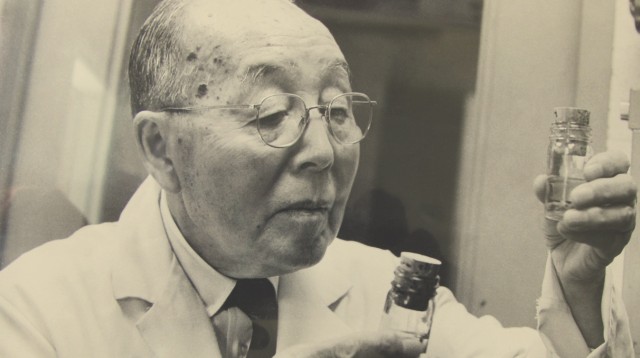

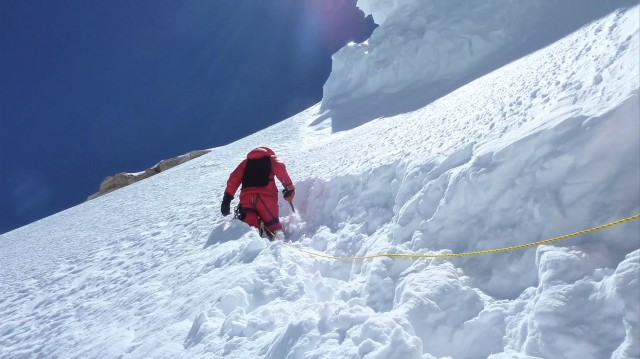
 In 1909, Prince Luigi Amedeo, the Duke of the Abruzzi, sought to climb to the summit of K2, the second highest mountain in the world after Everest, bringing with him writer Filippo de Filippi and photographer Vittorio Sella to document their journey. To celebrate the centennial of that seminal event, alpinist and mountain guide Fabrizio Zangrilli gathered a team of climbers to attempt to reach the top of K2 in 2009, bringing along first-time director Dave Ohlson to capture their daring adventure. Situated in the Karakoram mountain range along the Pakistan-China border, K2 — one of the fourteen legendary “eight-thousanders” (mountains of more than eight thousand meters) — stands 8,611 meters tall, challenging climbers with a death rate much higher than that of Everest. “The will to just try something big, something dangerous, something extraordinary — it’s part of who we are,” says one member of the team, which includes Zangrilli, Canadian mountain guide Chris Szymiec, Austrian alpinist Gerlinde Kaltenbrunner, British mountaineer Jake Meyer, and German cameraman David Göttler. As they make their way across the treacherous Karakoram Highway and through Skardu, the Baltoro Glacier, and Concordia, Ohlson cuts between thrilling still photos and film footage from the 1909 trip and the 2009 attempt, delving into the history of the spectacularly beautiful area and emphasizing how difficult it is to reach K2’s summit. “Everest and K2 aren’t even the same sport,” Szymiec says. Joined by a group of porters, they find obstacles every step of the way — and it gets even more threatening the closer they get. The film reveals the depth of the human spirit and the fierce power of nature, especially when the team has to stop when a friend dies while skiing down the mountain. Watching the seventy-five-minute documentary, you just might consider taking on K2 yourself someday — and then you’ll quickly change your mind and settle back comfortably into your chair. K2: Siren of the Himalayas opens August 22 at the Quad, with Ohlson and Jason Reid, one of the producers and editors, participating in Q&As following the 4:30 and 8:05 shows on Friday and Saturday.