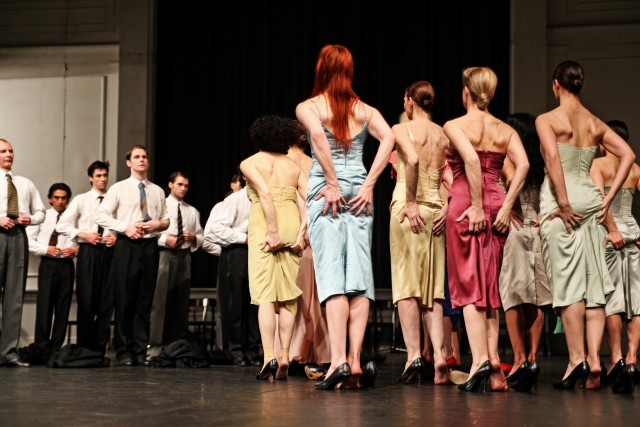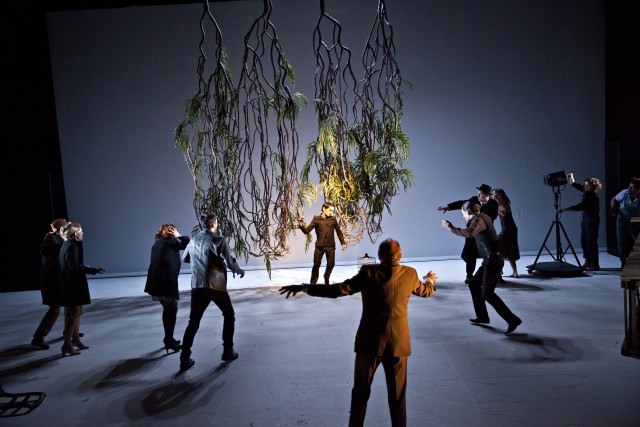
Théâtre de la Ville production of Luigi Pirandello absurdist classic will search for the meaning of existence in Brooklyn (photo by Jean-Louis Fernandez)
Brooklyn Academy of Music
BAM Harvey Theater
651 Fulton St. between Ashland & Rockwell Pl.
October 29 – November 2, $20-$75
718-636-4100
www.bam.org
www.theatredelaville-paris.com
“Unfortunately, there always has to be a third, unavoidable element that intrudes between the dramatic author and his creation in the material being of the performance: the actor,” playwright, novelist, and poet Luigi Pirandello wrote in his 1908 essay “Illustrators, Actors, and Translators.” That tenet is central to one of his most famous works, 1921’s Six Characters in Search of an Author, which is being presented at the BAM Harvey Theater October 29 to November 2 by Théâtre de la Ville, Paris, last at BAM in October 2012 with another absurdist classic, Eugène Ionesco’s Rhinocéros, Described by the playwright, who was born in Agrigento, Italy, in 1867, as a comedy “without acts or scenes,” Six Characters questions the very nature of its own being as a dramatic work as a half dozen abandoned characters appear onstage in need of a new author to define their existence. Adapted and translated by François Regnault and directed by Théâtre de la Ville head Emmanuel Demarcy-Mota, with set and light design by Yves Collet, music by Jefferson Lembeye, and costumes by Corinne Baudelot, this production once again stars Hugues Quester, who won the Critics’ Award for Best Actor for his performance in the play back in 2001. In conjunction with the show, BAM is teaming up with the Onassis Cultural Center NY for the discussion “On Truth (and Lies) in Authorship,” with Demarcy-Mota and host Simon Critchley, being held on October 30 at 6:00 at BAM Fisher Hillman Studio ($15), as part of the Hellenic Humanities Program.
 Called “the most revolutionary group in the history of rock ‘n’ roll” by Lester Bangs,

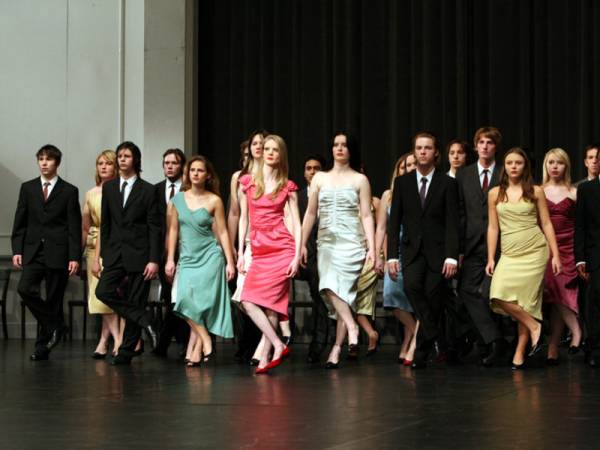
 From 1973 until her death in 2009, legendary dancer and choreographer Pina Bausch ran Tanztheater Wuppertal, the German company that changed the face of dance theater forever with such seminal productions as Rite of Spring, Café Müller, Danzón, Masurca Fogo, and so many others, many of which had their U.S. premieres at BAM. In 1978 she staged Kontakthof, collaborating with Rolf Borzik, Marion Cito, and Hans Pop, set to music by Juan Llossas, Charlie Chaplin, Anton Karas, Sibelius, and other composers. In 2000, she revisited the piece with a cast of senior citizens, and eight years later she turned the roles over to a group of Wuppertal high schoolers, most of whom had never heard of her and had never danced before. Director Anne Linsel and cinematographer Rainer Hoffmann follow the development of this very different production in Dancing Dreams, speaking with the eager, nervous participants, who talk openly and honestly about their hopes and desires, as well as with rehearsal directors Jo-Ann Endicott and Bénédicte Billet, who do not treat the teens with kid gloves but instead are trying to get them to reach deep inside of themselves and hold nothing back. When Bausch shows up to choose the final cast, telling the teenagers that she doesn’t bite, the tension mounts. Dancing Dreams is an intimate look at the creative process, about dedication and determination and what it takes to be an artist. It suffers at times from feeling too much like a reality television show, mixing American Idol and So You Think You Can Dance with the fictional Glee, but it also offers a last glimpse at Bausch, whose final interview is captured in the film. “You might think I’ve had enough of Kontakhtof,” she says at one point. “But every time it’s a new thing.” Dancing Dreams is screening October 27 at 7:30 in conjunction with the current production of