this week in lectures, signings, panel discussions, workshops, and Q&As

HAUTE COUTURE ON FILM: THE RULES OF THE GAME

Lisette (Paulette Dubost) and Christine (Nora Grégor) discuss love and fidelity in Jean Renoir masterpiece

Lisette (Paulette Dubost) and Christine (Nora Grégor) discuss love and fidelity in Jean Renoir masterpiece

CinéSalon: THE RULES OF THE GAME (LA RÈGLE DU JEU) (Jean Renior, 1939)
French Institute Alliance Française, Florence Gould Hall
55 East 59th St. between Madison & Park Aves.
Tuesday, May 5, $13, 4:00 & 7:30
Festival runs through May 26
212-355-6100
www.fiaf.org

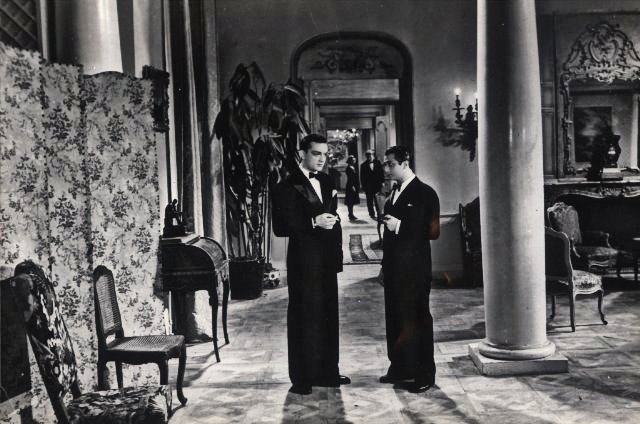
“We’ll have as much fun as we can,” Robert de la Chesnaye (Marcel Dalio) says in Jean Renoir’s 1939 comic masterpiece, the madcap farce The Rules of the Game. And oh, what fun it is. Renoir, the son of Impressionist painter Pierre-Auguste Renoir, skewers love and lust among France’s idle rich on the eve of WWII, the haute bourgeoisie fiddling in their own self-defeating way while their country is about to burn. Banned by the government for being “too demoralizing,” The Rules of the Game follows a group of men and women, both servants and masters, as they jump from bed to bed, sometimes in full view of their spouse. It’s 1939, but even with war on the horizon, a fanciful coterie of friends and acquaintances have gathered for a weekend at Château de la Colinière, the country estate owned by Robert, who is married to Christine (Nora Grégor) but has been fooling around with Geneviève de Marras (Mila Parély). Christine, meanwhile, is being wooed by aviator André Jurieux (Roland Toutain), who has just flown solo across the Atlantic, and the dapper Monsieur de St. Aubin (Pierre Nay). Newly hired domestic Marceau (Julien Carette) has the hots for Christine’s maid, Lisette (Paulette Dubost), whose extremely jealous husband, Edouard Schumacher (Gaston Modot), is Robert’s game warden, prowling the grounds with a rifle he is ready to use. And in the middle of it all is Octave (Renoir), a bear of man who is friends with André and Christine and a former lover of Lisette’s. Borrowing elements from Alfred de Musset’s Les caprices de Marianne and Pierre-Augustin Caron de Beaumarchais’s Le mariage de Figaro, Renoir depicts French society as a bunch of silly, selfish fools, and even though in the credits, over delightful music by Mozart, he calls it “A Dramatic Fantasy” that “does not claim to be a study of manners,” he later referred to it as “an exact description of the bourgeoisie of our time.” Its truthfulness is what helped make the film a critical and popular failure upon its initial release, leading Renoir to cut nearly a half hour in a desperate attempt to save it.
André Jurieux (Roland Toutain) and Robert de la Chesnaye (Marcel Dalio) fight over Robert’s wife in THE RULES OF THE GAME

André Jurieux (Roland Toutain) and Robert de la Chesnaye (Marcel Dalio) fight over Robert’s wife in THE RULES OF THE GAME

“It is a war film, and yet there is no reference to the war,” Renoir wrote in his 1974 memoir, My Life and My Films. “Beneath its seemingly innocuous appearance the story attacks the very structure of our society. Yet all I thought about at the beginning was nothing avant-garde but a good little orthodox film. People go to the cinema in the hope of forgetting their everyday problems, and it was precisely their own worries that I plunged them into. The imminence of war made them even more thin-skinned. I depicted pleasant, sympathetic characters, but showed them in a society in process of disintegration, so that they were defeated at the outset, like Stahremberg and his peasants. The audience recognized this. The truth is they recognized themselves. People who commit suicide do not care to do it in front of witnesses. I was utterly dumbfounded when it became apparent that the film, which I wanted to be a pleasant one, rubbed most people up the wrong way.” The Rules of the Game was ultimately restored and reevaluated in 1959, being justly recognized as a misunderstood classic. Renoir and cinematographer Jean Bachelet use deep focus, long scenes, and carefully orchestrated close-ups to comment on luxury and class, brilliantly using metaphor as a storytelling device, particularly during the hunting scene at the château. The militaristic Shumacher is determined to catch the poor, disheveled Marceau poaching rabbits — first those sexually active animals on the grounds of the estate, then Shumacher’s wife inside. As the wealthy men and women fire at the rabbits, as well as pheasants, Renoir doesn’t turn the camera away, instead showing the creatures dying as the hunters cheer their success. It’s a painful scene to watch in a film otherwise filled with inventive slapstick and mayhem. It’s no wonder the French public initially booed the picture, which was essentially a rather unflattering mirror placed before their very eyes.

The Rules of the Game is one of the most important, and most entertaining, films ever made about love and class, about the relationships between the rich and the poor, both personal and professional. It’s no coincidence that it is Octave, played by writer-director Renoir himself, who says, “This world has rules — very strict rules,” which Renoir (Grand Illusion, Boudu Saved from Drowning) then tears down. The film still feels fresh and alive today, no mere museum piece, part “Love Stinks” by the J. Geils Band (“You love her / but she loves him / and he loves somebody else / you just can’t win”), part Upstairs, Downstairs, devastatingly funny and devilishly playful. And look for genre-redefining photojournalist Henri Cartier-Bresson as the English servant. Coco Chanel designed the dazzling “robes de la maison,” making The Rules of the Game a worthy selection for the French Institute Alliance Française CinéSalon series “Haute Couture on Film,” part of the larger “Fashion at FIAF” festival, where it is screening May 5 at 4:00 & 7:30; both presentations will be followed by a wine reception, and journalist Anne-Katrin Titze will introduce the later show. The series continues through May 26 with such other films as Jean Negulesco’s How to Marry a Millionaire and Luis Buñuel’s Belle de jour. The third annual “Fashion at Fiaf” also includes talks with Kate Betts and Garance Doré and a gallery exhibit of the work of photographer Grégoire Alexandre.


THE MAGICAL ART OF TRANSLATION: FROM HARUKI MURAKAMI TO JAPANS LATEST STORYTELLERS

Translators and authors will gather at Japan Society for special discussion on May 7

Translators and authors will gather at Japan Society for special discussion on May 7

Who: Jay Rubin, Ted Goossen, Aoko Matsuda, Satoshi Kitamura, Motoyuki Shibata, and Roland Kelts
What: Lecture, discussion, and reception
Where: Japan Society, 333 East 47th St. at First Ave., 212-715-1258
When: Thursday, May 7, $12, 6:30
Why: Haruki Murakami is one of the world’s greatest living writers, but he couldn’t have reached that level without working with outstanding translators. That critical literary art form is explored in this Japan Society program, featuring Jay Rubin, who has translated such Murakami books as The Wind-Up Bird Chronicles, Norwegian Wood, and 1Q84, and Ted Goossen, who translated The Strange Library and this summer’s Wind/Pinball: Two Early Novels, the long-awaited official English-language publications of Murakami’s Hear the Wind Sing and Pinball, 1973. Goossen will also talk about his debut novel, The Sun Gods. Joining Rubin and Goossen will be authors Aoko Matsuda and Satoshi Kitamura and Murakami translating partner Motoyuki Shibata, with Monkey Business coeditor Roland Kelts serving as narrator. The literary evening, which will conclude with a reception, is part of a Monkey Business tour that will also be stopping off at BookCourt on May 3, Asia Society on May 4, and McNally Jackson on May 7; the latest edition of Monkey Business features a new essay by Murakami. Murakami fans might also want to check out Ninagawa Company’s theatrical production of Kafka on the Shore, which comes to the Lincoln Center Festival July 23-26.

AUGUST WILSON MONOLOGUE COMPETITION

monologue competition helps keep August Wilsons legacy alive

Annual monologue competition helps keep August Wilson’s tremendous legacy alive

Who: High school students from Atlanta, Boston, Chicago, Los Angeles, New York, Pittsburgh, Portland, and Seattle
What: Seventh annual August Wilson Monologue Competition
Where: August Wilson Theatre, 245 West 52nd St. between Broadway & Eighth Ave.
When: Monday, May 4, free, 7:00
Why: The finals for the 2015 August Wilson Monologue Competition will take the stage May 4 at the August Wilson Theatre on Broadway, honoring the late, legendary playwright by performing two-to-three-minute excerpts from his works, the ten-part Pittsburgh Cycle that includes such modern classics as The Piano Lesson, Fences, Two Trains Running, Joe Turner’s Come and Gone, and Gem of the Ocean. The finalists, two from each city, will work with longtime Wilson collaborators Kenny Leon and Todd Kreidler on their monologue and also get the opportunity to take in Something Rotten! The judges for the annual event, which began in 2007, are Crystal Dickinson, Brandon J. Dirden, David Gallo, Stephen McKinley Henderson, and Pauletta Washington. The winner receives $1,500, with $1,000 for the runner-up and $500 for honorable mention. The evening will also include a live performance by musician Guy Davis.

WHITNEY BLOCK PARTY

The Meatpacking District welcomes the Whitney to the neighborhood at all-day block party on May 2 (photo © Nic Lehoux)

The Meatpacking District welcomes the Whitney to the neighborhood at all-day block party on May 2 (photo © Nic Lehoux)

Whitney Museum of American Art
99 Gansevoort St.
Saturday, May 2, free, 11:00 – 8:00
212-570-3600
whitney.org

The Whitney is celebrating the opening of its new home on Gansevoort St. with a block party on May 2, featuring live performances, interactive installations, workshops, and free admission to the museum, where you can check out the inaugural exhibitions “America Is Hard to See” and, on the roof, “Mary Heilman: Sunset.” At the block party, you can take the mic in Trisha Baga’s “Whitney Idol Karaoke,” catch K8 Hardy and Ryan McNamara’s pop-up, site-specific The Poseurs, a Dance, trade your own smile recipes for canned smiles in Nari Ward’s “Sugar Hill Smiles,” get your groove on at My Barbarian’s “Classical Music Dance Party,” make forts, monsters, and other cool things at Friends of the High Line’s “High Line Builders,” learn about the history of the Meatpacking District from local purveyors Jobbagy Meats, help Lize Mogel construct a scale model of New York in “Crowd-Sourced City,” and hang out at Ei Arakawa and Shimon Minamikawa’s “Cyber Café.” Live performances include Gobby in Bed-Stuy Love Affair’s “Gate,” spoken-word DJ Mark Beasley, the Ethyl Eichelberger cover band the Eichelburglers, Jacolby Satterwhite’s “Ein Plein Air: Diamond Princess” with Camp & Street, Tracie Morris with Mr. Jerome Harris and Jemman, and a Tribe Called Red.

INDEPENDENT BOOKSTORE DAY

independent bookstore day

Multiple locations in Brooklyn, Queens, and Manhattan
Saturday, May 2 free
bookstoredaynyc.com

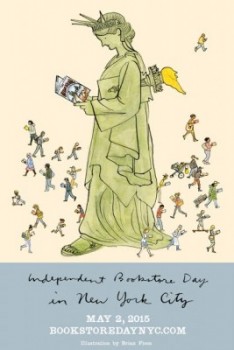
More than two dozen independent bookstores in Manhattan, Brooklyn, and Queens are participating in Independent Bookstore Day on May 2, with signings, readings, lectures, film screenings, art exhibits, children’s activities, giveaways, games, food tastings, discussions, and, in several cases, free beer, to steer you clear of Amazon and B&N. Guitarist Gary Lucas will be performing live at bookbook on Bleecker St. Paul Durham, Matt Myklusch, Michael Northrop, Dianne K. Salerni, and Josh Lieb join together for a Fantastic Middle Grade panel at Books of Wonder. Amy Hest, Chris Raschka, Deborah Heligman, and Cynthia Weill are among a dozen authors and illustrators who will be at Bank Street Book Store. Housing Works will host a Kidlit Game Show emceed by C. Alexander London. Colm Tóibín, Eileen Myles, Joseph O’Neill, DJ Spooky, Said Sayrafiezadeh, and others are among the literati taking part in a marathon Langston Hughes reading at McNally Jackson. Jon Scieszka will lead a Mad Scientist Party at the Community Bookstore, followed by an evening celebration with Paul Auster, William Corbett, and Felix Harr. The powerHouse Arena will launch Luke’s Lobster’s Real Maine Food, with sample treats. And Raina Telgemeier and Dave Roman will be team captains in a game of Pictionary at the Astoria Bookshop during this first-ever national Independent Bookstore Day.

WFMU RECORD FAIR

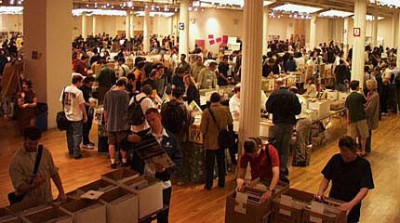
Annual WFMU Record Fair moves into Brooklyn Expo Center this weekend

Annual WFMU Record Fair moves into Brooklyn Expo Center this weekend

Who: Bambi Kino, Olivia Neutron John, Conspiracy of Beards, Tin Sandwich, Daniel Kahn, Danny Kroha, Todd-O-Phonic Todd, the Baseball Project, Michael Shelley, Fool’s Paradise with Rex, Miriam, Billy Jam, and more than 150 record and CD dealers
What: WFMU Record Fair
Where: Brooklyn Expo Center, 79 Franklin St. between Noble & Oak Sts.
When: May 1-3, $7, 4:00 – 7:00 Friday, 10:00 am – 7:00 pm Saturday & Sunday (early admission Friday at 4:00, $25)
Why: Because there’s still nothing like spinning that black circle. In addition to tons of vintage vinyl and CDs for sale from all musical genres, the annual WFMU Record Fair will feature screenings of such cult classics as Francis Ford Coppola’s Dementia 13, Dan Lucal’s Dance of the Clones, Tim Smith’s Sex and Broadcasting (followed by a Q&A with Smith), Christopher Kirkley’s I Sing the Desert Electric, Paul Lovelace and Jessica Wolfson’s Radio Unnameable, Selma Vilhunnen’s Song, Cate Giordano’s Heritage, Olivia Wyatt’s The Pierced Heart & the Machete, and Philippe Garrel’s The Inner Scar.

IRIS

(photo courtesy Magnolia Pictures)

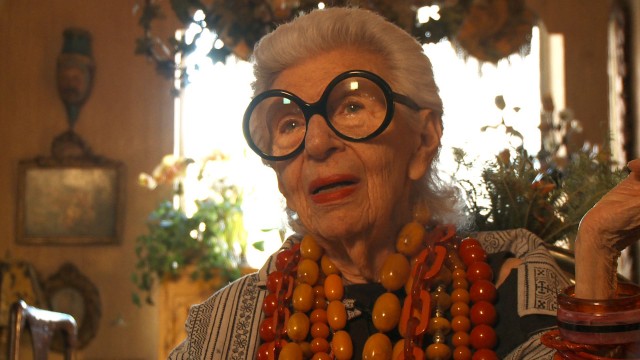
Iris Apfel shows off her unique and influential fashion sense in Albert Maysles documentary (photo courtesy Magnolia Pictures)

IRIS (Albert Maysles, 2014)
Film Forum, 209 West Houston St., 212-727-8110
Lincoln Plaza Cinema, 1886 Broadway between 62nd & 63rd Sts., 212-757-2280
Opens Wednesday, April 29
www.magpictures.com
mayslesfilms.com

“I like individuality,” self-described “geriatric starlet” and nonagenarian fashion doyenne Iris Apfel says at the beginning of octogenarian Albert Maysles’s penultimate film, Iris. “It’s so lost these days. There’s so much sameness. Everything is homogenized. I hate it. Whatever.” Iris celebrates that individuality, not only Apfel’s, who at ninety-three is still active in the fashion world, but Maysles’s, who passed away in March at the age of eighty-eight, leaving behind a legendary legacy that changed the face of documentary cinema, including such classics as Salesman, Grey Gardens, and Gimme Shelter. Throughout the film, Apfel speaks directly to Maysles, who ends up on camera several times, breaking that once-impenetrable fourth wall that he, his brother, David, and their partner, Charlotte Zwerin, helped tear down years ago. Maysles spent four years filming the Queens-born Apfel as she shared her lovely story, growing from an interior designer and textile-business owner to a world-renowned fashion collector, tastemaker, and rule breaker, accompanied all along the way by her husband of more than sixty-six years, Carl. Maysles shows Iris, in her trademark enormous circular-framed glasses and unique, colorful ensembles that mix designer clothing with a healthy dose of inexpensive accessories, as she bargains at a cheap local store, advises women at a special Loehmann’s event, prepares for her 2005 show at the Metropolitan Museum of Art’s Costume Institute, hawks her jewelry line on the Home Shopping Network, works on a window display at Bergdorf Goodman, and talks fashion with Martha Stewart, Tavi Gevinson, and others. Maysles interviews such designers as Alexis Bittar, Duro Olowu, Naeem Khan, and Dries van Noten, Met curator Harold Koda, Architectural Digest editor in chief Margaret Russell, and J. Crew head Jenna Lyons, who have only the most kind and generous things to say about the always positive Apfel, who has a genuine love of life. “It’s better to be happy than well dressed,” she tells friend and photographer Bruce Weber.

(photo courtesy of Magnolia Pictures)

Nonagenarian Iris Apfel and octogenarian Albert Maysles display a love of life in IRIS (photo courtesy of Magnolia Pictures)

Maysles also explores the Apfels’ inspiring relationship, filled with humor, a love of collecting knickknacks and tchotchkes (strewn about their cluttered apartment), and an infectious yen for trying anything and everything that life has to offer. The film concludes with Carl’s one-hundredth birthday party. Early on, Iris tells a story about one of her first jobs, toiling for Frieda Loehmann in Brooklyn. “One day she called me over and she said, ‘Young lady, I’ve been watching you.’ She said, ‘You’re not pretty, and you’ll never be pretty, but it doesn’t matter. You have something much better. You have style.’” Iris indeed has style, as this wonderful documentary extols, a marvelous tribute both to her and Carl as well as Albert Maysles. Who needs pretty when something this beautiful is what emerges? Iris opens April 29 at Lincoln Plaza and Film Forum, where it will be preceded by Vivian Ostrovsky’s fashion short, Losing the Thread. Producers Laura Coxson and Rebekah Maysles, one of Albert’s children, will be at Film Forum for the 6:20 show on April 29, while Iris herself will participate in a Q&A following the 6:20 screening on May 1 and will then introduce the 8:20 show.