
Zhang Jinsheng (Zhang Yi) shows his love for Shen Tao (Zhao Tao) in materialistic ways in Jia Zhangke’s MOUNTAINS MAY DEPART
MOUNTAINS MAY DEPART (SHAN HE GU REN) (Jia Zhangke, 2015)
Film Society of Lincoln Center
Monday, September 28, Alice Tully Hall, 6:00, and Tuesday, September 29, Francesca Beale Theater, 9:15
New York Film Festival runs through October 11
212-875-5050
www.filmlinc.org
 Master Chinese writer-director Jia Zhangke returns to the New York Film Festival with Mountains May Depart, a melancholic look at love and relationships in which one decision can change the rest of your life, as well as an allegory about China itself and its path in the world. Jia’s wife and muse, Zhao Tao, stars as Shen Tao, a flighty, flakey young woman flirting with coal miner Liangzi (Liang Jin Dong) and burgeoning capitalist Zhang Jinsheng (Zhang Yi) in 1999 China, the country on the cusp of an economic crisis. It’s easy to see the young woman’s romantic decision as a microcosm of China’s economic decisions, as the working class battles the wealthy elite, and the effects of both are profound. The setup is reminiscent of the love triangle at the center of François Truffaut’s Jules et Jim, but Jia takes it much further, continuing the story in 2014, and then into 2025, a bleak future where individual happiness is painfully elusive. Jia (Still Life, The World, 24 City) and his longtime cinematographer, Yu Lik-wai, shoot the three time periods in different screen ratios, exemplifying how much things evolve as Chinese capitalism and globalism take over, affecting — and disaffecting — the next generation. But the past is always snapping at the characters’ heels; much of the film takes place in the Yellow River basin, where ancient structures recall China’s history, and in Jia’s vision of the future, vinyl LPs are back in fashion (although handheld devices are much cooler). Music plays a key role in the film, primarily Sally Yeh’s Cantonese song “Take Care” and the Pet Shop Boys’ cover of the Village People’s “Go West,” the latter a title that gets to the heart of the film.

Mia (Sylvia Chang) takes stock of her complicated life in MOUNTAINS MAY DEPART
Zhao is marvelous as the bittersweet Shen, from singing at the colorful Fenyang Spring Festival Gala as the new millennium approaches to trying to restore her relationship with her son (Dong Zijian), who her husband insisted be named Dollar. Her eyes are filled with emotion as she proceeds on a course that was never what she dreamed. In the third section, Sylvia Chang shines as Mia, a sensitive, divorced teacher from Hong Kong who grows close to Dollar in a future world in which English has eclipsed Chinese, so fathers and sons literally do not speak the same language. Navigating the four physical sufferings of Buddhist thought — birth, old age, sickness, and death, Jia avoids showing many key moments in the lives of the characters, often leaving it up to the audience to uncover what has happened over the years and decades, which has a certain grace, although the ambiguous ending is more than a bit frustrating, even if it makes sense as a parable for China as a whole. But it’s all encapsulated in the briefest of kisses in a helicopter that will both brighten and break your heart. And keep an eye out for the guy with the Guangdong Broadsword. Mountains May Depart is screening at the New York Film Festival on September 28 at 6:00 and September 29 at 9:15, with Jia and Zhao in person to talk about the film. In addition, Jia will take part in a free HBO Directors Dialogue at the Howard Gilman Theater on September 29 at 6:00, and Walter Salles’s documentary, Jia Zhangke, a Guy from Fenyang, is being shown at the festival on September 30 and October 1.



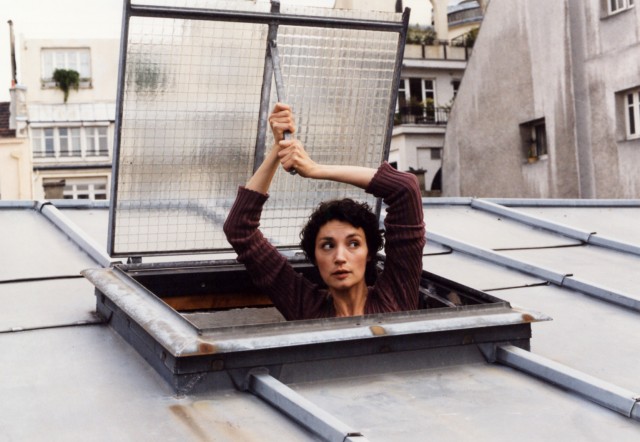
 Jacques Rivette’s Va Savoir is a long, talky French movie about very beautiful, very complicated, sex-crazed men and women — and it just might be the master filmmaker’s crowning glory, a magnificent masterpiece that deserved its slot as the New York Film Festival’s opening night selection back in 2001. This erotically charged, very funny drama is set around a traveling theater company’s return to Paris to put on Pirandello’s As You Desire Me in the original Italian. Ugo (Sergio Castellitto), the director and costar of the play, is romantically involved with Camille (Jeanne Balibar), the lead actress, who visits her former lover Pierre (Jacques Bonnaffé), a philosopher with a thing for Heidegger, who is now living with Sonia (Marianne Basler), a dance instructor who is being chased by Arthur (Bruno Todeschini), a ne’er-do-well whose half sister, Do (Hélène de Fougerolles), has taken a liking to Ugo and offers to help him find an unpublished ghost play by Carlo Goldini, which her mother (Catherine Rouvel) just might have. Every minute of this film is pure magic, and at the center of it all is the fantastique Camille, an instinctual, graceful actress whom everyone — men and women — fall in love with, played by the fantastique, instinctual, graceful Balibar, whom audiences will fall in love with as well. French film enthusiasts should watch for Claude Berri in a small role. Lovingly photographed by William Lubtchansky and edited by his wife, Nicole Lubtchansky, Va Savoir is screening at 4:00 and 7:30 on September 29 in FIAF’s CinéSalon series “Theater & Cinema”; the later show will be introduced by Mathieu Bauer. (FIAF is screening the 154-minute version, not the 220-minute director’s cut.) The Tuesday festival continues through October 27 with such other stage-related dramas as Olivier Assayas’s Clouds of Sils Maria, Arnaud Desplechin’s Esther Kahn, Abdellatif Kechiche’s Games of Love and Chance, and François Truffaut’s The Last Metro.