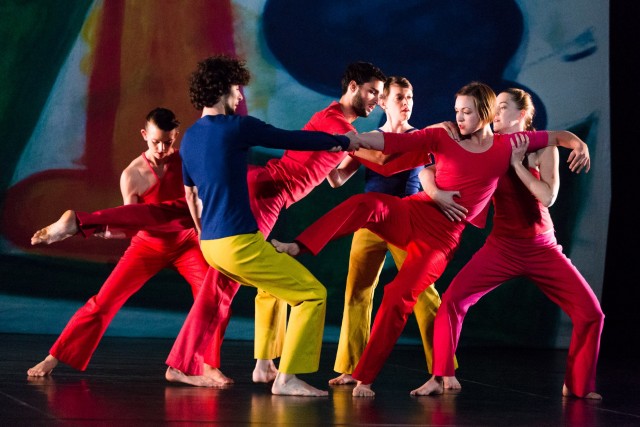
PRESENT TENSE is one of three Trisha Brown pieces that will be presented at BAM this week (photo by Dirk Bleicker)
BAM Howard Gilman Opera House
30 Lafayette Ave. between Ashland Pl. & St. Felix St.
January 28-30, $25-$65, 7:30
718-636-4100
www.bam.org
www.trishabrowncompany.org
In January 2013, Trisha Brown Dance Company kicked off its “Proscenium Works” tour at BAM, presenting Newark (Niweweorce), Les Yeux et l’âme, I’m going to toss my arms — if you catch them they’re yours, Homemade, and Set and Reset in the Howard Gilman Opera House. The New York–based troupe, which was founded in 1970, took the tour around the world, with stops in Canada, Germany, Slovenia, France, and other countries, and is now returning to BAM for the next-to-last “Proscenium Works” show, being held January 28-30 at BAM. (The grand finale takes place February 4-6 at the University of Washington in Seattle.) The program begins with the seminal 1983 BAM commission Set and Reset, which we described three years ago as “a stirring collaboration” bringing together Laurie Anderson’s hypnotic, repetitive “Long Time, No See,” Robert Rauschenberg’s three-part geometric construction on which newsreel-style black-and-white footage is projected, and lighting by six-time Tony nominee Beverly Emmons. That is followed by Present Tense, Brown’s 2003 work that features aerial choreography set to a score by John Cage and colorful costumes and stage design by artist Elizabeth Murray. (The costumes have been reimagined by Elizabeth Cannon.) The evening concludes with Newark (Niweweorce), in which different-colored wall screens by artist Donald Judd occasionally descend from above and divide the stage into claustrophobic spaces; the piece is set to Judd’s minimalist score that combines silence with bolts of loud noises that resemble the sounds of an MRI, which didn’t exist when Newark (Niweweorce) debuted in 1987. The company includes Cecily Campbell, Marc Crousillat, Olsi Gjeci, Leah Ives, Tara Lorenzen, Carolyn Lucas, Diane Madden, Jamie Scott, and Stuart Shugg. And as a bonus, “Heart and Mind,” an exhibition of Murray’s paintings and drawings, is on view through February 15 in the Diker Gallery Café.


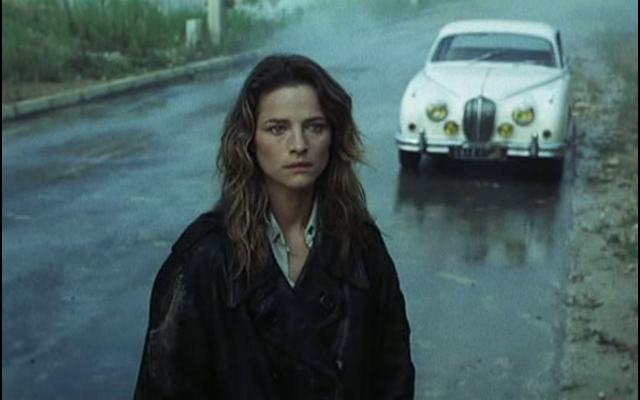
 French stage and opera director Patrice Chéreau made an offbeat choice for his debut film, deciding to adapt British thriller writer James Hadley Chase’s The Flesh of the Orchid, the 1948 sequel to his first novel, 1939’s No Orchids for Miss Blandish, which had been made into a 1948 film by St. John Legh Clowes considered to be one of the worst movies ever. So it’s little surprise that The Flesh of the Orchid is a dark and gloomy, not wholly successful, both tantalizing and frustrating tale of lust and greed. Following up her controversial role in Liliana Cavani’s The Night Porter, the exquisite Charlotte Rampling stars as Claire, a mentally unbalanced heiress who has a penchant for blinding men who attempt to have sex with her. But she takes an odd liking to Louis Delage (Bruno Cremer), a man with financial problems who is on the run after witnessing a murder committed by a pair of cold-blooded killers, brothers Gyula and Joszef Berekian (Hans Christian Blech and François Simon). Meanwhile, Claire’s aunt, the elegant, très chic Madame Wegener (Edwige Feuillère), and her ne’er-do-well son, Arnaud (Rémy Germain), are hot on her trail as well, determined to lock her away again so they can get their hands on the family money.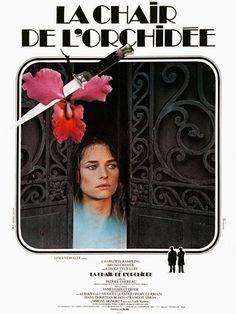

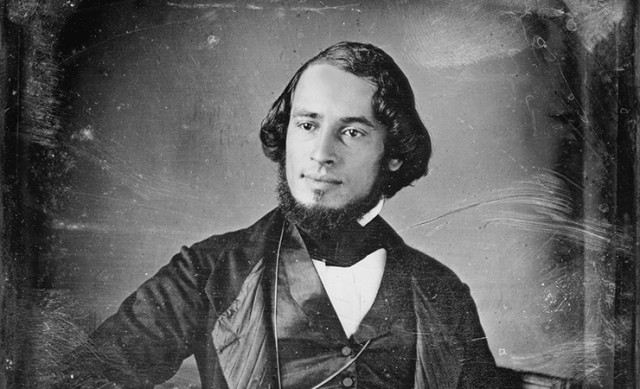
 The extraordinary story of nineteenth-century Jewish-American Renaissance Man Solomon Nunes Carvalho is told in the beautiful documentary Carvalho’s Journey. Born in Charleston, South Carolina, the Jewish cultural center of the U.S. in 1815, Carvalho was a painter, daguerreotypist, inventor, philosopher, husband, father, and practicing Jew. In 1853, Mathew Brady recommended him to explorer John C. Frémont, who was looking for a photographer to document his fifth and final Westward Expedition. So Carvalho brought his bulky equipment and set out to do what no one had done before, take pictures of a vast and treacherous landscape, a journey that would risk the lives of everyone involved as Frémont searched for a railroad route through the Rocky Mountains. Along the way, Carvalho never lost sight of his faith and his deep love for his wife, Sarah Miriam, as evidenced by the detailed, poetic letters he wrote her in addition to his 1857 memoir, Incidents of Travel and Adventure in the Far West. “With few men, religion is a color, a lifeless, abstract notion, but abstraction is not pure religion. Religion must signify itself in our actions in life. Aye, it must embrace the whole sphere of our activities and affections,” Carvalho, voiced by Josh Hamilton in the film, wrote. Historian David Oestreicher explains, “He was very proud of who he was, but at the same time he was a proud American; he saw the promise of America. I believe that he was being a good American by exercising his right to openly belong to his people. I don’t think he saw a conflict there.”