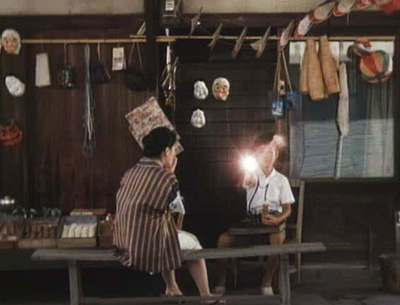
Nobuhiko Obayashi shines a light on wartime Japan in unusual coming-of-age drama
BOUND FOR THE FIELDS, THE MOUNTAINS, AND THE SEACOAST (NO YUKI YAMA YUKI UMIBE YUKI) (Nobuhiko Obayashi, 1986)
Japan Society
333 East 47th St. at First Ave.
Saturday, November 21, $12, 4:00
Series continues through December 6
212-715-1258
www.japansociety.org
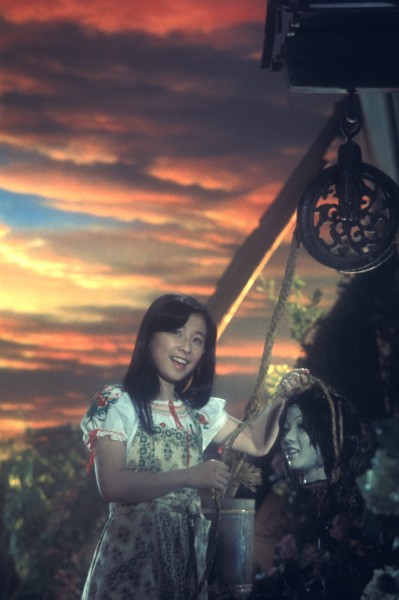
 Over the opening credits of Nobuhiko Obayashi’s Bound for the Fields, the Mountains, and the Seacoast, the sweet sound of children singing can be heard over machine-gun blasts and explosions, immediately setting the tone for this unusual, highly stylized war-set drama. “It was a time of mischief in Japan. Even in wartime,” it says at the end of the black-and-white credits, before cutting to a shot of the red-and-white Japanese flag blowing in the wind. Kids slowly march to school to the beating of a drum, except for Sotaro Sudo (Yasufumi Hayashi), who skips down narrow streets by himself, wearing a pseudo-military outfit and carrying a pair of binoculars to help him spy on what’s going on. When he spots someone in the teacher’s (Jô Shishido) office who he’s never seen before, he wonders to himself, “She looks too young to be an adult, but too old to be a child.” That sets the stage for the rest of the film, in which Obayashi follows a group of boys and girls as they battle among themselves, experience bullying and budding sexuality, and grow up a little too fast, serving as a microcosm of twentieth-century Japan. “It is clear that reality and lies can divide people. We should not quarrel too hastily,” the teacher says. Sotaru becomes enamored with the young woman, Kawakita (Riki Takeuchi), whose younger brother, Sakae Osugi (Junichirô Katagiri), is new in school. “Please don’t be violent,” Kawakita tells Sakae, but it isn’t long before he may not have any other choice, especially when their parents (Taru Minegishi and Toshie Negishi) consider selling her into prostitution to pay off their mounting debts.
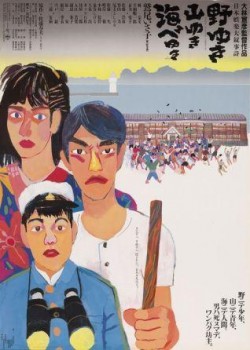
Bound for the Fields, the Mountains, and the Seacoast is a fanciful fairy tale that has fun playing with Japanese storytelling conventions, mixing genres while utilizing over-the-top comic-book surrealism. Obayashi, who gained international fame for his cult hit House, instills this unique coming-of-age story with scenes that not only evoke cartoony manga panels but also the films of Yasujiro Ozu, Kenji Mizoguchi, and Shuji Terayama. Not one for subtlety, he intercuts several drawings of animals from an odd kind of textbook that Sotaru carries with him, making humorously metaphorical comparisons between humans and beasts. Though often silly and patently absurd, Bound for the Fields, the Mountains, and the Seacoast has an infectious, irresistible charm that will pull you right in even as you contemplate how ridiculous so much of it is. The film, adapted by screenwriter Nobuo Yamada from Haruo Satô’s novel A Time of Mischief, was made into black-and-white and color versions; the former no longer exists, but the latter is having a rare screening November 21 at 4:00 in the Japan Society series “Nobuhiko Obayashi: A Retrospective,” which continues through December 6 with such other Obayashi films as I Are You, You Am Me; Sada; The Discarnates; and his latest, the three-hour epic Seven Weeks, in addition to a special conversation and audience Q&A with Obayashi, moderated by series curator Aaron Gerow, on November 21 at 1:00 ($12).
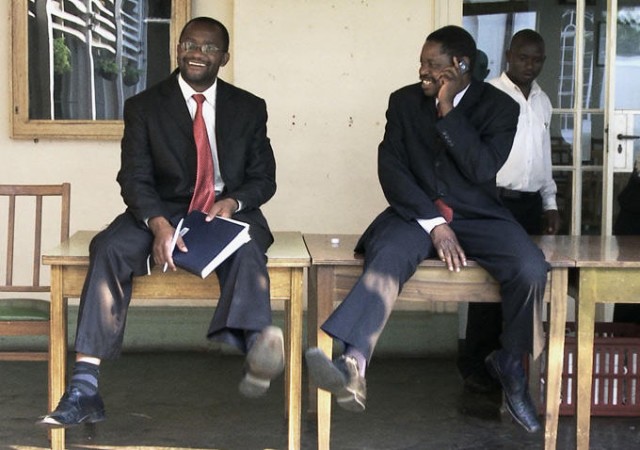
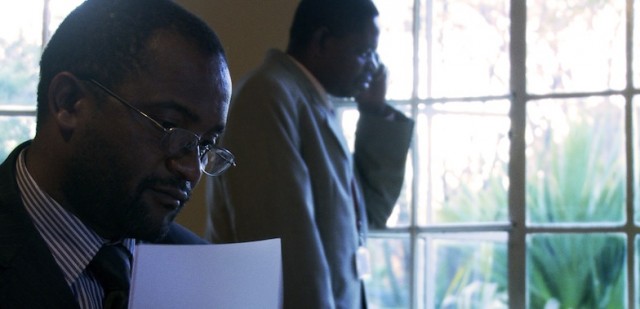
 Perhaps the most frightening aspect of Danish filmmaker Camilla Nielsson’s gripping thriller of a documentary, Democrats, is how unsurprising all of the revelations are, how we all have become inured to the pervasive power of the dictatorships that control so much of the world. Following the controversial 2008 reelection of Zimbabwe president Robert Mugabe, who had been in power since 1980, when the country officially gained its independence from the British-led Rhodesia, Mugabe’s ruling party, ZANU-PF (Zimbabwe African National Union – Patriotic Front), and election runner-up Morgan Tsvangirai’s opposition party, MDC-T (Movement for Democratic Change), agreed to form an inclusive coalition government and collaborate on a new constitution, to be drafted by COPAC, a committee co-chaired by former minister of information Paul Mangwana of ZANU-PF and human rights lawyer and parliament member Douglas Mwonzora of MDC-T. On the advice of Danish journalist Peter Tygesen, Nielsson requested access to the intense negotiations, and what she was given was an amazing, exclusive behind-the-scenes look into the process. Over the course of twelve shoots of between one and three weeks from 2010 to 2013, Nielsson alternately follows Mangwana and Mwonzora as they take their case to the people of Zimbabwe, traveling to rural communities and cities as their teams organize nearly six thousand town-hall-style meetings. Mangwana is a big, jolly fellow who believes Mugabe and his government are untouchable, that they will do anything and everything they can to maintain their leadership status. “Be seen as a man of peace. Even if you are not,” he brazenly says to the camera, adding, “The game of politics is pretending.” Meanwhile, Mwonzora, a much more deliberate man, explains, “We never imagined that a black man could suppress his own people.” As he makes his way across Zimbabwe, Mwonzora supports fighting back using pen and brains, not violence, imploring people to “tell us how much power we should have.” Amid claims of illegal busing and harassment by military veterans and the secret police on behalf of Mugabe, the entire constitution-making process is on the verge of falling apart, but the absurdity reaches a whole new level when the safety and freedom of Mangwana and Mwonzora are threatened.