Timely documentary details one family’s legal and moral fight over child gender identity
GROWING UP COY (Eric Juhola, 2016)
Thursday, June 16, 7:00, IFC Center, 323 Sixth Ave. at West Third St., 212-924-7771
Friday, June 17, 6:30, Film Society of Lincoln Center, Walter Reade Theater, 165 West 65th St. between Eighth Ave. & Broadway, 212-875-5050
Festival runs June 10-19
ff.hrw.org/new-york
growingupcoy.com
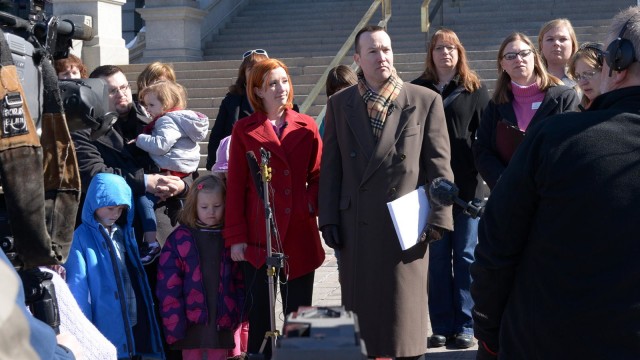
 “To me, this is a story about two parents who love their children, who love this particular child who is transgender, and who want the very best things in the world for her,” Michael Silverman of the Transgender Legal Defense & Education Fund says at the beginning of Growing Up Coy, a poignant and timely documentary about one family’s public fight to allow one of their children to legally establish her gender identity. When she was eighteen months old, Coy Mathis, who was born male but was unhappy that way, began displaying distinct female tendencies, exhibiting extreme displeasure when treated as a boy. She began kindergarten in the conservative town of Fountain, Colorado, as male but soon chose to transition, identifying as female. “She started asking us, when are we going to take her to the doctor so that she can be a girl, and when are we going to get the doctors to cut her penis off,” her mother, Kathryn Mathis, says in the film. “That was when it became a problem, and we reassured her that we would do everything we could so that she would be happiest as an adult.” Coy was initially given permission to use the girls bathroom, but in first grade, in late 2012, the school changed its policy and she was denied access. Kathryn, a photographer, and her husband, former Marine and full-time student Jeremy, decided to fight back, engaging in a legal battle that they eventually brought to the press when the school administration refused to acknowledge Coy’s gender choice. Soon the Mathises, who have five children under the age of eight — Dakota, who is is autistic, Auri, and triplets Coy, Max, and Lily, who has cerebral palsy and quadriplegia — are being both celebrated and excoriated on social media, in newspaper columns, and by talking heads on television, but they are determined to do whatever it takes, even if it includes making Coy the poster child in a heated debate over a controversial issue that most people don’t fully understand. “She doesn’t want to have to explain who she is and talk about how she’s different,” Kathryn says. “She just wants to be.”
Director and producer Eric Juhola and his husband, producer and editor Jeremy Stulberg, who previously collaborated on Off the Grid: Life on the Mesa, follow Coy and her family as they meet with child psychologist Tara Eastcott, discuss legal matters with Silverman, and participate in interviews with local and national media, including a high-profile sit-down with Katie Couric. The Mathises, who married when Kathryn was seventeen and Jeremy twenty-one, speak honestly and intelligently about the situation, fully aware of what they are doing and the potential ramifications, even when their relationship becomes strained because of it. They are clearly loving parents who want what’s fair and right for their children and are willing to take personal risks for the future of their family as well as the nation, although they do not consider themselves activists. “We know that once we do this, there’s no going back,” Kathryn says. Growing Up Coy is having its world premiere at the Human Rights Watch Film Festival, screening on June 16 at 7:00 at IFC Center and June 17 at 6:30 at the Walter Reade Theater, both followed by a Q&A with Juhola, Silverman, Stulberg, and HRW Bernstein Fellow Ryan Thoresen. The Mathis family has recently sought privacy; although they participated in the making of the film, they are not currently scheduled to make any public appearances in conjunction with it.
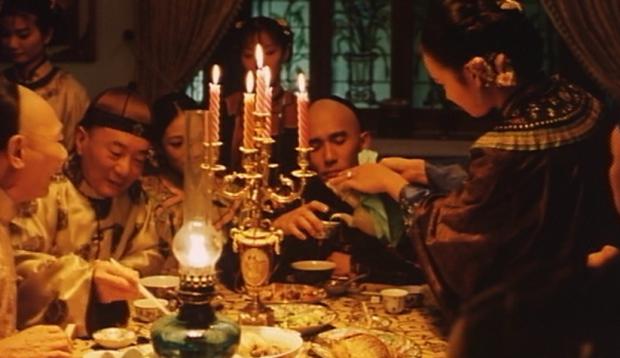
 Taiwanese New Wave master Hou Hisao-hsien might be the best filmmaker whose work you’ve never seen. For more than thirty years, he has been telling intimate, meditative stories about life, family, and relationships with a gentle, deeply intuitive style, infused with gorgeous visuals and subtly beautiful soundtracks. One of his most elegant works, Flowers of Shanghai, is set in brothels, known as flower houses, in 1884 in the British Concession, where men and women congregate for social interaction and develop long-term bonds and responsibilities to one another based on much more than just sex. The men play drinking games, smoke opium, and buy the women gifts. The story, told in a series of vignettes as Mark Lee Ping-Bing’s camera slowly moves through dark, lush, reddish gas-lit interiors, focuses on Master Wang (Tony Leung Chiu-wai), who has promised to be the sole patron of Crimson (Michiko Hada) but who has also been secretly seeing the younger Jasmin (Vicky Wei) and lavishing her with presents. The elder Master Hong (Luo Tsai-erh) and Auntie Huang (Rebecca Pan), the madam, discuss the situation, bringing up issues of responsibility and honesty, attempting to come to some kind of understanding in an exchange that shows respect for both the men and women who are a far cry from the Western conception of johns and prostitutes.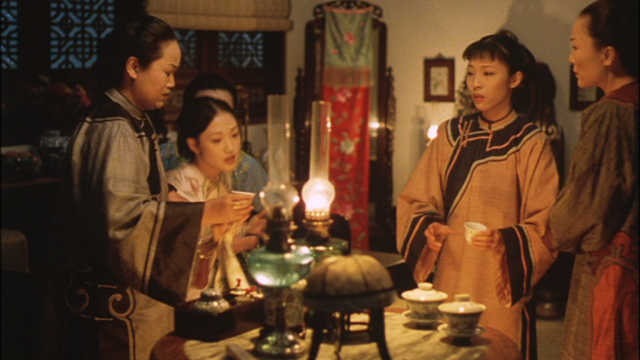

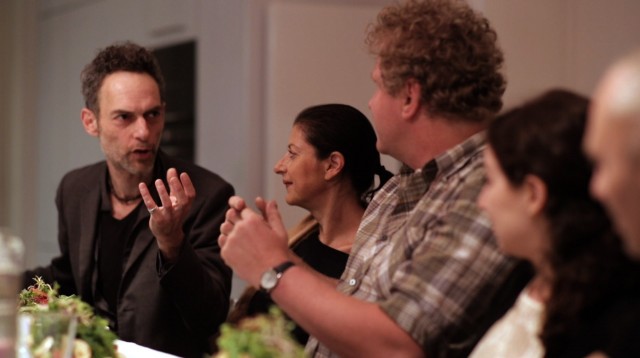
 Janina Quint’s debut feature documentary, Germans & Jews, explores an intriguing premise: why so many Jews are moving to Germany, either returning to their homeland or living there for the first time. However, director and producer Quint, a non-Jewish German, and producer and executive producer Tal Recanati, an American-born Jew raised in the U.S. and Israel, reduce the film to random cocktail-party chatter; in fact, far too much of Germans & Jews takes place at a dinner party as second-generation Germans and Jews ramble on about guilt, responsibility, education, forgiveness, and how Germany has changed since WWII. The film would have benefited from more speakers like German-born American historian Dr. Fritz Stern and Thorsten Wagner, a Danish-German historian and grandson of a Nazi sympathizer, who are able to put the situation into fascinating perspective with a sincere intelligence. “I think it is true that most Germans now understand their past and the horror that they visited upon the world, but it’s a very hard thing,” Dr. Stern says. “And to find ways around to explain it is a natural human response.”
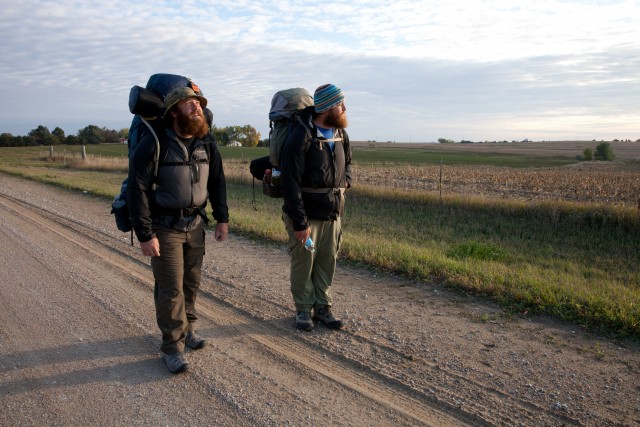
 Michael Collins’s emotionally gripping documentary, Almost Sunrise, is built around an absolutely shocking statistic: According to the Department of Veteran Affairs, twenty-two U.S. veterans commit suicide every day. That’s one self-inflicted death every sixty-five minutes. In the film, two young veterans of Operation Iraqi Freedom, facing depression and suicidal thoughts themselves, decide to walk from their homes in Milwaukee, Wisconsin, to Los Angeles, California, in order to clear their own heads and raise awareness of this horrifying issue. Tom Voss and Anthony Anderson, a pair of big, bushy-haired men, became media darlings as they continued what became known as