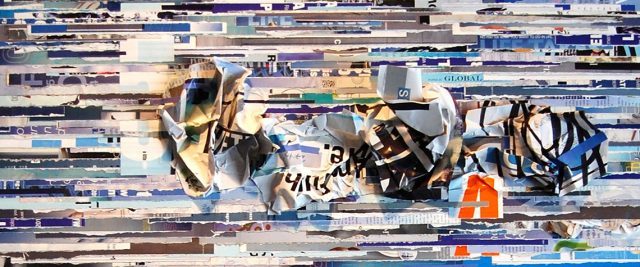
Art on Paper: Tm Gratkowski, “No Matter What,” collaged paper on wood panel (courtesy of the artist and Walter Maciel Gallery)
It’s that time of year again when the art world descends on New York City for the start of art fair season. There are no fewer than eleven fairs this week, with the next batch scheduled for May. Below is a brief look at March’s shows, highlighted by participating artists and special events and projects.
What: Moving Image
Where: 269 11th Ave. between 27th & 28th Sts.
When: February 27 – March 2, free
Why: “A viewing experience with the excitement and vitality of a fair while allowing moving image-based artworks to be understood and appreciated on their own terms,” with works by Rebecca Allen, Marcos Bonisson and Khalil Charif, Kevin Cooley, Adriana Duque, Zachary Fabri, Nina Fischer & Maroan el Sani, John Craig Freeman, Claudia Hart, Robert Hodge, Marlon Hall, and Robert Pruitt, Iyvone Khoo, Christopher Manzione & Seth Cluett, Alexander Mazza, Joiri Minaya, Brenna Murphy, Damir Očko, Will Pappenheimer, Jacques Perconte, Jefferson Pinder, Jordan Rathus, Casey Reas, Michael Rees, Rick Silva, Jakob Kudsk Steensen, Tamiko Thiel and Zara Houshmand, Naoko Tosa, Anton van Dalen, Arda Yalkın, Matteo Zamagni
What: The Art Show
Where: Park Avenue Armory, Park Ave. at Sixty-Seventh St.
When: March 1-5, $25
Why: “Offers collectors, arts professionals, and the public the opportunity to engage with artworks of the highest quality through intimately scaled and thoughtfully curated exhibitions that encourage close looking and active conversation with gallerists”
Friday, March 3
“Beyond New York: Cultural Vibrancy Across the U.S.,” Keynote at the Art Show, with Kaywin Feldman, Lawrence J. Wheeler, and Zannie Giraud Voss, moderated by Lindsay Pollock, Board of Officers Room, 6:00
What: NADA New York
Where: Skylight Clarkson North, 572 Washington St.
When: March 2-5, $20-$40
Why: “Contemporary Drag,” curated by Gordon Robichaux, and numerous special discussions and performances
Thursday, March 2
“Social Noise!” panel discussion hosted by Sam Hillmer, with Don Christian, Azikwe Mohammed, Maria Chavez, and Victoria Keddie, 5:00
Friday, March 3
“Contemporary Drag in Conversation: Stonewall Was a Riot,” with Lady Bunny and Horrorchata, moderated by David Yarritu, 2:00
Saturday, March 4
“Jacolby Satterwhite: Artist Talk,” with Jacolby Satterwhite, presented with Moran Bondaroff, 2:00
Sunday, March 5
“Contemporary Drag: Baby Tea,” featuring a conversation with Theda Hammel and performances by Matt Savitsky, Merrie Cherry, and Patti Spliff, presented by Tyler Ashley aka the Dauphine of Bushwick and Wise Men, 3:30
What: VOLTA NY
Where: Pier 90, West 50th St. at 12th Ave.
When: March 2-6, $25-$60
Why: “Showcases relevant contemporary art positions from emerging international artists, from cutting-edge trendsetters to next year’s rising stars [with an] approachable solo-booth format”
Friday, March 3
“Alternative Myths,” with Jesse Bransford and Dominic Shepherd, the Volta Salon with ArtNet, 1:00
Saturday, March 4
“Improv for Artists,” with Morgan Bassichis, Jill Pangallo, and Richards Smit, moderated by Hollis Witherspoon, 2:00
Sunday, March 5
“Art Meets Tech,” with Ashley Zelinskie, Valentine Uhovski, and Alicia Carbone, moderated by Ariel Adkins, 2:00
What: Spring/Break Art Show: Black Mirror
Where: 4 Times Square at 43rd St.
When: March 1-6, $15-$50
Why: “An internationally recognized exhibition platform using underused historic New York City spaces to activate and challenge the traditional cultural landscape of the art market”
What: Scope
Where: Metropolitan Pavilion, 125 West Eighteenth St. between Sixth & Seventh Aves.
When: March 2-5, $15-$150
Why: “SCOPE New York’s spirit of innovation has consistently forged the way for emerging artists and galleries. Attuned to nuances in the market and itself an influential force in the cultural sphere, SCOPE continues to usher in a new vision of the contemporary art fair.”
What: The Armory Show
Where: Piers 92 & 94, 12th Ave. at 50th St.
When: March 3-6, $25-$80
Why: “New York’s premier art fair and a definitive cultural destination for discovering and collecting the world’s most important 20th and 21st century artworks,” featuring Platform projects by Abigail DeVille, Fiete Stolte, Evan Roth, Jun Kaneko, Dorian Gaudin, Douglas Coupland, Ai Weiwei, Iván Navarro, Yayoi Kusama, Per Kirkeby & Lawrence Weiner, Abel Barroso, Patricia Cronin, Sebastian Errazuri
Friday, March 3
“What’s Technology Got to Do with It? Art in the Digital Age,” with Shiva Ahmadi, Charles Atlas, Marilyn Minter, and Thomas Allen Harris, moderated by Barbara London, 4:00
Saturday, March 4
“David Salle: The Painting Life,” artist talk with Joe Bradley, Alex Katz, Dana Schutz, and Chris Martin, moderated by David Salle, 2:30
Sunday, March 5
“Glenn O’Brien: Like Art,” artist talk with Glenn O’Brien, Jeffrey Deitch, and Andy Spade, 1:00
What: Art on Paper
Where: Pier 36, 299 South St.
When: March 2-5, $25-$40
Why: “Art on Paper’s medium-driven focus lends itself to significant projects — unique moments that have set the fair apart and established a new and important destination for the arts in New York City,” featuring special projects by Pablo Lehmann, Peter Sarkisian, Tahiti Pehrson, Valerie Hammond, and Timothy Paul Myers in collaboration with Andrew Barnes
What: Clio Art Fair: The Anti-Fair for Independent Artists
Where: 508 West 26h St. between Tenth & Eleventh Aves.
When: March 2-5, free
Why: “Focuses attention on the kinds of contemporary art and interventions that are being created by independent artists the world over,” featuring works by Piero Manzoni, Carla Accardi, Maurizio Cattelan, Nina Berman, Denise Adler, Sonia Aguessy, Paul Bouchard, Peter Bradley Cohen, Robby Davis, Monica Delgado, Matthew Demers, Wenjun Fu, Orit Fuchs, Rachel Goldsmith, Larry Jones, Rusudan Khizanishvili, Gary Low, Rafael Melendez, Hayley Palmatier, Alicia Piller, Claudia Shapiro, Emily Strange, Kimberly Zeluck, more
What: The Independent
Where: Spring Studios, 50 Varick St.
When: March 2-5, $25
Why: “An invitational art fair devised by and for gallerists, which reexamines the traditional methods of presenting, viewing, and experiencing contemporary art”
What: New City Art Fair
Where: hpgrp Gallery, 434 Greenwich St.
When: March 3-6, free
Why: “A boutique art fair which aspires to globalize contemporary Asian art,” this year featuring works by Japanese artists Daisuke Takahashi, snAwk, So Sekiyama, Meguru Yamaguchi, more