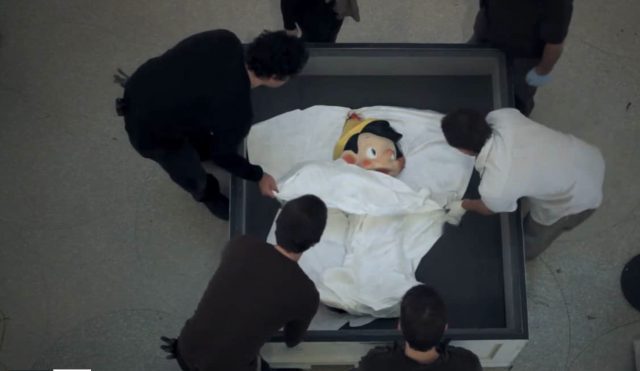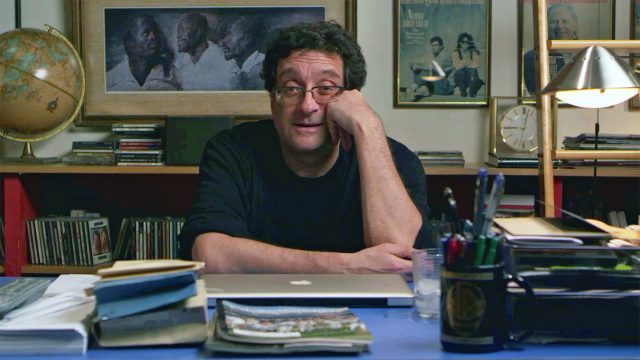
Bruce Weber discusses the intricacies of writing obituaries in surprisingly charming documentary
OBIT.: LIFE ON DEADLINE (Vanessa Gould, 2016)
Film Forum, 209 West Houston St., 212-727-8110
Lincoln Plaza Cinema, 1886 Broadway at 63rd St., 212-757-2280
Opens Wednesday, April 26
www.facebook.com
 Vanessa Gould’s surprising charmer, Obit., might primarily be about the documentation of individual death by the New York Times obituaries desk, but at its heart it’s a celebration of life. “It’s almost never depressing because we’re almost always writing about someone in his or her eighties or nineties who has died after a long, rich, creative, fulfilling life,” obituaries senior writer Margalit Fox explains. “In an obit of eight hundred words or so, maybe a sentence or two will be about the death and the other ninety percent is about the life. So it’s counterintuitive, ironic even, but obits have next to nothing to do with death and, in fact, absolutely everything to do with the life.” Inspired by an obituary the New York Times ran about a friend of hers at her urging, Gould spent about a week in the Times offices, capturing the obit writers and editors in action as they do extensive research (online and on the phone), work hard on the lede, carefully fact check, and get just the right photo for what they consider legitimate news stories, not simply memorials to the deceased. “It’s a once-only chance to make the dead live again,” obituaries writer (and former food critic) William Grimes notes. They are shown deciding whose life was newsworthy, keeping to a specific word count, and pitching for better placement of their story while attempting to capture the essence of the individual they are writing about. When researching the death of typewriter repairman Manson Whitlock, Fox hits the keys of an old Royal, attempting to incorporate the sound and feel of the instrument in her article. In addition to the obviously famous and influential, they also cover such people as Slinky creator Richard T. James, Bill Haley bass player Marshall Lytle, television remote inventor Gene Polley, Brown v. Board of Education of Topeka plaintiff Zelma Henderson, aviatrix Elinor Smith, advertising executive Richie Rich, Skylab saviour Jack A. Kinzler, and William P. Wilson, the JFK aide who helped orchestrate John F. Kennedy’s critical televised debate win over Vice President Richard M. Nixon. Gould’s film includes archival photographs and film footage of many of the obituary subjects and the times in which they lived, although some of the clips are not completely relevant. Still, they are cool to see and flesh out the documentary with visual splendor and fun details.
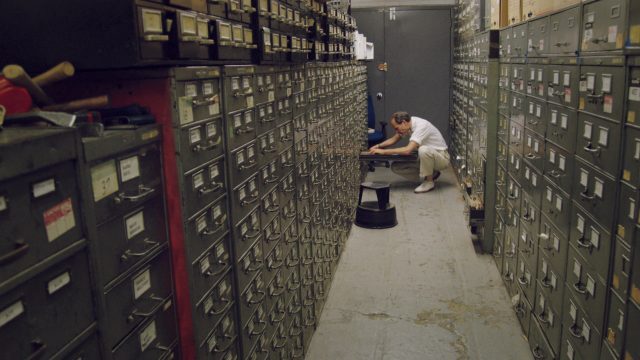
Archivist Jeff Roth runs the massive New York Times archives known as the morgue
The film also features obituaries desk editor William McDonald, who points out that they are writers who never get to meet or speak directly with their subjects; former obituaries writer Paul Vitello, who refers to himself as an obituarist; assistant obituaries editor Peter Keepnews; chief pop music critic Jon Pareles; former deputy obituaries editor Jack Kadden; former obituaries writer Douglas Martin; and Jeff Roth, who for nearly a quarter of a century has overseen the morgue, the vast archives filled with tens of thousands of files of newspaper clippings and photographs as well as nearly two thousand advance obituaries. Gould often asks the writer to read the obituary they have written while she shows film footage and rare photos of the subject: one memorable scene highlights Fox and her poetic obituary of British rower and adventurer John Fairfax. “This was an obit that broke all the rules and proudly announced obits in the twenty-first century can be just as rollicking and swaggering as their subjects,” she says. And the discussion about how to cover sudden, unexpected celebrity deaths — Michael Jackson, Prince, David Foster Wallace, Philip Seymour Hoffman, attempting to get something up on the Times website quickly while battling the six o’clock deadline for the next day’s print edition — is downright exciting. The film primarily works because the writers and editors themselves are intellectual eccentrics who love what they do even as it makes them consider their own mortality. “Literally, I show up in the morning and I say, ‘Who’s dead?’” Weber explains. “And somebody puts a folder on my desk and that’s what I do that day.” Obit. opens April 26 at Lincoln Plaza and Film Forum; Gould will be at Film Forum for Q&As with Weber at the 7:00 screenings on April 27 and 28, with Roth after the 7:00 show on April 29, and with Grimes at the 4:45 show on April 30, in addition to several introductions, while at Lincoln Plaza Fox and producer Caitlin Mae Burke will discuss the film on April 26 and 28, followed by Gould and obituary writer Dan Slotnik on April 29.

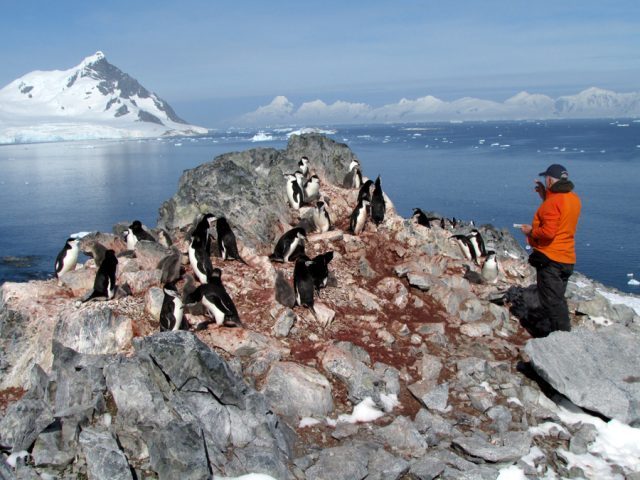
 Peter Getzels and Harriet Gordon’s The Penguin Counters arrives at Cinema Village just in time for World Penguin Day on April 25, which celebrates the cute and cuddly black-and-white (and often yellow) aquatic birds. However, the tuxedoed animals are facing a major challenge, as climate change threatens their very existence. The film follows Ron Naveen and his small team — Thomas Mueller of Frankfurt’s Biodiversity and Climate Research Center, research ecologist Steve Forrest, Stony Brook assistant professor Heather Lynch, and PhD candidates Mike Polito and Paula Casanovas — as they go from Argentina to Deception Island, tracking three varieties of penguins and following in the footsteps of British explorer Sir Ernest Shackleton, who led a famously treacherous journey to the Antarctic in the first decade of the nineteenth century aboard the aptly named Discovery. In a bit of serendipitous luck, on a cruise ship he’s essentially hitchhiking on, Naveen meets Angie Butler, the biographer of Shackleton’s right-hand man, Frank Wild, who is transporting Wild’s ashes to South Georgia so they can be buried next to Shackleton’s remains, and Naveen joins her on her mission. Naveen, the founder and president of Oceanites, is gathering information for the Antarctic Site Inventory project, which has been detailing the plight of oceanic birds and the ecosystem for more than twenty years. “We’re not explorers, climbers, or athletes,” Naveen explains in a message about the film. “The weather we face is grueling. The terrain is hostile, and we’re only kitted out with golf-ball-sized tally-whackers and waterproof spiral notebooks. But our data has been instrumental in the formation of policies among polar scientists and the fifty member nations of the Antarctic Treaty Organization.”


 Italian artist and prankster extraordinaire Maurizio Cattelan has built his wildly successful career out of controversy, provocation, and mystery, taking on the very art world that has made him a superstar. Documentarian Maura Axelrod includes the same elements in her vastly entertaining film, Maurizio Cattelan: Be Right Back. The title refers to both the beginning of Cattelan’s career, a Milan solo show in which he locked the gallery door and hung a sign on it that said “Torno Subito” (Be Right Back) as well as what might or might not be the end, as he announced his retirement following the brilliant 2011 retrospective at the Guggenheim,