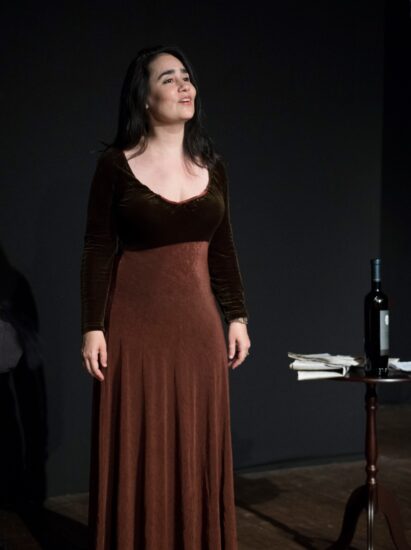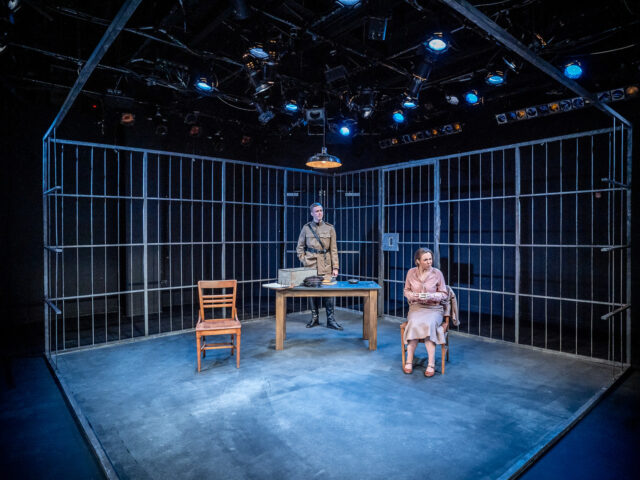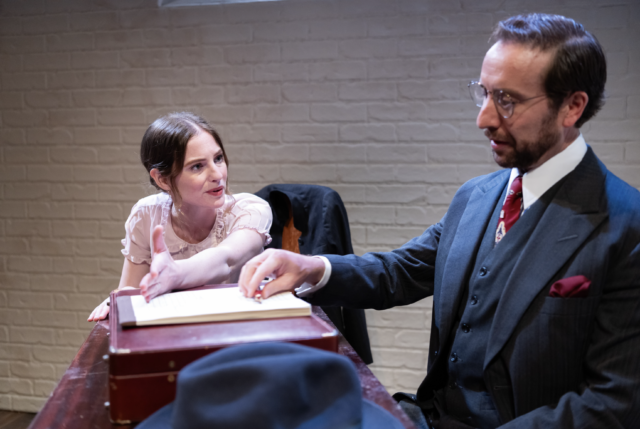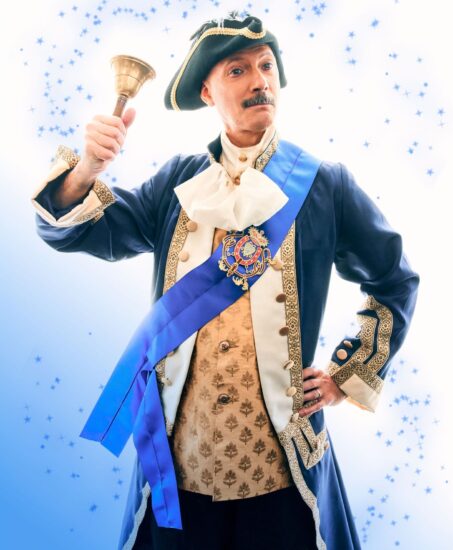
David Pasteelnick plays Lord Pinkleton in Blue Hill Troupe’s production of Rodgers + Hammerstein’s Cinderella (photo by J. Demetrie Photography)
RODGERS + HAMMERSTEIN’S CINDERELLA
The Theatre at St. Jean
150 East Seventy-Sixth St. between Lexington & Third Aves.
November 1-9, $45-$100
bht.org/events
“David is a treasure,” playwright and author Jessica Feder-Birnbaum says about David Pasteelnick.
I heartily agree.
Since 2007, Pasteelnick has been involved with the Purim Spiel at Town & Village Synagogue (T&V), the annual comic retelling of “The Megillah,” the story of Esther, Mordecai, Queen Vashti, King Ahasuerus, and the evil Haman, who is trying to get rid of all the Jews of Persia. After collaborating with several temple stalwarts adapting canned scripts, Pasteelnick started writing the show from scratch in 2014, featuring musical parodies performed by members of the shul, based on such cultural touchstones as Harry Potter (“Esther Potter & the Megillah of Secrets”), Disney movies (“When You Wish Upon a Spiel”), Schmigadoon! (“Schmegillah!”), and Stranger Things (“Stranger Spiels”) as well as the media (“Fake Schmooze”). The fun, goofy productions are codirected by Feder-Birnbaum, with Cantor Shayna Postman as musical director and Gary Mund providing the orchestrations; Pasteelnick always plays King Ahasuerus.
For more than twenty-five years, Pasteelnick, who was born and raised in New Jersey and lives in Brooklyn with his husband and cat, has been a grant writer and manager, working for several high-profile arts institutions; he has been with the Brooklyn Public Library since 2013. In addition, he was recently inaugurated as the president of the board of the Blue Hill Troupe, a hundred-year-old organization dedicated to the legacy of operetta masters Lewis Gilbert and Arthur Sullivan. The amateur company puts on one of thirteen Gilbert & Sullivan (G&S) works every spring; in 1984, they added a fall production, performing such musical theater favorites as Anything Goes, Urinetown, Little Shop of Horrors, Follies, and The Mystery of Edwin Drood.
This past spring they staged H.M.S. Pinafore (next year will be The Grand Duke), and they will be presenting the 2013 Douglas Carter Beane Broadway version of Rodgers + Hammerstein’s Cinderella at the Theatre at St. Jean November 1–9, directed by Robert DuSold, conducted and musically directed by Noah Turner, and choreographed by Sabrina Karlin, with Rachel Naugle as Ella and Amnon Carmi as Prince Topher; Pasteelnick plays Lord Pinkleton. (Among his previous roles for Blue Hill and the St. Bart’s Players are King Sextimus the Silent in Once Upon a Mattress, Major General Stanley in The Pirates of Penzance, Nathan Detroit in Guys and Dolls, and Charles Guiteau in Assassins.) Beane, who was nominated for a Tony for his adaptation of Oscar Hammerstein II’s 1957 book, will participate in a talkback following the 4:00 matinee on November 3.
“David is an amazing collaborator. He is kind, gracious, and open to suggestions,” Feder-Birnbaum adds. “His tremendous talent brings out the best in the entire cast. He is able to gauge our community’s strengths and is able to tailor musical numbers and comic bits to their capabilities. He is dedicated to making our spiels an ensemble effort giving everyone a chance to shine.” A self-proclaimed Sondheim freak, Pasteelnick brings that same dedication to the Blue Hill Troupe.
On a recent Saturday afternoon, I met with Pasteelnick in the midtown space where the troupe was busy rehearsing Cinderella amid set construction, costume making, and sirens, as we discussed musical theater, presidential responsibilities, exhaustion, and more. Just as we began, a man walked in and approached us.

David Pasteelnick, his husband, Karl, and David’s sister, Ellen, take a break at the 2024 US Open in Queens (photo courtesy David Pasteelnick)
david pasteelnick: This is Sam Militello. He has been with the troupe about forty years.
sam militello: Thirty-four.
dp: Thirty-four years. He does backstage and front stage; we have some people who do both. He does a lot of the lighting with his wife, Betsy, who’s been a past president of the troupe, among other things. Sam’s a pillar of the troupe. And I will say, these folks are professionals; I can’t really call this amateur theater. It’s what I like to call professional amateur theater. We have really high production values.
twi-ny: Well, I see what’s going on right now, with the costumes, the set building, the rehearsal.
dp: It’s people just like that. Not just talented performers but technically skilled and artistic members as well.
twi-ny: You’re currently working on the fall show. What are some of the main differences between that and the spring show?
dp: The fall show started as a way to give more people opportunities to participate. Musical theater is also a somewhat different voice type. It doesn’t matter if you don’t have that legit operatic voice, or maybe you’re a great belter, or you prefer to be in the G&S ensemble but are still interested in larger roles outside that genre. It’s an opportunity for people to do other things. However, if you’re in the troupe and you don’t want to audition for a lead G&S role, you’re still automatically in the ensemble if you’re a front stage member.
Backstagers [members who are primarily not performers] also have the opportunity to audition for the fall show. It’s one single cast, and we typically perform it in a smaller space. The spring show has its lead roles double cast to give more people an opportunity to play the principals.
The troupe was founded in 1924 with Gilbert & Sullivan in mind. In fact, our bylaws are written in verse, like a G&S patter song. But about forty years ago, audiences started to change; audiences in 1970, 1980, 1990 were different from those in 1930 and 1940. And the membership started to shift as well; some people not only loved G&S but also musical theater. So we decided to add a musical, because at the time we only did one show a year; we just did G&S in the spring. So we began doing fall shows, which are musical theater.
twi-ny: You were born and raised in New Jersey. You clearly have been into the arts your entire life.
dp: Yeah, my folks were very culturally connected.
[Sam comes by again and looks down at the table.]
sm: That’s my phone.
twi-ny: Ah, that’s your phone. I was gonna take it if it was left there.
sm: You don’t want to. I’m a criminal lawyer.
twi-ny: I thought you were going to stop after the first word.
dp: No, he’s a criminal lawyer.
[Sam walks off with his phone.]
twi-ny: So, David, how did you get into musical theater?
dp: Well, it’s funny. I grew up in central-northern Jersey. My folks, they mostly listened to classical music, and we went to museums. But, you know, Broadway was there. We didn’t go a lot, but it was there. Also, my local library had an enormous musical theater album collection. And I just gravitated toward that. Even in school, in grade school, intermediate school, high school, I was always doing shows. I could sing, and I enjoyed it. I went to artsy summer camps. So it was always just there; I was always interested in doing it. And then in college as well.
twi-ny: At Brandeis.
dp: At Brandeis, exactly. When I graduated, I found there was a community theater right in my town. Although, amusingly enough, at the time, when you’re a kid, you go to the high school that’s in your town, go to the houses of worship that are nearby in your area. I thought, I live in Randolph, therefore I can only perform at the Randolph Community Theater, because that’s my community theater.
It didn’t occur to me until a couple years later that I could go somewhere else. And then, Boom! There were four or five other theaters I could perform at. I performed at the Barn Theatre in Montville. the Black River Playhouse in Chester, the Dover Little Theatre, Studio Players in Montclair; the County College of Morris had a light opera company. I had all these places that I performed at. And then I moved to New York and thought, well, I can never do community theater in New York because it’s all professionals here. I had no idea there was community theater. So there were several years I just did not do theater because I just didn’t think it was an option.
And then I was going to a piano bar and started making friends there, and one of them said, “Hey, I’m doing a community theater show, come see me.” So I attended a performance and saw they were just like me, and I started doing community theater again. For about six or seven years, I was performing with the St. Bart’s Players, and some of those people were also in the Blue Hill Troupe and said, “We really think you would like it,” so I auditioned and joined and they sucked me in.
twi-ny: That’s serendipitous. What were some of your favorite shows that you saw growing up?
dp: My goodness, okay.
twi-ny: Maybe a few that influenced you.
dp: Some of the shows I like the best are the shows that my parents had cast albums of. My dad had Fiddler on the Roof.
twi-ny: My parents too.
dp: But he also had Tom Lehrer, he had John Denver, Pete Seeger, plus a whole bunch of classical music. I loved “Night on Bald Mountain,” “Danse Macabre,” “Nutcracker.” I went to ballet as well growing up; I enjoyed the storytelling and everything. But I remember seeing Barnum in high school.
I took a theater class as an elective, and we went and saw Barnum. And I loved it. If I look back on missed opportunities, I worked for the school newspaper, and every year the editors got to go to a Broadway show. The year before I became an editor they saw Sweeney Todd.
twi-ny: I saw that in high school on a school trip.
dp: I was heartbroken I missed that. So the following year, I made the editorial staff. I was so excited. But that year we went and saw Laser Floyd at the Hayden Planetarium. I was like, What? I became editor for this? I was profoundly disappointed.
Actually, in eighth grade we did You’re a Good Man, Charlie Brown, and I had the best time doing that. I discovered Li’l Abner, Snoopy!, which is a bit obscure. Working, I remember, blew my mind. And then in college I really started to get into Sweeney Todd and Sondheim because some of my friends were into it.
I did Cabaret while I was in college, and I did Merrily We Roll Along my senior year. And that was a phenomenal experience. I did summer stock for a very brief time. I did The Music Man and a couple other things. But I saw The Secret Garden during that time and that was an amazing experience. I just love that show so much. Oh, The Magic Show, way back when I was in grade school. That wasn’t a typical Broadway show; it’s a Stephen Schwartz musical, but you can’t do it now because the rights are all messed up legally.
twi-ny: Doug Henning.
dp: Well, he was gone by the time I saw it, but he was the one who started it. My bestie at the time was an amateur magician himself. He would do backyard shows and raise money for charities and stuff like that.
[We hear singing in the background coming from the rehearsal room down the hall.]
dp: This is “Stepsisters’ Lament.” It’s a great number, the act two opener.
And I just loved [The Magic Show]. That show blew me away. No one’s ever done it again because the rights are tied up in some kind of legal battle. It’s crazy.
twi-ny: Probably estate stuff. They were just starting to do Broadway commercials around then. And everybody knew that commercial, with Henning.
dp: I think it’s funny; there are so many commercials for shows that I never saw. I remember the radio commercials for Pippin. I was like, What is this?
twi-ny: With Ben Vereen.
dp: Yeah, Ben Vereen was in it. But it was movie musicals on TV mostly that my sister and I saw: Funny Girl, West Side Story, Oklahoma! We watched them every year. The Sound of Music. Any time they were on; we would watch them over and over and over again. The Wiz, South Pacific, Hello, Dolly!
twi-ny: You don’t want to read my review of the Bette Midler version.
dp: OK, that’s fine. I saw it twice, once with Donna Murphy and once with Bernadette Peters. Completely different.
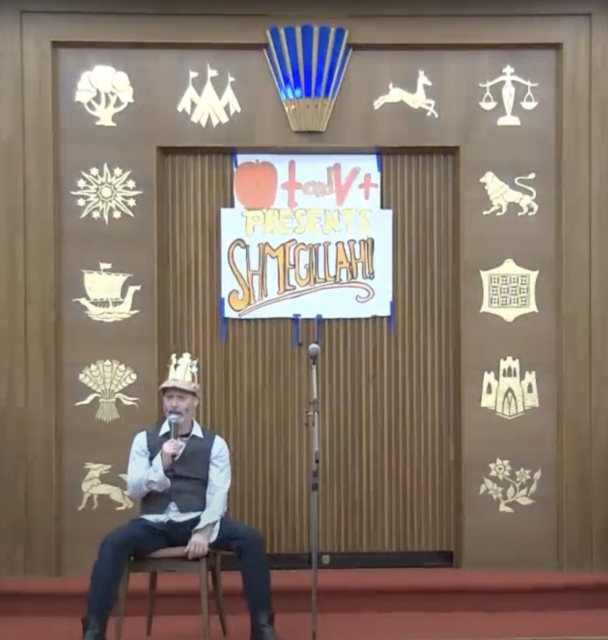
David Pasteelnick plays King Ahasuerus in “Schmegillah!” Purim Spiel at T&V (screenshot courtesy T&V)
twi-ny: Do you have a dream role?
dp: As I’m heading toward sixty, I’ve actually had to say goodbye to a number of dream roles.
twi-ny: Why?
dp: If someone got on their knees and begged me, I would go, Okay, fine, even though it’s wildly inappropriate. But for me, if I’ve aged out, in my head, I’ve aged out. I’ve seen shows where someone who is way too old to do a part do a part, and I just see that and go, “I will never do that.” Even if I could sing it, people would be looking at me and thinking, “Why is this old, old person in this role for a middle-aged person or a young person?” I had a friend, lovely guy, but he was doing juveniles into his late thirties. It’s like, yes, but no.
I’d always wanted to do the baker in Into the Woods. I’ve done Jack. I would love to do that role. But I just feel I’m too old for it. So now, the Mysterious Man / Narrator. I would love to play that; I still love the show. A perfect example is A Little Night Music. I’ve done the show three times. I did it as Henrik when I was age appropriate for Henrik. I did it as Mr. Erlanson when they went with somebody else for the lead, but I was good enough to be ensemble. And then I got to do it again and be Fredrik when I was the right age for Fredrik.
twi-ny: Did that give you a new perspective on the show as a whole or just those characters?
dp: It’s my opportunity to revisit the show in a different way, how you’re doing the show as Henrik versus Fredrik versus the liebeslieders. It’s very different, and also each show is different itself, in different spaces, different director’s vision, how it was staged, how it was cast. But I don’t know perspective-wise; for me it would be more like if I did the same role twice, and I’ve done that. I did Judas/John the Baptist from Godspell twice.
Two very, very different productions, so you just get a different sense of the show. And also, Godspell is just so malleable. People do different things with it all the time.
twi-ny: I saw one of my best friends play Jesus at Temple Gates of Zion in Valley Stream. He’s Jewish, and the show was at a synagogue.
dp: Well, they’re all Jewish, technically, if you think about it.
twi-ny: Right! Which brings us to how we know each other. We met at T&V, which my wife and I found after a long search, and you found it after a long search as well.
dp: Yes.
twi-ny: There’s something just so warm and loving about that community.
dp: It’s very unique, and it filters down from the top.
twi-ny: For many years now, you have written and starred in the Purim Spiel.
dp: I believe coming up will be my twelfth or thirteenth.
twi-ny: How did your involvement get started?
dp: Within a year or two of my being there, people thought, this guy sings; I think I probably advertised whatever shows I was in on the listserv, so people knew I was doing shows.
twi-ny: You have an impressive resume.
dp: T&V would buy these prewritten scripts from another temple; they were like hour-and-a-half-long spiels. Cantor Postman would buy the rights to the script and then we would have to chop it down, and so the first few years we were doing these Frankenstein-ed scripts. And so we did a couple years of that. One year we did a movie, which is where I met Jessica Feder-Birnbaum. We screened it for the congregation and it was a lot of fun.
The following year we went back to the Frankenstein-ed scripts. About two or three years into it, I remembered that decades ago, when I was in my synagogue in New Jersey where I grew up, they’d asked me, You do community theater. Would you do one for the kids in Hebrew school? And so for three years, I created scripts for them. And so I was, like, Wait, I have these scripts. So one year at T&V I said, Can you give me what you’ve got and I can edit it so that it’s actually of a piece?
The cantor was a little skeptical, but she and Jessica and I sat down together and we smoothed it out and fixed a lot of things, because I’m a stickler with song parodies. So we would rewrite lyrics and fix things, make characters make sense and cut stuff out.
twi-ny: And the three of you worked really well together?
dp: Yes. And then the following year, the cantor said, Well, let’s try one of your scripts. Years ago, one of the ones I did was “The Brothers Grimmberg’s Purim Tales.” And we had Little Red Schmatta, Snow Weiss and the Twelve Tribes, and Cinder Esther.
twi-ny: I remember that.
dp: So “Cinder Esther” was the first one I did, but I rewrote all the songs. Also we had an entirely different number of people, so I had to completely change the casting. But it went really well, and we were off to the races after that. We have a system now, because it’s me, it’s Jessica, it’s Gary Mund, and the cantor. In the summer we have these post-wrap-up dinners, A: to celebrate, and B: to think about the following year and talk it through. What did we do? What could we do better?
Initially it was stuff that amused me, like the Marvel superheroes one, I enjoyed that, but a lot of people didn’t get it. Which is why the Disney one worked so well, why last year’s general musical theater one, “Shmegillah!,” was also popular. It’s telling the same story every year, but it gets to stay fresh. The next one is going to be Sesame Spiel. Sesame Street is going to be the theme. We’ve got King Grovershverous. Haman the Grouch.
[Feder-Birnbaum points out, “Every June, the Spiel Team — David, Cantor Postman, Gary Mund, and I — meet to discuss the following year’s spiel. Whether it’s tapping into the contemporary Netflix zeitgeist or leaning into the nostalgia factor, David will come up with an innovative and hilarious concept.”]
twi-ny: That’s a great one. Cookie Monster?
dp: Cookie Mordecai.
twi-ny: Excellent.
dp: But Esther will be Esther because there’s always at least some humans. It also depends on who shows up at auditions. So we’ll figure that out.
twi-ny: I had a blast the one year I did it online.
dp: You were terrific.
twi-ny: Awww. I could never do it in person, but I was happy to be able to do it virtually. They’re all on YouTube.
dp: Yeah. Anyone can watch them.
twi-ny: Let’s go to another part of your life. While you’re doing all this music theater, you’ve been a grant writer for various arts organizations, right now at the Brooklyn Public Library.
dp: It’s been just over a decade, yeah.
twi-ny: How has the grant-writing process changed over the last twenty-five years, since you started?
dp: The one thing for sure that’s changed a lot is just how much more online it is. Some people still use mail, because they’re small family foundations and don’t have a website. But a lot of places have moved online; they have portals, or you just email it to them.
twi-ny: There’s such a skill to grant writing. Is it just something that you’ve learned over the years or did you just take to it immediately?
dp: It’s a mix. I did go to graduate school for arts administration, which is not fundraising specifically. It was one of several different things we learned about, at Teachers College at Columbia. We learned about fundraising, but we learned about how to create a business plan. We learned about labor laws. We learned about collective bargaining. We had org psych stuff, real estate, the history of the nonprofit field in America, how to incorporate a nonprofit.
I was at Roundabout for five years. I worked very briefly at Signature.
twi-ny: With Jim Houghton?
dp: Yes. May he rest in peace. A lot of the great nonprofit theater leaders have passed: Todd Haimes is now gone. Jeffrey Horowitz is still alive at Theatre for a New Audience, although he’s stepping down. I was there for about six years. Then I went to this museum that shall remain nameless for three years.
But it allowed me to have more than just theater on my resume, and that got me to the library. I’ve learned so much there. I help fund early literacy, we’ve done social worker grants, funding for incarcerated individuals, a capital campaign, small-level capital projects, teen internships, education programs. It’s been expanding so much over these last years. and the need is so much greater now for a lot of the things that we provide.
twi-ny: That’s good training for the Blue Hill Troupe, since you’re now the president.
dp: Yes, for this year. You’re president for one year.
twi-ny: You’ve got such a busy life. How do you maintain a balance, and what do you hope to accomplish as president? What’s your platform?
dp: Well, it’s interesting. It’s a two-edged sword, because last year was our centennial, and that was an incredibly important year, our one hundredth anniversary. There was a big push to involve membership: do more, give more, show up more, perform more, bigger budgets, buy more tickets, sell more tickets, So coming into this year, I knew I had an exhausted membership, but my goal is to find ways to keep people engaged through this year, to make sure we still raise substantial money for our partner charity, Young People’s Chorus of New York City.
They told me, “You get the victory lap year,” But I’m like, “No, I don’t. I get the everyone’s exhausted year.” It’s actually harder than people think.
twi-ny: It’s like being the manager of a baseball team that wins the World Series. The next year, you want to win the series again. You can’t just party all year.
dp: Exactly. There is that pressure that we have. Hopefully, everyone’s caught their breath a little, bringing it back to normal. This year has been a bit of a struggle. Every show we do, except for the director and the musical director, every single position is volunteer. The lighting designer is a volunteer. The set construction, costume and props construction is all volunteer. Stage management, show program creation: We do our own playbills — everything is in-house.
So I try to give people support and encouragement, asking, “How can I assist you?” A lot of brainstorming, making sure the membership understands this year is another full-out year, that we all need to show up in all the different ways that troupe members show up. And they have shown up, thankfully.
Also, Cinderella is perhaps a bit ambitious. We have a lot of ball gowns.
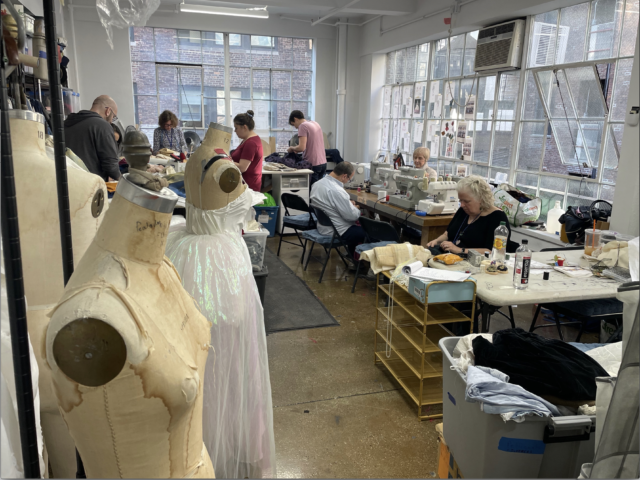
Blue Hill costume crew is hard at work on a Saturday afternoon (photo by twi-nymdr)
twi-ny: Yes, I saw some of them being made. They’re beautiful.
dp: Our costume crew is here on a Saturday, they’re working hard. We always work on Saturdays, on the weekends. Probably the busiest time. We’re starting to do weeknight sessions. We need people every weeknight. There are things to paint, things to hammer, things to stitch.
twi-ny: And I see them doing it right now.
dp: Exactly. And they do amazing work. They’re sculpting, they’re cutting up wood, they’re building. It can be a bit last minute. Sometimes, we’ll be in dress rehearsal and we’re told, “Don’t touch that because the paint’s still drying.”
That’s just how it is sometimes with amateur groups; people also have jobs and families.
twi-ny: You’ve done it so many years now. Is it always a thrill and exciting, or every year is it, Uh oh, no, we’re not going to make it?
dp: Every show is different. I will say some shows we’ve just gently landed that plane and other times, well, buckle up, there’s going to be turbulence. You can absolutely never predict. I have been in shows where leading up to tech week, I’m, like, “Wow, we are golden.” And then tech week comes and it’s, like, What happened? We’re so off the rails. Maybe there are technical elements or some kind of complication with sound or with lighting that we didn’t anticipate.
And so, in tech week, with the pressure, with that deadline looming, people just boom, boom, boom, boom — they get it done. And then we open and it’s like, How did we do that? Again, it’s a testament to the professionalism of our group, that people really do come through and they will stay until one in the morning redoing the lighting plot because they believe in the troupe and they are dedicated — and that’s just one of the many inspiring things with this group.
Until the curtain goes up on opening night, I will be believing that we can do this. I don’t know that I’ve ever done a show where we opened and I thought, Holy f%^k, that was a disaster. That’s never happened. There have been rough openings where we made it by the skin of our teeth but then the next night we know it will be better.
But the energy’s there. Our casts are really great. I remember one of my roles, it was in Patience; or Bunthorne’s Bride. I have this patter song. It was in the middle of the first act, on opening night. And someone had brought a toddler, and that kid screamed through my entire patter song. But the orchestra kept playing and I kept singing. And I’ve seen other people, something falls and they just keep going, something knocks over or the lights go out, we just keep going.
twi-ny: The show must go on.
dp: Each show is worth doing. We’ve all worked so hard. People just commit. They’re giving their all, and that carries the show through. We just believe in ourselves, and we know the track record’s there. And we also have this reputation to uphold. Absolutely. People come to our shows and they have definite expectations.
When I worked at that museum that shall not be named, I had a friend who had previously only seen me do a staged reading of a show, and then I told her, I’m doing this other show, A Funny Thing Happened on the Way to the Forum, and you should come. She said okay. And she was expecting something like the reading.
But she was not prepared for the level that she got from the Blue Hill Troupe.
twi-ny: That was like the first time I saw the company. I was not expecting that level of quality.
dp: Yeah, and we don’t charge nearly as much compared to professional theater, which we are essentially giving the audience. So, you know, we’re the best deal in town.
[Mark Rifkin is a Brooklyn-born, Manhattan-based writer and editor; you can follow him on Substack here.]