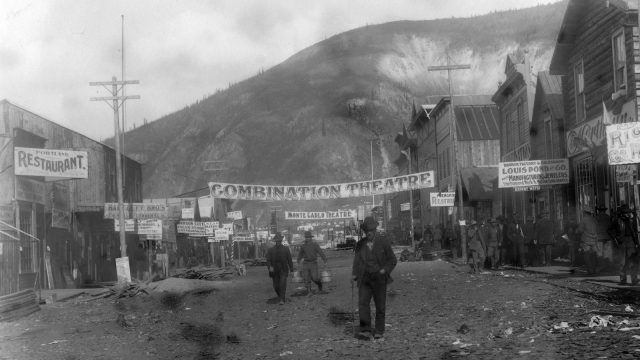
Bill Morrison follows the boom and bust of a Yukon gold-rush town in Dawson City: Frozen Time
DAWSON CITY: FROZEN TIME (Bill Morrison, 2016)
Museum of the Moving Image
35th Ave. at 36th St., Astoria
August 18-20
718-777-6800
www.movingimage.us
billmorrisonfilm.com
 “What power has gold to make men endure it all?” a title card asks in William Desmond Taylor’s 1928 silent film, The Trail of ’98, based on a novel by Robert Service. Both Taylor and Service were at one time residents of Dawson City, the town in the Yukon in Canada that was at the center of the Klondike Gold Rush in the late 1890s. In June 1978, while construction was just under way to build a new recreation center behind Diamond Tooth Gertie’s Gambling Hall in Dawson, Pentecostal minister and city alderman Frank Barrett uncovered a treasure trove of motion picture stock, hundreds of silent films that had been believed to have been lost forever. Writer, director, and editor Bill Morrison uses stunning archival footage from those films in his elegiac, beautiful documentary, Dawson City: Frozen Time, which brilliantly tells the story of greed, perseverance, and the growth of the entertainment industry in the late nineteenth and early twentieth centuries. After gold was discovered in Dawson, the indigenous Hän people were relocated to Tr’ochëk and some hundred thousand prospectors stampeded in, the gold mining destroying the Hän’s fishing and hunting grounds. Morrison also follows the invention of film itself, celluloid stock that would end up causing many fires, including one every year in Dawson for nine years. Bookended by an original interview with Michael Gates, Parks Canada curator of collections, and his wife, Kathy Jones-Gates, director of the Dawson Museum, the film traces the boom-and-bust fortunes and misfortunes of Dawson, as gambling casinos, movie theaters, hotels, and restaurants are built, including the Arctic, a hotel and restaurant owned by Ernest Levin and Fred Trump, the president’s grandfather, that might have served as a brothel as well. The film is supplemented with photographs by Eric A. Hegg, a giant in the field who left behind glass plates when he ultimately departed Dawson. Among others making their way through Dawson at one time or another are newsboy Sid Grauman, who went on to build Grauman’s Chinese Theatre; New York Rangers founder Tex Rickard; comic superstar Fatty Arbuckle; and Daniel and Solomon Guggenheim, who dominated the mining there.

Discovery of long-lost silent films tells a fascinating story in Dawson City: Frozen Time
Morrison, whose previous films, including Decasia, The Miners’ Hymns, and The Great Flood, employ archival footage to often tell historical tales, uses thousands of clips in Dawson City: Frozen Time, from newsreels to such films as Temperance Town, The Half Breed, The End of the Rainbow, and The Frog. Footage from the found clips, identified as “Dawson City Film Find” on the screen, also delves into the evolving battle between workers and owners, the deportation of political radicals, and the Black Sox scandal, all of which Morrison relates to the upstart movie industry. The film is a tour de force of editing, as Morrison streams together scenes of actors going through doorways, kissing, or moving in vehicles, not just a torrent of random images, all set to Alex Somers’s haunting experimental score. (Somers’s brother, John, is the sound designer.) The film also sets a new personal high for Morrison, clocking in at 120 minutes, by far his longest work; all of his previous features are less than 80 minutes, but this latest one further establishes that Morrison’s mesmerizing but unusual visual approach is not time-sensitive. With Dawson City: Frozen Time, Morrison has created a magical ode to the history of film, to preservation, to pioneers, and to perseverance, told in his hypnotic, unique style. Following its initial theatrical run this past June at IFC Center, the film is screening August 18-20 at the Museum of the Moving Image, with Morrison on hand Friday at 7:30 to talk about the work. In addition, as part of its “New Adventures in Nonfiction” series, MoMI is presenting
Artists Space Ugo Rondinone’s citywide celebration of his husband, “I ❤ John Giorno,” continues Wednesday night with a special poetry jam at Artists Space organized by Bowery Poetry Club, the downtown institution down the street from John Giorno’s apartment and studio. The free event will be hosted by Bob Holman, Nikhil Melnechuk, Ashley August, and Mason Granger and feature readings by Julius Baltonado, Stefan Bondell, Steve Cannon, Lynne DeSilva Johnson, Timothy DuWhite, Joel François, Myles Golden, David Henderson, Sam Jablon, Amy Lawless, Lisa Markuson, Sam O’Hana, Noel Quiñones, Shawn Randall/Symphonics Live, Patrick Roche, Hannah Wood, and Anton Yakovlev. Swiss artist Rondinone’s tribute to his life partner, the eighty-year-old Giorno, a poet, painter, musician, and performance artist who has no time for rules, is taking place at thirteen venues, with exhibitions, wall murals, film and video, portraiture, at the Kitchen, Hunter College, the New Museum, White Columns, Sky Art in Hell’s Kitchen, the Swiss Institute, Red Bull Arts New York, Artists Space, and the Broadway and Washington Square windows. Who: Akerman/Jansen, Battery Dance, Danuka Ariyawansa + Behri Drums and Dance Ensemble, Janis Brenner & Dancers, Martha Graham School, Cía. Elías Aguirre, Compañía Nacional de Danza Contemporánea de República Dominicana, Fadi J. Khoury’s FJK Dance, Mari Meade Dance Collective (MMDC), Nadine Bommer Dance Company, SLK Ballet, Trezon Dancy, Aakansha Maheshwari, Dimple Saikia, Kalanidhi Dance, Kalamandir Dance, Sruthi Mohan, Viraja and Shyamjith Kiran, Ballet Inc., Buglisi Dance Theatre, Cía. Elías Aguirre, Maxine Steinman & Dancers, Tina Croll + Company, Wilder Project, Mophato Dance Theatre, Amy Marshall Dance Company, Ariel Rivka Dance, Bollylicious, Peridance Contemporary Dance Company, SYnC Dance Company, the Movement Playground, Trainor Dance Special musical programs enhance Chihuly exhibition at New York Botanic Garden The New York Botanical Garden The New York Botanical Garden’s “CHIHULY” exhibition, his first new show in New York in a decade, features colorful and extravagant site-specific glass-blown works by Dale Chihuly spread throughout the grounds, including at the Native Plant Garden, the Lillian and Amy Goldman Fountain of Life, the Leon Levy Visitor Center, the Arthur and Janet Ross Conifer Arboretum, and the Enid A. Haupt Conservatory Courtyard’s Tropical Pool, as well as works on paper and early works on view in the LuEsther T. Mertz Library Building. There are special bonuses during the month of August to enhance the oeuvre of the Washington State native, whose NYBG pieces were partially inspired by a 1975 Niagara Falls group show he participated in. On August 12 and 13 from 1:00 to 4:00, accordionist Tony Kovatch, Spanish guitarist David Galvez, and saxophonist Keith Marreth will play acoustic music at various locations in the garden, joined by steel drummer Earl Brooks Jr. and cellist Laura Bontrager on Saturday and steel drummer Mustafa Alexander and oboist Keve Wilson on Sunday. Meanwhile, Brooklyn-based UrbanGlass will host flame-work demonstrations at Conservatory Plaza and the visitor center. There will also be ice-cold treats available for purchase to keep everyone cool. On August 19, the NYBG Summer Concert Series presents “Jazz & Chihuly: Songs of Protest & Reconciliation,” with live music by pianist Damien Sneed and an all-star ensemble, along with special guest trumpeter Keyon Harrold, followed by a late-night viewing of the exhibition. You can also see short films about Chihuly’s creative process on Saturdays and Sundays from 10:00 am to 5:00 pm or check out “Chihuly Nights,” with Fulaso, Richard & Ashlee, and Mustafa Alexander on April 10, Mandingo Ambassadors, Almanac Dance Circus Theater, and Alexander on August 17, and Samba New York! and Alice Farley on August 24. “I want people to be overwhelmed with light and color in a way they have never experienced,” Chihuly says about his work; these programs enhance that experience in unique ways. Emily Johnson’s Then a Cunning Voice and a Night We Spend Gazing at Stars will take place overnight on Randall’s Island on August 19 (photo by Chris Cameron) Who: Emily Johnson / Catalyst Pierre Thomas (Pascal Cervo) uses Grindr as a GPS in Jérôme Reybaud’s 4 Days in France) 4 DAYS IN FRANCE (JOURS DE FRANCE) (Jérôme Reybaud, 2016) Paul (Arthur Igual) doesn’t understand why his lover left him in 4 Days in France) We actually learn more about the minor characters, some of whom are onscreen for a very short period of time, than we do about Paul and Pierre; there’s no back story establishing who they are and what kind of relationship they have, no explanation of why Pierre left and what he is searching for, yet writer-director Reybaud gets us to become wholly involved in their lives, desperately hoping that Paul catches up to Pierre and they make up, even as neither is exactly faithful during this trying dilemma. But each vignette, in the spirit of such Jim Jarmusch films as Stranger Than Paradise, Night on Earth, and Coffee and Cigarettes, comments about the state of human existence in the twenty-first century in abstract, obscure, yet tantalizing ways. The wall that separates Pierre from the salesman in the hotel is the centerpiece of the film, the two men on opposite sides, both in need of almost any kind of connection. Another critical scene is when a young woman steals Pierre’s travel bag and they end up going through it together, figuring out what his various possessions are worth — compared to the value of being with other people. Reybaud prefers long scenes with little camera movement, particularly in cars; Pierre drives for miles and miles, through such gorgeous scenery as the Alps and vast green landscapes — the lovely cinematography is by Sabine Lancelin, who has worked with Manoel de Oliveira, Chantal Akerman, Michel Piccoli, Éric Rohmer, and Raoul Ruiz — and the camera mostly remains still, as if putting the viewer in the backseat in this strange yet involving journey. And despite clocking in at 140 minutes, 4 Days in France is utterly addictive even though nothing of great significance ever really happens. Early on, when Pierre drives a stranded Diane to the nursing home, she asks if he wants to come in and watch her show. He says no; he would never do anything like that, at least partly because he is likely to be suffering from a fear of death, among several other private maladies. But Reybaud lets the audience see Diane as she whisper-sings in a sparkly costume. When it comes right down to it, this film is not about why Pierre walked out on Paul and set out on his own; it’s really just about how none of us wants to be alone. “Where are you going?” the woman with the wagon asks Pierre, who casually responds, “I don’t know.” 4 Days in France opens August 4 at the Quad, with Reybaud participating in Q&As following the 6:40 shows on Friday and Saturday night. “Doria Dee Johnson at her home in Chicago, Illinois, 2017” (photo by Melissa Bunni Elian for the Equal Justice Initiative) Brooklyn Museum The Brooklyn Museum starts preparing for the West Indian American Day Carnival events over Labor Day weekend with the August edition of its free First Saturday program. (First Saturdays is skipped in September.) There will be live performances by RIVA & Bohio Music and the Drums and Bugles International Bands Association; the mobile art center caribBEING House, where visitors can share their own stories; a gallery tour of “We Wanted a Revolution: Black Radical Women, 1965–85” with Elizabeth A. Sackler Center for Feminist Art curatorial assistant Allie Rickard; pop-up gallery talks of “Life, Death, and Transformation in the Americas” with teen apprentices; a screening of Matt Ruskin’s Sundance Audience Award winner Crown Heights, introduced by actress Natalie Paul and followed by a Q&A with film subject Colin Warner, community activist Rick Jones, and attorney Ames Grawert; a sneak peek of Cori Wapnowska’s documentary Bruk Out!, followed by a talkback with Wapnowska and Dancehall Queen Famous Red, moderated by Hyperallergic editor Seph Rodney; a Book Club event with Oneka LaBennett reading and discussing her new book, She’s Mad Real: Popular Culture and West Indian Girls in Brooklyn, followed by a signing; an Artist’s Eye talk by Melissa Bunni Elian on her contribution to “The Legacy of Lynching: Confronting Racial Terror in America”; a wukkout! movement workshop based on high-energy soca dancing; a hands-on workshop in which participants can make paintings with watercolor and salt; and a Flag Fete in which visitors can bring their own national flag, joined by female-identified Caribbean artists Sol Nova, Young Devyn, and Ting & Ting featuring Kitty Cash and special guests.
BOWERY POETRY ❤ JOHN GIORNO

55 Walker St.
Wednesday, August 16, free, 7:00
artistsspace.org
BATTERY DANCE FESTIVAL 2017
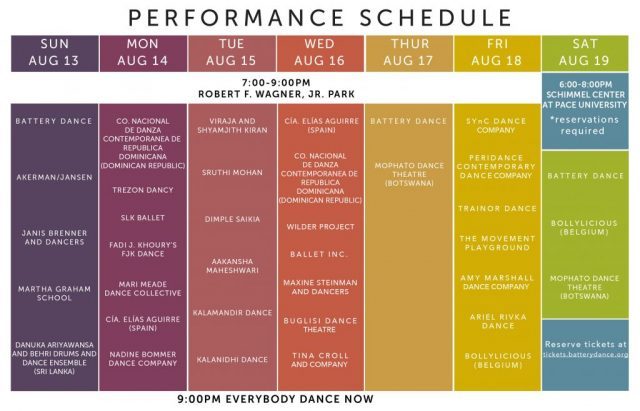
What: Thirty-sixth annual Battery Park Dance Festival
Where: Robert F. Wagner Jr. Park, 20 Battery Pl., Battery Park City
When: August 13-19, free, 7:00 – 9:00
Why: Continuing its mission to connect the world through dance, Battery Dance, which was founded in Lower Manhattan in 1976, is hosting the thirty-sixth annual Battery Dance Festival, held outside August 13-18 in Robert F. Wagner Jr. Park in Battery City. Thirty companies from around the world are participating, with troupes from Sri Lanka, Spain, the Dominican Republic, India, Belgium, Botswana, and the United States. The always popular IAAC Erasing Borders Festival of Indian Dance takes place on August 15, while the closing event, including reception, is set for August 19 at 6:00 in the Michael Schimmel Center, with free tickets and $50 VIP admission available in advance here. That finale will feature Battery Dance’s On Foot, Bollylicious’s Yatra, and Mophato Dance Theatre’s Pula. In addition, there will be daily free morning workshops at 10:30 at Battery Dance Studios on the fifth floor of 380 Broadway, with Battery Dance on August 14, Compañía Nacional de Danza Contemporánea de República Dominicana on August 15, Cía. Elías Aguirre on August 16, Bollylicious on August 17, and Mophato Dance Theatre on August 18; advance RSVP is required here.
CHILLIN’ WITH CHIHULY
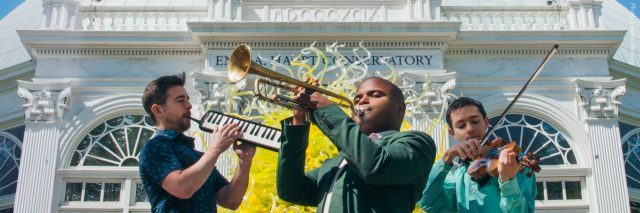
2900 Southern Blvd., Bronx
Chillin’ with Chihuly: Saturday, August 12, and Sunday, August 13, 1:00 – 4:00
Chihuly Nights: Thursday, August 10, 17, 24, $35, 6:30
Jazz & Chihuly: Friday, August 18, $40, 6:00
Exhibition continues Tuesday – Sunday through October 29, $10-$28
718-817-8700
www.nybg.org
www.chihuly.com
TICKET ALERT: THEN A CUNNING VOICE AND A NIGHT WE SPEND GAZING AT STARS
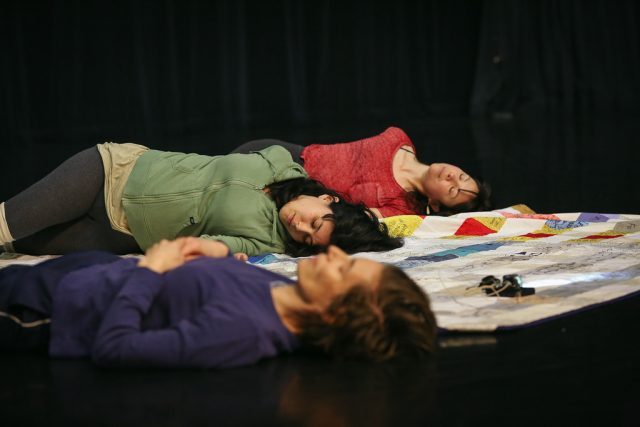
What: All-night outdoor performance gathering
Where: Randall’s Island Park
When: Saturday, August 19, $50, dusk to after sunrise
Why: You don’t just go to a show by Emily Johnson / Catalyst; you become part of an experience. In such presentations as Niicugni and Shore, Johnson builds a sense of community for all involved, including cast, crew, and audience. On August 19, her multiyear project Then a Cunning Voice and a Night We Spend Gazing at Stars reaches its next level on Randall’s Island, where people will gather for an evening of song, dance, storytelling, quilting, ritual, and more under the night sky. The world premiere, presented by Performance Space 122, is directed by three-time Obie winner Ain Gordon (The Family Business, Spalding Gray: Stories Left to Tell) and features performers Tania Isaac, twelve-year-old Georgia Lucas, and Johnson, with visual design by textile artist Maggie Thompson, lighting by Lenore Doxsee, and quilt construction by volunteers from around the country. The ten-to-twelve-hour piece explores such questions as “What do you want for your well-being? For the well-being of your chosen friends and family? For your neighborhood? For your town, city, reserve, tribal nation, world?” You can participate as much as you want as the audience is led into discussions and programs about engaged citizenship, safety, Indigenous people, and making connections. Four thousand square feet of quilts will serve as home base for performances, resting, and just hanging out. Supper, breakfast, and snacks will be served as well. Johnson is a magnetic personality who cares very deeply about the future of all the people and animals living on this planet, so Then a Cunning Voice and a Night We Spend Gazing at Stars should be a powerful and moving experience, in addition to being a lot of fun. Look for our interview with Johnson about the project coming soon; in the meantime, you can contribute to the Kickstarter campaign to help fund this project here.
4 DAYS IN FRANCE
Quad Cinema
34 West 13th St. between Fifth & Sixth Aves.
Opens Friday, August 4
212-255-2243
www.quadcinema.com
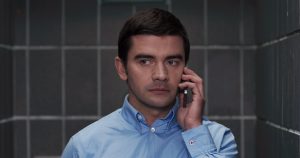
www.cinemaguild.com Jérôme Reybaud’s feature debut, 4 Days in France, is a hypnotic existential road movie about deep-set, pervasive loneliness, tinged with bittersweet dark humor. In the middle of the night, Pierre Thomas (Pascal Cervo) packs a bag and quietly walks out on Paul (Arthur Igual), who doesn’t notice he’s gone until he wakes up in the morning, mystified by his lover’s absence. Pierre heads out across the French countryside and through small towns in his white Alfa Romeo sedan, using Grindr as his GPS, seeking out anonymous sex with men in remote gay hook-up areas. The distraught Paul, meanwhile, goes to the opera — Mozart’s Così fan tutte, which can be translated as “Women are like that” — without Pierre and realizes how much he misses him, so he takes off after his errant partner. He follows him on Grindr as well, but he is already far behind. As this slow-speed “chase” goes on, both Pierre and Paul encounter a series of lonely individuals, played by well-known French actors and celebrities, including Fabienne Babe as Diane Querqueville, who performs at an out-of-the-way nursing home; Natalie Richard as a bookseller who Pierre doesn’t remember; Lætitia Dosch as a philosophical thief; Liliane Montevecchi as Pierre’s elegant aunt; Jean-Christoph Bouet as an older man who services strangers; Florence Giorgetti as a strong-willed woman protecting her turf; Corinne Courèges as a Happy Dough employee with a surprising proposition for Paul; Hervé Colas as an unfriendly butcher; Dorothée Blanck as a woman pulling a wagon; Bertrand Nadler as a traveling salesman Pierre encounters in a hotel parking lot; Marie France as a woman who has an unexpected task for Pierre to help her with; and Emilien Tessier as a man literally standing between two worlds. Neither Paul nor Pierre ever say that much, although we do learn that Pierre is rather fastidious and naturally polite, preferring to follow rules and not be touched unless he wants to be.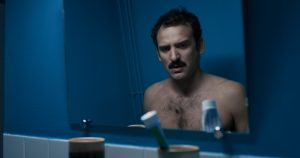
BROOKLYN MUSEUM FIRST SATURDAY: CaribBEING IN BROOKLYN

200 Eastern Parkway at Washington St.
Saturday, August 5, free, 5:00 – 11:00
212-864-5400
www.brooklynmuseum.org