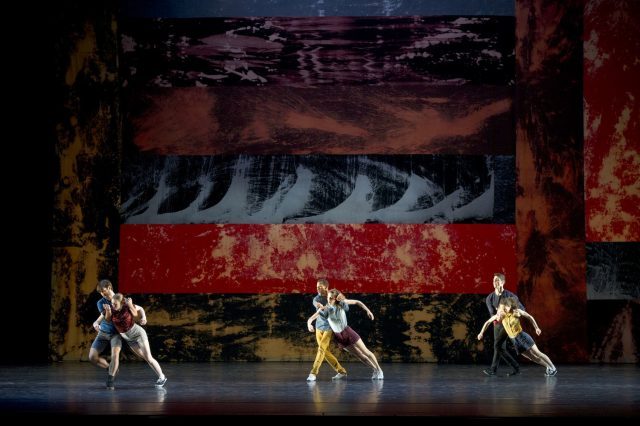
Sterling Ruby created the scenic design for Justin Peck’s Murder Ballades, part of the L.A. Dance Project’s two-week season at the Joyce
The Joyce Theater
175 Eighth Ave. at 19th St.
June 13-25, $26-$66
212-242-0800
www.joyce.org
www.ladanceproject.com
The innovative and exciting L.A. Dance Project follows up its 2016 Joyce debut with a two-week run at the Chelsea institution, performing a pair of what promise to be terrific programs, boasting an impressive array of collaborators. For the first program, the company, which was founded in 2012 by former New York City Ballet principal dancer Benjamin Millepied, will be presenting 2015’s Hearts & Arrows, choreographed by Millepied, with music by Philip Glass performed live by PUBLIQuartet, sets by English conceptual artist Liam Gillick, lighting by Roderick Murray, and costumes by company dancer Janie Taylor; Ohad Naharin’s Yag, a forty-minute piece for six dancers, set to music by John Zorn, Gaetano Donizetti, John Taverner, Ennio Morricone, Ran Slavin, and Maxim Waratt and for which LADP rehearsed with ballet masters from Naharin’s Batsheva Dance Company; and the world premiere of Millepied’s In Silence We Speak, a duet, inspired by Michelangelo Antonioni’s L’Avventura, for Taylor and Carla Korbës that you can get a sneak peek at here. The second program consists of New York City Ballet resident choreographer Justin Peck’s 2013 Murder Ballades, with an original score by Bryce Dessner of the National, sets by American artist Sterling Ruby, and lighting by Brandon Stirling Baker; Merce Cunningham’s MinEvent, a collage of excerpts from Cunningham’s oeuvre, with live piano by Adam Tendler; In Silence We Speak; and the world premiere of Millepied’s multimedia Orpheus Highway, set to Steve Reich’s Triple Quartet, played live by PUBLIQuartet. The company also includes Stephanie Amurao, Aaron Carr, David Adrian Freeland Jr., Rachelle Rafailedes, Nathan B. Makolandra, Julia Eichten, Robbie Moore, Morgan Lugo, and Lilja Rúriksdóttir. There will be a Curtain Chat following the June 15 performance of Program 2. LADP’s 2016 season at the Joyce sold out, so you better hurry if you want to see this sizzling hot company.

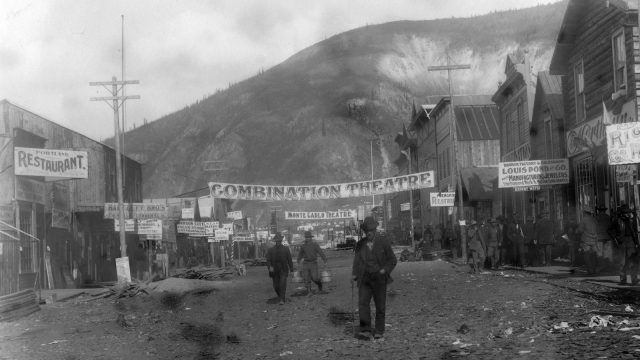
 “What power has gold to make men endure it all?” a title card asks in William Desmond Taylor’s 1928 silent film, The Trail of ’98, based on a novel by Robert Service. Both Taylor and Service were at one time residents of Dawson City, the town in the Yukon in Canada that was at the center of the Klondike Gold Rush in the late 1890s. In June 1978, while construction was just under way to build a new recreation center behind Diamond Tooth Gertie’s Gambling Hall in Dawson, Pentecostal minister and city alderman Frank Barrett uncovered a treasure trove of motion picture stock, hundreds of silent films that had been believed to have been lost forever. Writer, director, and editor Bill Morrison uses stunning archival footage from those films in his elegiac, beautiful documentary, Dawson City: Frozen Time, which brilliantly tells the story of greed, perseverance, and the growth of the entertainment industry in the late nineteenth and early twentieth centuries. After gold was discovered in Dawson, the indigenous Hän people were relocated to Tr’ochëk and some hundred thousand prospectors stampeded in, the gold mining destroying the Hän’s fishing and hunting grounds. Morrison also follows the invention of film itself, celluloid stock that would end up causing many fires, including one every year in Dawson for nine years. Bookended by an original interview with Michael Gates, Parks Canada curator of collections, and his wife, Kathy Jones-Gates, director of the Dawson Museum, the film traces the boom-and-bust fortunes and misfortunes of Dawson, as gambling casinos, movie theaters, hotels, and restaurants are built, including the Arctic, a hotel and restaurant owned by Ernest Levin and Fred Trump, the president’s grandfather, that might have served as a brothel as well. The film is supplemented with photographs by Eric A. Hegg, a giant in the field who left behind glass plates when he ultimately departed Dawson. Among others making their way through Dawson at one time or another are newsboy Sid Grauman, who went on to build Grauman’s Chinese Theatre; New York Rangers founder Tex Rickard; comic superstar Fatty Arbuckle; and Daniel and Solomon Guggenheim, who dominated the mining there.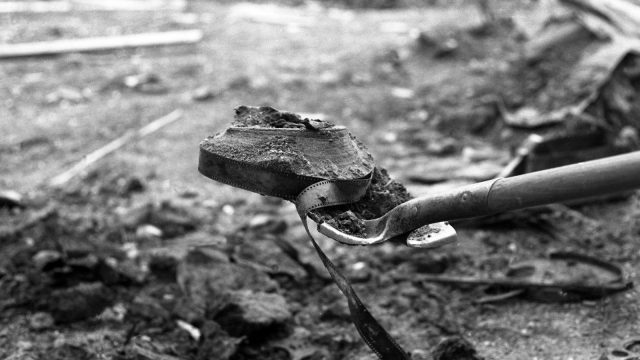
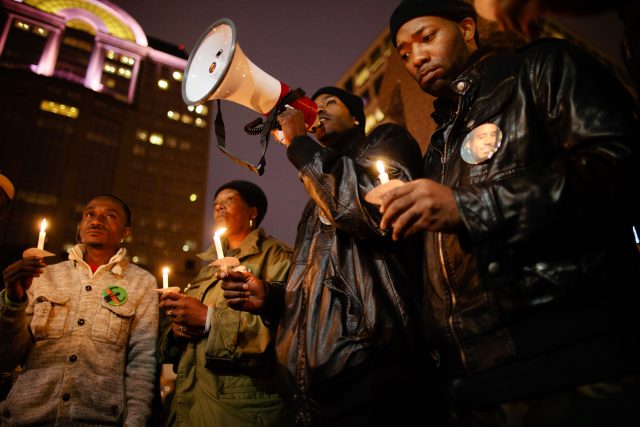
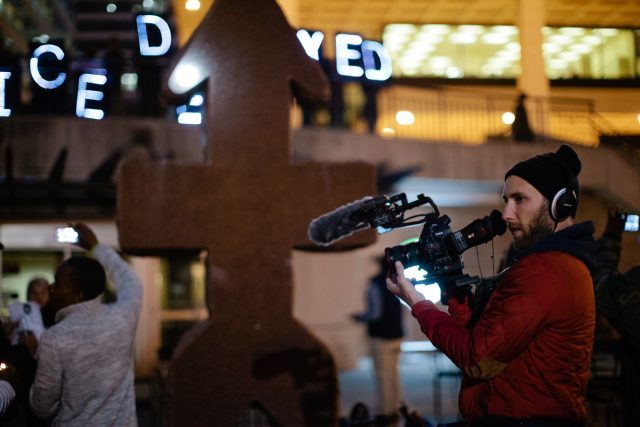
 Eric Garner, Michael Brown, Tamir Rice, Sandra Bland, Philando Castile, Alton Sterling, Freddie Gray — the list of unarmed black men, women, and children who died during or shortly after altercations with mostly white police officers keeps growing. Erik Ljung tells the story of a lesser-known victim, Dontre Hamilton, in The Blood Is at the Doorstep, making its New York premiere this weekend at the Human Rights Watch Film Festival. On the afternoon of April 30, 2014, the thirty-one-year-old Hamilton, who suffered from schizophrenia, was resting in a public park when he was roused by police officer Christopher Manney, who, after a confrontation, shot Hamilton fourteen times, killing him. The Hamilton family wasn’t notified until after midnight, more than eight hours later, then spent more than a year seeking information, and justice, trying to find out why Dontre had been killed and what was going to happen to the officer responsible. Ljung, who serves as director of photography as well, follows Dontre’s mother, Maria, and his brothers, Nate Hamilton and Dameion Perkins, as they demand answers, remaining peaceful yet strong. Ljung meets with Dontre’s father, Nathaniel Hamilton Sr., who is divorced from Maria but is still in his children’s lives, and Michael Bell, a white man who talks in detail about the murder of his son at the hands of Kenosha, Wisconsin, police officer Alberto Gonzales. Also sharing their views are Hamilton family attorney Jonathan S. Safran, District Attorney John T. Chisholm, and Milwaukee police chief Ed Flynn, who is quick to defend Manney’s actions while painting a false picture of Dontre as a repeat violent offender with a dangerous mental illness. Ljung, who has done work for VICE News, Al Jazeera, PBS, and other outlets, and editor Michael T. Vollman add footage from news reports, showing how the story played out in the media as public information trickled in over months and months.