this week in lectures, signings, panel discussions, workshops, and Q&As

THE LOST VILLAGE

The Lost Village

The Lost Village looks at NYU’s expansion into real estate and other community ills

THE LOST VILLAGE (Roger Paradiso, 2018)
Cinema Village
22 East 12th St. between University Pl. & Fifth Ave.
Opens Friday, October 19
212-529-6799
www.bgpics.com
www.cinemavillage.com

Roger Paradiso’s The Lost Village takes on a subject near and dear to many a New Yorker’s heart: the gentrification and corporatization of the city, which is replacing affordable housing and mom-and-pop shops with luxury buildings and fancy boutiques. However, the film provides no new insight into the dilemma; in fact, Paradiso even hurts his cause by speaking with a fairly random assortment of people, including some fringe, less-than-objective, not very articulate figures, and demonstrating little skill with a camera. “People came to the Village because it was different,” he explains, stating the obvious. “They’re trying to change the character of the Village, trying to make it a hipster’s suburban mall version of what was once a great Village of artists and working-class families. It’s enough to make a Villager puke.” The film begins as a screed against NYU’s massive expansion into real estate, pointing out that many women students have become sex workers in order to afford their tuition. Mark Crispin Miller, NYU professor of Media, Culture, and Communication, shows a radical 1960s spirit in arguing against the university’s policies, but the rest of the film is scattershot and hackneyed as Paradiso, who previously wrote and directed the movie version of Tony n’ Tina’s Wedding, marches in a handful of economists, brokers, journalists, and activists who give meandering lectures that sound like “Voice of the People” letters in the Daily News. And it doesn’t help that the film looks like a 1970s relic in dire need of restoration. There’s an important story buried somewhere here; perhaps the series of talks accompanying numerous screenings at Cinema Village will shed more light on this critical topic. [Full disclosure: I’m an NYU graduate with a degree in Cinema Studies.]

Friday October 19, 6:45
“St. Vincent’s Hospital and Other Places I Remember,” with George Capsis and Lincoln Anderson, moderated by Jim Fouratt

Saturday, October 20, 2:45
“The Inside Story of What Is Going on in the Village,” with Caroline Benveniste and Jim Fourrat, moderated by Roger Paradiso

Saturday, October 20, 6:45
“The Art of the Gouge: How NYU Squeezes Billions from Its Students and Where that Money Goes,” with Mark Crispin Miller and Andrew Ross, moderated by Jim Fouratt

Sunday, October 21, 2:45
“Where Have All the Artists Gone?,” with Heidi Russell and Sandy Hecker, moderated by Jim Fouratt

Sunday, October 21, 6:45
“Resistance from the Pulpit,” with Reverend Ed Chinery, moderated by Jim Fouratt

Monday, October 22, 6:45
“Where Have All the Activists and Artists Gone?,” with Doris Deither and Alison Greenberg, moderated by Jim Fouratt

Tuesday, October 23, 6:45
“Saving Mom & Pops,” with Marnie Halasa and Peter Cetera, moderated by Jim Fouratt

Wednesday, October 24, 6:45
“Taking Back the Village & Saving It,” with Anthony Gronowicz and Carol Yost, moderated by Jim Fouratt

MARX FESTIVAL: ON YOUR MARX

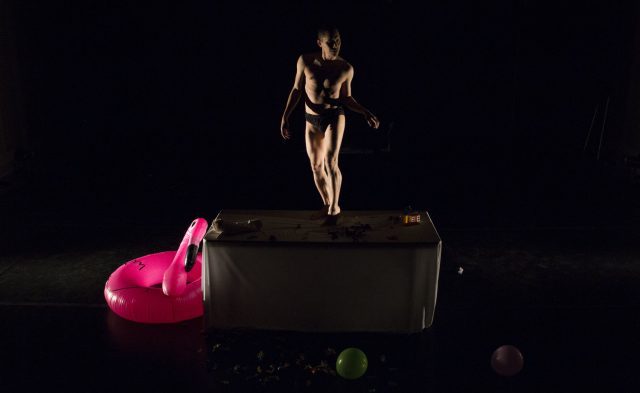
Ivo Dimchev: P PROJECT

Ivo Dimchev’s P Project offers audience members cash in exchange for a performance

NYU Skirball Center for the Performing Arts and other NYU locations
566 La Guardia Pl. between Third & Fourth Sts.
October 17-28, free with advance RSVP
212-992-8484
nyuskirball.org

This past May, Karl Marx would have turned two hundred years old. The NYU Skirball Center is celebrating his bicentennial with twelve days of special free programming honoring the man who wrote, “The mode of production of material life conditions the social, political, and intellectual life process in general. It is not the consciousness of men that determines their being, but, on the contrary, their social being that determines their consciousness.” Audiences can also determine if they want to contribute to the performances based on supply and demand and their own consciousness; the events are all free with advance RSVP but donations are welcome. The “Karl Marx Festival: On Your Marx” begins October 17 at 7:30 with London-based Bulgarian performance artist Ivo Dimchev’s one-hour show, P Project, in which people from the audience will get paid by agreeing to do spur-of-the-moment things involving words that begin with the letter “P.” For example, Dimchev will present them with tasks that might involve such words as Piano, Pray, Pussy, Poetry, Poppers, etc. On October 18 at 6:00, NYU professors Erin Gray, Arun Kundnani, Michael Ralph, and Nikhil Singh will discuss “Racial Capitalism” at the Tamiment Library. On October 19 at 9:30, DJs AndrewAndrew will spin Marxist discs along with readings by special guests from Das Kapital and The Communist Manifesto.

marx festival

On October 19 and 20 at 7:30, Brooklyn-based Uruguayan dancer and choreographer luciana achugar will present the world premiere of Brujx, which explores ideas of labor. On October 22 at 6:30, Slavoj Žižek will deliver the Skirball Talks lecture “The Fate of the Commons: A Trotskyite View.” On October 23 at 5:30, NYU professors Lisa Daily, Dean Saranillio, and Jerome Whitington will discuss “Futurity & Consumption” at the Department of Social & Cultural Analysis. On October 24 at 4:00, author Sarah Rose will talk about her 2017 book, No Right to Be Idle at the eighth floor commons at 239 Greene St. On October 25 at 5:30, luciana achugar, Julie Tolentino, and Amin Husain will join for the conversation “Labor, Aesthetics, Identity” at the Department of Performance Studies. On October 26 at 7:30, Malik Gaines, Miguel Gutierrez, Latasha N. Nevada Diggs, Ryan McNamara, Seung-Min Lee, and Alison Kizu-Blair will stage “Courtesy the Artists: Popular Revolt,” a live-sourced multimedia work directed by Alexandro Segade and Amy Ruhl. The festival concludes October 28 at 5:00 with Ethan Philbrick’s Choral Marx, a singing adaptation of Karl Marx and Friedrich Engels’s Manifesto for the Communist Party, performed by Benjamin Bath, Gelsey Bell, Sarah Chihaya, Hai-ting Chinn, Tomás Cruz, Amirtha Kidambi, Brian McQueen, Gizelxanath Rodriguez, and Ryan Tracy.

A HAUNTING AT HENDRICK’S

The historic Hendrick I. Lott House will open its doors for several special events this month

The historic Hendrick I. Lott House will open its doors for several special events this month

Hendrick I. Lott House
1940 East 36th St., Marine Park
Thursday, October 20, $75, 7:00
Tours on October 27-28, $25, 11:00 & 2:00
www.lotthouse.org
archtober.org

In 1652, the Lotts, a family of French Huguenots, immigrated to Brooklyn from Holland. In 1719, they purchased a farm in Flatlands and built a house there the following year. The Dutch Colonial farmhouse, a New York City landmark that was bought by the city in 2002 — and has a history that includes slave labor — is generally closed to the public, but it will open its doors this Halloween season for several special events. On October 20, the home will host “A Haunting at Hendrick’s,” a cocktail party and costume fundraiser at 7:00, with all proceeds going to the preservation and renovation of the house. In addition, on October 27 and 28 at 11:00 and 2:00, there will be rare tours of the Lott home. It’s all part of Archtober, a month of programs celebrating the architecture of the city. Among the many other sites participating in Archtober are Grand Central Terminal, the Brooklyn Botanic Garden, Times Square, the South Street Seaport, the Guggenheim, Ellis Island, and the subway.

NETFLIX’S HOUSE OF CARDS SCREENING AND TALK

obin Wright will be at the 92nd St. Y to discuss last season of House of Cards

Robin Wright will be at the 92nd St. Y to discuss last season of House of Cards on October 17

92nd St. Y, Kaufmann Concert Hall
1395 Lexington Ave. at 92nd St.
Wednesday, October 17, $20-$45, 8:30
212-415-5500
www.92y.org
www.netflix.com

It’s one of the most hotly anticipated series of the fall season, streaming on Netflix beginning November 2, and you can get a sneak peek at it on October 17 at the 92nd St. Y when House of Cards comes to the Upper East Side. Kevin Spacey’s career turned into a house of cards when he was accused of sexual assault by Anthony Rapp and others, but the show will go on without him for one more season, with stars Robin Wright and Michael Kelly and executive producers Melissa Gibson and Frank Pugliese at the Y to talk about it. Wright, of course, plays Claire Underwood, who has taken over the presidency from her devious husband, Frank Underwood (Spacey, as a character whose initials are not accidentally FU); Kelly is Doug Stamper, the dark and dedicated loyal ally to Frank who knows where all the bodies are buried. The evening will look at political thrillers, the idea of the first woman president, and how the show evokes what is really happening in Washington and across the country.

CROSSING THE LINE: JEANNE BALIBAR IN LES HISTORIENNES

French star Jeanne Balibar will be at FIAF for three special events during October

French star Jeanne Balibar will present the world premiere of her one-woman show, Les Historiennes, at FIAF on October 13

French Institute Alliance Française, Florence Gould Hall
55 East 59th St. between Madison & Park Aves.
October 13, $30-$60, 7:00
Film series continues Tuesdays through October 30
212-355-6100
crossingthelinefestival.org
heymancenter.org

On October 13, extraordinary French actress Jeanne Balibar will be at Florence Gould Hall for the world premiere of Les Historiennes (“The Historians”), a one-woman show that concludes FIAF’s annual Crossing the Line multidisciplinary festival. Balibar, the daughter of a renowned philosopher and a well-respected physicist, will portray three characters in the presentation: the Murderer, based on Anne-Emmanuelle Demartini’s writings on Violette Nozière, a teenager who killed her father in the 1930s; the Slave, based on Charlotte de Castelnau’s writings on several historical issues; and the Actress, about French stage and film star Delphine Seyrig and her father, archaeologist Henri Seyrig. In conjunction with Les Historiennes, FIAF has been hosting “Brilliant Quirky: Jeanne Balibar on Film,” consisting of ten Balibar movies on Tuesdays through October 30. On October 9 she will be at FIAF for a Q&A following the 7:30 sneak preview screening of Barbara, directed by Mathieu Amalric, who was celebrated at FIAF three years ago with his own film series and his US theatrical debut in Le Moral des ménages (“Fight or Flight”).

Jeanne Balibar

Jeanne Balibar will be at FIAF on October 9 to discuss her latest film, Mathieu Amalric’s Barbara

In addition, Maison Française at Columbia is hosting several free, related discussions with the scholars that inspired Les Historiennes, in French with English translations. Last night, “Writing History from a Crime: The Violette Nozière Case” featured Demartini in conversation with Stephane Gerson and Judith Surkis. On October 10 at 6:00, “Marriage and Slavery in the Early Portuguese Atlantic World” features de Castelnau-L’Estoile in conversation with Amy Chazkel and Roquinaldo Ferreira, followed on October 11 at 6:00 by “Biography and the Social Sciences: the Case of Claude Lévi-Strauss” with Loyer in conversation with Emmanuelle Saada and Camille Robcis. And on October 12, Balibar will join Demartini, Loyer, and de Castelnau-L’Estoile for “Women’s voices, women’s stories” at 1:00. “Brilliant Quirky: Jeanne Balibar on Film” continues with such other Balibar flicks as Raúl Ruiz’s Comedy of Innocence and 2013’s Par exemple, Électre, her first film as a director, a collaboration with Pierre Léon in which she also stars.

THE WAR AT HOME

The War at Home

Restored documentary follows ten years of student protests at the University of Wisconsin in Madison

THE WAR AT HOME (Glenn Silber, 1979)
New York Film Festival: Film Society of Lincoln Center, Francesca Beale Theater
West 65th St. between Eighth Ave. & Broadway, 212-875-5610
Tuesday, October 9, 8:00
Metrograph, 7 Ludlow St. between Canal & Hester Sts., 212-660-0312
Opens Friday, October 12
www.filmlinc.org
metrograph.com

In 1979, the Oscars paid tribute to a changing sentiment in the country regarding the Vietnam War and its veterans, showering accolades on The Deer Hunter and Coming Home. The next year, Vietnam was not so front and center, although a small but important film was nominated for Best Documentary Feature (and also won the Special Jury Prize at Sundance): Glenn Silber and Barry Alexander Brown’s The War at Home, an eye-opening look at the year-by-year history of the antiwar movement at the University of Wisconsin in Madison from 1963 into the early 1970s. Following a Kickstarter campaign to raise funds for a rerelease of a new 4K digital restoration by IndieCollect, The War at Home is screening October 9 in the Revivals section of the fifty-sixth annual New York Film Festival before opening for a theatrical run at Metrograph on October 12. Although the revival shows its age, the film is startlingly relevant, serving as both a primer and a warning about peaceful protest today. “When we were producing The War at Home in our twenties, we often said we were ‘making this film for our children’ because we understood that we had lived through an extraordinary political and turbulent period,” Silber and Brown explain on the Kickstarter page. “The film is also about the lessons of this politically intense time when a generation of young Americans confronted their government’s policies and lies.”

Glenn Silber and Barry Alexander Brown in 1979 while making The War at Home

Glenn Silber and Barry Alexander Brown in 1979 while making The War at Home

The film traces the antiwar movement in Madison chronologically, combining new interviews of participants on both sides of the issue with archival footage of the brutality of the war and clips of such politicians as Presidents John F. Kennedy, Lyndon B. Johnson, and Richard M. Nixon, presidential candidates Eugene McCarthy, Hubert Humphrey, and Charlene Mitchell, Defense secretary Robert McNamara, and Congressman Gerald R. Ford. In one of the film’s most poignant moments, Sen. Ted Kennedy says to a UW audience that he knows what they are against but asks what they are for. Silber and Brown speak with such pivotal figures as Karleton Armstrong, Wisconsin Student Association vice president Margery Tabankin, sociology professor Maurice Zeitlin, black activists Wahid and Liberty Rashad, Elinore Pullen, Susan Colson, ROTC cadet Jack Calhoun, Evan Stark, Quaker peace activist Betty Boardman, businessman and Holocaust survivor Jack Von Mettenheim, underground newspaper editor Ken Mate, Madison mayor Paul Soglin, campus journalist Jim Rowen, and poet Allen Ginsberg, along with campus police chief Ralph Hanson, Sen. Gaylord Nelson, Madison police chief inspector Herman Thomas, university president H. Edwin Young, and Vietnam veterans Al Jenkins, Doug Bradley, and Ron Carbon. “We were trying to build a whole counterculture,” says Students for a Democratic Society head Henry Haslach, noting that their goal was to have an impact on all social issues, not just the war. The film shows the protestors as they burn draft cards, occupy an administration building, demonstrate against Dow chemical, hold a student strike, travel to the 1968 Democratic National Convention, and participate in a national moratorium while featuring songs by Bob Dylan, Phil Ochs, Buffalo Springfield, and Sgt. Barry Sadler and a remarkable political advertisement that makes today’s attack ads look mild.

(photo by Roger Turner / Wisconsin State Journal)

University of Wisconsin was a hotbed of student protests during the Vietnam War (photo by Roger Turner / Wisconsin State Journal)

Nearly forty years after its initial release, The War at Home is no mere time capsule, particularly as Wisconsin is now a key swing state, and Silber will be at the NYFF screening to talk about the film’s current relevance. “Today, we’re facing another president who’s threatening war, destroying our environmental protections, rejecting climate change, lying to the public, debasing the truth, attacking the news media, and tearing at the very fabric of our democratic institutions. That’s why the resistance has sprung up and is fighting back,” he and Brown write on the Kickstarter page. After the Tuesday screening at the festival, The War at Home will open at Metrograph on Friday, with Silber and Brown appearing at Q&As with an all-star lineup: October 12 at 8:30 with Michael Moore, October 13 at 1:00 with Alex Gibney, October 14 at 1:00 with Mark Rudd, and October 15 at 7:15 with Amy Goodman.

NYFF56 SPOTLIGHT ON DOCUMENTARY: CARMINE STREET GUITARS

Carmine Street Guitars

Rick Kelly and Cindy Hulej are a mutual admiration society in Carmine Street Guitars

NEW YORK FILM FESTIVAL: CARMINE STREET GUITARS (Ron Mann, 2018)
Film Society of Lincoln Center
West 65th St. between Eighth Ave. & Broadway
Saturday, October 6, Walter Reade Theater, 4:15
Monday, October 8, Francesca Beale Theater, 2:30
Festival runs through October 14
212-875-5610
www.filmlinc.org

In the second half of Ron Mann’s utterly delightful and unique documentary Carmine Street Guitars, a well-dressed, well-groomed young man enters the title store in Greenwich Village and identifies himself as Adam Shalom, a Realtor who is selling the building next door. Shalom tries to talk about square footage, but Carmine Street Guitars founder and owner Rick Kelly barely looks up as he continues cleaning a fret. It’s a critical, uncomfortable moment in an otherwise intimate and inviting film; throughout the rest of the eighty-minute documentary, the soft-spoken Kelly talks guitars and craftsmanship with a stream of very cool musicians and his punk-looking young apprentice, Cindy Hulej. But Shalom’s arrival harkens to one of the main reasons why Mann made the movie: to capture one of the last remaining old-time shops in a changing neighborhood, a former bohemian paradise that has been taken over by hipsters and corporate culture, by upscale stores and restaurants and luxury apartments. You’ll actually cheer that Kelly gives Shalom such short shrift, but you’ll also realize that Shalom and others might be knocking again at that door all too soon.

Carmine Street Guitars

Rick Kelly welcomes “instigator” Jim Jarmusch to his Greenwich Village shop in Carmine Street Guitars

The rest of the film is an absolute treat. Mann follows five days in the life of Carmine Street Guitars; each day begins with a static shot of the store from across the street, emphasizing it as part of a community as people walk by or Kelly, who was born in Bay Shore, arrives with a piece of wood he’s scavenged. The camera then moves indoors to show Kelly and Hulej making guitars by hand, using old, outdated tools and wood primarily from local buildings that date back to the nineteenth century. Kelly doesn’t do computers and doesn’t own a cell phone; he leaves all that to Hulej, who posts pictures of new six-strings on Instagram. Meanwhile, Kelly’s ninetysomething mother, Dorothy, works in the back of the crazily cluttered store, taking care of the books with an ancient adding machine. Over the course of the week, they are visited by such musicians as Dallas and Travis Good of the Sadies (who composed the film’s soundtrack), “Captain” Kirk Douglas of the Roots, Eleanor Friedberger, Dave Hill of Valley Lodge, Jamie Hince of the Kills, Nels Cline of Wilco, Christine Bougie of Bahamas, Marc Ribot, and Charlie Sexton. Bill Frisell plays an impromptu surf-guitar instrumental version of the Beach Boys’ “Surfer Girl.” Stewart Hurwood, Lou Reed’s longtime guitar tech, talks about using Reed’s guitars for the ongoing “DRONES” live installation. “It’s like playing a piece of New York,” Lenny Kaye says about the guitars made from local wood while also referring to the shop as part of the “real village.”

Mann, the Canadian director of such previous nonfiction films as Grass, Know Your Mushrooms, and Comic Book Confidential, was inspired to make the movie at the suggestion of his friend Jarmusch, who in addition to directing such works as Stranger Than Paradise (which featured Balint), Down by Law, and 2016 NYFF selection Paterson is in the New York band Sqürl. Plus, it was Jarmusch who first got Kelly interested in crafting his guitars with wood from buildings, “the bones of old New York,” resulting in Telecaster-based six-strings infused with the history of Chumley’s, McSorley’s, the Chelsea Hotel, and other city landmarks. Carmine Street Guitars, which is far more than just mere guitar porn, is screening in the Spotlight on Documentary section of the New York Film Festival on October 6 and 8, with Mann participating in Q&As after each show, joined by special guests, including Kelly and Hulej on October 6. The film will be preceded by the world premiere of eighty-seven-year-old Manfred Kirchheimer’s thirty-nine-minute Dream of a City, a collage of 16mm black-and-white images of construction sites and street scenes taken between 1958 and 1960, set to music by Shostakovich and Debussy. Kirchheimer (Stations of the Elevated) will also be at both Q&As as well as the October 6 free NYFF Docs Talk with Alexis Bloom, James Longley, Mark Bozek, and Tom Surgal, moderated by Lesli Klainberg.