this week in lectures, signings, panel discussions, workshops, and Q&As

MAIRA KALMAN: BOLD AND THE BRAVE BOOK SIGNING AND EXHIBITION

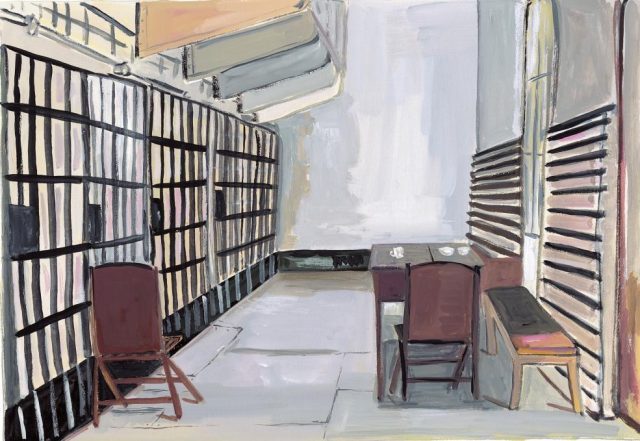
Maira Kalman, Sometimes the women were jailed for months, gouache on paper, 2018

Maira Kalman, “Sometimes the women were jailed for months,” gouache on paper, 2018 (courtesy Julie Saul Gallery)

Who: Maira Kalman
What: Book signing and exhibition
Where: Julie Saul Gallery, 535 West 22nd St. between Tenth & Eleventh Aves., sixth floor, 212-627-2410
When: Saturday, December 1, free, 3:00 -6:00
Why: Artist Maira Kalman will be at Chelsea’s Julie Saul Gallery on Saturday for the opening of her latest exhibit, “Bold & Brave,” in the project gallery, consisting of twenty-nine gouache paintings made in association with the book Bold & Brave: Ten Heroes Who Won Women the Right to Vote (Knopf, November 13, $18.99), written by Sen. Kirsten Gillibrand and illustrated by Kalman. Kalman will be signing books from 3:00 to 6:00. (She will also be signing copies of Sara Berman’s Closet, which she wrote with her son, Alex Kalman.) Among the heroes depicted in the book are Susan B. Anthony, Harriet Tubman, Alice Paul, Inez Milholland, Ida B. Wells, Mary Church Terrell, Elizabeth Cady Stanton, Sojourner Truth, Jovita Idar, and Lucy Burns. “They fought so women could be heard,” writes Gillibrand, who also pays tribute to her grandmother Dorothea “Polly” Noonan, who was recently portrayed by Edie Falco in the New Group world premiere of The True. Also on view at the gallery is Sarah Anne Johnson’s “The Cave.”

MAKING WAVES — NEW ROMANIAN CINEMA: AFERIM!

AFERIM!

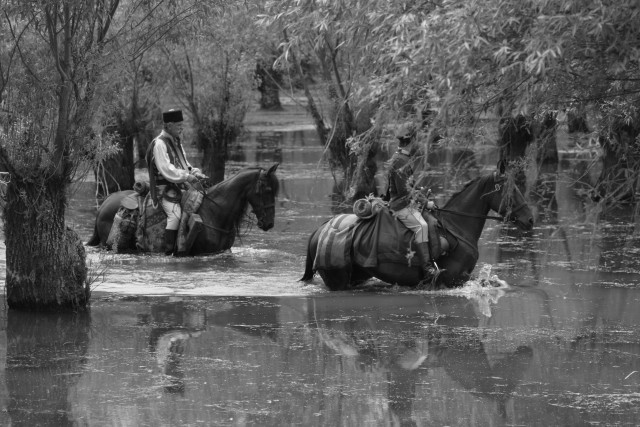
Father (Teodor Corban) and son (Mihai Comānoiu) hunt for a runaway slave in wickedly funny Aferim!

AFERIM! (Radu Jude, 2015)
BAMcinématek, BAM Rose Cinemas
30 Lafayette Ave. between Ashland Pl. & St. Felix St.
Sunday, December 2, 6:30
Series runs November 26 – December 2
718-636-4100
www.bam.org
bigworldpictures.org

BAM’s weeklong “Making Waves: New Romanian Cinema” series began November 26 with Adina Pintilie’s Golden Bear winner Touch Me Not and concludes December 2 with Radu Jude’s Silver Bear winner Aferim! Romania’s 2015 submission for the Academy Awards is a savagely funny blacker-than-black comic Western about bigotry, infidelity, and frontier justice in 1835 Wallachia. Lawkeeper Costandin (Teodor Corban) and his son, Ionitā (Mihai Comānoiu), are galloping through the local countryside, searching for runaway Gypsy slave Carfin (Cuzin Toma), who Boyar Iordache Cindescu (Alexandru Dabija) has accused of having an affair with his wife, Sultana (Mihaela Sîrbu). The surly Costandin leads the hunt, verbally cutting down everyone he meets, from random old women to abbots to fellow lawmen, with wicked barbs, calling them filthy whores, crows, and other foul names while spouting ridiculous theories about honor and religion; he even batters his son, saying he’s “a waste of bread” and that “if you slap him, he’ll die of grief.” It’s a cruel, cholera-filled time in which even the monks beat the poor and where Costandin regales a priest with the telling riddle, “Lifeless out of life, life out of lifeless,” which the priest thinks refers to the coming doomsday.

Cowritten by Jude and novelist Florin Lăzărescu (Our Special Envoy, Numbness), who previously collaborated on the short film The Tube with a Hat, and shot in gloriously stark black-and-white by Marius Panduru (12:08 East of Bucharest; Police, Adjective), the Romanian / Bulgarian / Czech coproduction is an absurdist combination of Monty Python and the Holy Grail, Andrei Tarkovsky’s Andrei Rublev, Hal Ashby’s The Last Detail, and John Ford’s The Searchers, skewering everything in its path, either overtly or under its wide-reaching breath. Even Dana Pāpāruz’s costumes are a genuine riot, especially the boyar’s majestically ridiculous hat. But Aferim! is more than just a clever parody of period films and nineteenth-century Eastern European culture and social mores; it is also a brilliant exploration of the nature of racism, discrimination, misogyny, and the aristocracy that directly relates to what’s going on around the world today as well as how Romania has dealt with its own sorry past of enslaving the Romani people. Jude was inspired by real events and historical documents, setting the film immediately after the 1834 Russian occupation, which adds to its razor-sharp observations.

Aferim! is an attempt to gaze into the past, to take a journey inside the mentalities of the beginning of the nineteenth century — all epistemological imperfections inherent to such an enterprise included,” Jude says in his director’s statement. “It is obvious that such an effort would be pointless should we not believe that this hazy past holds the explanation for certain present issues.” Aferim! is screening December 2 at 6:30, followed by a Q&A with producer Ada Solomon. The series also includes such other recent Romanian films as Monica Lãzurean-Gorgan and Andrei Gorgan’s Free Dacians, Mona Nicoară and Dana Bunescu’s The Distance Between Me and Me, and Ivana Mladenovic’s Soldiers: A Story from Ferentari in addition to Jude’s “I Do Not Care if We Go Down in History as Barbarians,” The Dead Nation, The Happiest Girl in the World, Scarred Hearts, and Everybody in Our Family.

THE COEN BROTHERS GO WEST: THE BALLAD OF BUSTER SCRUGGS

The Ballad of Buster Scruggs

Tim Blake Nelson plays the title character, a singing gunslinger, in Coen brothers’ Western anthology

THE BALLAD OF BUSTER SCRUGGS (Joel & Ethan Coen, 2018)
Museum of the Moving Image, Redstone Theater
35th Ave. at 36th St., Astoria
Thursday, November 29, $15, 7:00
Costume exhibition continues through May 26
718-777-6800
www.movingimage.us

The Coen brothers honor and subvert the Western as only they can in The Ballad of Buster Scruggs, a six-part anthology film they made for Netflix. It also was shown in two theaters for a week — making it eligible for Oscars — and is having a special screening on November 29 at the Museum of the Moving Image. Over the course of the last quarter-century, Joel and Ethan Coen wrote a handful of short movies that they thought would never get made, but they eventually decided to put them together into one omnibus film. Each segment tackles a different subgenre, involves at least one death, and begins with the turning of pages in an illustrated book, as if these are old classic Western fables, although that’s just a cinematic conceit: Only “The Gal Who Got Rattled” and “All Gold Canyon” were inspired by real works, by Stewart Edward White and Jack London, respectively.

The Ballad of Buster Scruggs

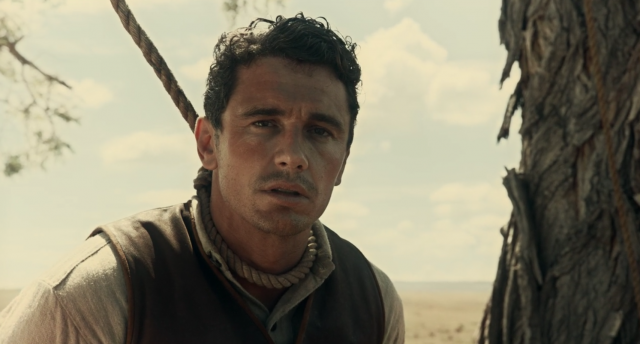
James Franco stars as a doomed bank robber in The Ballad of Buster Scruggs

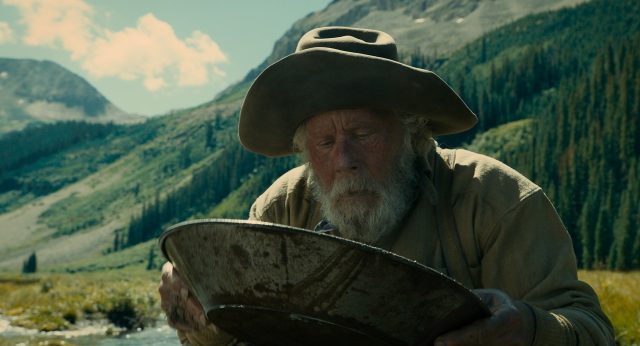
The anthology opens with the title tale, about singing cowboy Buster Scruggs (Tim Blake Nelson), who casually takes on all challengers with his remarkable shooting prowess, speaking directly into the camera as he creatively disposes of one gunslinger after another. In “Near Algodones,” a cowboy (James Franco) thinks it will be easy pickings to rob a bank in the middle of nowhere, but then he runs into a teller (Stephen Root) who is not about to surrender any cash. In “Meal Ticket,” a traveling impresario makes money by putting a limbless man (Harry Melling) on a stage on the back of his wagon, reciting Shelley’s “Ozymandias,” Lincoln’s Gettysburg Address, and other famous writings and speeches. Tom Waits is nearly unrecognizable as an old prospector in “All Gold Canyon,” panning for valuable nuggets until a young man (Sam Dillon) sneaks up on him. In “The Girl Who Got Rattled,” quiet Alice Longabaugh (Zoe Kazan) is on her way to meet a suitor chosen for her by her earnest brother, Gilbert (Jefferson Mays), accompanied by his noisy dog, President Pierce. They are part of a wagon train led by the handsome Billy Knapp (Bill Heck) and the tough-as-nails Mr. Arthur (Grainger Hines), but trouble awaits when Gilbert falls ill and an Indian appears in the distance. And finally, in “The Mortal Remains,” a grizzled old trapper (Chelcie Ross), erudite Frenchman (Saul Rubinek), and proper lady (Tyne Daly) are sharing a stage coach with a pair of bounty hunters, an Englishman (Jonjo O’Neill) and an Irishman (Brendan Gleeson), who are transporting their latest capture on the roof.

The Ballad of Buster Scruggs

A nearly unrecognizable Tom Waits is a wily old prospector in “All Gold Canyon” segment of The Ballad of Buster Scruggs

Written, directed, edited, and produced by the Coens, The Ballad of Buster Scruggs is a fabulous journey through the Old West, as the brothers play with genre tropes and stereotypes while paying tribute to John Ford, John Wayne, William A. Wellman, Gene Autry, Howard Hawks, Walter Brennan, John Huston, and many other Western stalwarts. Cinematographer Bruno Delbonnel lovingly shoots the vast landscapes and blue skies using a digital camera, a first for a Coen brothers film, while the inimitable Carter Burwell provides the period soundtrack and Mary Zophres the historically accurate, mostly handmade outfits. Despite the six different stories, the film flows together quite naturally, with the last entry a sly commentary on everything that came before it; essentially, the characters played by Rubinek, Daly, and Ross represent the audience, as the Englishman mesmerizingly describes the art of storytelling itself, something the Coen brothers have mastered yet again. (Now, if only they could fix the typo on the first page of “Meal Ticket.”)

The Museum of the Moving Image screening will be followed by a Q&A with longtime Coen brothers costume designer Zophres, moderated by MoMI senior curator Barbara Miller; it is being held in conjunction with the new exhibition “The Coen Brothers Go West: Costume Design for The Ballad of Buster Scruggs.” The display, which consists of sixteen costumes (including the fab one worn by Nelson and the protective one donned by Root), ten costume boards, and several hairpieces, will be open after the MoMI screening. For more Coen magic, IFC Center’s “Weekend Classics” series continues on Friday, Saturday, and Sunday mornings at eleven with The Big Lebowski (November 23-25), O Brother, Where Art Thou? (November 30 – December 2), No Country for Old Men (December 7-9), True Grit (December 14-16), The Hudsucker Proxy (December 21-23), and Inside Llewyn Davis (December 28-30).

THE CONTENDERS 2018: BLACKkKLANSMAN

BlacKkKlansman

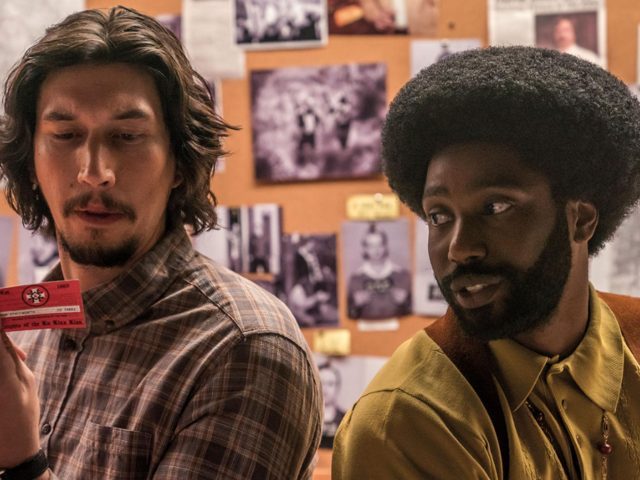
Detectives Flip Zimmerman (Adam Driver) and Ron Stallworth (John David Washington) go undercover to infiltrate the KKK in Spike Lee’s BlacKkKlansman

BLACKkKLANSMAN (Spike Lee, 2018)
MoMA Film, Museum of Modern Art
11 West 53rd St. between Fifth & Sixth Aves.
Sunday, November 25, 2:00
Series runs through January 8
212-708-9400
www.moma.org
www.focusfeatures.com

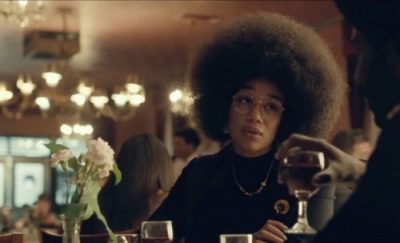
BlacKkKlansman is Spike Lee’s best fiction film since 1989’s Do the Right Thing, a comic thriller inspired by the real-life story of Ron Stallworth (John David Washington), a Colorado cop who went undercover with the KKK. “Dis joint is based upon some fo’ real, fo’ real sh*t,” the movie announces at the start. Stallworth, wearing an impressive natural afro, is hired by Chief Bridges (Robert John Burke) to diversify the force. When the police hear that Black Power activist Stokely Carmichael, now using the name Kwame Ture (Corey Hawkins), will be speaking at an event sponsored by the Colorado College Black Student Union, the chief and Sergeant Trapp (Ken Garito) send Stallworth in to scout out the situation. There he meets Patrice Dumas (Laura Harrier), a dedicated activist fighting the racist system, with a particular dislike for cops. Seeing an ad for the KKK in the local paper, Stallworth proposes to his bosses that he infiltrate the secretive organization, and they come up with a plan in which Stallworth will gain intelligence over the phone, speaking with local KKK leaders. The only problem is that Stallworth, in a major rookie mistake, used his real name when first talking to Walter Breachway (Ryan Eggold), which complicates the operation. But they proceed, as Detective Flip Zimmerman (Adam Driver) insinuates himself into the group in person, applying for membership and trying to find out about any future marches, cross burnings, or other attacks, gaining the trust of the straightforward Breachway and the goofy Ivanhoe (Paul Walter Hauser), while the nasty Felix Kendrickson (Jasper Pääkkönen) quickly grows suspicious of him. In the meantime, Stallworth develops a phone friendship with Grand Wizard David Duke (Topher Grace) and begins dating Dumas, while Kendrickson’s wife, Connie (Ashlie Atkinson), desperately wants to prove her racism by participating in the KKK’s schemes — which are explicitly limited to “white Christian men.”

Patrice Dumas (Laura Harrier) fights for justice in

Patrice Dumas (Laura Harrier) fights for justice in Spike Lee’s BlacKkKlansman

Written by Charlie Wachtel, David Rabinowitz, Kevin Willmott, and Lee, BlacKkKlansman takes plenty of liberties with the facts — for example, Stallworth has never identified his white partner, Dumas is a fictional character (although based on Angela Davis and Kathleen Cleaver), and the time shifts a few years ahead — but the heart and soul of the story is true, and Lee captures it with gusto. The film is wickedly funny and frighteningly realistic, all too relevant to today’s rising racist hatred around the world. As Dumas teaches Stallworth about his responsibility to the black race, Stallworth does the same with Zimmerman about his Jewishness. “Why you acting like you don’t have skin in the game?” Stallworth asks him. Photographed by Chayse Irvin and edited by Barry Alexander Brown, BlacKkKlansman is also one of Lee’s best-looking, most-accomplished films, featuring a terrific score by Terence Blanchard along with songs by such diverse musicians as James Brown, Prince, the Edwin Hawkins Singers, Looking Glass, and Emerson, Lake & Palmer. Washington — who played a student in Lee’s Malcolm X, starring his father, Denzel Washington — and Driver have a great chemistry that propels the film, which was released on the first anniversary of the Unite the Right white supremacist rally in Charlottesville.

Several lines of dialogue specifically evoke what his happening in America today, and Lee seals the deal with a finale that includes footage of Duke and President Trump refusing to condemn what went down in Virginia on August 12, 2017. (He also has Trump impersonator Alec Baldwin play a not-too-bright white supremacist; actually, none of the racists is endowed with much intelligence.) As is his trademark, Lee pulls no punches; especially effective is how he switches between Jerome Turner (Harry Belafonte) relating the true story of the lynching of Jesse Washington and the Klansmen watching D. W. Griffith’s Birth of a Nation. Because, of course, we all have a skin in this game. BlacKkKlansman is screening November 25 at 2:00 in MoMA’s annual series “The Contenders,” consisting of works the museum believes will last the test of time, which continues through January 8 with such other 2018 films as Morgan Neville’s Won’t You Be My Neighbor? (followed by a discussion with Neville and producer Nicholas Ma), Paul Dano’s Wildlife (followed by a discussion with Dano, cowriter Zoe Kazan, and actors Carey Mulligan and Jake Gyllenhaal), Paul Schrader’s First Reformed (followed by a discussion with Shrader and Ethan Hawke), and John Krasinski’s A Quiet Place (followed by a discussion with Krasinski).

GLORIA: A LIFE

(photo by Joan Marcus)

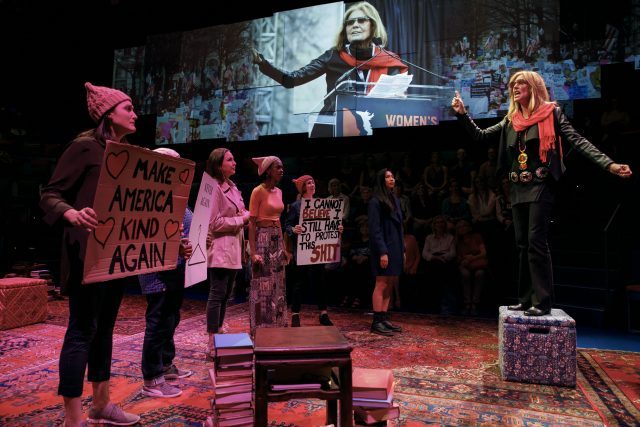
Christine Lahti portrays feminist icon Gloria Steinem in world premiere production at the Daryl Roth Theatre (photo by Joan Marcus)

Daryl Roth Theatre
103 East 15th St. between Irving Pl. & Park Ave.
Saturday – Tuesday through March 31, $55-$150
gloriatheplay.com

Gloria: A Life is being billed as a play about feminist icon Gloria Steinem, but that’s not completely accurate; it’s really more of an illustrated lecture/performance than a truly dramatic narrative, a relatively chronological recap of her life and career. Told by Oscar, Emmy, and Obie winner Christine Lahti as Steinem, complete with aviator sunglasses, bell-bottoms, and long brown hair, the story evolves as a diverse group of six women take on multiple roles. Tony-nominated writer Emily Mann (Having Our Say, Execution of Justice) and Tony-winning director Diane Paulus (The Gershwins’ Porgy and Bess, All the Way) capture Steinem’s greatest hits, from her early days in journalism, including her breakthrough Playboy bunny exposé, her New York magazine story on abortion, and the harsh misogyny she encountered, to her founding of Ms., her participation in the 2017 Women’s March, and her unfortunately brief marriage to David Bale. Lahti stays primarily in the center of Amy Rubin’s comfy theater-in-the-round set, which features rows of benches, each seat with its own brightly colored pillow back. Actresses Joanna Glushak, Fedna Jacquet, Francesca Fernandez McKenzie, Patrena Murray, DeLanna Studi, and Liz Wisan portray various Steinem friends and enemies, colleagues, and family members, including Coretta Scott King, Bella Abzug, Wilma Mankiller, Florynce Kennedy, Dorothy Pitman Hughes, and Steinem’s mother.

(photo by Joan Marcus)

Christine Lahti is joined by a cast of diverse actresses in Gloria: A Life (photo by Joan Marcus)

Archival footage of Steinem is projected onto two walls of the theater, along with occasional live video of what’s happening onstage, primarily re-creations of actual interviews. It’s all fairly straightforward and lacking any real conflict; Lahti does not attempt to completely transform herself into Steinem — for example, she uses her real speaking voice and doesn’t change costumes or hairstyle to match the passing years — while the other actresses’ portrayals tend to be underwhelming or over the top. But the show is hard not to like as Steinem, now eighty-four and the author of such books as Outrageous Acts and Everyday Rebellions and My Life on the Road, is a captivating figure and Lahti, sixteen years younger and the author of the new essay collection True Stories from an Unreliable Eyewitness: A Feminist Coming of Age, which features advance praise on the back cover from Steinem, is utterly charming as our host.

After ninety minutes, Gloria changes direction and turns into a Talking Circle where the audience in invited to participate in a discussion about the play, Steinem, or other issues related to feminism and the world today. A sign announces, “Lead with love. Low ego. High impact. Move at the speed of trust.” The night I went, Lahti moderated the conversation, but there are often special guests, such as Lena Dunham, Christiane Amanpour, Julie Menin, show consultant Kathy Najimy, Letty Cottin Pogrebin, and Steinem herself. It was a fascinating exchange of ideas about the absence of African American women in second-wave feminism, the decision to not mention Betty Friedan in the play, how the vast majority of the crew and producers are women, and the impact of current activist movements. Among those in the audience were Melissa Silverstein, cofounder and producing director of the Athena Film Festival at Barnard, New York City political stalwart Ruth Messinger, and a woman who once worked for Steinem, a self-described hope-aholic who, after all these years, still believes every one of us can make a difference.

BILL SHANNON: TOUCH UPDATE

(photo courtesy Kelly-Strayhorn)

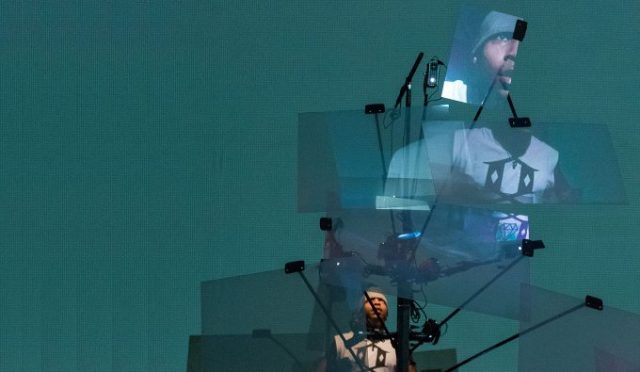
Bill Shannon’s multidisciplinary Touch Update will be presented at New York Live Arts this week (photo courtesy Kelly Strayhorn Theater)

New York Live Arts
219 West 19th St. between Seventh & Eighth Aves.
November 14-17, $15-$20, 7:30
212-924-0077
newyorklivearts.org
www.whatiswhat.com

Extraordinary multidisciplinary artist Bill Shannon brings his latest project, the multimedia Touch Update, to New York Live Arts this week, accompanied by special programs. Shannon is best known for his performances and unique technique using crutches, as he was born with a degenerative hip condition. But that hasn’t stopped Shannon from skateboarding through the Financial District, moving through Duarte Square and Governors Island, and appearing at the Maker Faire in Queens. Over the years, he has been adding cutting-edge technology to his performances and installations, culminating in Touch Update, which incorporates dance, theater, prerecorded and live video, and a cubist mask onto which images are projected; Shannon met with neuroscientists to get everything just right. “It’s built around basic philosophical questions about humanity: Can people change?” he says in an online promo piece in which he also calls the show “a response to the filter of social and digital media and how humans interact.” The seventy-minute work, which was developed at a residency at the Kelly Strayhorn Theater in Pittsburgh, includes reverse engineering of the Shannon Technique for those who do not require crutches and will be performed by Raphael Botelho Nepomuceno, Ron Chunn Jr., Teena Marie Custer, Anna Thompson and Taylor Knight of slowdanger, Jacquea Mae, Cornelius Henke, and David Whitewolf. The November 15 show will be followed by a Stay Late Conversation moderated by Jennifer Edwards; there will also be a Reverse Engineering Workshop ($15) on November 17 at 1:00 and a lecture, “The Condition Arriving” ($10, $5 with ticket), the same day at 5:00.

SHOAH: FOUR SISTERS / THE LAST OF THE UNJUST

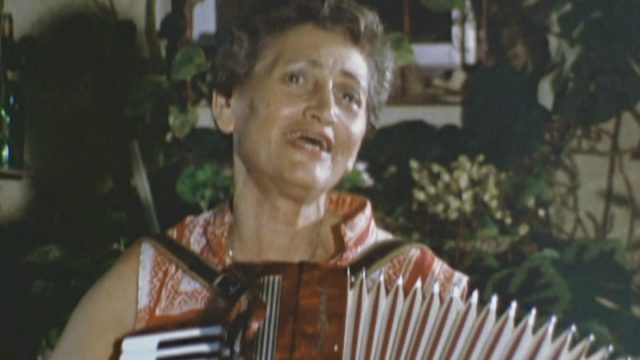
Holocaust survivor Ruth Elias tells her amazing story to Claude Lanzmann — and sings — in The Hippocratic Oath

Holocaust survivor Ruth Elias tells her amazing story to Claude Lanzmann — and sings — in The Hippocratic Oath

CLAUDE LANZMANN’S FOUR SISTERS (Claude Lanzmann, 2017)
Quad Cinema
34 West 13th St. between Fifth & Sixth Aves.
Opens Wednesday, November 14
212-255-2243
quadcinema.com
cohenmedia.net

“You are very well informed,” Holocaust survivor Ruth Elias tells filmmaker Claude Lanzmann in The Four Sisters: The Hippocratic Oath. Thanks to the Paris-born Lanzmann, a French resistance fighter during WWII, we are all very well informed about so many of the atrocities perpetrated by the Nazis, told to him in moving, powerful stories by “living witnesses” for decades. In The Four Sisters, which made its world premiere at the New York Film Festival in October, the Shoah director, who passed away in July at the age of ninety-two, focuses on the extraordinary experiences of four strong women who survived concentration camps, each one originally interviewed for Shoah. “The more I thought about these four women, the more the necessity to bring the spotlight on these female faces of the Shoah seemed important,” Lanzmann explains in his director’s note about deciding to turn them into four separate portraits. “Each of them deals with a little-known chapter of the Holocaust, each from a unique point of view. . . . The incredible strength in each of them has to exist in its own right, and yet the exceptional quality they all share also had to come through — that searingly sharp, almost physical intelligence, and an irrepressible survival instinct which could not be extinguished, despite an apparently certain death awaiting them.” The four-part film is being told in two parts at the Quad beginning November 14, Hanna & Paula and Ruth & Ada.
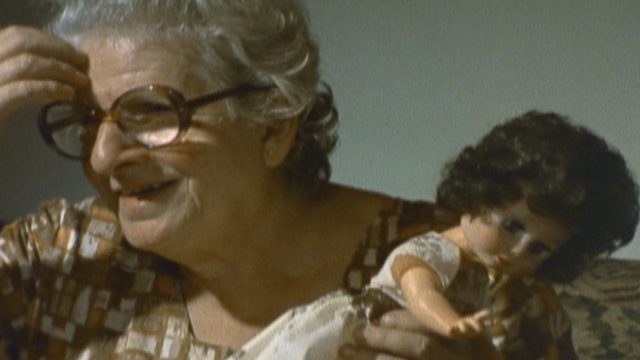
Ada Lichtman details her time in Sobibór in The Merry Flea

Ada Lichtman details her time in Sobibór in The Merry Flea

In The Hippocratic Oath, Ruth Elias tells her remarkable story from the Nazi occupation of Czechoslovakia in March 1939 to her deportation in April 1942 to Theresienstadt, where she was reunited with and married her boyfriend, to her pregnancy in the winter of 1943, which led to her being sent to Ravensbrück and Auschwitz, where she met Dr. Josef Mengele, who chose to use her baby in an inhuman experiment. Filmed in a little garden, Elias, an accordion player, is firm and direct as she shares the details of precisely what happened, her dark eyes seemingly sent back to Eastern Europe as her words bring it all to vivid life; one can visualize each location, each movement, each glance. The camera occasionally turns to Lanzmann, smoking a cigarette as he listens to her, mesmerized, just as the audience is. Lanzmann is more active in Baluty, walking along the shore in Panama City, Florida, with Paula Biren, whose story begins in Lodz, Poland. An elegant woman, Biren needs a little more prodding to speak, which she does very carefully, with a brutally cold honesty. She describes how Lodz was turned into a ghetto, how she became a police officer there, and then was sent to Auschwitz, where her younger sister and mother were killed, followed by her father’s death shortly thereafter. Lanzmann supplements the film with archival photographs of Lodz. Throughout The Merry Flea, Ada Lichtman is cleaning and mending dolls; it is eerie as viewers eventually find out why. Lichtman, from the Polish town of Wieliczka, relates her story of being captured by the Germans and sent to Sobibór, speaking at a determined, almost eager pace, sometimes skipping around so that Lanzmann has to interject to get her back on track or to go into more specifics, particularly regarding her treatment at the hands of a Nazi officer named Wagner and her description of cattle cars where naked men, women, and children were forced to dance with one another. The camera occasionally shifts to her husband, who she met in the camps; he stares ahead almost blankly, with hollow, haunted eyes, then hides his head in his hands. The sound of traffic outside can be heard, as if coming from another time and place.
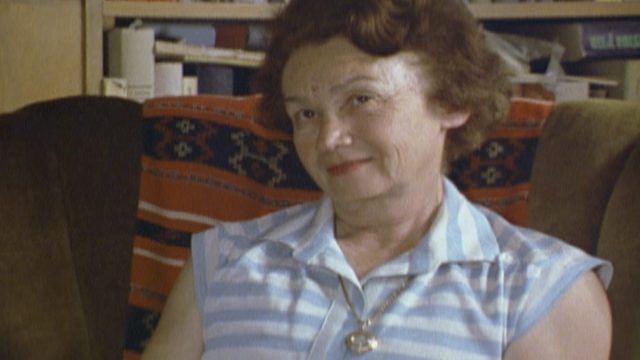
Hanna Marton has a frightening tale to tell Claude Lanzmann in Noah’s Ark

Hanna Marton has a frightening tale to tell Claude Lanzmann in Noah’s Ark

Finally, in Noah’s Ark, Lanzmann introduces Hungarian native Hanna Marton, who sits calmly in a chair, holding a small notebook as she speaks in Hebrew, the director sitting right in front of her, nearly knocking knees; in the film’s production notes, Lanzmann explains, “I’ve never heard an account that is as constantly, relentlessly painful as the one that Hanna Marton gave me when I filmed her during the shoot for Shoah in her Jerusalem apartment.” Her eyes sometimes tearing up, Marton, continually on edge and at times defensive, talks about the early Zionist movement in her hometown of Cluj, the capital of Transylvania; discusses how Jews were used by the Hungarian army, which supported Germany and Italy, as living mine detectors; details the creation of the Kolozsvár ghetto in May 1944 as a way to quickly exterminate Jews; and delves into her involvement with the Kastner train, a deal made between Jewish-Hungarian lawyer Rudolf Kastner and Nazi Obersturmbannführer Adolph Eichmann. The Four Sisters is no mere addendum to Shoah, nor is it a footnote to Lanzmann’s long, important career; together, the four films make a powerful statement about hatred and bigotry, about violence and war, and about the indomitable strength and spirit of women, especially during the war and its aftermath. They are also a terrifying reminder that given the state of the world today, it’s not impossible that something like this could happen again, even right here in America, as there are fewer and fewer concentration-camp eyewitnesses, Holocaust deniers litter the internet, nations build walls and fences to keep out refugees, and a sitting president insists that some white supremacists are “very fine people.”
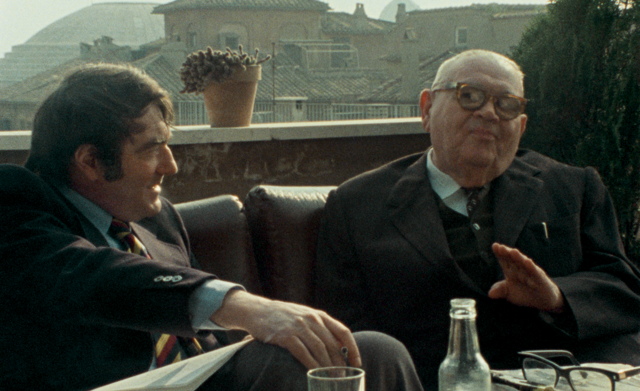
Claude Lanzmann and Benjamin Murmelstein discuss the Holocaust in revealing documentary

Claude Lanzmann and Benjamin Murmelstein discuss the Holocaust in revealing documentary

THE LAST OF THE UNJUST (LE DERNIER DES INJUSTES) (Claude Lanzmann, 2013)
Quad Cinema
34 West 13th St. between Fifth & Sixth Aves.
Wednesday, November 14, 6:35, and Monday, November 19, 6:35
212-255-2243
quadcinema.com
www.cohenmedia.net

For more than forty years, late French filmmaker Claude Lanzmann documented the Holocaust and the birth of the state of Israel in such provocative and powerful films as Israel, Why; Sobibór, October 14, 1943, 4 p.m.; and his nine-and-a-half-hour masterpiece, Shoah. In 1997, he made A Visitor from the Living, built around a 1979 interview with International Red Cross worker Maurice Rossel, who led a delegation inspecting the Nazis’ so-called “model ghetto” of Theresienstadt, which turned out to be a glorified concentration camp. Lanzmann returns to the Czech camp in The Last of the Unjust, an utterly fascinating 218-minute documentary consisting of a series of interviews he conducted in Rome in 1975 with Rabbi Benjamin Murmelstein, the only Jewish Elder to survive the Holocaust. For years, Murmelstein, who was appointed directly by and reported to Obersturmbannführer Adolph Eichmann, has been declared a Nazi collaborator, by writer Hannah Arendt and many others, even being arrested, imprisoned, and tried by Czech authorities. But in The Last of the Unjust, he paints a vivid portrait of everyday life in Theresienstadt, claiming he was not a collaborator but instead was doing whatever he could to improve conditions for the Jews there.
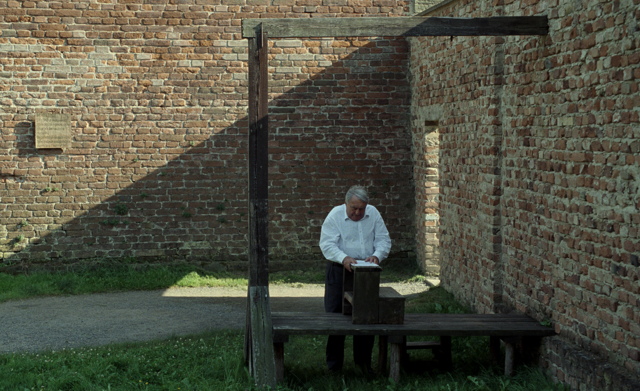
Claude Lanzmann

Claude Lanzmann visits Theresienstadt in film about the model ghetto’s last Jewish Elder

He poignantly describes not knowing about gas chambers and trains to Auschwitz and proudly defends his actions, referring to himself as the “last of the unjust.” Murmelstein has a spectacular memory, vividly recalling specific moments, answering all of Lanzmann’s questions with a bold honesty and correcting long-held misbeliefs concerning Theresienstadt. A cool, cigarette-smoking Lanzmann is seen in the old interviews and he also appears in new footage shot as he visits the camp and other relevant locations, geographically linking the past and the present. Between Murmelstein’s amazing storytelling ability and Lanzmann’s sharing of his personal perspective, the film never gets boring or repetitive over the course of its three-and-a-half-hour length. In the written introduction, Lanzmann states, “It took me a long time to come to the realization that I didn’t have the right to keep this to myself.” He indeed did a great service by not keeping this to himself, making yet another poignant document of the Holocaust as seen through the eyes of a unique and thoroughly intriguing witness. The Last of the Unjust is screening at the Quad on November 14 and 19 at 6:35 (the November 14 show will be introduced by Lanzmann assistant Laura Koeppel) as part of the “Claude Lanzmann’s Cinema of Remembrance” series, which continues through November 21 with such other works as Napalm; Sobibór, October 14, 1943, 4 p.m.; Israel, Why; A Visitor from the Living and The Karski Report; Shoah in two sections; and Tsahal.