this week in lectures, signings, panel discussions, workshops, and Q&As

LOCKDOWN

(photo by Sandra Coudert)

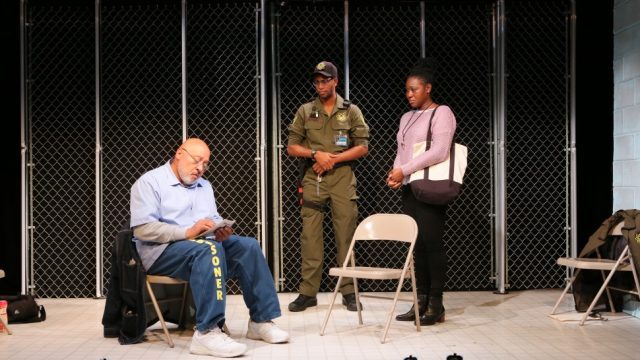
C.O. McHenry (Eric Berryman) and Ernie (Zenzi Williams) wait for Wise (Keith Randolph Smith) in Lockdown (photo by Sandra Coudert)

Rattlestick Playwrights Theater
224 Waverly Pl. between Eleventh & Perry Sts.
Through May 19, $46-$61
866-811-4111
www.rattlestick.org

Cori Thomas’s Lockdown is a social justice story with a critical message that overwhelms the potent drama at its well-meaning heart, resulting in a didactic narrative that feels more educational than entertaining. The plot is torn from the headlines, evoking the current case of Judith Clark, a former Weather Underground activist who was convicted of murder in 1981 for her part in a robbery in which two security guards and two policemen were killed. Clark was sentenced to seventy-five years, but she turned her life around in prison and was released this month for good behavior, against loud and angry opposition. In Lockdown, which continues at Rattlestick through May 19, the longtime prisoner is the fictional James “Hakeem” Jamerson (Keith Randolph Smith), better known as Wise, who has been incarcerated for forty-six years, since the age of sixteen. Young writer Ernie Morris (Zenzi Williams) is volunteering at the prison and has been assigned to Wise, who is making the most of his time, earning a degree and mentoring fellow inmates. “I started a program in here to help the men understand that they don’t need to keep coming in and out and in and out of here. I’m trying to prevent as many as possible from becoming one more black man living they entire life in prison,” he tells Ernie.

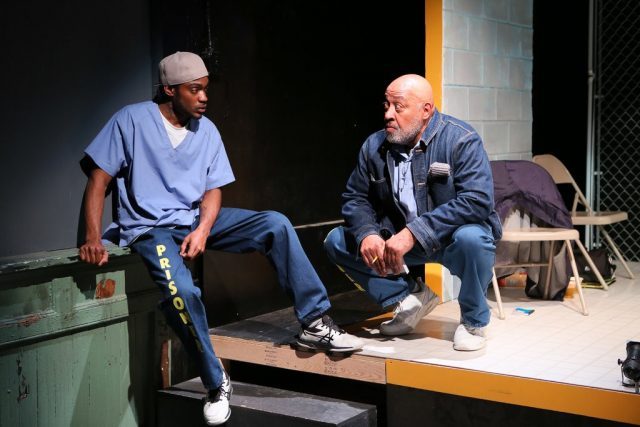
Wise and Ernie meet regularly and form a bond, under the watchful eyes of C.O. McHenry (Eric Berryman), who makes sure that they follow the rules, commanding her, “Do not engage in any intimate form of physical contact with any of the inmates. Displays of affection are not allowed! For instance, hugging. Hugging will be cause for immediate termination of your volunteering activities. Overfamiliarity is not permitted. It will not be tolerated!” Meanwhile, Wise is having trouble getting through to young fellow prisoner Clue (Curt Morlaye), a rapper who believes the system is rigged. “Sitting here wishin i could climb this barb wire / Sippin on some pruno, maa-an, that shit is fire! / Scapin’ from living a life of non-sense / Life doing time now add up to no-sense / Doing time has got me feeling age-less / ’Cause in my head it’s all bout bein cage-less / Lil bro say he learnin from big bro / Pointing ya .38 aint the same thing though,” he rails.
(photo by Sandra Coudert)

Clue (Curt Morlaye) and Wise (Keith Randolph Smith) deal with life behind bars in world premiere at Rattlestick (photo by Sandra Coudert)

Thomas (Citizens Market, When January Feels Like Summer) and director Kent Gash (Barbecue, Langston in Harlem) wear their hearts on their sleeves as they push humane rehabilitation over inhumane incarceration and questionable parole regulations, never missing a chance to score political points that stop the action in its tracks. “Somebody should expose how unfair the process is,” Wise says about facing the parole board. “Writers always coming in here wanting to write about death row. How come nobody never want to write about somebody like me? I wish people on the outside could see us as individuals, ’cause then they might want to write about us.” Thomas was inspired to write the play after visiting San Quentin for a possible podcast and meeting an inmate named Lonnie Morris, an activist and role model who asked Thomas if she would help him with a play he was writing; Thomas quickly scrapped a play she was working on (about death row) and began Lockdown.

The talented cast of Berryman (The B-Side: Negro Folklore from Texas State Prisons, A Record Album Interpretation), Morlaye (Gotham, Blue Bloods), Smith (Jitney, Paradise Blue), and Williams (Henry V, School Girls; or, the Mean African Girls Play) is hampered by the play’s overstated and repetitive reform agenda. Thomas did extensive research in prisons, running all the scenes past incarcerated men and corrections officers, and it feels that way, as if any tension is a means to an end as opposed to an evolving, involving story as characters preach to the converted on Jason Sherwood’s effective, caged-in set. The message is also sent in the opening music, San Quentin inmate David Jassy’s “Freedom.” Each performance is followed by a community talkback, and the production has partnered with such organizations as Drama Club, the Fortune Society, NYC Together, Pen America, Project Liberation, and RTA (Rehabilitation Through the Arts). Lockdown has a lot of important things to say about how the system treats prisoners, particularly men of color, but it includes too many teaching moments instead of trusting the audience to get the point in a less dogmatic way.
DELANYMANIA

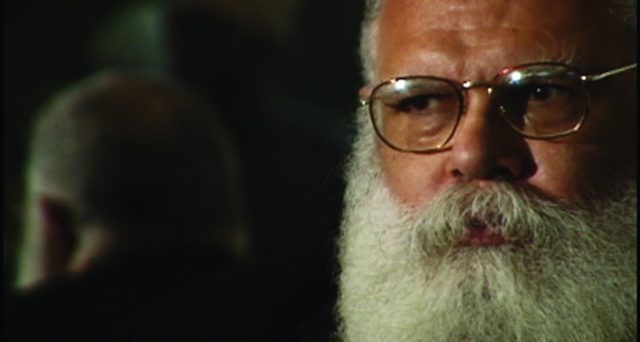
Samuel R. Delany will be at Metrograph for a pair of special programs

Samuel R. Delany will be at Metrograph for a pair of special programs

Metrograph
7 Ludlow St. between Canal & Hester Sts.
May 17-19
212-660-0312
metrograph.com
www.samueldelany.com

In Fred Barney Taylor’s 2009 documentary The Polymath, about writer, filmmaker, and social historian Samuel R. “Chip” Delany, Jonathan Lethem explains, “He embraces the whole of intellectual curiosity while remaining committed to an artistic practice. He’s a philosophical, confessional, and fictional genius. How often is this encountered in American literature? I don’t know that there’s any precedent. Geniuses are usually monomaniacs; they do one thing to the utmost. Well, Chip does several things to the utmost.” Metrograph is honoring the seventy-seven-year-old Delany’s life and career with the three-day series “Delanymania,” featuring films by and about him or that made an impact on him. “They’re films I liked early, and they contributed to my own appreciation of science fiction, films, and writing (This Island Earth), and an appreciation of the cost of difference (The Boy with Green Hair, Touch of Evil), and what I wanted to do with the movement of bodies in The Orchid (Gold Diggers of 1937, The Seventh Seal),” he notes about the program. Delany, a New York City native and the author of such science-fiction tomes as Dhalgren and Babel-17, will be at Metrograph for several screenings, introducing shows and participating in Q&As for The Polymath with Taylor on May 17 at 6:00 and for “3 Films by Samuel R. Delany” on May 18 at 3:30. The latter consists of his only film as a director, the controversial 1971 experimental work The Orchid, and two extremely low-budget DIY shorts by his then-partner, Frank Romeo, Bye, Bye Love and The Aunts.

The Orchid

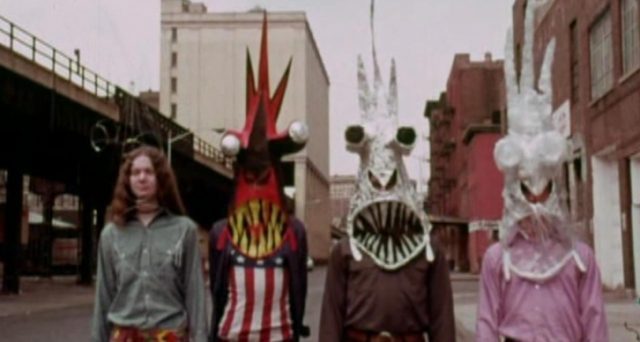
Metrograph will show Samuel R. Delany’s only film as a director, The Orchid

The Orchid is Delany’s Un Chien Andalou, a bizarre, surreal, delightfully amateurish tale of a businessman with a thing for protractors and other basic mathematical equipment who has strange encounters on the streets of New York City with a little boy, a man carrying a microphone, and members of a cultlike group than don bizarre masks, take off their clothes, and take part in odd rituals. Produced by Barbara Wise, the film features a playful score by John Herbert McDowell; Adolfas Mekas, brother of Jonas, was the production coordinator. Writing as K. Leslie Steiner, Delany opined that when the film “primiered [sic] at the World Science Fiction Convention in Chicago that September (Delany himself was not present), it caused a riot. Outraged fans tried to shout the film off and even pulled down the screen.” Chip Delany is credited as script boy for Bye, Bye Love, in which two brothers (Frank De Fay and Martin Zone) from upstate head to the Big Apple to become famous by recording their version of the Everly Brothers classic “Bye Bye Love,” and The Aunts, in which a group of women (Cass Morgan, Katie McDonough, Mayda Sharrow, and Pat Tortorici) gossip away in a small kitchen as a young girl (Jocelyn Mason) listens in from her bedroom. Delany’s father was an undertaker and his mother was a library clerk, which explains a lot. In conjunction with “Delanymania” and other cinematic literary events, Metrograph is hosting a Spring Film Book Fair on May 18 and 19 from 11:00 to 6:00, promising “thousands of rare, vintage, and out of print items, including biographies, monographs, hundreds of periodicals, plus memorabilia, scripts, novelizations, and other extraordinary pieces of ephemera.”

INTERNATIONAL DAY OF LIGHT 2019

international day of light

Multiple venues
Thursday, May 16, free
www.lightday.org

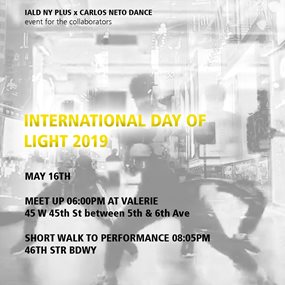
Every May 16, UNESCO’s International Day of Light is celebrated around the world, “a global initiative that provides an annual focal point for the continued appreciation of light and the role it plays in science, culture and art, education, and sustainable development, and in fields as diverse as medicine, communications, and energy.” There are several events here in New York City, all free. “Art of Light” at the HoloCenter at 352 Canal St. is hosting film screenings and discussion, held in conjunction with the exhibition “Iridescence,” comprising art holograms by Michael Bleyenberg, =Lana Blum, Philippe Boissonnet, Patrick Boyd, Betsy Connors, Pascal Gauchet, Setsuko Ishii, Sam Moree, August Muth, Ray Park, and Fred Unterseher; among the participants are Max Clarke, Eric Leiser, Lindsay Packer, Matthew Schreiber, and Moree, with a showing of Ikuo Nakamura’s 3D Gentle Storm, images of the Aurora Borealis under a G2 magnetic storm, with music by flutist Hayes Greenfield. Appropriately for the International Day of Light, there will be a Flash Mob in Times Square, a live pop-up installation choreographed by Carlos Neto and with cinematography by Jayna Maslechko; if you want to join in, meet up at 6:00 at Valerie at 45 West 45th St.; the event takes place at 8:05 at 47th St. and Broadway. Let there be light!

Harlem EatUp!

Dine+In+Marcus,+JJ,+Alex+and+Michael

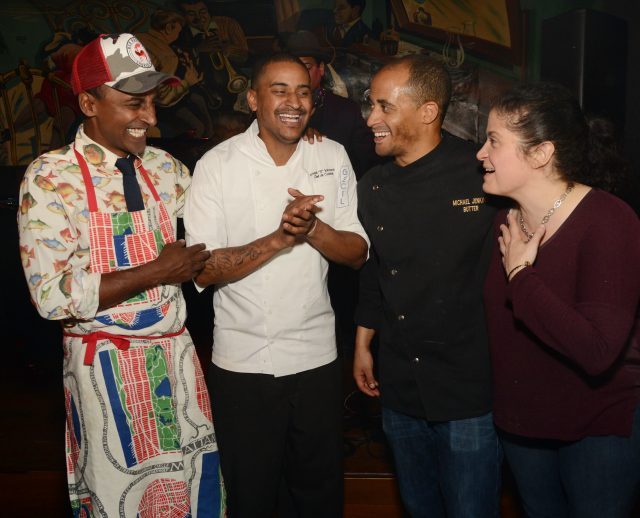
Chefs Marcus Samuelsson and JJ Johnson (left) return for the fifth annual Harlem EatUp! Festival (photo courtesy Harlem EatUp!)

Multiple locations in Harlem
May 13-19, free – $250
harlemeatup.com

The fifth annual Harlem EatUp! Festival takes place May 13-19, with dozens of chefs, restaurants, culinary organizations, mixmasters, and artists participating in tastings, dinners, concerts, and more celebrating Harlem culture, hosted by Bevy Smith. Below are only some of the special events happening uptown, with part of the proceeds benefiting Citymeals on Wheels, Historic Harlem Parks, and Harlem Park to Park.

Monday, May 13
Dine in Harlem: BLVD Bistro, hosted by owner Carlos Swepson and guest chef Leah Cohen, $135, 7:00

Tuesday, May 14
Dine in Harlem: FieldTrip, hosted by chef JJ Johnson and guest chef Marc Vetri, $85, 7:00

Wednesday, May 16
Dine in Harlem: Melba’s Restaurant, with owner Melba Wilson and guest chef Jerome Grant and DJ Nas Leber, $100, 7:00

Thursday, May 16
The Harlem EatUp! Annual Luminary Award Dinner, honoring Lana Turner and David N. Dinkins, hosted by chef Marcus Samuelsson and guest chefs Mashama Bailey of the Grey and Emma Bengtsson of Aquavit, Neil Patrick Harris and David Burtka, Mac McDonald of Vision Cellars, and Andre Mack of Maison Noir, with live music by the Rakiem Walker Project, Red Rooster Harlem, $250, 6:30

Saturday, May 18
The EatUp! Main Stage at the Harlem Stroll, with culinary demonstrations and live performances, Morningside Park, free, 12:30 – 5:30

Ultimate Grand Tasting at the Harlem Stroll, featuring participants Alvin Lee Smalls of Lee Lee’s Bakery, Alyah Horsford-Sidberr of Cove Lounge, Angel Grande of Nocciola Ristorante, Antonio Settepani of Settepani, Ashley Dikos and Andrew Martinez of Bo’s Bagels, Carlos Salazar of Rincón Mexicano, Carlos Swepson of BLVD Bistro, Cédric Durand of Tastings Social presents GAUDir, Cédric Durand of Charles’ Country Pan Fried Chicken, Drunken Fruit, Giannina Gutierrez, Harlem Haberdashery, Camaron Fagan of Harlem Tavern, Humberto Guallpa of Row House, Jake Timmons of Dinosaur Bar-B-Que, Jamaica Tourism Board, Norma Jean Darden of Miss Mamie’s Spoonbread, Jelena Pasic of Harlem Shake, Jessica Spaulding of Harlem Chocolate Factory, Juliet and Justine Masters of the Edge Harlem, Lara Land, Lexis Gonzalez and Dr. Sharon Gonzalez of Lady Lexis Sweets, Leticia “Skai” Young and Raymond Zamanta Mohan of LoLo’s Seafood Shack, Marcus Samuelsson of Red Rooster Harlem/Ginny’s Supper Club, Matthew Trebek & Nodar Mosiashvili of OSO Harlem, Milton Washington, Melba Wilson of Melba’s Restaurant, Nick Larsen and Petrushka Bazin Larsen of Sugar Hill Creamery, Nocciola, RanDe Rogers of Sisters Caribbean Cuisine, Raymond Weber of CUT by Wolfgang Puck, and Zach Sharaga and Samantha Phillips of Dear Mama, adults only, Morningside Park, $85, 12:30 – 5:30

Saturday, May 18
and
Sunday, May 19

The Marketplace at the Harlem Stroll, with more than two dozen food vendors, a kids’ zone, demonstrations, live performances, and more, Morningside Park, free, 12:30 – 5:30

Sunday, May 19
The EatUp! Main Stage at the Harlem Stroll, with DJ Stormin’ Norman, David Burtka, JJ Johnson of FieldTrip/Henry by JJ, Marcus Samuelsson, Neil Patrick Harris, Scott Conant of Cellaio Steak, Karl Franz Williams of Solomon & Kuff Rum Hall, Charles Gabriel of Charles’ Country Pan Fried Chicken, Johnny Mambo & Friends, Vy Higginson’s Sing Harlem Choir, and more, Morningside Park, free, 12:30 – 5:30

Ultimate Grand Tasting at the Harlem Stroll, featuring participants Aliyyah Baylor of Make My Cake, Amie Kiros of Piatto d’Oro, Andrew LoPresto of Bar314, Antonio Settepani of Settepani, Aromas Boutique Bakery, Camaron Fagan of Harlem Tavern, Carlos Salazar of Rincón Mexicano, Carlos Swepson of BLVD Bistro, Chris Pollok of Bier International, Davie Simmons of Uptown Veg & Juice Bar, Dear Mama, Drunken Fruit, Greedy Pot, Harlem Haberdashery, Humberto Guallpa of Row House, Jamaica Tourism Board, Jessica Spaulding of Harlem Chocolate Factory, Julian Medina of La Chula Harlem, Kenichi Tajima of Tastings Social presents Mountain Bird, Lara Land, Leon Johnson, Lexis Gonzalez and Dr. Sharon Gonzalez of Lady Lexis Sweets, Lloyd’s Carrot Cake, Betty Campbell-Adams of Maison Harlem, Marcus Samuelsson of Red Rooster Harlem/Ginny’s Supper Club, Mark Rosati of Shake Shack, Neca Bryan of Kingston Restaurant & Bar, Norma Jean Darden of Miss Mamie’s Spoonbread, RanDe Rogers of Sisters Caribbean Cuisine, Yohey Horishita, and Zachary Gelnaw-Rubin of Lion Lion, adults only, Morningside Park, $85, 12:30 – 5:30

COMPASSIONATE ACTION: THE HEALING POWER OF TELLING YOUR STORY

Lisa Weinert

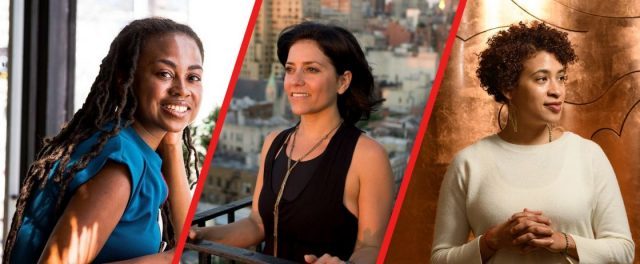
Jamia Wilson, Lisa Weinert, and Kate Johnson will come together for Compassionate Action at the Rubin on May 15 (photos by Aubrie Pick, Renee Choi, Filip Wolak)

Who: Kate Johnson, Jamia Wilson, Lisa Weinert
What: Thought Party (“mindfulness of thinking”) and Group Journaling
Where: Rubin Museum of Art, 150 West 17th St. at Seventh Ave., 212-620-5000
When: Wednesday, May 15, $25 (use discount code CA20 to save $5), 7:00
Why: On May 15, Feminist Press executive director Jamia Wilson, Narrative Healing founder Lisa Weinert, and meditation teacher Kate Johnson will gather at the Rubin Museum for the latest installment of Compassionate Action, a series of interactive events with artists, healers, and others that will help guide participants in strengthening their skills and making a difference in the ever-more-challenging contemporary world. The evening’s theme is “Thought Party (‘mindfulness of thinking’) and Group Journaling” and will include a mindful contemplation meditation, a conversation about how stories can lead to healing, and an activity to find your voice and express it, as we all have stories to tell and to hear. Co-created and hosted by Johnson, Compassionate Action continues Wednesdays in May and June with such other programs as “Pleasure, Power, and Sexual Liberation” with Lama Rod Owens and Johnson, “The Power of Hope in a Changing Climate” with Ibrahim Abdul-Matin and Jungwon Kim, and “Joy, Rigor, and the Power of Wise Masculinity” with Bobbito Garcia and Johnson.

ARUNDHATI ROY: THE ARTHUR MILLER FREEDOM TO WRITE LECTURE

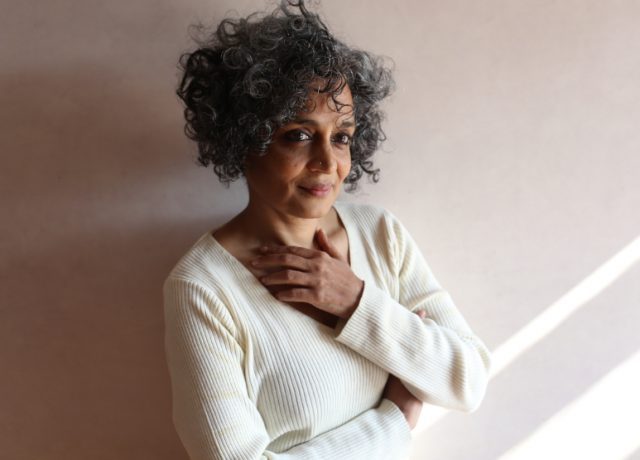
Arundhati Roy will deliver the Arthur Miller lecture at PEN America World Voices Festival (photo by Mayank Austen Soofi)

Arundhati Roy will deliver the Arthur Miller lecture at PEN America World Voices Festival (photo by Mayank Austen Soofi)

Who: Arundhati Roy, Siddhartha Deb
What: The Arthur Miller Freedom to Write Lecture, PEN America World Voices Festival
Where: Apollo Theater, 253 West 125th St.
When: Sunday, May 12, $30-$65, 6:00
Why: The fifteenth annual PEN World Voices Festival comes to a close in New York City on May 12 with Booker Prize winner Arundhati Roy delivering the prestigious Arthur Miller Freedom to Write Lecture, the keynote event of the weeklong celebration of the written word, which seeks to “broaden channels of dialogue between the United States and the world.” The Indian screenwriter, essayist, novelist, and activist is the author of The God of Small Things and The Ministry of Utmost Happiness; her collection of essays, My Seditious Heart, is coming out in June. She will be speaking about “the defense of the collective, of the individual, and of the land, in the face of the destructive logic of financial, social, religious, military, and governmental elites”; the talk will be followed by a Q&A with Indian writer and professor Siddhartha Deb. Among the other events this weekend are “Secrets and Lives” with Boris Kachka, Dani Shapiro, and Bridgett M. Davis, “The Art of Violence” with Rodrigo Rey Rosa, Tommy Orange, and Mohammed Hanif, “Women Uninterrupted” with Jennifer Egan, Inês Pedrosa, and Elif Shafak, and the free debate “A Question of Justice” at the Center for Social Innovation.

JEAN-CLAUDE CARRIÈRE: YOYO / HEREUX ANNIVERSAIRE

YOYO

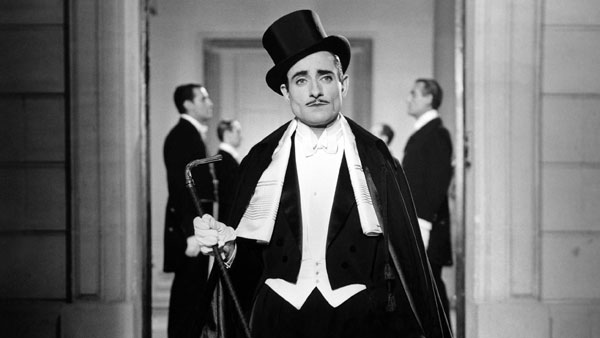
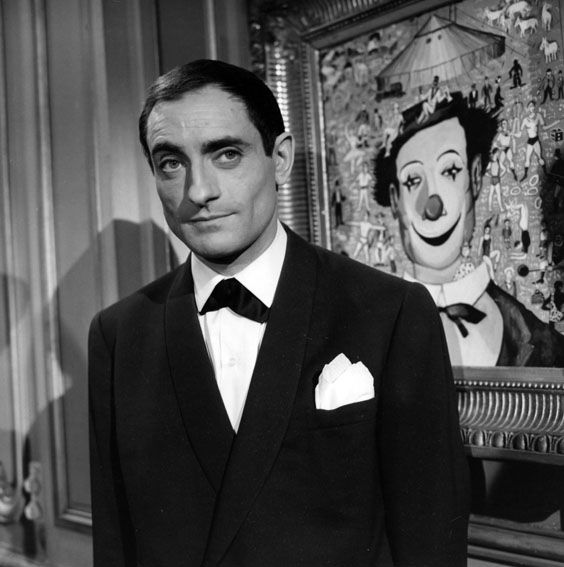
All the wealth in the world can’t make a lonely millionaire (Pierre Étaix) happy in Yoyo

YOYO (Pierre Étaix, 1965) / HEREUX ANNIVERSAIRE (Pierre Étaix & Jean-Claude Carrière, 1962)
MoMA Film, Museum of Modern Art
11 West 53rd St. between Fifth & Sixth Aves.
Thursday, May 9, 4:30, and Wednesday, May 15, 7:00
Series runs May 9 – June 16
www.moma.org

French auteur Pierre Étaix’s strange and beautiful films were long inaccessible, the subject of nearly two decades of legal wrangling, but on May 9 and 15, MoMA will be presenting his 1965 bittersweet black-and-white slapstick charmer, Yoyo, as part of its “Jean-Claude Carrière” series, celebrating the screenwriter and master collaborator who worked with such legends as Luis Buñuel, Louis Malle, Miloš Forman, Jean-Luc Godard, Andrzej Wajda, Nagisa Oshima, and Peter Brook; the eighty-seven-year-old Carrière will introduce the May 9 screening. (In April 2010, Étaix was finally able to once again bring his films to the public, his entire output restored and making their New York debut at a festival at Film Forum in October 2012.) Étaix, who wrote Yoyo with Carrière, stars as a ridiculously wealthy but extremely bored man who lives alone in an ornately decorated, absurdly large chateau. It’s 1925, and he has servants for absolutely everything, as well as his own private band and flappers, but he pines for his lost love, Isolina (Claudine Auger). One day she arrives with a traveling circus, along with a young boy (Philippe Dionnet) who turns out to be his son. She at first rejects the multimillionaire, but when he loses it all on Black Tuesday, the three of them form their own traveling circus, with the boy ultimately turning into a popular clown named Yoyo (played as an adult by Étaix) and seeking to restore the chateau and his family.
YOYO

French auteur Pierre Étaix takes clowning around very seriously in rediscovered classic

The first section of the film is a glorious homage to the silent film era and other cinematic comedians, with Étaix evoking his mentor, Jacques Tati; Charlie Chaplin; Buster Keaton; and, later, Jerry Lewis, with whom he’d appear as Gustav the Great in Lewis’s never-to-be-seen Holocaust film The Day the Clown Died. Nouvelle Vague cinematographer Jean Boffety (An Occurrence at Owl Creek Bridge; Je t’aime, je t’aime) shoots Yoyo in a sharp, gorgeous black-and-white, composing breathtaking shots that boast a dazzling symmetry that must make Wes Anderson giddy with delight, while Étaix fills the film with ingenious sight gags that would make Ernie Kovacs proud (just wait till you see the supposed still-life painting), all anchored by Jean Paillaud’s memorable musical theme. But once the stock market crashes and talkies take over, dialogue enters the picture, and the camera is often off balance, the perfect symmetry a thing of the past. With Yoyo, Étaix, who had previously made Le Soupirant and would go on to make The Great Love and En pleine forme, was influenced by the sudden, tragic death of his father, his love of the circus — he had already worked under the big tent, and he would leave films to become a clown in a traveling circus in the early 1970s — and his viewing of Fellini’s 8½ (look for the La Strada poster) resulting in a film that sometimes gets a little lost and too surreal, but he ultimately brings things back around as Yoyo grows into a star and the story travels through the arc of twentieth-century entertainment, from the silent era to talkies to television. Truffaut called it “a beautiful film in which I loved every shot and every idea, and which taught me many things about movies.”

MoMA festival pairs

Pierre Étaix and Jean-Claude Carrière’s Heureux Anniversaire kicks off Carrière festival at MoMA with Yoyo

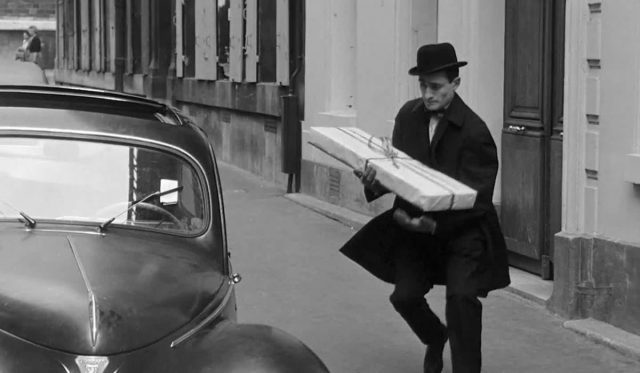
It’s a real treat that Étaix’s work is undergoing this rediscovery; lovers of Michel Hazanavicius’s The Artist will particularly enjoy Yoyo, which is being shown with Heureux Anniversaire, Étaix and Carrière’s deliriously funny black-and-white short that won the 1963 Oscar for Best Live Action Short Subject. As a woman (Laurence Lignières) prepares a special anniversary dinner at home, her husband (Étaix) gets trapped in all kinds of craziness as he desperately tries to make it home in time, but the traffic and parking gods are against him. Hysterical slapstick ensues virtually without dialogue, like a classic silent film with a wacky score. And you’ll never be able to look at Mr. Bean the same way again. “Jean-Claude Carrière” runs May 9 to June 16 and includes such other works Carrière wrote and/or directed as Philip Kaufman’s The Unbearable Lightness of Being, Godard’s Every Man for Himself, Buñuel’s The Phantom of Liberty, and Wajda’s Danton, with Carrière introducing several screenings.