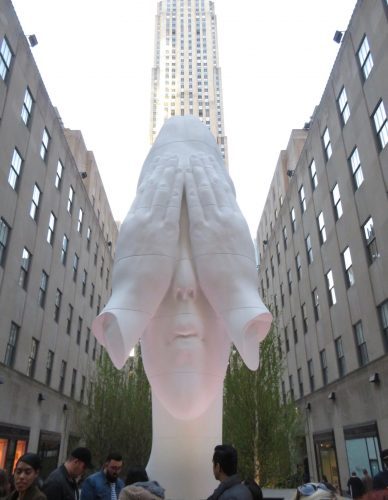
Jaume Plensa, Behind the Walls, 2019 (photo by twi-ny/mdr)
30 Rockefeller Plaza
Between West 48th & 51st St. and Fifth & Sixth Aves.
Daily through June 28, free
212-588-8601
www.rockefellercenter.com
frieze.com
online slideshow
The Frieze New York art fair takes place May 2-5 at Randall’s Island Park, where tickets run up to $85.50 with ferry service and a magazine subscription. But you can get a free taste at Rockefeller Center, where Frieze New York and Tishman Speyer have partnered for Frieze Sculpture, an exhibition of public works by fourteen artists, with pieces lining Rockefeller Plaza outside and a few hidden away in lobbies. The participating artists are Nick Cave, Aaron Curry, Jose Dávila, Walter De Maria, Rochelle Goldberg, Goshka Macuga, Ibrahim Mahama, Joan Miró, Paulo Nazareth, Jaume Plensa, Pedro Reyes, Kiki Smith, Sarah Sze, and Hank Willis Thomas. The display is curated by Brett Littman of the Isamu Noguchi Foundation and Garden Museum, whose choices were inspired by Noguchi’s 1940 News on the facade of the Associated Press building as well as the 1934 Diego Rivera mural that the Rockefellers destroyed because it included an image of Lenin.
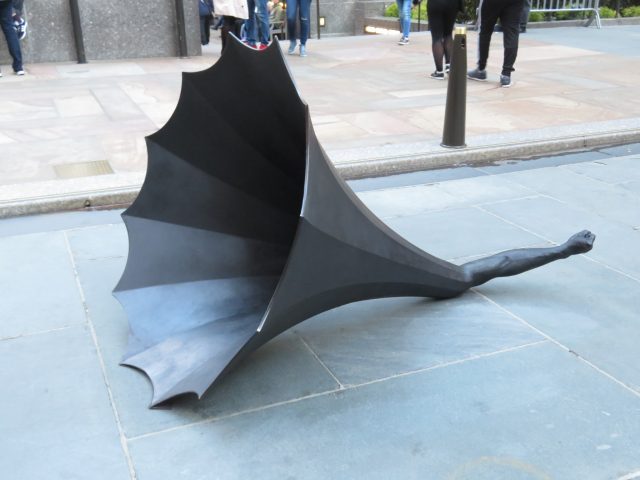
Nick Cave, Untitled, 2018 (photo by twi-ny/mdr)
One of the themes linking many of the works is that of protest, of speaking out to fight the status quo and to initiate change. Paulo Nazareth’s DRY CUT [from Blacks in the Pool — Tommie] depicts a larger-than-life cutout of Tommie Smith raising his gloved right hand while accepting his Olympic medal in 1968. An untitled piece by Nick Cave features an arm with a fist at the end emerging from an old gramophone speaker. Jaume Plensa’s monumental Behind the Walls is a huge white head with disembodied hands covering the eyes, as if refusing to see what is happening. Joan Miró’s Porte II consists of two slanted doors with a long chain dangling in between, as if a threat of punishment.
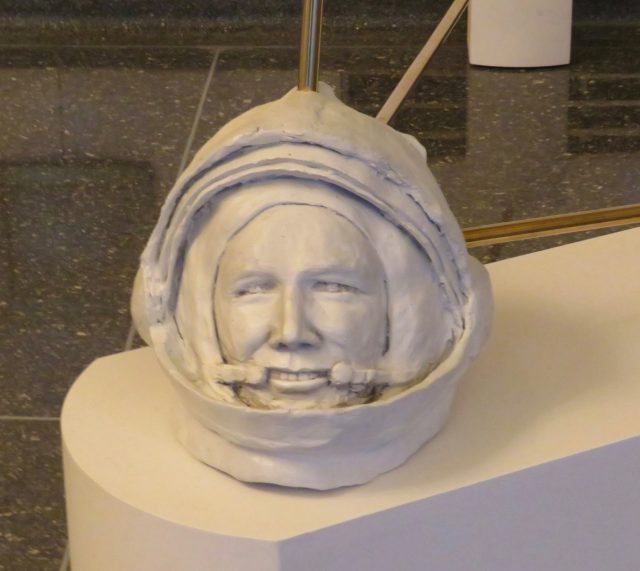
Goshka Macuga, International Institute of Intellectual Co-operation, Configuration 25, First Man: Yuri Gagarin, 2016 (photo by twi-ny/mdr)
Rochelle Goldberg’s Cannibal Junkie and Kiki Smith’s Rest Upon are reminders of humanity’s connection to nature — and what might occur if we’re not more careful. Ibrahim Mahama has removed the nearly two hundred flags of UN countries that surround the skating rink and replaced them with fifty ratty flags made of jute in Ghana, evoking global poverty. Hank Willis Thomas’s Harriet and Annie (Capri) and Josephine and Kazumi (Real Red) offer passersby a public platform to share their thoughts. And Goshka Macuga’s Institute of Institutional Co-operation, seen below Dean Cromwell’s 1946 mural The Story of Transportation, shows just what we are capable of.
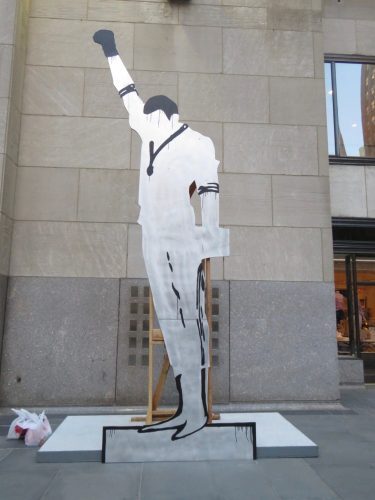
Paulo Nazareth, DRY CUT [from Blacks in the Pool — Tommie], (photo by twi-ny/mdr)
There will be several family programs, on alternate Sundays at 10:30 am, held in conjunction with the sculpture display. On May 12, Noguchi educators will lead a “3D: Build Up!” tour of the sculptures for four-year-olds (advance registration required). On May 26, “Your Neighborhood: Public Art” offers a guided tour for five- and six-year-olds, followed by a model-making workshop (advance registration required). On June 9, “Figures: Strike a Pose” consists of a tour and a workshop for children ages seven to eleven with advance RSVP. And on June 23, the drop-in “Get the Scoop: Stories and Art” offers children two to eleven the opportunity to explore the exhibit and make art in response to what they experience.

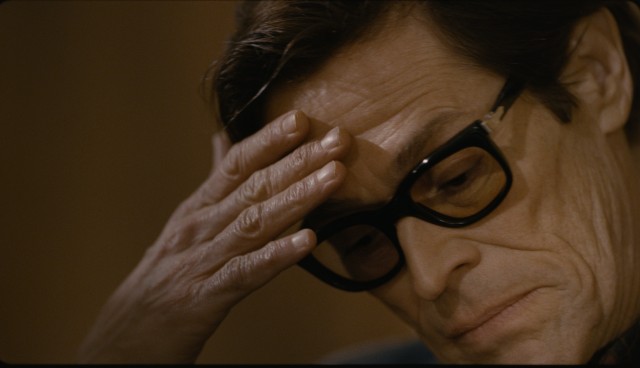
 Director Abel Ferrara packs a whole lot into controversial Italian writer and filmmaker Pier Paolo Pasolini’s last day on earth in the multinational coproduction Pasolini. Unfortunately, it all ends up a rather confusing jumble, with Ferrara (Bad Lieutenant, The Addiction) and screenwriter Maurizio Braucci (Gomorrah, Black Souls) squeezing too much into too little. Willem Dafoe stars as Pasolini on November 2, 1975, as the director is interviewed by a journalist, reads the newspaper on the couch, sits down at his typewriter to work on his novel Petrolio, edits what would be his final film (Salò, or the 120 Days of Sodom), and goes cruising to pick up a young stud. Ferrara adds enactments of scenes from the never-realized Porno-Teo-Kolossal, with Pasolini’s real-life lover, Ninetto Davoli, playing the fictional character Epifanio. (Davoli was supposed to play the younger Nunzio in the hallucinatory tale, about a search for faith and the messiah. Davoli is played by Riccardo Scamarcio in Ferrara’s film.) Ferrara never really delves into the internal makeup of Pasolini (The Gospel According to Matthew, Teorema), an openly gay outspoken social and political activist, poet, Marxist, Christian, and documentarian, instead using brief episodes that only touch the surface, as if Dafoe is playing a character based on Pasolini rather than the complex man who was indeed Pasolini. But Ferrara does get very specific about Pasolini’s mysterious, brutal death. Pasolini is screening May 3 at 7:00 in the MoMA series “Abel Ferrara: Unrated” and will be followed by a Q&A with the director and Dafoe.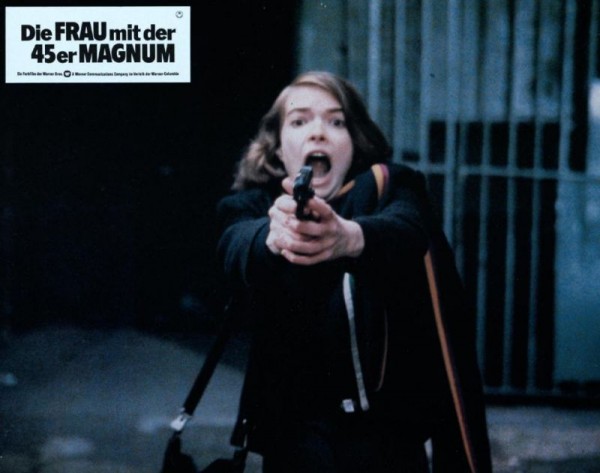
 Abel Ferrara’s third film, following the 1976 pornographic 9 Lives of a Wet Pussy Cat and the 1979 gorefest The Driller Killer, is a low-budget grindhouse female revenge fantasy set on the gritty streets of New York City. In Ms. 45 (also known as Angel of Vengeance), Zoë Tamerlis Lund makes her screen debut as Thana, a mute woman working as a seamstress in the Garment District. After being raped twice in one day on separate occasions, she soon goes all Death Wish / Taxi Driver on men seeking a little more from women. Thana — named after Freud’s death instinct, Thanatos, the opposite of the sex instinct, Eros — grabs herself a .45 and quickly proves she is one helluva shot as she goes out in search of potential victims in Chinatown, Central Park, and the very place where Woody Allen and Diane Keaton sat on a bench, romantically looking out at the Queensboro Bridge in an iconic moment from Manhattan. Ferrara, who plays the masked rapist, captures the nightmarish feel of the city at the time, where danger could be lurking around any corner, with the help of James Lemmo’s lurid, pornlike cinematography and Joe Delia’s jazz-disco soundtrack. Lund would go on to cowrite Ferrara’s Bad Lieutenant, in which she plays a junkie named Zoë, before drugs killed her in 1999 at the age of thirty-seven. Ms. 45 is a cult classic that keeps getting better with age — and yes, that is a man dressed as Mr. Met at the Halloween party. A new digital restoration will be screening May 7 and 11 in the MoMA series “Abel Ferrara: Unrated,” which runs May 1-31 and includes such other Ferrara works as The Addiction, Welcome to New York, Body Snatchers, King of New York, Fear City, Bad Lieutenant, The Funeral, and his latest, The Projectionist. Ferrara will be at MoMA to participate in discussions following several screenings the first week.
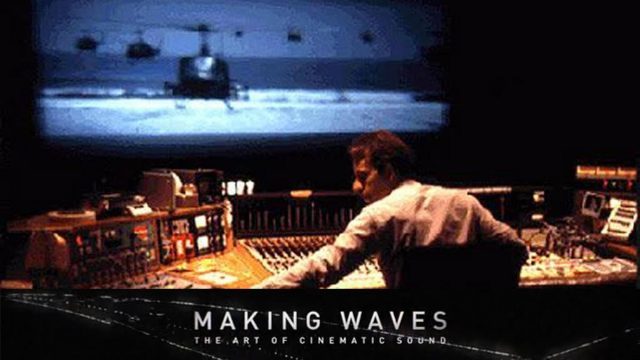
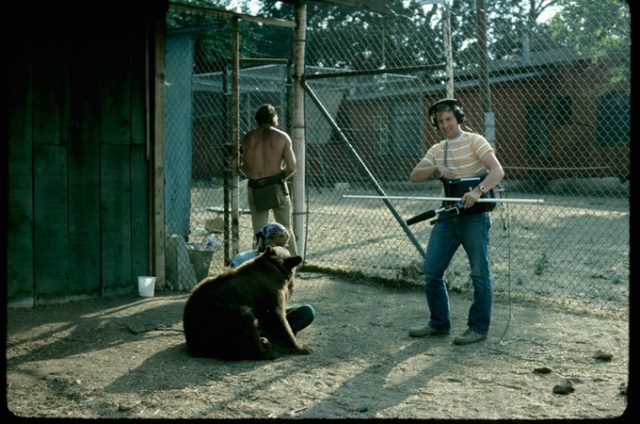
 Longtime sound editor and teacher Midge Costin pays tribute to her discipline in the eye- and ear-opening documentary Making Waves: The Art of Cinematic Sound, having its world premiere this week at the Tribeca Film Festival. The celebration of sound focuses on three of the best in the business: three-time Oscar winner Walter Murch (Apocalypse Now, The English Patient), four-time Oscar winner Ben Burtt (E.T. the Extra-Terrestrial, Star Wars), and seven-time Oscar winner Gary Rydstrom (Saving Private Ryan, Toy Story). “Before we were born, you’re looking at darkness. Sound is the first sense that’s plugged in,” Murch says at the beginning of the film. “Six months, seven months into the womb, it’s hearing the mother’s heartbeat, it’s hearing her breathing, it’s hearing Dad shouting from the garage. It’s making sense of the world. You have emerged into a kind of consciousness using only sound. And then you’re born. Sound affects us in a deeper way almost than image does. It goes deeper. And yet we’re naturally, seemingly oblivious to that.”