Brooklyn Expo Center
72 Noble St.
Saturday, December 7, $70 (use code WHISKEYBK to save $25), 2:00 – 5:00, 6:30 – 9:30 www.brooklynwhiskeyfest.com
“Too much of anything is bad, but too much good whiskey is barely enough,” Mark Twain famously said. You can test his hypothesis on December 7 at the Brooklyn Whiskey and Spirits Fest. Taking place at the Brooklyn Expo Center, the festival is divided into two three-hour sessions, beginning at 2:00 and 6:30. Attendees will be given a souvenir tasting glass with which they can sample more than one hundred varieties of bourbon, blended, Irish, Scotch, Tennessee, rye, single malt, and Canadian whiskey and craft spirits, including gin, tequila, rum, stout, and more. Among the participants are Iron Smoke, the Fighting 69th Irish Whiskey, BSB Brown Sugar Bourbon, the Vale Fox, Sono 1420, Twinstills Moonshine, Cutwater, Copper Sea Distilling, Black Button Distillery, and Elijah Craig, with experts on hand to talk about their offerings. There will be live music as well as food available for purchase. You can also get a designated driver ticket for $15, but if you’re caught stealing a sip, you’ll be escorted out.
Dana Davenport and Samita Sinha will present new work together for Gibney DoublePlus (photos by Maria Baranova and Yanissa Grand-Pierre)
The Theater at Gibney 280 Broadway
280 Broadway between Chambers & Reade Sts.
December 5-7, 12-14, 19-21, $15-$20, 8:00 gibneydance.org
Gibney’s annual DoublePlus program, in which established artists mentor pairs of emerging choreographers, kicks off December 5-7 with Pilipinx-American producer, administrator, contemporary performance manager, and Current Sessions founder Alexis Convento curating works by Korean and black American interdisciplinary artist Dana Davenport and composer and vocal artist Samita Sinha. Davenport will present the new movement piece Experiments for ~Relaxation~, while Sinha debuts Kaalo Jol (“Black Waters”), a duet with Sunny Jain on dhol on Thursday and guitarist Grey Mcmurray on Friday and Saturday. The December 6 show will be preceded at 7:00 by a free Living Gallery site-specific performance of Capital-D Dance by Brooklyn-based dancer, writer, and producer Tara Sheena. The series continues December 12-14 with Alexander Diaz’s Getting closer to Coral and Jennifer Harrison Newman’s topologies, curated by Charmaine Warren, and December 19-21 with Laurel Atwell’s We Wield and Hyung Seok Jeon’s Deep Out Agents, curated by Tei Blow.
Laurie Anderson and Nicole Krauss will be at the Morgan Library on December 5 for latest Le Conversazioni presentation (photos by Ebru Yildiz and Goni Riskin)
Morgan Library & Museum
225 Madison Ave. at 36th St.
Thursday, December 5, $20, 7:00
212-685-0008 www.themorgan.org
The ongoing series “Le Conversazioni: Films of My Life” continues December 5 at the Morgan Library with Laurie Anderson and Nicole Krauss sitting down for a discussion with moderator Antonio Monda, the artistic director and cofounder of Le Conversazioni, an Italian festival started in 2006 dedicated to literature but which has since spread to include other disciplines. Anderson is an Illinois-born, New York-based, Grammy-winning musician, filmmaker, composer, and multimedia performance and spoken-word artist who has released such records as Big Science and Mister Heartbreak, made such films as Home of the Brave and Heart of a Dog, and staged such cutting-edge shows as United States Live,Moby-Dick, and The End of the Moon. Krauss is the Manhattan-born award-winning author of Man Walks into a Room, The History of Love, Great House, and Forest Dark. They will be discussing films that influenced their work. The 7:00 event is being held in conjunction with the Morgan exhibition “Verdi: Creating Otello and Falstaff — Highlights from the Ricordi Archive,” which will be open at 6:00 for ticket holders.
Jack Sim is on a mission to bring clean toilets to India, China, and the rest of the world
MR. TOILET: THE WORLD’S #2 MAN (Lily Zepeda, 2019)
Village East Cinema
181-189 Second Ave. at 12th St.
Opens Friday, November 22
212-529-6799 mrtoiletfilm.com www.villageeastcinema.com
Jack Sim is my new hero. Known as Mr. Toilet, the Singapore native and former construction entrepreneur travels around the globe preaching the gospel of poo, promoting safe and healthy sanitation in countries where bathrooms are scarce and open defecation leads to rampant disease and even crime, especially against women and children, who find themselves particularly vulnerable when they must relieve themselves outside in remote areas. Lily Zepeda tells Sim’s story in her first feature film, the vastly entertaining and important documentary Mr. Toilet: The World’s #2 Man. “The toilet is a spiritual room, a place to cherish and rejoice,” Sim explains at the beginning of the film. “When you go and let go, you’re connected with the universe. That’s why good ideas come up from the toilet. If you survey people before and after they use the toilet, ninety-nine percent of them will be much happier than before they go to the toilet. When you open the toilet door, it’s not the toilet inside; it’s your future.” Sim must go a lot, because he is one happy guy.
Zepeda follows the eccentric Sim as he meets with government officials, local leaders, young students, and the general public in Singapore, China, India, and the United Nations, lobbying for more toilets, particularly for schoolchildren and women. He has a never-ending array of fecal puns (one of his mottoes is “Getting People to Give a Shit”), rides around on a scooter, uses a toilet brush to comb his hair, swims with a poo emoji float, and often dresses up in costume as a man sitting on a toilet, doing his business; the playful animation Zepeda includes highlights Sim’s youthful qualities. Now sixty-two, he is away from home a lot, which disappoints his loyal wife, Julie Teng, and their four kids, daughters Faith and Earth and sons Worth and Truth, who consider their father “a twelve-year-old trapped in a sixty-year-old man’s body.” Sim does things his own way, with little regard for the consequences; he believes strongly in civil disobedience, feeling that certain rules don’t apply to him. “I’m very naughty,” he admits.
Sim is nearly all laughs and smiles until there are rumbles of dissatisfaction with some board members of his nonprofit, the World Toilet Organization, which boasts such fans as Oscar winner Matt Damon, Bollywood star Salman Khan, and “Indian King of Toilets” Dr. Bindeshwar Parhak. “I support his movement, but for me, frankly, the task for Jack is too big,” notes former Singapore prime minister Goh Chok Tong, not necessarily realizing his own fecal pun. But as goofy as Sim is — and he’s plenty goofy — he knows his shit and is very serious about changing the planet’s perception of poop, one toilet, and one crappy joke, at a time. Mr. Toilet: The World’s #2 Man opens November 22 at Village East Cinema, with Zepeda and Sim participating in Q&As after the 7:00 shows on Friday and Saturday.
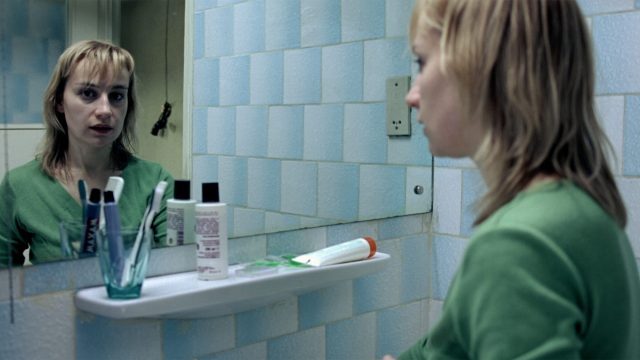
Anamaria Marinca stars in Cristian Mungiu’s harrowing 4 Months, 3 Weeks and 2 Days,, part of Film Forum celebration of the last three decades of Romanian cinema
Film Forum
209 West Houston St.
Through November 26
212-727-8110 filmforum.org
On December 25, 1989, Romanian dictator Nicolae Ceaușescu and his wife, Elena, were executed by a firing squad after being found guilty of corruption and genocide. In the wake of his death, the Romanian film industry reinvented itself, and Film Forum pays tribute to that change with “The Romanians: 30 Years of Cinema Revolution,” consisting of thirty films screening over twelve days through November 26. Several shows will be followed by Q&As with the director and/or actor. In addition to the below four recommendations, the series includes Nae Caranfil’s Do Not Lean Out the Window, Radu Mihaileanu’s Train of Life, Alexandru Solomon’s The Great Communist Bank Robbery, and Constantin Popescu’s Pororoca.
4 MONTHS, 3 WEEKS AND 2 DAYS (Cristian Mungiu, 2007)
Friday, November 22, 3:30, 7:45 filmforum.org
Winner of the Palme D’Or at the 2007 Cannes Film Festival, Cristian Mungiu’s 4 Months, 3 Weeks and 2 Days is a harrowing look at personal freedom at the end of the Ceaușescu regime in late-’80s Romania. Anamaria Marinca gives a powerful performance as Otilia, a young woman risking her own safety to help her best friend, Gabita (Laura Vasiliu), out of a difficult, dangerous situation. Their lives get even more complicated when they turn to Bebe (Vlad Ivanov) to take care of things. Cinematographer Oleg Mutu, who shot Cristi Puiu’s brilliant The Death of Mr. Lazarescu, keeps the camera relatively steady for long scenes, without cuts, pans, dollies, or zooms, as the actors walk in and out of view, giving the film a heightened level of believability without looking like a documentary. Set in a restrictive era with a burgeoning black market, 4 Months goes from mystery to psychological drama to thriller with remarkable ease — and the less you know about the plot, the better.
Father (Teodor Corban) and son (Mihai Comānoiu) hunt for a runaway slave in wickedly funny Aferim!
Romanian director Radu Jude won the Silver Bear as Best Director at the 2015 Berlin International Film Festival for Aferim!, his savagely funny blacker-than-black comic Western about bigotry, infidelity, and frontier justice in 1835 Wallachia. Lawkeeper Costandin (Teodor Corban) and his son, Ionitā (Mihai Comānoiu), are galloping through the local countryside, searching for runaway Gypsy slave Carfin (Cuzin Toma), who Boyar Iordache Cindescu (Alexandru Dabija) has accused of having an affair with his wife, Sultana (Mihaela Sîrbu). The surly Costandin leads the hunt, verbally cutting down everyone he meets, from random old women to abbots to fellow lawmen, with wicked barbs, calling them filthy whores, crows, and other foul names while spouting ridiculous theories about honor and religion; he even batters his son, saying he’s “a waste of bread” and that “if you slap him, he’ll die of grief.” It’s a cruel, cholera-filled time in which even the monks beat the poor, where Costandin regales a priest with the telling riddle, “Lifeless out of life, life out of lifeless,” which the priest thinks refers to the coming doomsday.
Cowritten by Jude (The Happiest Girl in the World, Everybody in Our Family) and novelist Florin Lăzărescu (Our Special Envoy, Numbness), who previously collaborated on the short film The Tube with a Hat, and shot in gloriously stark black-and-white by Marius Panduru (12:08 East of Bucharest; Police, Adjective), the Romanian / Bulgarian / Czech coproduction is an absurdist combination of Monty Python and the Holy Grail, Andrei Tarkovsky’s Andrei Rublev, Hal Ashby’s The Last Detail, and John Ford’s The Searchers, skewering everything in its path, either overtly or under its wide-reaching breath. Even Dana Pāpāruz’s costumes are a genuine riot, especially the boyar’s majestically ridiculous hat. But Aferim! is more than just a clever parody of period films and nineteenth-century Eastern European culture and social mores; it is also a brilliant exploration of the nature of racism, discrimination, misogyny, and the aristocracy that directly relates to what’s going on around the world today as well as how Romania has dealt with its own sorry past of enslaving the Romani people. Jude was inspired by real events and historical documents, setting the film immediately after the 1834 Russian occupation, which adds to its razor-sharp observations. “Aferim! is an attempt to gaze into the past, to take a journey inside the mentalities of the beginning of the nineteenth century — all epistemological imperfections inherent to such an enterprise included,” Jude says in his director’s statement. “It is obvious that such an effort would be pointless should we not believe that this hazy past holds the explanation for certain present issues.” Don’t miss this absolute gem of a film, which was Romania’s submission for the Academy Awards.
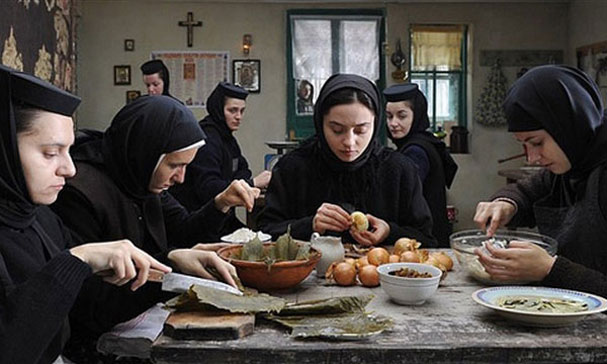
Voichita (Cosmina Stratan) must choose between her faith and her best friend in Cristian Mungiu’s Beyond the Hills
BEYOND THE HILLS (DUPA DEALURI) (Cristian Mungiu, 2012)
Sunday, November 24, 7:30
Monday, November 25, 12:40 filmforum.org
Inspired by a true story detailed in a pair of nonfiction novels by Romanian journalist Tatiana Niculescu Bran, Cristian Mungiu’s Beyond the Hills is a powerful, emotional study of love, friendship, dedication, devotion, and sexual repression. In a barren section of modern-day Romania, Alina (Cristina Flutur) arrives at a poverty-stricken Orthodox monastery, where her childhood friend Voichita (Cosmina Stratan) has become a nun. Both young women grew up in a poor orphanage, and both still have no real place in society. Alina has come to try to convince Voichita — possibly her former lover — to leave the flock and go with her to Germany, where they can live and work together freely. Early on, Voichita rubs a tired Alina’s bare back; when Alina turns over, Voichita just stops short of massaging her friend’s chest, the sexual tension nearly exploding in a scene of quiet beauty that speaks volumes about their relationship. Despite Alina’s pleading, Voichita, apparently filled with deep inner guilt, refuses to turn her back on the priest (Valeriu Andriuţă), whom all the nuns refer to as Pa, and her newfound vocation. Unable to accept her friend’s decision, Alina begins acting out in threatening ways to both herself and the true believers, leading to shocking, tragic consequences.
Mungiu’s feature-film follow-up to the 2007 Palme d’Or winner 4 Months, 3 Weeks and 2 Days is another harrowing examination of characters trapped in a devastating situation. The two-and-a-half-hour film seems to take place in a different era, far away from contemporary towns and cities, cell phones and even electricity. Mungiu, who won the Best Screenplay award at Cannes for the film, is careful not to condemn or belittle Pa, Ma (Dana Tapalagă), and their faith, but he doesn’t praise them either, leaving it up to viewers to decide for themselves. In their feature-film debuts, Flutur and Stratan, who are both from Mungiu’s hometown of Iasi and shared the Best Actress award at Cannes, are exceptional, their eyes filled with fear and longing as Alina and Voichita try to find a balance in their opposing worlds.
Luminița Gheorghiu plays a controlling, domineering mother in Călin Peter Netzer’s award-winning Child’s Pose
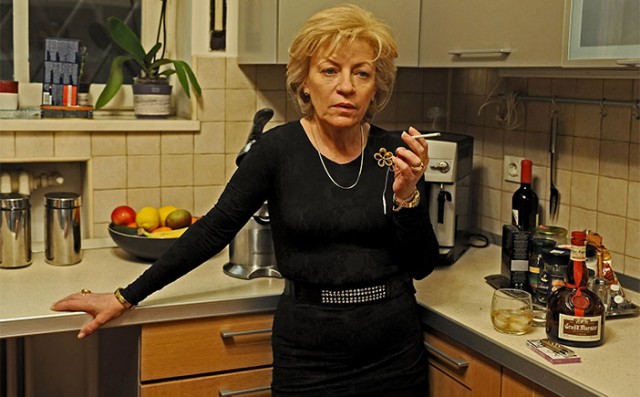
Luminita Gheorghiu, grand dame of the Romanian New Wave, was nominated for Best Actress at the European Film Awards for her devastating portrayal of a domineering mother in Călin Peter Netzer’s Child’s Pose. Gheorghiu (The Death of Mister Lazarescu;4 Months, 3 Weeks and 2 Days) stars as Cornelia Kerenes, an elegant, cigarette-smoking architect who immediately jumps into action when her son, Barbu (Bogdan Dumitrache), is involved in a terrible car accident, killing a child. Despite their recent estrangement — Cornelia and Barbu have rarely spoken since he married Carmen (Ilinca Goia) — Cornelia starts constructing a scenario, like designing one of her buildings, to keep Barbu out of jail. She and her surgeon husband, Reli (Florin Zamfirescu), along with her sister, Olga (Nataşa Raab), start calling in favors and doling out bribes while showing a stunning lack of concern for the family of the boy who Barbu killed. As the child’s funeral approaches, relationships come together and fall apart as parents try to deal with what has happened to their children. Winner of the Golden Bear at the Berlinale, Child’s Pose is a searing examination of class, corruption, and power.
Reminiscent of Lucrecia Martel’s The Headless Woman, in which María Onetto gives a mesmerizing performance as an Argentine upper-class wife and mother who looks the other way when it appears that she might have run over a local boy, Child’s Pose is a penetrating character study that centers around the wide gap between the rich and the poor. Early on in the film, Cornelia, who her husband at one point calls “Controlia,” sits down with her dour cleaning woman and offers her a pair of used shoes, expecting her to rejoice in such wonderful charity. The scene sets the stage for what occurs later, as Cornelia believes money is the primary route to Barbu’s freedom, but it’s a path littered with more than just one young child’s body. The taut, razor-sharp script was written by Netzer (Maria, Medal of Honor) and Răzvan Rădulescu, who has worked on such other Romanian New Wave films as The Death of Mister Lazarescu, Stuff and Dough, and Tuesday, After Christmas. In Cornelia, they have created a woman worthy of joining the pantheon of classic domineering cinematic mothers.
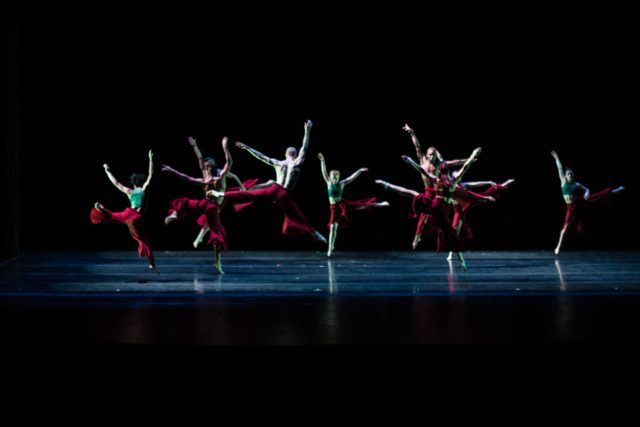
“Tilted Arc” is the first of three movements in Elisa Monte Dance’s Emerged Nation at the Flea (photo by Tony Turner)
Flea Theater, the Sam
20 Thomas St. between Broadway & Church St.
November 21-24, $10-$25
212-352-3101 theflea.org www.elisamontedance.org
Elisa Monte Dance takes the emotional temperature of America in Emerged Nation, making its world premiere November 21-24 at the Flea. Choreographed by company artistic director Tiffany Rea-Fisher, the evening-length work explores issues of immigration, culture, and diversity in three movements; the piece is performed by Tracy Dunbar, Katherine Files, Jenny Hegarty Freeman, Daniela Funicello, Hannah Gross, Madelyn LaLonde, Ashley LaRosa, and Sai (Napat) Rodboon, with lighting by Michael Cole and a score by DJ Twelve45 and ambient chamber music composer Kevin Keller. Emerged Nation opens with “Tilted Arc,” which was commissioned by the DOT for the 2017 Summer Streets program and references Richard Serra’s controversial 1989 sculpture in Foley Square, followed by “Emerged Nation,” which examines black and Native American cultural assimilation in the States, and “Kinetic Kinship,” which delves into New York City’s reputation as a melting pot.
“Moving into Elisa Monte Dance’s thirty-ninth season, I wanted to reprise and expand my seminal work, ‘Tilted Arc,’ into an evening-length work. When I revisited this repertory piece, I felt that it left questions that needed to be answered about mine and so many others’ struggle to find a cultural place in America. This work takes the audience on my journey of self-exploration,” Rea-Fisher said in a statement. The November 23 performance will be followed by a talkback with Rea-Fisher, the composers, and other members of the cast and crew. And be on the lookout for the HP Reveal App that will enhance the experience.
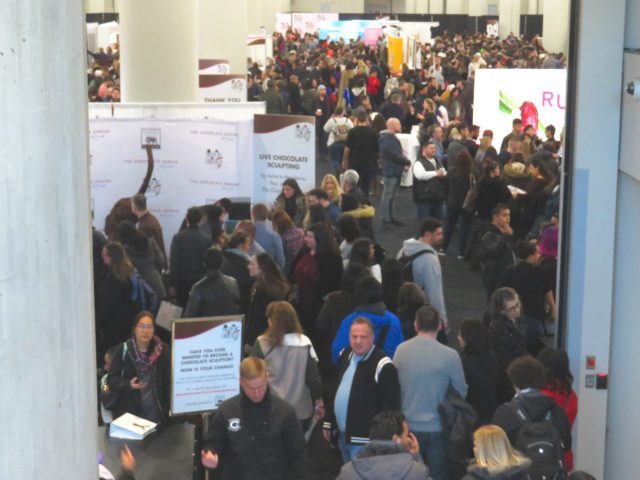
Chocolate lovers flock to Javits Center for return of cacao salon (photo by twi-ny/mdr)
Salon du Chocolat
Javits Center
655 West 34th St. at 11th Ave.
Saturday, November 16, 10:00 am – 6:00 pm, and Sunday, November 17, 11:00 am – 5:00 pm
Admission: $10-$25 in advance, $12-$35 onsite www.salonduchocolatny.com www.javitscenter.com
The return of Salon du Chocolat to New York has attracted a big crowd to the Javits Center, where chocolate-obsessed minions can experience all things cacao, from samples and demonstrations to workshops and fashion. There are more than eighty booths and dozens of events, so navigating it can be tricky. Several popular purveyors — including two that are offering alcohol-infused chocolate — have long lines, so we suggest skipping those. However, where there are lines, please acknowledge them; we saw far too many people not honoring the queues, rudely pushing in front of others to snag a free bonbon, truffle, or nib. There is a lot to try, and many of the men and women behind the booths are the owners, chefs, or creators and love talking about their process, so do engage them (and perhaps even get a bonus taste). We were impressed with brands from South America (Hoja Verde — Global Cadena), New Zealand (Hogarth), Vanuatu (Aelan), Haiti (Askanya), and Vietnam (Marou) as well as New Jersey (Knipschildt), Connecticut (Le Rouge), Texas (Maggie Louise), and the Lower East Side (Roni Sue’s) on our international chocolate tour; below are some of our favorite stops.
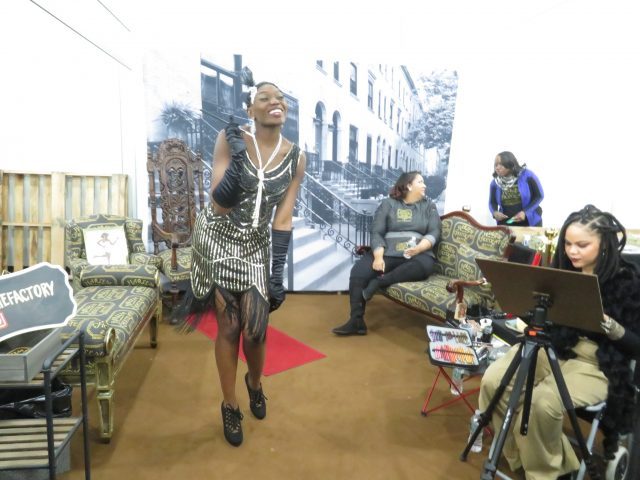
The Harlem Chocolate Factory adds 1920s glamour to confection convention (photo by twi-ny/mdr)
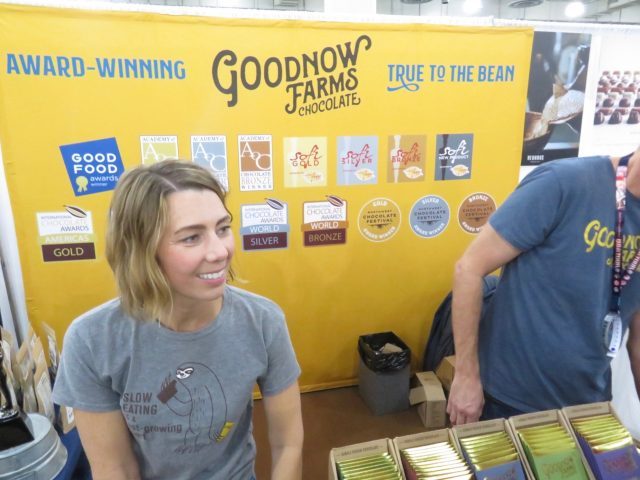
Goodnow Farms uses fresh-pressed single origin South American beans in creating unique flavors (photo by twi-ny/mdr)
The Honey Jack caramel bonbon at Two Chicks with Chocolate is a stand-out (photo by twi-ny/mdr)
Le Rouge Aartisan Chocolates adds an Indian twist to French delights (photo by twi-ny/mdr)
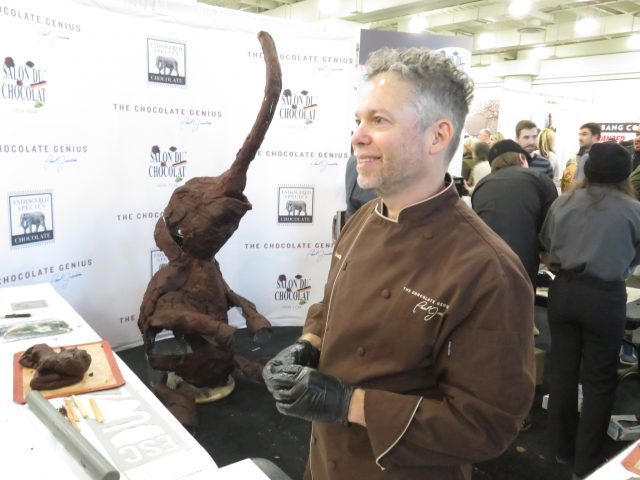
Chocolate Genius Paul Joachim molds the elephant in the room (photo by twi-ny/mdr)
Austin-based Maggie Louise Confections offers generous samples of sweet treats (photo by twi-ny/mdr)
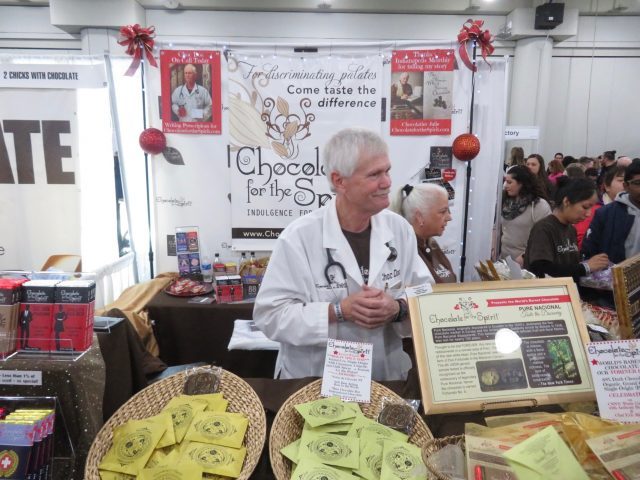
The Choc Doc is on the case, offering Chocolate for the Spirit (photo by twi-ny/mdr)
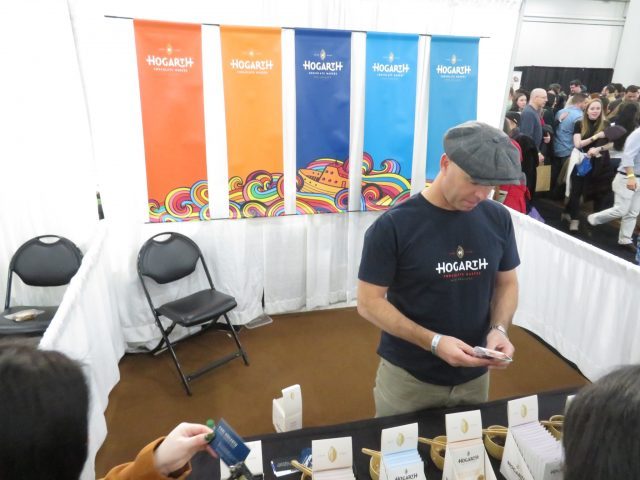
Karl Hogarth has traveled from New Zealand to serve his bean-to-bar chocolate (photo by twi-ny/mdr)
Pastry chefs and other industry pros give talks and demonstrations at Salon du Chocolat (photo by twi-ny/mdr)
Master chocolatier Håkan Mårtensson has sculpted chocolate dragons at his booth (photo by twi-ny/mdr)




 On December 25, 1989, Romanian dictator Nicolae Ceaușescu and his wife, Elena, were executed by a firing squad after being found guilty of corruption and genocide. In the wake of his death, the Romanian film industry reinvented itself, and Film Forum pays tribute to that change with “The Romanians: 30 Years of Cinema Revolution,” consisting of thirty films screening over twelve days through November 26. Several shows will be followed by Q&As with the director and/or actor. In addition to the below four recommendations, the series includes Nae Caranfil’s Do Not Lean Out the Window, Radu Mihaileanu’s Train of Life, Alexandru Solomon’s The Great Communist Bank Robbery, and Constantin Popescu’s Pororoca.
 Inspired by a true story detailed in a pair of nonfiction novels by Romanian journalist Tatiana Niculescu Bran, Cristian Mungiu’s Beyond the Hills is a powerful, emotional study of love, friendship, dedication, devotion, and sexual repression. In a barren section of modern-day Romania, Alina (Cristina Flutur) arrives at a poverty-stricken Orthodox monastery, where her childhood friend Voichita (Cosmina Stratan) has become a nun. Both young women grew up in a poor orphanage, and both still have no real place in society. Alina has come to try to convince Voichita — possibly her former lover — to leave the flock and go with her to Germany, where they can live and work together freely. Early on, Voichita rubs a tired Alina’s bare back; when Alina turns over, Voichita just stops short of massaging her friend’s chest, the sexual tension nearly exploding in a scene of quiet beauty that speaks volumes about their relationship. Despite Alina’s pleading, Voichita, apparently filled with deep inner guilt, refuses to turn her back on the priest (Valeriu Andriuţă), whom all the nuns refer to as Pa, and her newfound vocation. Unable to accept her friend’s decision, Alina begins acting out in threatening ways to both herself and the true believers, leading to shocking, tragic consequences.