this week in lectures, signings, panel discussions, workshops, and Q&As

EVERYTHING IS A MOVIE: MOI-MÊME AT SEGAL FEST

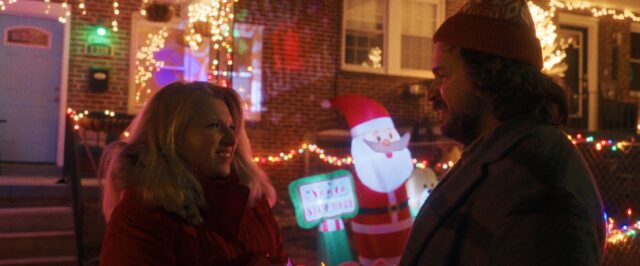
Mojo Lorwin finishes his father’s film, Moi-même, after more than half a century

MOI-MÊME (Mojo Lorwin & Lee Breuer, 1968/2024)
Segal Center Film Festival on Theater and Performance
Anthology Film Archives
32 Second Ave. at Second St.
Saturday, May 17, $10– $14, 3:00
Festival runs May 15– 28
www.thesegalcenter.org
www.anthologyfilmarchives.org

In 1968, experimental theater director, playwright, and poet Lee Breuer began making a black-and-white improvised film during the May 1968 Paris riots, where he was living at the time. He and cinematographer John Rounds shot the footage but never added sound, edited it, or wrote a script. In 1970, Breuer cofounded the seminal New York City company Mabou Mines with Philip Glass, Ruth Maleczech, JoAnne Akalaitis, David Warrilow, and Frederick Neumann, winning numerous Obies among other accolades over the next half century, but he never finished the movie, which itself is about making a movie.

Breuer died in January 2021 at the age of eighty-three; one of his children, Mojo Lorwin, decided to complete the project, hiring voice actors and musicians and serving as writer, director, editor, and producer. The result is the hilarious Nouvelle Vague satire Moi-même (“Myself”), a sixty-five-minute foray into the world of François Truffaut, Jacques Rivette, Jean-Pierre Melville, Agnès Varda, William Klein, and Jean-Luc Godard, who makes a cameo, walking backward as Kevin shares a series of statements ending with “Everything is a movie.”

Kevin Mathewson stars as Kevin (voiced in 2024 by Declan Kenneally), an adolescent who is making a film with his alter ego (Patrick Martin). As he proceeds around town, he meets up with a strange driver (executive producer Russ Moro / 2024 composer Olivier Conan), a movie producer (Frederick Neumann / David Neumann, Frederick’s son), a starlet (Ginger Hall / Clove Galilee, Breuer and Maleczech’s daughter), the son of a baron (Warrilow / David Neumann), an Italian heiress (Renata / Tessie Herrasti), a revolutionary actress (Anna Backer / Tiera Lopper), her replacement (Judy Mathewson, Kevin’s younger sister / Ruma Breuer, Lee’s granddaughter), a sleazy agent (Mark Smith / Alon Andrews), a couple of goons (Pippo and Mike Trane / Frier McCollister), and the owner of a film shop (Lee Pampf / Thomas Cabus). He is often accompanied by his conscience (Maleczech / Alexandra Zelman-Doring) as he faces financial and creative crises.

Lorwin has fun with cinematic and societal tropes while maintaining the underground, DIY feel; for example, he doesn’t match the dialogue exactly to the movement of the characters’ mouths as they make such proclamations as “The movies aren’t fair,” “The movies are a game and everyone who plays is a cheater,” and “All I want is to be seen and heard.” The soundtrack consists of unexpected sound effects and songs and music by Frank LoCastro, Alex Klimovitsky, Eliot Krimsky, Conan, and others.

There’s lots of drinking and smoking, violent shootings, political ranting, discussions of art and love, vapid gatherings, a heist, a touch of psychedelia, and superfluous nudity, nearly everything you could possibly want in a French film.

“Film costs money, more than you’ve got,” the driver barks at Kevin. “Producers are perverts,” Kevin tells the actress while preparing a baby bottle of milk. Unable to afford film reels, Kevin says, “Film is more expensive than love and revolution.”

Describing the film to the agent, Kevin explains, “Here it is: It’s me, but it’s not me. You dig? I mean, it’s the film adaptation of me. I just need a little bread to turn boring old me into moi-même. Feels like doors are finally opening for me.” He delivers the last line as a door opens in front of him.

Perhaps the most important line of dialogue is given to Kevin from a man on the street, who tells him, “There are no rules.” I would add, “Viva la revolución!”

Moi-même is being shown May 17 at 3:00 at Anthology Film Archives as part of the Segal Center Film Festival on Theater and Performance, followed by a Q&A with Lorwin (Summer in the City, 2020 Brooklyn Film Festival) and Kevin Mathewson, moderated by Segal Center executive director Frank Hentschker. The festival runs May 15– 28 at Anthology and the CUNY Graduate Center and includes such other presentations as the North American premiere of Aniela Gabryel’s Radical Move, the US premiere of Sophie Fiennes’s Acting, Pinny Grylls and Sam Crane’s Grand Theft Hamlet, and a Richard Foreman retrospective.

Meanwhile, Mabou Mines (The Lost Ones, The Gospel at Colonus, Dollhouse) is still going strong; their latest piece, This Like a Dream Keeps Other Time, is playing May 15– 18 at their East Village home, @122CC.

[Mark Rifkin is a Brooklyn-born, Manhattan-based writer and editor; you can follow him on Substack here.]

DOOM SCROLLING AT THE APOCALYPSE: THE LAST BIMBO

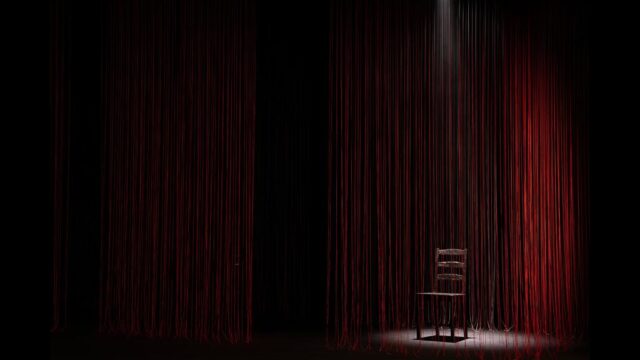
The Worms (Patrick Nathan Falk, Milly Shapiro, and Luke Islam) dig deep into an internet rabbit hole in The Last Bimbo of the Apocalypse (photo by Monique Carboni)

THE LAST BIMBO OF THE APOCALYPSE
The New Group at the Pershing Square Signature Center
The Alice Griffin Jewel Box Theatre
480 West 42nd St. between between Ninth & Tenth Aves.
Tuesday – Sunday through June 1, $38-$94
thenewgroup.org

Michael Breslin and Patrick Foley take an iconic 2006 photo and build an exciting mystery around it in The Last Bimbo of the Apocalypse, zeroing in on the allure of online celebrity through pop-culture obsession.

On November 29, 2006, the New York Post published a cover photograph of Lindsay Lohan, Britney Spears, and Paris Hilton in the front seat of a car with the headline “Bimbo Summit”; the accompanying story was called “3 Bimbos of the Apocalypse — No Clue, No Cares, No Underwear: Meet the Party Posse of the Year,” labeling Britney as Bashful, Paris as Dopey, and Lindsay as Sleepy.

Nearly twenty years later, a young woman known as She/Her Sherlock (Milly Shapiro) has a popular online true crime channel devoted to finding missing girls. “Wars and hurricanes / Botched elections, mass infections / Apocalypse is in my veins,” she sings. “So I stay inside and fixate on / Girls who disappeared / I find what no one sees or hears / I crack crimes in the end times / And I haven’t been outside in four years / No one looked for me / No one looked for me / Which means / I don’t exist unless I’m online / On their screens.” She’s excited by her latest case, announcing, “I’ve never been more stumped! This new girl is from an archaic, regressive, primitive civilization that I know nothing about. I need evidence! I need experts!”

At the same time, a pair of young men, Earworm (Luke Islam) and Bookworm (Patrick Nathan Falk), with their own channel, devoted to ’00s (the “aughts”) pop culture, that rarely gets any viewers at all, are analyzing the Post picture, seen behind them as a painting on a large canvas. “Have you ever wondered how this one photo from twenty years ago created the digital dystopia we live in today?” Earworm asks. When their only viewer logs out, they wonder if their show is over. “No!” Bookworm declares. “The first time I heard you talk about Juicy Couture tracksuits, I felt like I finally understood the cultural context of 9/11.” Earworm responds, “And I never understood why Britney Spears shaved her head until you taught me about Operation Iraqi Freedom.”

Earworm and Bookworm are surprised when Sherlock herself makes a comment, pointing out that there is a fourth girl in the photo: Barely visible extending from the backseat is a hand with a bracelet around the wrist that says Coco. They next show a 2006 video from Coco (Keri René Fuller), a wannabe star who posted a YouTube song called “Something out of Nothing” in which she declares, “I don’t wanna do / Anything / And I wanna be rewarded for it. . . . Uh huh / Gonna shoot a massive blank / Bang bang! / Gonna rob an empty bank / Am I a manifesto or a prank? / I don’t think therefore I am! / The future of this world of cameras! / I’ll take a picture on my phone / And post it so I’m not alone.”

The video tanked and, according to gossipmonger Perez Hilton, Coco was dead a few days later. Rebranding herself Brainworm, Sherlock teams up with Earworm and Bookworm to find out exactly what happened to Coco, but the only other clue they have is a selfie of Coco and two other women in a clothing store with palm trees outside. They zoom in on the photo (re-created by the cast) and decide to refer to the older woman as Coco’s mother (Sara Gettelfinger) and the other as Hoodie Girl (Natalie Walker); the Worms come up with an outrageous murder scenario that they have to abandon, but it sends them down a, well, wormhole as they dig deeper and deeper, especially when the bracelet suddenly appears on Brainworm’s doorstep.

An old selfie provides important clues in world premiere musical from the New Group (photo by Monique Carboni)

Developed and directed by Obie winner Rory Pelsue, who worked with Breslin and Foley on This American Wife and Pulitzer Prize finalist Circle Jerk, and featuring fun choreography by Jack Ferver, The Last Bimbo of the Apocalypse is a lively, appealing ninety-minute pop opera about a group of unique characters trying to figure out who they are and what they want, seeking answers by using social media from the distant (to them) past instead of going out into the current real world. They are terrified of actual contact with other humans; Brainworm hasn’t been outside in four years and hides her face when she is online, having been traumatized by a single cruel comment from an anonymous user when she was twelve. Earworm, who is gay, and Bookworm, who claims he is straight, do not broadcast from the same space but are a thousand miles apart, the former in Staten Island, the latter in Nebraska — and afraid of sharing their true feelings with each other. The three actors might be onstage together, but their fears and physical distance are palpable; they are near but so far.

The book does meander a few times, particularly with references to the old MTV show Total Request Live, but it always manages to come back around, complete with a cool double twist.

Stephanie Osin Cohen’s set consists of a series of concentric semicircles from which various elements occasionally drop down, providing information about the Worms’ search. Amith Chandrashaker’s lighting casts ever-shifting colors across the stage, along with illumination from the phones when things get dark. Cole McCarty’s costumes get funky, from hoodies and T-shirts with emojis to internet chic, while Matthew Armentrout’s hair and wig designs are fab. The sound design, by Megumi Katayama and Ben Truppin-Brown, is loud and clear, effectively shifting between live music and online discussions. The rocking orchestrations are by music director Dan Schlosberg, who plays the keyboards, joined by Jakob Reinhardt on guitar and ukulele, Brittany Harris on bass and cello, and Emma Ford on drums and percussion; the back wall rises whenever the group is performing so we can see them in action.

The cast is an exuberant delight, highlighted by Tony winner Shapiro (Matilda the Musical, You’re a Good Man, Charlie Brown) and Fuller (Six, Jagged Little Pill), who embody the loneliness that comes with online addiction. About halfway through the show, during the song “Stop Scrolling,” a character yells at Brainworm, “You think you know about the world, little girl? You know nothin’! Why don’t you get your own life and live it yourself?” then screams out the chorus: “Stop scrolling! / Stop scrolling! / Log off and live / It’s controlling you! / You will never reach the end of your feed! / This will never fill the pit of your need!” The message is delivered by a villainous figure, but it still packs a punch and strikes a nerve, for the Worms and the audience.

In 2006, many young girls considered Lindsay, Britney, and Paris role models. In her program note, one of the dramaturgs, Ariel Sibert, writes, “On TikTok, I see a lot of comments from Millennials under videos of enlightened high schoolers explaining economic inequality, or teaching their homeroom teacher what ‘twink death’ means — comments like, ‘the kids are alright’ [emojis]!!! Are the kids alright, really? Have you checked? Were they ever alright? I mean, were you?”

As the internet age continues and we all spend more and more time on our devices, are any of us alright?

[There will be a series of talkbacks taking audiences behind the scenes of the making of The Last Bimbo of the Apocalypse, including “Designing The Last Bimbo of the Apocalypse and the Y2K Era” on May 17 at 2:00 with Armentrout, assistant costume designer Jason A. Goodwin, fashion designer Cynthia Rowley, and dramaturg Cat Rodríguez; LGBTQ+ Night on May 22, moderated by Preston Crowder; and on May 27 a conversation with the cast and creative team, moderated by Bryan Campione.]

[Mark Rifkin is a Brooklyn-born, Manhattan-based writer and editor; you can follow him on Substack here.]
BOOKS & ODDITIES: THE INAUGURAL CONEY ISLAND BOOK FAIR

CONEY ISLAND BOOK FAIR
Coney Island USA
1208 Surf Ave.
Saturday, May 10, fair free, panels $20, variety show $25, $40 for both
www.coneyislandbookfair.org

Coney Island has been a poignant location in such books as Lawrence Ferlinghetti’s A Coney Island of the Mind, Sol Yurick’s The Warriors, Joseph Heller’s Now and Then: From Coney Island to Here: A Memoir, Billy O’Callaghan’s My Coney Island Baby, and Alice Hoffman’s The Museum of Extraordinary Things.

The Brooklyn home of the Cyclone, the Wonder Wheel, Luna Park, and the New York Aquarium is now taking the next step in its literary history with the inaugural Coney Island Book Fair, done in its usual style, with more than a touch of freaky entertainment. On May 10, there will be four panel discussions, books for sale, art vendors, jewelry, food and drink, and a concluding variety show with special guests. Below is the full schedule.

Buy Books & Oddities!, book fair, Shooting Gallery Annex, free, noon – 6:00

Sip, Search, and Swap Stories!, Freak Bar, noon – last call

Writing the City: New York as Muse, with Eddie McNamara, John Strausbaugh, and Laurie Gwen Shapiro, moderated by Heather Buckley, 1:00

Writing the Creepy: Books That Go Bump in the Night, with Leila Taylor, S. E. Porter, Colin Dickey, Alix Strauss, and Sadie Dingfelder, moderated by Laetitia Barbieri, 2:00

Writing the Shimmy: The Politics of Pasties and Performance, with Jo Weldon, Linda Simpson, and Elyssa Goodman, moderated by Ilise S. Carter, 3:00

Writing the Bally: Sideshow as a Main Character, with James Taylor, Jim Moore, and Dawn Raffel, hosted by Trav S.D., 4:00

Body of Work: A Literal Literary Variety Show, with Jo Weldon, Johnny Porkpie, Fancy Feast, Victoria Vixen, Garth Schilling, and more, hosted by journalist, author, writer, sword swallower, fire-eater and straitjacket escape artist the Lady Aye, $25, 7:00

[Mark Rifkin is a Brooklyn-born, Manhattan-based writer and editor; you can follow him on Substack here.]

DISCOVERING JAPAN: CONCERT, PARADE, AND STREET FAIR CELEBRATION

Japan Parade and Street Fair returns to NYC May 10 (photo courtesy Japan Parade)

Who: Masaharu Morimoto, Sayaka Yamamoto, Sandra Endo, the cast of ATTACK on TITAN: The Musical, Koji Sato, Soh Daiko, COBU, Taiko Masala Dojo, Harlem Japanese Gospel Choir, Japanese Folk Dance Institute of NY, Yosakoi Dance Project — 10tecomai / KAZANAMI, IKO Kyokushinkaikan, New York Kenshinkai, Anime NYC, Miyabi Koto Shamisen Ensemble, more
What: Japan Parade and Street Fair and Japan Night concert
Where: Parade: Central Park West between Sixty-Eighth & Eighty-First Sts.; concert: Edison Ballroom, 240 West Forty-Seventh St.
When: Concert: Friday, May 9, $81.88-$108.55, 5:30; parade and street fair: Saturday, May 10, free, 11:00 – 5:00
Why: The fourth annual Japan Parade and Street Fair takes place on May 10, celebrating the long friendship between the United States and Japan. Among the many participants in the parade, which kicks off at 1:00 at Central Park West and Eighty-First St. (the opening ceremonies are set for 12:30 at West Seventy-First St.), will be the cast of ATTACK on TITAN: The Musical, Hello Kitty, My Melody, Kuromi, taiko drummers, Japanese dance troupes, martial arts organizations, language schools, a gospel choir, singer-songwriter Sayaka Yamamoto, and members of Anime NYC. The grand marshal is Iron Chef restauranteur and author Masaharu Morimoto, the community leader is JAANY president Koji Sato, the honorary chairman is Ambassador Mikio Mori, and the emcee is television news correspondent Sandra Endo. In addition, there will be a street fair from 11:00 to 5:00 on West Seventy-Second St. between CPW and Columbus Ave., featuring food and drink, calligraphy, Yukata, origami, tourist and cultural information, a donation tent, prizes, and more.

“I am deeply honored to be appointed the grand marshal of this year’s Japan Parade in New York City,” Chef Morimoto said in a statement. “This role gives me a unique opportunity to celebrate and share the rich, dynamic culture of Japan with the heart of one of the world’s most vibrant cities.”

The parade will be preceded on May 9 by Japan Night at the Edison Ballroom in the Theater District, with performances by the cast of ATTACK on TITAN: The Musical, Miyabi Koto Shamisen Ensemble with Masayo Ishigure, and Sayaka Yamamoto, the former captain of NMB48, in addition to a sake tasting and a crafts presentation by ASP Group. The event will be hosted by NBC News correspondent Emilie Ikeda; tickets are $81.88-$108.55.

“The Japan Parade, a community-wide effort, represents the interwoven cultural and economic ties between Japan and New York, reflecting — and deepening — the strong alliance between Japan and the US,” Ambassador Mori added. “And right now, with the world in considerable need of unity, goodwill, and hope, Japan–US relations are more vital than ever, demonstrating what can be accomplished by working together towards common goals. So, by extension, the Japan Parade is also vital — the greater the celebration, the greater our cooperation!”

[Mark Rifkin is a Brooklyn-born, Manhattan-based writer and editor; you can follow him on Substack here.]
NOVA REN SUMA WAKES THE WILD CREATURES AT McNALLY JACKSON

Who: Nova Ren Suma, Libba Bray
What: New York City launch of Wake the Wild Creatures
Where: McNally Jackson SoHo, 134 Prince St.
When: Wednesday, May 7, seat $5, book and seat $18.99, 6:30
Why: At first it was beautiful. A hunter’s moon hovered in the sky, tremendous and pulsing with light, making the air glow warm all around me. I was spending the night out on my own, near the perimeter marked with subtle symbols and stones, wandering for the joy of it, then running because I could. I lost hold of time passing, or maybe the hours themselves held still. Tree bodies everywhere. Knotted oak shoulders and the rough, ridged skin of red spruce and tall firs. The forest I’d known all my life was awake, and so was I: two quick legs whipping through the bright-gold dark, more animal than girl.

I reached the clearing with the seven white pines, their heads thrust up, and stopped to get my breath back. The mist filled my lungs, peppery and also sweet, and the momentum pushed me forward, but I wasn’t about to go farther than where I could see from this cliff edge. I wouldn’t dare. Giddy, I dropped into a bed of moss, soft and slick in spots, and rolled in it, howled for no reason, felt close to an understanding of some kind, as if an eye inside me was peeling open. It was the first full moon after I turned thirteen, and I knew that whatever happened in this next stretch of hours would change me forever after.

I wasn’t wrong.

So begins #1 New York Times bestselling author Nova Ren Suma’s latest thrilling novel, Wake the Wild Creatures (Little, Brown Books for Young Readers, May 6, $18.99). The book is divided into eleven chapters, including “Light in the Forest,” “Strange Land,” and “Monsters,” telling the story of a teenager whose life is upended when her mother is arrested at an abandoned Catskills hotel where a group of women have built their own community, away from society.

In the April 12 edition of her newsletter, “The Words Around Us,” Suma explains, “It was the height of lock-down, when I couldn’t leave my house except for groceries, when I became obsessed with infamous lost places. I found myself fixated on mysterious and often mythical places in the world that aren’t always findable on maps, places where people disappear, places where tragic things are known to happen, places that have been lost — the Bermuda Triangle, Aokigahara Forest, Roanoke, Lemuria. I collected urban legends about mysterious places that couldn’t be found a second time — such as a gas station off a highway where someone stopped in the middle of the night and yet swore they never saw on that same road again, no matter how many times they drove it. Or a part of the forest glimpsed down a hidden path that could never be reached afterward, no matter how many times someone went searching. These places fascinated me. (Writers who’ve worked with me know how much I love a list of fascinations!) But many of these legends have unhappy endings and frightening underbellies, and I didn’t want to write a horror story. I had it in mind to write about a place you’d want to find . . . because the world outside is the horror.”

Suma, the author of such other novels as The Walls Around Us, A Room Away from the Wolves, and 17 & Gone, read an advance excerpt from her debut YA novel, Imaginary Girls, at twi-ny’s tenth anniversary party at Fontana’s in 2011. As with all her work over the last fourteen years, it is clear in Wake the Wild Creatures how painstaking a writer she is; every word, every sentence has a potent immediacy, with nothing extraneous seeping in. She is a master storyteller who devises unique, surreal plots that are all too real.

(photo courtesy Nova Ren Suma on Instagram)

Suma told twi-ny, “Writing Wake the Wild Creatures changed and challenged me as a person in a different way than all of my previous books. Yes, this was a hard book to write and articulate in the way I thought the story deserved, and it took me more time than I ever imagined, but I mean beyond that. This was the book that faltered and re-found its footing during the pandemic. This was the book that made me face my own pessimistic ideas about humanity and our collective future and consider the ways my own small life could be approached in a different and more courageous way. In this story there is an off-grid community hidden away in an old abandoned hotel in the Catskill Mountains, and they have turned their backs on broken society below. Writing this place — the Neves — helped me find hope again and allowed me to see a way to the future. I most want the book to find its readers and perhaps help do the same for them.”

She added, “Everything feels different on the other end of writing this novel. I lost my editor while I was writing this book (don’t worry, she’s okay! She’s a literary agent now!), and I’m happy to say we did get to finish our editorial work together. But the tumult wasn’t over. I then lost two more editors. My longtime publisher, the beloved Algonquin Young Readers, was shuttered. I have since found a new publishing home in Little, Brown, and I’m completely surprised that I landed on my feet, yet I still feel so dazed about where I was when I started . . . and where (and who) I am now. I write these words from a train as I head out on my first-ever pub week book tour, a publishing dream I never dared allow myself to wish for because I didn’t think it could happen to me. But no matter what happens with this book out in the world, I know what I put on the page: the story I most needed to tell in this current moment.”

The book tour brings Suma to McNally Jackson SoHo on May 7, joined by Printz Award–winning author and playwright Libba Bray (Under the Same Stars, Going Bovine) for a conversation and signing. Admission is $5 for a seat or $18.99 for a seat and a copy of Wake the Wild Creatures.

[Mark Rifkin is a Brooklyn-born, Manhattan-based writer and editor; you can follow him on Substack here.]

CHILDS, CHU, AND ASSAF: GIBNEY AT THE JOYCE

Gibney Company will be at the Joyce May 6–11 with three premieres (photo by Hannah Mayfield)

GIBNEY COMPANY
The Joyce Theater
175 Eighth Ave. at Nineteenth St.
May 6–11, $62-$82
www.joyce.org
gibneydance.org

“This season at The Joyce embodies what Gibney Company stands for — bringing together choreographers with distinct voices, movement languages, and artistic philosophies to shape a program that challenges, inspires, and moves us,” founding artistic director and CEO Gina Gibney said in a statement. “Lucinda Childs, Peter Chu, and Roy Assaf each bring a unique lens to dance, offering profoundly different yet equally compelling perspectives on how movement can communicate, resonate, and evolve.”

The New York–based dance and social justice troupe will be at the Joyce May 6–11, presenting three works. The evening begins with the US premiere of Roy Assaf’s A Couple, a fifteen-minute duet about relationships, set to music by Johannes Brahms performed by Glenn Gould and featuring “Perhaps you are a couple” text by Ariel Freedman; the pairings will be Graham Feeny and Zack Sommer, Madison Goodman and Lounes Landri, and Madi Tanguay and Andrew McShea.

The bill continues with two world premieres, first Peter Chu’s Echoes of Sole and Animal. The full company, consisting of Tiare Keeno, Jie-hung Connie Shiau, Feeny, Sommer, Goodman, Landri, Tanguay, and McShea, explore how sound shapes space, with movement inspired by animal Qi Gong and Taiji philosophies in search of human compassion and connection, with music and sound design by Djeff Houle in addition to immersive guitarist Ferdinand Kavall’s 2024 “Flageolets.” Chu also designed the costumes with Victoria Bek.

The program concludes with Lucinda Childs’s Three Dances (for prepared piano) John Cage, which takes Childs back to her Judson days, examining transdisciplinarity and formalism through structured repetition. The twenty-minute work, performed by all eight dancers, is set to recordings of Cage’s 1944–45 three-part piece played by Xenia Pestova and Pascal Meyer.

“Gibney Company is built on the idea that dance is a conversation — between artists, disciplines, traditions, and generations,” company director Gilbert T. Small II added. “This program brings together choreographers whose work is shaped by their histories, their influences, and the questions they explore through movement. We are honored to collaborate with such extraordinary artists whose work expands the boundaries of contemporary dance.”

Some shows are nearly sold out, so act fast to get tickets. The May 8 performance will be followed by a Curtain Chat with Childs and biophysicist and applied mathematician Dr. Michael Shelley, who participated together in the Open Interval residency combining dance and science.

[Mark Rifkin is a Brooklyn-born, Manhattan-based writer and editor; you can follow him on Substack here.]

FOOTBALL AS AMERICA: MATTHEW BARNEY AT METROGRAPH

Matthew Barney’s multichannel Secondary will be shown on a single screen at Metrograph (image © Matthew Barney, courtesy of the artist, Gladstone Gallery, Sadie Coles HQ, Regen Projects, and Galerie Max Hetzler)

SECONDARY
Metrograph
7 Ludlow St. between Canal & Hester Sts.
Saturday, May 3, 5:00
metrograph.com
secondary.matthewbarney.net
online slideshow

It was the hit heard round the world.

On August 12, 1978, the New England Patriots were playing a preseason game against the Oakland Raiders at Oakland-Alameda County Coliseum. Late in the second quarter, the Pats have a third and eight at the Raiders twenty-four-yard line. QB Steve Grogan calls the 94 Slant, and wide receiver Darryl Stingley heads downfield. At the ten-yard line, Stingley reaches for the overthrown pass and is crushed in midair by two-time Raiders All-Pro safety Jack Tatum, known as the Assassin for his punishing style of play. Stingley immediately crumples to the ground. Four Oakland defenders look down at Stingley and walk away; Patriots wide receiver Russ Francis stands over his fallen teammate, knowing something is wrong. The twenty-six-year-old Stingley is wheeled off the field on a stretcher, a quadriplegic for the rest of his life; he died in 2007 at the age of fifty-five. Tatum wasn’t penalized on the play and never apologized to Stingley, claiming it was a legal hit and that he had done nothing wrong. Tatum, who died in 2010 at the age of sixty-one, was also involved in the Immaculate Reception on December 23, 1972, in a playoff game against the Steelers; with twenty-two seconds left and Pittsburgh down by one, future Hall of Famer Terry Bradshaw was facing a fourth and ten from his own forty. He ran to his right and threw a pass down the middle. Tatum smashed into Steelers running back Frenchy Fuqua, the ball popped up into the air, and future Hall of Famer Franco Harris picked it up by his shoestrings and ran forty yards into the end zone for the winning score.

Filmmaker and installation artist Matthew Barney was eleven years old when Tatum pummeled Stingley. Seeing the collision over and over again on replay did not prevent Barney from becoming a star quarterback in high school in Idaho. But at Yale, he switched from sports to art, beginning his “Drawing Restraint” series in 1987 and making his Jim Otto Suite in 1991–92, about orifices, bodily fluids, energy, Harry Houdini, and Raiders Hall of Fame center Jim Otto, who wore the number double zero, mimicking the letters at the beginning and end of his palindromic last name.

Violence in football takes center stage as a metaphor for America in Matthew Barney’s Secondary (image courtesy Matthew Barney Studio, © Matthew Barney / photo by Julieta Cervantes)

In 2023, Barney said farewell to his longtime Long Island City studio with Secondary, a five-channel video installation that used the Tatum-Stingley play to explore violence in athletic competition. Barney transformed the studio, which was right on the East River, into a football stadium, with a long, artificial turf surface divided into geometric patterns of different colors, centered by his “Field Emblem,” his Cremaster logo, an ellipse with a line going through it, evoking –0-. There were monitors in all four corners of the field, along with a three-sided mini-jumbotron hanging from the ceiling. Visitors could sit on the field or a bench; there was also a painting on the wall, an owners booth filled with football paraphernalia, and a ditch with broken piping and mud dug into the concrete. Outside, on the facade facing the water, there was a digital countdown clock next to graffiti that said, “Saboroso,” which means “delicious.”

Written and directed by Barney, photographed by Soren Nielsen, and edited by Kate Williams, the film — which lasts sixty minutes, the length of a football game — has now been reimagined on a single screen, where it will be shown at Metrograph on May 3 at 5:00, in conjunction with the publication of a two-volume companion book (Rizzoli, April 2025, $115), featuring contributions from Eric Banks, Jonathan Bepler, Raven Chacon, Mark Godfrey, Juliette Lecorne, Helen Marten, Maggie Nelson, and David Thomson; Barney will be at Metrograph for a postscreening discussion with book editor Louise Neri and Banks, followed by a reception with signed books available for purchase.

The multichannel version kicks off with indigenous rights activist Jacquelyn Deshchidn, a Two-Spirit Chiricahua Apache and Isleta Pueblo soprano, composer, poet, and public speaker, performing an alternate national anthem, a none-too-subtle jab at a league that still has teams using offensive Native American names and imagery. The cast, primarily consisting of dancers and choreographers, features movement director David Thomson as Stingley; Raphael Xavier as Tatum; Shamar Watt as Raiders safety Lester “the Molester” Hayes; Wally Cardona as Grogan; Ted Johnson as Francis; Isabel Crespo Pardo, Kyoko Kitamura, and Jeffrey Gavett as the line judges and referees; Barney as Raiders Hall of Fame QB Ken “the Snake” Stabler, who died of colon cancer but was discovered to have had high Stage 3 chronic traumatic encephalopathy (CTE), the disease that affects so many football players, brought on by getting hit so much in the head; and Thomas Kopache as Raiders owner Al Davis, whose motto was “Just win, baby,” no matter the cost. (Football fans will also notice cameos by actors portraying such Raiders favorites as wide receiver Fred Biletnikoff and defensive end John “the Tooz” Matuszak, who became an actor and died in 1989 at the age of thirty-eight from an opioid overdose.) The actors are generally much older than the people they represent, several of whom never made it to the age the performers are today.

The experimental film does not have a traditional chronological narrative; instead, Barney focuses on Tatum, Hayes, and Stingley training in slow motion in equipment rooms as if preparing for a ballet, Grogan making a football out of a gooey substance and then practicing with it, members of Raiders Nation shouting and cheering in fierce black-and-silver Halloween-like costumes, and players venturing into the muddy ditch, the broken pipe echoing Stingley’s shattered body. The music, by sound designer Jonathan Bepler, envelops the audience in a parade of noises, from hums and breathing to clangs and screams. Shots of the Manhattan skyline and the East River beckon to another life outside. The screens sometimes display the same footage, while other times they are different; it is like the viewer is at a football game, with the choice whether to watch the quarterback, the defensive alignment, or other fans in the stands. There is no actual pigskin in the film.

Matthew Barney turned his LIC studio into a multimedia installation (photo by twi-ny/mdr)

The game of football has always been lionized for its violence. Even as the league changes rules to try to protect the quarterback, kick returners, and receivers, the sports networks repeatedly show brutal hits like the one on Dolphins quarterback Tua Tagovailoa against the Cincinnati Bengals that resulted in severe head and neck injuries. When we think of Washington Redskins quarterback Joe Theismann, the first thing we remember is the career-ending injury he suffered on Monday Night Football in 1985 at the hands of New York Giants linebackers Lawrence Taylor and Harry Carson, brutally shattering his leg, and not his 1982–83 MVP season when he led his team to a Super Bowl victory over the Dolphins.

But Barney (River of Fundament, “Subliming Vessel”) is not merely commenting on football. Secondary is about America itself, its rituals and celebrations, its embracing of violence on and off the field. It’s about our lack of respect for the human body and one another, about a country torn apart into blue and red states like opposing teams, ready to do whatever is necessary to just win, baby.

[Mark Rifkin is a Brooklyn-born, Manhattan-based writer and editor; you can follow him on Substack here.]