this week in lectures, signings, panel discussions, workshops, and Q&As

THE VT SHOW

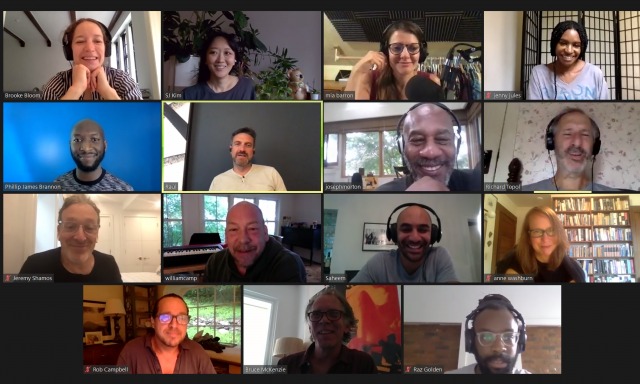
The Vt Show features special guests in Vineyard Theatre livestreams

Who: Creators of Lessons in Survival
What: Live discussion series
Where: Vineyard Theatre YouTube channel and Facebook Live
When: September 29, free, 5:30 (new programs the last Tuesday of each month)
Why: Vineyard Theatre continues its live, interactive program The VT Show on September 29 at 5:30 with an inside look at its upcoming series Lessons in Survival, in which a collective called the Commissary reenacts historic speeches, interviews, and conversations from activists and artists during revolutionary times. LIN, which kicks off October 6, was conceived by Marin Ireland, Peter Mark Kendall, Tyler Thomas, and Reggie D. White and features such episodes as “Survival Is Not a One Time Decision,” “I’m Trying to Make You See Something,” and “When You Say Revolution . . . What Do You Mean?” Among the participants are Kyle Beltran, Dan Butler, Helen Cespedes, Crystal Dickinson, Brandon J. Dirden, Nicole Lewis, Joe Morton, Deirdre O’Connell, and Keith Randolph Smith performing the words of Nina Simone, Lorraine Hansberry, James Baldwin, Angela Davis, Fannie Lou Hamer, Maya Angelou, Toni Morrison, Nikki Giovanni, and others. Future episodes of The VT Show will air on October 27 and November 24; you can catch previous episodes here, including talks with Whitney White, Ngozi Anyanwu, Cornelius Eady, Colman Domingo, Tina Satter, Emily Davis, Michael R. Jackson, Lileana Blain-Cruz, Judy Kuhn, and Anika Noni Rose.

NETFLIX’S THE SOCIAL DILEMMA Live Discussion and Q&A

Who: Jeff Orlowski, Tristan Harris, Tim Kendall, Cathy O’Neil, Rashida Richardson, Katie Couric
What: Live discussion and Q&A about The Social Dilemma
Where: 92nd St. Y online
When: Tuesday, September 29, free, 7:30
Why: If you’ve ever wondered why you can’t pull yourself away from Facebook, Twitter, Pinterest, Instagram, or any of the other social media platforms, writer-director Jeff Orlowski’s The Social Dilemma has the answers, and it’s not a pretty picture. The feature documentary, streaming on Netflix, investigates the big business behind keeping everyone addicted to these sites through manipulative algorithms that work hard to not let you go. Orlowski (Chasing Coral, Chasing Ice) speaks with men and women who worked for the social network giants, in addition to tech experts and lawyers, and what they have to tell us is downright frightening; in addition, scripted narrative segments follow a young man (Skyler Gisondo) who represents how each one of us can be controlled by Silicon Valley. You can find out more on September 29 at 7:30 when the 92nd St. Y hosts a free, live discussion and Q&A with Orlowski and several people who appear in the film: former Google Design ethicist and president and cofounder of the Center for Humane Technology Tristan Harris, former Facebook director of monetization and current Moment CEO Tim Kendall, data scientist and ORCAA founder Cathy O’Neil, and civil rights lawyer and Rutgers visiting scholar Rashida Richardson, moderated by journalist Katie Couric.

ARTISTIC INSTIGATORS: WHAT THE HELL IS A REPUBLIC, ANYWAY?

NYTW Usual Suspects Denis O’Hare and Lisa Peterson explore the future of our democracy in four-part What the Hell Is a Republic, Anyway?

Who: Denis O’Hare, Lisa Peterson, Roberta Stewart, Sonia Sabnis, Jeffery Robinson, more
What: Live, interactive performance/discussion series
Where: New York Theatre Workshop Zoom
When: Select Tuesdays through November 2, $10, 7:00
Why: The pandemic lockdown has forced theater companies to reinvent themselves without access to indoor venues where audiences sit and watch live performance. Amid benefit reunion readings, panel discussions, Q&As, master classes, workshops, and Zoom microplays, several troupes have established innovative online presences, including Red Bull, the Irish Rep, and the New Group here in New York City. Now downtown institution New York Theatre Workshop is expanding its programming for the upcoming fall season with the aptly titled “Artistic Instigators.” The project kicked off September 22 with the first episode of What the Hell Is a Republic, Anyway?, a live, interactive performance-discussion series comparing America with the Roman Empire and its notorious collapse. Republic is developed by Tony- and Obie-winning actor and playwright Denis O’Hare and two-time Obie-winning writer and director Lisa Peterson, longtime friends whose previous collaborations include An Iliad (NYTW, 2012) and The Good Book. The inaugural show, “Rome & America: Joined at Birth,” featured Dartmouth classical studies professor Roberta Stewart (there are two encore livestreams September 27 and October 5); the schedule continues October 6 with “Citizenship,” in which O’Hare (Take Me Out, American Horror Story) and Peterson (The Waves, Slavs) are joined by Reed College classics and humanities associate professor Sonia Sabnis, October 20 with “How Republics Fall Apart,” and November 2 with “The Election,” where they will speak with ACLU Trone Center for Justice and Equality deputy legal director Jeffery Robinson. (You can learn more about the series in this Token Theatre Friends interview.)

You can still catch many of NYTW’s previous online presentations here, including fireside chats with playwright Doug Wright, scenic designer Rachel Hauck, playwright Celine Song, Penny Arcade, Thaddeus Phillips, playwright Martyna Majok, director Rebecca Frecknall, actor, director, and playwright Ruben Santiago-Hudson, and Peterson; master classes and talks with playwrights Jeremy O. Harris and Mfoniso Udofia, directors Whitney White and Lileana Blain-Cruz, scenic/costume designer Adam Rigg, and actresses Celia Keenan-Bolger and Elizabeth Marvel; jam sessions with Martha Redbone and Aaron Whitby and Daniel & Patrick Lazour; the “How to Grab Your Audience without Even Touching Them” cabaret workshop with performer Dito van Reigersberg; and discussions dealing with contemporary sociopolitical issues. NYTW has also announced that the fall season will consist of The Seagull on Sims 4 by Song; Victor I. Cazares’s Pinching Pennies with Penny Marshall, Redbone and Whitby’s work-in-progress The Talking Circles, Ayad Akhtar’s solo piece Trump Is Just the Name of His Story, The Cooking Project, and Theater Mitu’s remnant, with the hope that some of these will happen in person, live onstage, with some kind of audience.

AMERICAN DREAMS

The online audience gets to pick the winner in American Dreams

Who: Andre Ali Andre, Leila Buck, India Nicole Burton, Jens Rasmussen, Imran Sheikh, Andrew Valdez
What: Live interactive production of American Dreams
Where: Multiple sites online
When: September 26 – November 15, free – $30
Why: Since January 2017, America has been led by a reality TV host, a man obsessed with ratings. So it’s more than fitting that Leila Buck’s 2018 play, American Dreams, which is set up as a game show, is being reimagined for an interactive, online experience now that theaters are closed because of the pandemic. First staged at the Cleveland Public Theatre two years ago, the work is going virtual, with live performances streaming September 26 to November 15 through Working Theater, Round House Theatre, Salt Lake Acting Company, Marin Theatre Company, HartBeat Ensemble, the Bushnell Center for the Performing Arts, and University of Connecticut’s Thomas J. Dodd Center, each one setting its own prices, from free to $30. Co-commissioned by ASU Gammage and Texas Performing Arts, the seventy-five-minute work is directed by Tamilla Woodard (Men on Boats, Yellow Card Red Card) and will be performed by Andre Ali Andre, India Nicole Burton, Jens Rasmussen, Imran Sheikh, Andrew Valdez, and Buck, with video design by Katherine Freer, virtual performance design by ViDCo, scenic design by Ryan Patterson, costumes by Kerry McCarthy, sound by Sam Kusnetz, and lighting by Stacey Derosier. “American Dreams is a play that needs to happen now as we are approaching an election,” Working Theater co-artistic director Mark Plesent said in a statement. “I think that the American Experiment is failing on so many levels. American Dreams offers us a safe opportunity, full of humor, to experience our individual complicity in the dangers facing our nation, and also points to ways to change course, beginning with ourselves.”

It is strongly advised that you watch on your computer, not your phone or tablet, and you can choose your own level of participation, with trivia and polls as you decide which of three immigrants gets to win American citizenship over the course of five rounds; there will also be live discussions about the play and immigration throughout the nation. “Though our theater buildings may be closed, the need to gather around provocative storytelling is still present,” Working Theater co-artistic director Woodard said in a statement. “With this unique partnership we get to do something we most certainly wouldn’t have been able to do before — create a national collaboration with nine institutions and theaters across the country to activate audiences in local conversations about immigrants rights, the power of the vote, and what it means to be a citizen. The agility all of the producing partners are able to bring to this collaboration is truly remarkable. Their appetite for innovation and invention is inspiring. This is the power of theater that makes room for radical access, radical inclusion, and a new model of collaboration.” Woodard knows of what she speaks; in 2013 she directed the powerful La Ruta, in which a small audience sat in the back of a truck, where they were made to feel like they were being transported illegally over the Mexican border and into the United States, danger at the ready. American Dreams might be more fun, but it’s no less relevant or important.

MARTHA MATINEES: THE EVE PROJECT

Martha Graham Dance Company concludes The Eve Project with livestream September 23 & 26 (photo copyright Martha Graham Center of Contemporary Dance, Inc.)

Who: Martha Graham Dance Company
What: Finale of The Eve Project
Where: Martha Graham Dance Company YouTube
When: Wednesday, September 23, and Saturday, September 26, free, 2:30
Why: Martha Graham Dance Company’s “Martha Matinees” series continues this week with the conclusion of The Eve Project, its celebration of the one hundredth anniversary of the ratification of the Nineteenth Amendment, which gave women the right to vote, as well as honoring the current renewed focus on gender and power. On September 23 and 26 at 2:30, MGDC will stream Julien Bryan’s 1935 film of Martha Graham performing Frontier: American Perspective of the Plains, which pays tribute to the spirit of pioneer women; a recent performance of Errand into the Maze with Charlotte Landreau and Lloyd Mayor; and the premiere of 19 Poses for the 19th Amendment, an Instagram challenge that asked people to re-create any of nineteen photos of Graham performing such poses as “Prelude to Action,” “Masque,” and “Spectre 1914” from Chronicle, “Clytemnestra,” “Phaedra,” “Satyric Festival Song,” “American Document” and “Primitive Mysteries.”

“Experimentation with technology has always been a significant part of how we make our work accessible to all audiences,” artistic director Janet Eilber, who hosts the “Martha Matinees” livestreams, explained in a statement. “Our use of media onstage and off, our interactive projects online, and our substantial presence on social media have prepared us to face the digital urgency of the Covid crisis. Our ninety-fifth season will be enhanced by the new, virtual journeys we are creating — coordinating our many online events and offering context to the depth and breadth of the Graham legacy and all we do to move into the future. Our dancers are not only nimble onstage but in the creation of online artistry.” Head over to the MGDC YouTube page to see such previous virtual presentations as Immediate Tragedy, Larry Keigwin’s Lamentation Variation, Justin Scholar’s Eve Forging, Landreau’s Opus One, and So Young An and Lloyd Knight in . . . Remember. . . .

COLLECTIVE TRAUMA SUMMIT 2020: THE POWER OF COLLECTIVE HEALING

Who: Hosts Thomas Hübl, Dr. Laura Calderón de la Barca, Kosha Joubert, Robin Alfred, and Anna Molitor, and more than forty guests
What: Live guided experiences, performances, artist dialogues
Where: Collective Trauma Summit
When: September 22 – October 1, free with registration
Why: It’s been a rough 2020, and it seems to only be getting worse. We could all use a bit of healing, and that’s just what the Collective Trauma Summit seeks to do. The virtual conference runs September 22 through October 1 with ten live events in addition to numerous prerecorded talks and performances, featuring music, poetry, panel discussions, guided experiences, and more with Sharon Salzberg, Priya Parker, Jacqueline Novogratz, Daniel J. Siegel, Melanie Goodchild, Joy Harjo, David Whyte, Marie Howe, Pádraig Ó Tuama, Li-Young Lee, Naomi Shihab Nye, Jami Sieber, Krishna Das, Dr. Srini Pillay, Margaret Wheatley, Yehudit Sasportas, Xiuhtezcatl, and many others. Among the topics are “The Link between Personal Trauma and Collective Trauma,” “How Neuroscience Can Inform Approaches to Trauma Healing,” “How to Become Aware of Unresolved States and Heal Them,” “The Future of Collective Healing Processes and Methods,” “How Communities Can Transform Themselves,” “Practices for Engaging the Wisdom of the Body,” “Working with Inherited Family and Ancestral Trauma,” “Transforming Cycles of Violence and Cultural Trauma,” and “Using Trauma as a Call to Service and Self-Transcendence.” The hosts are Thomas Hübl, Dr. Laura Calderón de la Barca, Kosha Joubert, Robin Alfred, and Anna Molitor. “Trauma is not just a personal experience. It is always embedded in a much wider chain of events and history. Examining our collective trauma is the way to tap into the evolutionary intelligence of humanity,” explains Hübl, the founder of the Academy of Inner Science and author of the forthcoming book Healing Collective Trauma. Admission is free; below are the live events.

Tuesday, September 22, noon
“Awakening to the Nature of Collective Trauma,” with Thomas Hübl, Laura Calderón de la Barca, Robin Alfred, Kosha Joubert, and Anna Molitor, music by Adam Bauer, and poetry by Kim Rosen

Wednesday, September 23, noon
“Uncovering Our Cultural Trauma Conditioning,” with Thomas Hübl, host Robin Alfred, music by Adam Bauer, and poetry by Kim Rosen

Thursday, September 24, noon
“Exploring Our Roots and Ancestral History,” with Thomas Hübl, host Kosha Joubert, music by Adam Bauer, and poetry by Kim Rosen

Friday, September 25, noon
“The Art of Peacemaking: Mediating Conflicts in a Traumatized Field,” with William Ury, host Kosha Joubert, and panelists Ameya Kilara and Claire Hajaj

Saturday, September 26, 1:00
“Collective Healing and Structural Inequality: A Contemplative Walk,” with Thomas Hübl, Angel Acosta, and host Laura Calderón de la Barca

Saturday, September 27, noon
“Poetry as a Gateway to Collective Healing,” with Marie Howe, Pádraig Ó Tuama, and host Anna Molitor

Tuesday, September 29, noon
“The Pocket Project: Activating the Power of Group Coherence,” with Thomas Hübl, Yehudit Sasportas, Kosha Joubert, and Laura Calderón de la Barca

Thursday, October 1, noon
“Climate Crisis: Restoring Our Relationship to the Earth,” with Thomas Hübl, host Kosha Joubert, and music by Adam Bauer

KAJILLIONAIRE

Kajillionaire follows a family of minor-league grifters struggling to pay the rent

KAJILLIONAIRE (Miranda July, 2020)
Opens theatrically September 25
Live virtual red carpet with Q&A September 24; live Q&A September 28
www.focusfeatures.com
www.mirandajuly.com
www.bam.org

Miranda July’s third feature is another wholly original, endlessly inventive tale, this time about a rather unusual family with a unique approach to their day-to-day life. The follow-up to July’s 2005 engaging romantic comedy, Me and You and Everyone We Know, and her 2011 eccentric domestic drama, The Future, Kajillionaire is a family portrait of the Dynes, a trio of extremely low-level con artists whose dynamic changes considerably with the addition of a new member.

Evan Rachel Wood is sensational as Old Dolio, the twenty-six-year-old daughter of Theresa (Debra Winger) and Robert (Richard Jenkins) Dyne. Although a practical reason is given for her name, Dolio, the word is the preterite form of the Spanish verb doler, which means “to hurt.” And Old Dolio is hurting something fierce, even if she and her parents don’t realize it. The three of them appear to live on their own planet, in their own time and space. They pull off absurdly tiny swindles in order to try to keep up with their meager rent. They live in a vacated office next to a company that manufactures bubbles; twice a day (and three times on Wednesday), pink bubbles start flowing down the far wall in their “home,” so they have to be sure to be there at those designated hours to catch the bubbles in garbage cans and steer them down the drain to avoid flooding. July adds wacky moments of physical comedy each time they have to get to their door without their strange landlord, Stovik (Mark Ivanir), seeing them and demanding money. It’s both hysterically funny and hugely pathetic, but there’s a beautiful magic to it, reminiscent of the peeling wallpaper in the Coen Brothers’ Barton Fink. It’s also representative of their Sisyphean lives as a whole, repeating the same patterns, getting nowhere, just bubbles disappearing.

Old Dolio is like a feral child, reminiscent of the boy in François Truffaut’s The Wild Child, Johnny Depp in Tim Burton’s Edward Scissorhands, and even Brendan Fraser’s caveman in Les Mayfield’s Encino Man. (Los Angeles is very much a character unto itself in Kajillionaire, as the Dynes make their way through various LA neighborhoods to pull off their very minor-league ripoffs; July grew up in Berkeley and lives in California with her husband and child.) Old Dolio looks down at the ground, shuffles her feet, and talks in a low-pitched voice with no nuance, as if she is still learning language. Her father admits that she was taught how to write via forgery. She can’t relate to other people, unable to have a real conversation, even with her parents, unless it’s about their cons.

The family structure shifts when Melanie (Gina Rodriguez) enters the picture, like a new baby sister who her parents nurture and care for more than they ever did Old Dolio. They meet when the Dynes are in the midst of a luggage scam, the parents acting as if they don’t know Old Dolio, which is a rather apt metaphor. Sitting next to Theresa and Robert on a plane, the outgoing, talkative Melanie instantly feels comfortable with them while Old Dolio looks on from another row, jealousy quickly building, likely a new emotion for her. The relationship between the two women drives the second half of the film, as they teeter on the edge of sisterhood, friendship, and maybe even a little more. Meanwhile, the parents recognize a change in their daughter, but they don’t necessarily know how to react, or even if they want to; they’re more like mini-cult leaders than mother and father. “They’re my parents,” Old Dolio tells Melanie, who replies, “In what sense?”

Director Miranda July and actor Evan Rachel Wood plan out a scene on the set of Kajillionaire (photo by Matt Kennedy / copyright: © 2020 Focus Features)

Kajillionaire is so enrapturing, so expertly made by writer-director July — with lovely, humorous cinematography by Sebastian Winterø, fun production design by Sam Lisenco, and a sweet score by Emile Mosseri — it is easy to wonder why it’s only July’s third film in fifteen years. But she’s also a performance artist, an author, a visual artist, an actress (she starred in her first two films), and an app creator. She has written the short story collection No One Belongs Here More Than You, the book It Chooses You, and the novel The Last Bad Man; created the Somebody app in conjunction with her 2014 short film Somebody; has released several records on the Kill Rock Stars label; has staged such interactive art projects as Eleven Heavy Things, Learning to Love You More, and New Society; and has just released her first monograph, to which I contributed a few photographs. Thus, film is only part of her vast, multidisciplinary oeuvre, but it is one she has mastered with her singular style.

Oscar nominees Winger (An Officer and a Gentleman, Urban Cowboy) and Jenkins (The Visitor, The Shape of Water) make a terrific oddball pair, with Emmy nominee Wood (Thirteen, Westworld) and Golden Globe winner Rodriguez (Jane the Virgin, Filly Brown) as the very different “children,” an introvert and an extrovert in search of some kind of real bonding. This family does not operate like the smooth hustlers of The Grifters or Ocean’s 11, Melanie’s favorite movie, but have more in common with the petty swindlers of Paper Moon and Nagisa Oshima’s Boy. In one of the film’s many running gags, the Dynes are terrified that a giant earthquake, “the big one,” is liable to hit at any moment; they freeze at the tiniest of tremors, as if the end of the world is near, but nothing of any sizable consequence ever happens to them; they’ve trapped themselves in a paltry existence they have created, a dour loneliness and sadness hanging over them like a dark cloud (as opposed to cute pink bubbles). “Me, I prefer to just skim,” Robert explains. July has done much more than skim in this captivating film that captures peculiar and idiosyncratic aspects of the human experience as only she can. Now, if we can only get her to make more movies.

Kajillionaire begins streaming through BAM beginning September 25, preceded by the three-day festival “Made Up: The Multiplicity of Miranda July,” a Focus Insiders exclusive consisting of screenings of Me and You and Everyone We Know, The Future, Love Diamond (her first full-length performance piece, which debuted in 1998), and other videos, along with a virtual red carpet and Q&A with July and the cast on September 24; you can also join a live Q&A with July and Spike Jonze hosted by American Cinematheque on September 28 at 10:30 EDT.