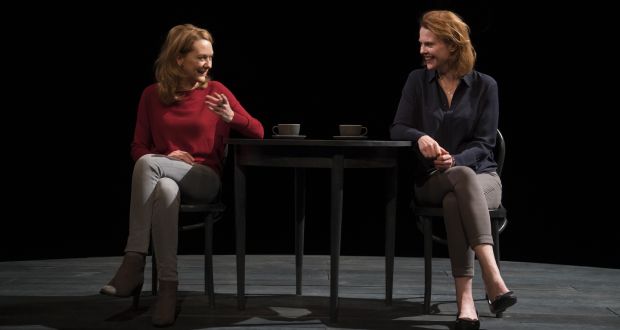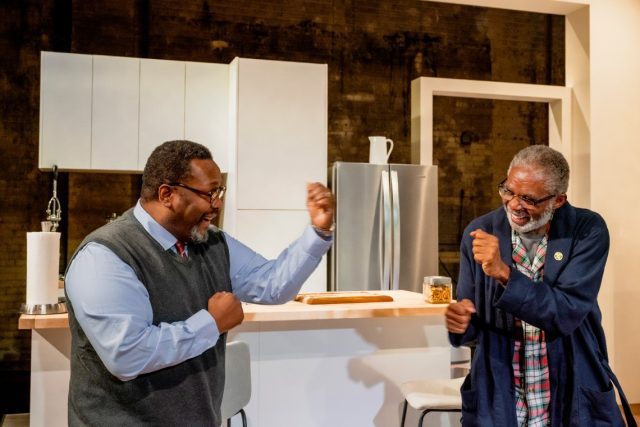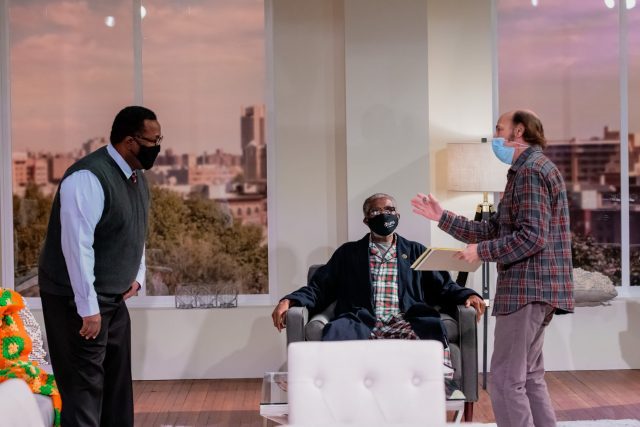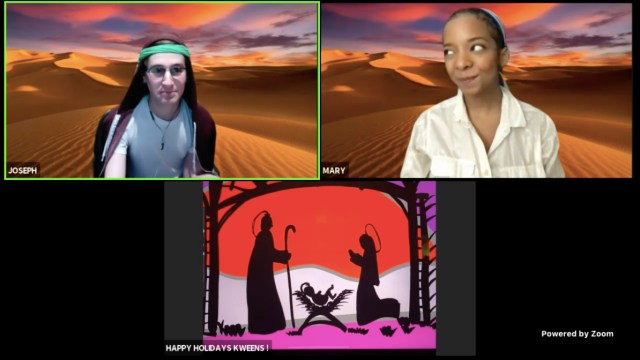
The Crossing marks Kenneth Tam’s live, virtual debut at the Kitchen OnScreen (rehearsal photo courtesy Lumi Tan and Kenneth Tam)
Who:Kenneth Tam,Lumi Tan What: Kenneth Tam’s first live performance Where:The Kitchen OnScreen Zoom When: December 5-6, free with RSVP, 7:00 Why: Brooklyn-based multidisciplinary artist Kenneth Tam has been in residence at Queenslab in Ridgewood since October 30, preparing a new work for the Kitchen, following all Covid-19 protocols as he rehearses the piece and prepares for its livestream debut December 5-6. Performed by Martin Richard Borromeo, Paulina Meneses, James Lim, and Resa Mishina, The Crossing explores issues of race, gender, identity, ritual, and assimilation in relation to Asian Americans and Culturally Based Fraternal Organizations, centering on Taoist funeral rites, probate ceremonies, and the brutal hazing death of Baruch college freshman and pledge Michael Deng in 2013 while running through the gantlet known as the Glass Ceiling. Admission is free with RSVP; the December 6 performance will be followed by a Q&A with Tam (All of M, Breakfast in Bed) and Kitchen curator Lumi Tan. You can see previous Kitchen OnScreen projects here by Baseera Khan, Autumn Knight, and Ka Baird with Max Eilbacher.
Katelyn Halpern and Paul Pinto’s Living Room video is part of “EdgeCut: Sanity”
Who:Malena Dayen,Karen Lancel & Hermen Maat,Caitlin & Misha,Katelyn Halpern,Paul Pinto,divinebrick,Chris SooHoo What: 3D live, interactive experience Where:New York Live Arts When: Saturday, December 5, $7-$15, 1:00 – 4:00 Why: On October 10, EdgeCut introduced us to the remarkable NowHere platform for the first part of its collaboration with New York Live Arts, “Captivity,” five hours of short performance works, discussions, and networking in which audience members navigated through different levels in order to watch livestreamed events in little pods and hang out with curators, creators, and other visitors in their pods. You could steer through fantastical landscapes, float in space, and pull up next to another pod and talk about where you’d been so far or where you were off to next, with cameras on so your face is visible on the front of your pod. I’ve tried just about every form of online entertainment while we’re all sheltering in place and arts venues are closed, and nothing else comes close to this one, even given various hiccups that require patience.
The second iteration, “Sanity,” takes place December 5 from 1:00 to 4:00, a more manageable three hours that will feature four unique rooms. In the Growth Room, you can catch director and singer Malena Dayen’s opera While You Are with Me and the bright and colorful Living Room music video of dancing television heads by multidisciplinary artists Katelyn Halpern and Paul Pinto; in the Worry Room, you can let out steam with Caitlin & Misha’s Infinite Worries Bash, a participatory installation of electroacoustic piñatas that inquires, “Can the destruction of these interactive worry vessels create space for clarity?”; in the Transformation Room, you can meditate to divinebrick and Chris Soohoo’s Performance Prayer; and in the Kissing Room, you can share private moments courtesy of intimacy agents Karen Lancel and Hermen Maat, who ask, “Can we measure a kiss and what kissers feel together?”
Intimacy agents Karen Lancel and Hermen Maat explore what online kissing is like at “EdgeCut: Sanity”
Curated by Heidi Boisvert and Kat Mustatea, the EdgeCut program, which originally convened at the New Museum’s NEW INC incubator for art, tech, and design for in-person presentations, is now seeking to expand and redefine the virtual 3D experience during the pandemic lockdown, exploring the question “How do we create collective experience and transformative gatherings in this moment of ‘a crisis within a crisis’ that speak to transition, change, healing, humanity?” The works were chosen through an open call; the finale of the trilogy, “Humanity,” is scheduled for February 13, 2021. Tickets range from $7 per room to $15 for the full experience, which has to be seen to be believed.
Film fans can watch obsessive film fanatics in Cinemania, streaming at BAM festival
BAM online
December 4 – January 3, free – $12 www.bam.org
Among the endless negative aspects of the pandemic lockdown is our inability to see and interact with our fellow New Yorkers in locations that are special to this great city. We are trapped inside, most of us making only virtual contact with friends, families, work colleagues, and strangers on the street. BAM takes us on a trip down memory lane in the first online edition of its continuing Programmers’ Notebook series, this one titled “New York Lives”; of course, we can’t even go to BAM to watch them in an audience filled with other film fans. In addition to the below recommendations, BAM will be showing Angela Christlieb and Stephen Kijak’s 2002 Cinemania, which follows, well, five obsessed film fans who do whatever they can to see as many movies as possible, each with unusual quirks (and all of whom I used to see at various screenings); Diego Echeverria’s 1984 Los Sures, about Puerto Rican street culture; Loira Limbal’s 2020 Through the Night, a portrait of three caregivers of children; Brett Story’s 2020 The Hottest August, a poetic and poignant look at what New Yorkers think about the future in August 2017; Megan Rossman’s 2019 The Archivettes, which goes inside the Lesbian Herstory Archives; and a double feature of Marci Reaven and Beni Matías’s 1979 The Heart of Loisaida and William Sarokin and Matías’s 1985 Housing Court, both of which explore the housing crisis.
Marc Singer’s Dark Days looks at people living in underground tunnels below Penn Station
DARK DAYS (Marc Singer, 2000)
Opens December 4, $4.99 www.bam.org
The award-winning documentary Dark Days takes a frightening look at a community of homeless men and women — many of them former or current crack users — who live in the Amtrak tunnels beneath Penn Station. They sleep in tents, cardboard shacks, and small plywood shanties, some of which have been painted and decorated. As the belowground residents shave, cook, play with their pets, and take showers under leaking pipes, trains speed by, and rats scavenge through the countless mounds of garbage. At times some of the men venture aboveground (“up top”) to go through trash cans, mostly looking for recyclable bottles and junk items they can resell. First-time filmmaker Marc Singer became a part of this colony for two years (he initially went down to help the people, not to film them), getting the residents to open up and tell their fascinating stories, which turn out to be filled with a surprising zest for living. In fact, all of the underground shooting was completed with the help of the subjects themselves acting as the crew when they were not on camera. DJ Shadow composed the haunting music for this strangely enriching look at a mysterious, truly terrifying part of New York City.
Crystal Kayiza’s See You Next Time is set in a nail salon that does extraordinary work (photo courtesy of Sundance Institute | photo by Leroy Farrell)
“See You Next Time: Neighborhood Stories” takes viewers on six slice-of-life journeys into unique parts of New York City, local tales about people making a difference or just struggling to get by — while also reminding us of things we cannot do or that have been severely limited during the Covid-19 crisis. In Aisha Amin’s Friday, a Brooklyn community is excited about the potential of acquiring a building to house their mosque. Crystal Kayiza’s See You Next Time introduces us to the relationship between a woman who gets extravagant nails and her salon artist. In Emily Packer and Lesley Steele’s By Way of Canarsie, a coastal community fights for ferry access. In Heather María Ács’s fictional Flourish, drag queen Crystal Visions (Justin Sams) prepares for an important show while battling with her drunk partner, Beau (Becca Blackwell), and young nonbinary couple Lazer (Poppy Liu) and T-Bone (Delfina Cano) consider making an addition to their love life. In Anna Pollack’s fictional Briarpatch, teenage siblings Marcus (Juan Lara) and Ashley (Oumou Traoré) face multiple hardships after the death of their mother. And in Tayler Montague’s semiautobiographical In Sudden Darkness, thirteen-year-old Tati (Sienna Rivers) navigates her way around a blackout. The free screening on December 9 at 7:30 will be followed by a live Q&A with the filmmakers, moderated by programmer Natalie Erazo (RSVP required here).
Manfred Kirchheimer’s Free Time is a symphonic film about a very different time in the city
In 2019, eighty-eight-year-old Manfred Kirchheimer was at Lincoln Center’s Francesca Beale Theater to screen and discuss his latest work, the subtly dazzling Free Time, which had its world premiere in the Spotlight on Documentary section of the fifty-seventh annual New York Film Festival. The German-born, New York-raised Kirchheimer has taken 16mm black-and-white footage he and Walter Hess shot between 1958 and 1960 in such neighborhoods as Hell’s Kitchen, Washington Heights, Inwood, Queens, and the Upper East Side and turned it into an exquisite city symphony reminiscent of Helen Levitt, Janice Loeb, and James Agee’s classic 1948 short In the Street, which sought to “capture . . . an image of human existence.” Kirchheimer does just that, following a day in the life of New York as kids play stickball, a group of older people set up folding chairs on the sidewalk and read newspapers and gossip, a worker disposes of piles of flattened boxes, laundry hangs from clotheslines between buildings, a woman cleans the outside of her windows while sitting on the ledge, a fire rages at a construction site, and a homeless man pushes his overstuffed cart.
Kirchheimer and Hess focus on shadows under the el train tracks, gargoyles on building facades, smoke emerging from sewer grates, old cars stacked at a junkyard, and grave markers at a cemetery as jazz and classical music is played by Count Basie (“On the Sunny Side of the Street,” “Sandman”), John Lewis (“The Festivals,” “Sammy”), Bach (“The Well Tempered Klavier, Book 1 — Fugue in B flat minor”), Ravel (Sonata for Violin & Cello), and others, with occasional snatches of street sounds. The title of the film is an acknowledgment of a different era, when people actually had free time, now a historical concept with constant electronic contact through social media and the internet and the desperate need for instant gratification. Kirchheimer, whose Dream of a City was shown at the 2018 NYFF and whose poetic Stations of the Elevated was part of the 1981 fest (but not released theatrically until 2014), directed and edited Free Time and did the sound, and it’s a leisurely paced audiovisual marvel. The only unfortunate thing is that it is only an hour long; I could have watched it for days.
Okwui Okpokwasili takes viewers behind the scenes of her one-woman show in Bronx Gothic (photo courtesy of Grasshopper Film)
“Okwui’s job is to scare people, just to scare them to get them to kind of wake up,” dancer, choreographer, and conceptualist Ralph Lemon says of his frequent collaborator and protégée Okwui Okpokwasili in the powerful documentary Bronx Gothic. Directed by Okpokwasili’s longtime friend Andrew Rossi, the film follows Okpokwasili during the last three months of her tour for her semiautobiographical one-woman show, Bronx Gothic, a fierce, confrontational, yet heart-wrenching production that hits audiences right in the gut. Rossi cuts between scenes from the show — he attached an extra microphone to Okpokwasili’s body to create a stronger, more immediate effect on film — to Parkchester native Okpokwasili giving backstage insight, visiting her Nigerian-born, Bronx-based parents, and spending time with her husband, Peter Born, who directed and designed the show, and their young daughter, Umechi. The performance itself begins with Okpokwasili already moving at the rear of the stage, shaking and vibrating relentlessly, facing away from people as they filter in and take their seats.
She continues those unnerving movements for nearly a half hour (onstage but not in the film) before finally turning around and approaching a mic stand, where she portrays a pair of eleven-year-old girls exchanging deeply personal notes, talking about dreams, sexuality, violence, and abuse as they seek their own identity. “Bronx Gothic is about two girls sharing secrets. . . . It is about the adolescent body going into a new body, inhabiting the body of a brown girl in a world that privileges whiteness,” Okpokwasili, whose other works include Poor People’s TV Room and the Bessie-winning Pent-Up: A Revenge Dance, explains in the film. National Medal of Arts recipient Lemon adds, “It’s about racism, gender politics — it’s not just about these two little black girls in the Bronx.” Rossi includes clips of Okpokwasili performing at MoMA in Lemon’s “On Line” in 2011, developing Bronx Gothic at residencies at Baryshnikov Arts Center and New York Live Arts, and participating in talkbacks at Alverno College in Milwaukee and the Bronx Academy of Arts and Dance, where the tour concluded, right next to her childhood church, which brings memories surging back to her.
Okwui Okpokwasili nuzzles her daughter, Umechi, in poignant and timely documentary (photo courtesy of Grasshopper Film)
Rossi is keenly aware of the potentially controversial territory he has entered. “As a white man, I was conscious of the complexity and implications of embarking on a project that revolves around the experience of African American females,” he points out in his director’s statement. “But fundamentally, I believe in an artist’s creative ability to explore topics that are foreign to the artist’s own background. I think this takes on even more resonance when the work itself has an explicit objective to ‘grow our empathic capacity,’ as Okwui says of Bronx Gothic, [seeking] an audience that is composed of ‘black women, black men, Asian women, Asian men, white women, white men, Latina women, Latina men. . . .’” Cinematographers Bryan Sarkinen and Rossi (Page One: Inside the New York Times, The First Monday in May) can’t get enough of Okpokwasili’s mesmerizing face, which commands attention, whether she’s smiling, singing, or crying, as well as her body, which is drenched with sweat in the show. “We have been acculturated to watching brown bodies in pain. I’m asking you to see the brown body. I’m going to be falling, hitting a hardwood floor, and hopefully there is a flood of feeling for a brown body in pain,” Okpokwasili says. Meanwhile, shots of the audience reveal some individuals aghast, some hypnotized, and others looking away.
Editor Andrew Coffman and coeditors Thomas Rivera Montes and Rossi shift from Okpokwasili performing to just being herself, but the film has occasional bumpy transitions; also, Okpokwasili, who wrote the show when she was pregnant, does the vast majority of the talking, echoing her one-woman show but also at times bordering on becoming self-indulgent. (Okpokwasili produced the film with Rossi, while Born serves as one of the executive producers.) But the documentary is a fine introduction to this unique and fearless creative force and a fascinating examination of the development of a timely, brave work.
Dael Orlandersmith will discuss the streaming Until the Flood at live online talk December 2 (photo by Robert Altman / courtesy Rattlestick Playwrights Theater, 2018)
Who: Dael Orlandersmith, Sherman Fleming, James King What: Live discussion about Until the Flood Where:All ArtsFacebook,YouTube When: Wednesday, December 2, free with RSVP, 4:00 Why: In January 2018, Pulitzer Prize finalist Dael Orlandersmith presented her one-woman show Until the Flood at Rattlestick Playwrights Theater. In the play, which was originally commissioned by the Repertory Theatre of St. Louis, Orlandersmith portrays eight composite characters in relating the tragic story of the killing of Michael Brown at the hands of police officer Darren Wilson in Ferguson, Missouri, on August 9, 2014; Orlandersmith traveled to Ferguson and interviewed dozens of people to understand the incident from every possible angle, creating Black retired schoolteacher Louisa Hemphill (70s), white retired policeman Rusty Harden (75), Black teen Hassan (17), white high school teacher Connie Hamm (35), Black barber Reuben Little (late 60s/early 70s), white landowner and electrician Dougray Smith (late 30s/early 40s), Black high school student Paul (17), and Black minister Edna Lewis (late 50s/early 60s), who share their thoughts on racism, anger, violence, poverty, fear, bigotry, liberalism, protest, privilege, education, and other social issues. Orlandersmith delivers each monologue in a different costume (by Kaye Voyce) on Takeshi Kata’s open set centered by a chair she often uses, with a burst of interstitial projections (by Nick Hussong) between scenes.
A recorded version of Until the Flood, directed by Neel Keller, is currently streaming for free at All Arts TV into 2023. On December 2 at 4:00, Orlandersmith (Yellowman,Forever) will be joined by Philly-based performance artist Sherman Fleming for a live Zoom talk moderated by All Arts artistic director James King, discussing the power of art and Until the Flood, placing the work in context of the murder of George Floyd, the Black Lives Matter movement, and the pandemic lockdown; admission is free with RSVP. The event is presented in partnership with ACT Theatre, Center Theatre Group, Denver Center for the Performing Arts, Goodman Theatre, Milwaukee Repertory Theater, Portland Center Stage, Rattlestick Playwrights Theater, and Repertory Theatre of St. Louis.
Sue Coe, It Can Happen Here, linocut on thin white Rives paper, 2016 (photo courtesy Galerie St. Etienne)
Who: Sue Coe, Stephen F. Eisenman What: Live conversation and Q&A Where:Galerie St. EtienneZoom When: Wednesday, December 2, free with RSVP, 6:00 Why: On November 7, English-born American artist Sue Coe said, “I am beside myself with joy, but it’s not exactly a revolution. The reality is that four to five million more Americans voted for Biden/Harris than for Trump. Although capitalist democracy beat fascism by a razor thin margin, our electoral system still benefits cruel bullying overlords. The struggle continues. . . .” The vote differential is now more than six million, but the struggle continues, especially with an incumbent president who refuses to concede and keeps tweeting about voter fraud with zero evidence. On December 2 at 6:00, Coe, who lives in Upstate New York, will have more to say about the state of the country in a live Zoom discussion with art historian, activist, Anthropocene Alliance cofounder, and Northwestern University professor Stephen F. Eisenman, author of The Temptation of Saint Redon, Gauguin’s Skirt, and The Abu Ghraib Effect and who has collaborated with Coe on her book The Ghosts of Our Meat and the new pamphlet American Fascism Now.
The talk, “Rebuilding Democracy,” is being hosted by Galerie St. Etienne, the midtown gallery that is showing “Sue Coe: It Can Happen Here” through December 30. The exhibition consists of more than eighty paintings, drawings, lithographs, linocuts, and woodcuts that deal with such issues as anti-Semitism, AIDS, animal abuse, the pandemic, police brutality, greed, torture, government corruption, and the Trump administration, the president being a favorite target of vitriol. Be sure to read the exhibition essay, which begins, “People often ask Sue Coe, ‘Did you think it was going to be this bad?’ A proverbial canary in the coal mine, the artist has been ‘tweeting’ out warnings since the 1980s. In her view, the problems that plague us — zoonotic diseases, systemic racism, inadequate healthcare, rising income inequality, global warming, and countless other related ills — are the result of an undiluted form of capitalism that puts profits above individual lives. Forty years of such skewed priorities conditioned America’s grotesque bungling of the Covid crisis and have brought us to the brink of fascism. On the other hand, the Black Lives Matter protests — which are broadly supported by people of all colors — offer hope that it is not too late to take back our democracy. ‘The tectonic plates are shifting and colliding,’ Coe says, ‘allowing us to see the primordial depths below. The question is whether we can rise to the occasion.’”
Sidra Bell and Immanuel Wilkins will present a work-in-progress of their new collaboration online December 4 (photo by David Flores Productions)
Who:Sidra Bell Dance New York,Immanuel Wilkins What: Performance of a new work in progress and conversation Where:92Y online When: Friday, December 4, $10, 7:00 Why: Originally scheduled to debut at National Sawdust in June, Sidra Bell Dance New York and Immanuel Wilkins’s waiting will make its work-in-progress premiere December 4 at 7:00 in a presentation hosted by the 92nd St. Y’s Harkness Dance Center. Bell and Wilkins met in June 2019 at an SBDNY performance and decided to collaborate; because of the pandemic lockdown, they have continued working on the piece, which was commissioned by the Jazz Gallery, over Zoom and are ready to show an early version, to be followed by a live discussion between SBDNY artistic director Bell, whose New York City Ballet commission, Pixelation in a wave (Within Wires), can be seen here, and composer, arranger, and alto saxophonist Wilkins, who released his debut album, Omega, in August. SBDNY, which calls itself “an internationally recognized boutique brand of prolific movement illustrators based in New York City that presents and fosters a canon of innovative and progressive dance theater in a world of ideas and (im)possibilities,” consists of Marisa Christogeorge, AJ Libert, Kimie Parker, Sophia Halimah Parker, and Uma Shannon; Wilkins will be joined by Jeremy Corren on piano, Daryl Johns on bass, and Kweku Sumbry on drums. Virtual tickets for “Infrastructure (of a Work): waiting” are $10 and are available here.
Who: Elizabeth Alexander, Cornelius Eady, Richard Hamilton, Rachel M. Harper, Aja Monet, Anthony Walton, Philip Schultz What: Poetry readings in honor of Black Lives Matter Where:The Writers StudioZoom webinar When: Friday, December 4, free with RSVP, 7:00 Why: Founded in 1987 by Pulitzer Prize-winning poet Philip Schultz, the Writers Studio is dedicated to helping students discover and nurture their own voice. On December 4 at 7:00, the New York-based organization will honor Black Lives Matter with an all-star reading of works from Every Shut Eye Ain’t Asleep: An Anthology of Poetry by African Americans Since 1945, the 1994 collection edited by Michael S. Harper and Anthony Walton that contains poems by nearly three dozen Black authors, including Derek Walcott, Rita Dove, Gwendolyn Brooks, Ishmael Reed, Sonia Sanchez, and Ralph Dickey. The participants, who will share some of their own poetry as well, include Elizabeth Alexander, Cornelius Eady, Richard Hamilton, Rachel M. Harper, Aja Monet, Walton, and Schultz. (Alexander and Eady are featured in the book.) The program will be streamed live over Zoom; advance RSVP is required.