this week in lectures, signings, panel discussions, workshops, and Q&As

THIS IS WHO I AM

Ramsey Faragallah and Yousof Sultani play a father and son who are separated by more than just distance in This Is Who I Am (photo courtesy PlayCo and Woolly Mammoth Theatre Company)

WOOLLY ON DEMAND: THIS IS WHO I AM
Through January 3, $15.99 single, $30.99 household
www.woollymammoth.net
playco.org

Woolly Mammoth and PlayCo’s This Is Who I Am is the best play created during the pandemic that is not specifically about the pandemic. Presented in association with American Repertory Theater, Guthrie Theater, and Oregon Shakespeare Festival, Amir Nizar Zuabi’s poignant, exquisitely told seventy-minute Zoom work is a treat for all five senses while exploring such issues as love, loss, loneliness, grief, memory, and distance, so much a part of our life amid the ongoing coronavirus crisis.

Zuabi, who was raised in Palestine, was the associate director of Young Vic London for eight years, and is now artistic director of the ShiberHur theater in Haifa, set his 2013 site-specific show, Oh My Sweet Land, in kitchens in real apartments, where small audiences would cram in and watch a woman cook while telling stories about Syrian refugees; everyone was handed a delicacy she made on the way out. This Is Who I Am also takes place in real kitchens, but in this case belonging to two actors portraying an estranged father and son reconnecting over Zoom; you might not get a bite of the spinach-and-onion-stuffed dumpling-like peasant dish known as fteer that they make together, but you will feel as if you can touch, smell, and taste it, in addition to watching and listening to their intimate, heart-tugging conversation. (However, you will get the recipe so you can prepare it yourself in your own kitchen.)

The father (Ramsey Faragallah) is Zooming in from his home in Ramallah, while the son (Yousof Sultani) is in New York, having left the West Bank city years ago to become an art curator, a job his manly, hardworking father fails to understand. As they go step-by-step through the recipe of their late wife/mother’s favorite dish, they talk about the past and delve deep into their relationship, which changed drastically during her prolonged illness. “She used to make such incredible food. Why this, why fteer?” the son asks. “It was the first thing she prepared for me,” the father replies. “She said to me, ‘This is who I am. I am a pocketful of surprises.’”

As they add the ingredients, the differences between them are revealed not only through the dialogue but by how they are making the dish. While the son uses modern utensils and measures everything precisely, the father uses his fingers and judgment with the salt and the sumac, the onions and the yeast. “You were always a horrible cook,” the son says, as if referring to his role as a father as well. The father declares that his lentil soup is to die for, which leads the son to quip, “Death is definitely one of the consequences that can occur as a result of your lentil soup.”

Making fteer together leads them to “fill the gaps” of their lives. When they brush on the olive oil, they remember the olive trees of Ramallah; where the father waxes poetic about the beauty, culture, tradition, and sustenance they represent, the son recalls that the “trees are drenched in blood. They live in a land that had so many people claim it, so many people die for it. You walk around those trees and you feel the reverence of history; I walk around those trees and I hear the shouts of slaughtered men that had to sacrifice themselves to keep it.” When the son insists that water has to be lukewarm, considering it a “safe” temperature, the father interprets that as his son yet again taking the easy way out, not going for the extremes of hot and cold. As they reach the end of the preparation and get ready to place the food in the oven, their topics grow ever-more-serious, with accusations and condemnations being squeezed out like the juice of a lemon, tart and bitter.

Turkish immigrant Evren Odcikin (When My Mama Was a Hittite, Nine Parts of Desire), the associate artistic director at OSF, directs the show with a natural, realistic grace, keeping the actors onscreen the entire time, next to each other in static boxes without camera movement, close-ups, or cuts; we’ve all been part of so many Zoom calls with friends and family and watched a multitude of live, online cooking programs that it’s easy to forget that this is a play and that the two men are fictional constructions. Instead, you’re likely to feel that you’re eavesdropping on an intensely private moment between two complex individuals as they intimately discuss trust, fear, memory, choice, disappointment, and what makes a person a hero.

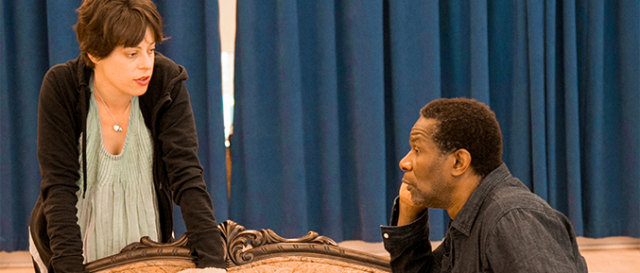
Ramsey Faragallah and Yousof Sultani rehearse Amir Nizar Zuabi’s This Is Who I Am (photo courtesy PlayCo and Woolly Mammoth Theatre Company)

LA-born actor, writer, and teacher Faragallah (The Profane, Homeland) and Northern Virginia native Sultani (Heartland, Photograph 51) are marvelous as father and son, fully embodying their characters just as the dish they are making brings their wife/mother to life. Faragallah portrays the strong and stalwart father with a tender vulnerability that is deeply affecting, while the handsome, hirsute Sultani is sensitive and authentic as the seemingly intractable, unyielding son who is harboring a critical secret. Just follow the movement of their eyes; they might not be in the same room, but their innate attachment is palpable.

In October, Woolly Mammoth’s Woolly on Demand season kicked off with Telephonic Literary Union’s fun Human Resources, which took place completely over the phone as a “choose your own adventure” series of prerecorded messages. This Is Who I Am comes to us live, in real time, via cameras in the actors’ homes in an honest, intrinsically human story that captures who we are and what we are facing without ever mentioning the pandemic we are suffering through; it’s a timeless story whose time is now, for people everywhere.

(This Is Who I Am continues through January 3; tickets are $15.99 for one and $30.99 for a household. On January 2, you can take part in a postshow community meetup hosted by A.R.T. with the Boston Palestine Film Festival by registering here. It’s also worth checking out the archived December 20 virtual panel discussion “Story as Resistance: The Joys, the Heartbreak, and the Food.”)

OLD VIC: IN CAMERA — A CHRISTMAS CAROL

Andrew Lincoln shines a light on a different aspect of Scrooge’s psyche in Old Vic adaptation (photo by Manuel Harlan)

A CHRISTMAS CAROL
The Old Vic, London
Through December 24, £10-£65
www.oldvictheatre.com

For its fourth “In Camera” presentation, the Old Vic has revived Jack Thorne’s 2017 reimagining of Charles Dickens’s A Christmas Carol, which moved to Broadway in fall 2019 and plans to return next holiday season. Thorne’s bold adaptation minimizes the traditional ghost story elements and instead develops a narrative that focuses on Ebenezer Scrooge’s childhood trauma (George Samuel Townsend plays him as a boy, Andrew Lincoln as an adult) and how it influenced his development into the greedy, heartless man he now is — revealing the psychological damage wrought by a demanding, overbearing father (Michael Rouse), never mentioned in Dickens’s original; the boy’s relationship with his adored sister, Fan (Melissa Allan), named only once by Dickens; and his one chance at love with Belle (Gloria Obianyo), the daughter of his employer, Mr. Fezziwig (Clive Rowe), who in this version runs a funeral parlor, although Dickens himself never elucidates Fezziwig’s business.

The heart-tugging Cratchit family — Scrooge’s clerk, Bob (John Dagleish), Bob’s wife (Maria Omakinwa), and their children, including the lame Tiny Tim (Rayhaan Kufuor-Gray, Lara Mehmet, Lenny Rush, or Eleanor Stollery) — is almost an afterthought in Thorne’s retelling, while Scrooge’s deceased partner, Jacob Marley (Rouse), is given more prominence, as is Scrooge’s nephew, Fred (Eugene McCoy). The Ghosts of Christmas Past, Present, and Future are portrayed by a trio of women (Julie Jupp, Golda Rosheuvel, and a surprise third character) who are not daunting spirits but rather have much more intimate connections with Scrooge.

Old Vic’s “In Camera” livestreamed production of A Christmas Carol follows Covid-19 protocols (photo by Manuel Harlan)

The Old Vic’s “In Camera” series, live plays streamed direct from its London stage, adhering to all Covid-19 protocols and performed without an audience, previously offered very short runs of Brian Friel’s Faith Healer with Michael Sheen, David Threlfall, and Indira Varma, Stephen Beresford’s Three Kings with Andrew Scott, and Duncan MacMillan’s Lungs with Claire Foy and Matt Smith. Helmed by Tony-winning artistic director Matthew Warchus (Matilda, God of Carnage), A Christmas Carol is riveting theater for most of its two-hour length. The action is filmed with multiple cameras that give tantalizing close-ups as well as long views, while the tech crew often utilizes split screens so expertly that it’s sometimes difficult to figure out whether actors are actually next to each other or are socially distancing, especially during several handshakes.

Lincoln (The Walking Dead, Parlour Song) is sensational in one of the most familiar roles ever written, playing Scrooge as a flawed human being rather than a brutally cold and unforgiving ogre. It’s a welcome change, as are the changes brought to other minor characters, with stand-out performances by Obianyo, Rowe, and Rosheuvel. The cast also features Rosanna Bates as Jess, Tim van Eyken as Nicholas, and Sam Lathwood as Ferdy. This is not your grandparents’ Christmas Carol.

The set by Rob Howell, who also designed the period costumes, is anchored by a slotted-wood floor, with frames without doors through which characters enter and exit and dozens of lanterns hanging from the ceiling. At the 2017-19 in-person shows, audience members received clementines and cookies; the Old Vic tries to maintain a level of interactivity by having an online quiz that begins about an hour before the play starts and by providing a family activity pack that can be downloaded for free here.

Which brings us to the ending. Throughout the show, Christmas carols are played by a masked band in the balcony, consisting of pianist and musical director Will Stuart, cellists Christopher Allan and Pedro Vieira da Silva, violinist Clare Taylor, and clarinetist Martin Robertson. The songs often get in the way of the narrative, especially with Thorne’s (Harry Potter and the Cursed Child, His Dark Materials) unexpected twists, but it all becomes particularly annoying when the music, acting, and staging all combine to go way over the top during Scrooge’s rethinking of what Christmas means. What was a gripping, tense tale instantaneously lapses into a tired traditional holiday finale, turning its back on everything that came before. It had challenged what we know about this classic story but then settled for the lowest common denominator for its conclusion, which is a shame. Or, of course, I’m just being a scrooge. Bah, humbug.

PAM TANOWITZ DANCE: FINALLY UNFINISHED PARTS 1 & 2

Pam Tanowitz Dance’s Finally Unfinished streams from the Joyce through December 26

JoyceStream
The Joyce Theater
December 12-26, $13
www.joyce.org
pamtanowitzdance.org

Pam Tanowitz Dance (PTD) continues its digital site-specific season with Finally Unfinished: Part I, streaming from the Joyce through December 26. During the pandemic, with theaters emptied by health restrictions, the Bronx-born Tanowitz, who was a 2013 Joyce Residency Artist, has created several outdoor works that take dance fans and performers outside. David, a solo for American Ballet Theater principal dancer David Hallberg as part of “ABT Today: The Future Starts Now,” is set at the Glass House in New Canaan, while Solo for Russell: Sites 1-5, a solo for New York City Ballet principal dancer Russell Janzen for NYCB’s New Works Festival, guided viewers around the Lincoln Center campus, from the Illumination Lawn to the Damrosch Park Bandshell. (In June 2019, Tanowitz’s Time is forever dividing itself toward innumerable futures took place in several locations in Nelson A. Rockefeller Park in Battery Park City for the 2019 River to River Festival.)

Now Tanowitz has returned to the Joyce Theater, where she has presented such works as Passagen and Heaven on One’s Head in February 2014, Sequenzas in Quadrilles and the story progresses as if in a dream of glittering surfaces in September 2016, and New Work for Goldberg Variations in December 2019, with a multipart show created specifically for online viewing through JoyceStream. Made following Covid-19 protocols during a residency on Governors Island, the work, following an iteration livestreamed from the Annenberg Center in Philadelphia on October 15, is a “flexible dance piece” that is set in and around the Joyce, from the proscenium stage to the wings, from the aisles to the balcony.

“We finally finished Finally Unfinished, but it’s never really finished,” Tanowitz announces before the curtain literally rises on Jason Collins, Christine Flores, Zachary Gonder, and Victor Lozano, who perform Gustave Le Gray, No. 2 on an empty stage. The four barefoot dancers, wearing tan shorts and T-shirts designed by Reid Barthelme and Harriet Jung, move gingerly in unison to a score by Caroline Shaw played by pianist Amy Yang; the camera shoots them from multiple angles, with closeups of their bare legs and long shots from the back of the theater.

After ten minutes, they are joined by Brittany Engel-Adams, Lindsey Jones, and Melissa Toogood for the explosion that is Finally Unfinished: Part 1. Amid piped-in crowd noises (“Field Recordings” by Dan Siegler) and recordings of cues from PTD’s 2014 appearance at the Joyce (“Cueing Sound Score,” with the disembodied voices of Laurie Benoit and Jeff Segal), Toogood takes over the stage, dressed in a full-length space-age onesie with a hood, followed by a masked cameraman in the same outfit. Soon everyone has changed costumes (including some garb that incorporates the design and color of the seats in the audience, the curtain, and the carpeting) as they dance to “Furtive Movements,” an electronic score by Ted Hearne, performed by cellist Ashley Bathgate and percussionist Ron Wiltrout. It all builds to an exhilarating crescendo until a peaceful and quiet finale with, of course, no applause.

But it’s not quite over; Finally Unfinished: Part II continues online with what PTD calls “a Digital Curio Case.” Designed by Jeremy Jacob and beginning with old footage of a clapping crowd, Part II reveals some of Tanowitz’s inspirations and creative process, including text (“Nowhere is a dead end”), cutouts of the dancers, a collection of clips from films in which characters perform playful dances using their fingers on a table (The Gold Rush, A Band Apart, Benny & Joon), a behind-the-scenes look at costumes by Barthelme and Jung and scenery by Suzanne Bocanegra, recommended reading, and more.

From the dances to the multimedia scrapbook, it’s a judicious and entertaining tribute to the Joyce using the internet as medium during a health crisis that has left us all in front of our screens, unable to experience dance and other live entertainment in person. As Tanowitz says, “It’s a different format now. / What format should it be? / We finished it for you. / It’s never finished for me.”

STAND WITH TEACHERS

Who: Stevie Van Zandt, Eddie Vedder, Margo Price, Bruce Springsteen, Sammy Hagar, Steve Buscemi, Bobby Cannavale, Lowell Levinger, Matisyahu, Whoopi Goldberg, Melle Mel, Tom Morello, Edward Norton, Vincent Pastore, Maureen Van Zandt, Trønd Fausa Aurvåg, Steinar Sagen
What: Holiday fundraiser for TeachRock
Where: TeachRock
When: Monday, December 21, $25-$150, 8:00
Why: “Little Steven’s TeachRock program brings an essential curriculum of music and culture into school and makes it available at no cost to educators. In a time of cutbacks in arts funding, Steve’s programs are keeping kids engaged in the arts, and in school — this is his greatest legacy,” Bruce Springsteen said about his longtime E Street Band cohort Stevie Van Zandt’s TeachRock, an organization dedicated to teaching arts, and specifically popular music, in schools. Part of the nonprofit Rock and Roll Forever Foundation, TeachRock has adapted to remote learning by making available special lesson packages for children of all ages.

On December 21 at 8:00, Van Zandt and TeachRock will host a benefit fundraiser highlighted by performances by board members Springsteen and Jackson Browne, Eddie Vedder, Margo Price, and Matisyahu in addition to appearances by Sammy Hagar, Steve Buscemi, Bobby Cannavale, Whoopi Goldberg, Melle Mel, Tom Morello, Edward Norton, Vincent Pastore, Maureen Van Zandt, and, from Lillyhammer, Trønd Fausa Aurvåg and Steinar Sagen. Tickets are $25 or $150 to get your name added to the TeachRock Solidarity Wall. “Music connects us, even when we must be apart,” Van Zandt said in a statement. “Our amazing teachers stood by us and provided structure, emotional support, and a reassuring sense of normalcy to our children during Covid. Now we’re going to stand with teachers and provide them the resources they need to keep kids engaged, emotionally healthy, and learning.” The hourlong event will be followed by a Holiday Video Jukebox featuring songs by Little Steven and the Disciples of Soul, Darlene Love, Dean Frasier, and others.

HOMESICK

Danielle Agami looks deep inside herself in Homesick (photo courtesy Source Material)

HOMESICK
December 20 – January 10, $10-$25 (pay-what-you-can)
www.homesickthefilm.com
www.sourcematerialcollective.com

Israeli-born, LA-based dancer and choreographer Danielle Agami has reimagined her autobiographical solo piece, Framed, which had its world premiere in May 2018 at NYU Tisch School of the Arts, as the fifteen-minute film Homesick, streaming online December 20 to January 10. In the work, she looks deep inside herself as a woman and a creator, asking such questions as “What is expected for me to provide? Will dance be enough? Am I enough?” Directed by Samantha Shay and photographed by Victoria Sendra for Source Material, Homesick follows Agami as she moves from her apartment to a bar (where she is served by real-life Icelandic cocktail bartender Martin Cabejsek) to an indoor flower market (where she is joined by Jordan Klitzke) to a vast outdoor landscape and, as an encore, around Jerry Moss Plaza at the Music Center in LA.

For much of the film, Agami, a former Batsheva dancer and gaga teacher who has run Ate9 Dance Company since 2012, first in Seattle, then in LA, changes between a black negligee, head shaved, to regular clothing and fuller hair, moving in fits and starts on her hands and knees, shaking her head in trancelike gestures, petting a cat, and extending her arms as if searching for freedom and love. “For me, there are two kinds of home,” she narrates. “There is the outer, and the inner. When I feel safe and peaceful in my surroundings and my mind, I feel at home, and everything falls into place.” Agami dances to a pair of haunting songs by Iceland-based Danish musician Sara Flindt, aka ZAAR, “Homesick” and “How Many Hearts.” The film is followed by a Q&A with Agami (Pick a Chair, calling glenn), Shay (In These Uncertain Times, Light), Sendra, and Flindt, moderated by CalArts professor of dance cinema Francesca Penzani.

LIFT UP

Who: Blake Shelton, Dave Matthews, Jimmie Allen, Jason Mraz, Michael Ray, Shy Carter, the War and Treaty, John Rzeznik, Dispatch, Keala Settle, Mt. Joy, Augustana, Indigo Girls, Lucie Silvas, Annie Bosko, Bre Kennedy, CJ Hammond & Sloane, Veridia, Public, Michael Cerveris, the McCrary Sisters, Sam Wade, Roger Daltrey, Steve Connell, Michael McDonald, Kenny G, Jeff Tweedy, Nick Wheeler, Greta Van Fleet, Adam Gardner, Ray Parker Jr., Jerry Dipizzo, Taye Diggs, Ben Wysoki, the Harleys, Dublin Gospel Choir, Jim Sheridan, Storme Warren, Nicole Ryan
What: “A Festival of Music & Stories of Life On & Off the Road”
Where: Ryman Auditorium
When: Wednesday, December 16, free (donations encouraged), 8:30
Why: “It is so important that music fans and governments realize the impact this virus is having on millions of self-employed people who make the music industry function to bring much needed joy to our lives,” Roger Daltrey says about the effect the pandemic lockdown is having on the people who make a living supporting the work of superstar musicians. Daltrey will be appearing along with dozen of other rock, country, pop, R&B, and gospel musicians at “Lift Up,” a festival streaming live on Twitch from the Ryman Auditorium in Nashville that benefits the entertainment and events industry. The concert will feature the brand-new song “12 Million,” written by Sam Wade and LEVL UP music supervisor Keith Levenson in tribute to the crews that make music happen from behind the scenes. “Almost my whole adult life I have been touring in one shape or form and the road crews on my team and the venue crews that welcomed us and helped us put on a great show are all part of my extended touring family,” Cisco Adler said in a statement. “They really make it possible for artists like me to do what we do, and they are truly unsung heroes. They are also the first to be hit hard by a situation like this, so part of our mission at NoCap is to get shows happening again and get these good people back to work.”

THE DYBBUK

Theater for the New City is presenting a livestreamed adaptation of The Dybbuk through Sunday (screenshot by twi-ny/mdr)

Theater for the New City
December 9-13, $5-$36 (pay-what-you-can)
www.stellartickets.com
theaterforthenewcity.net

Good things come to those who wait. If there’s one thing we’ve learned during this pandemic, it’s that we need to have patience. Help is on the way, but if we as a nation follow protocols and have strong leadership, we can each make a difference, even with an administration that has turned its back on its people. We also have to be patient with the return of live theater as companies around the world experiment with Zoom, livestreaming, recording onstage without an audience, and other attempts to bring storytelling to a starving public.

So there I was on December 9, watching the hundredth-anniversary premiere of Theater for the New City’s livestreamed revival of the popular Yiddish play The Dybbuk, performed live onstage and broadcast over the Stellar platform. The chat function was on, so virtual attendees started getting ornery quickly when the show didn’t start exactly on time. And once it did, there were significant technical problems involving superimposed text, the green screening, and, most important, the sound, with a screeching electronic score drowning out the dialogue. Several people in the chat began complaining, even demanding a refund. But a solitary voice of reason explained that this is an opening night different from in-person opening nights and everyone should calm down. And she was right, because the tech crew was on the case, and after a near-disastrous beginning, the rest of the play was wonderful.

Written in 1914 by Jewish playwright S. An-ski, aka Shloyme Zaynvl Rapoport, who hailed from what is now Belarus, The Dybbuk premiered at the Elyseum Theatre in Warsaw on December 9, 1920, one month after An-ski’s death at the age of fifty-seven. Presented in association with New Yiddish Rep, this new English-language adaptation (with a fair sprinkling of Yiddish) is by NYR artistic director David Mandelbaum. The Dybbuk takes place in an old Jewish shtetl, where a long-arranged match between Menashe and Leah, the daughter of the wealthy Sender, dooms the love young student Khanan has for her. But on her wedding day, she is possessed by a spirit who will not let her marry Menashe, and the case soon comes before the judgment of the learned rabbi.

Cool backgrounds propel Theater for a New City virtual revival of classic Yiddish play (screenshot by twi-ny/mdr)

Director Jesse Freedman eventually works out the kinks in real time and gets everything in sync — with lighting by Alexander Bartieneff, sound by Eamon Goodman, and video by Tatiana Stolpovskaya — resulting in a moving and delightful production that features fun backgrounds and solid performances by Darrel Blackburn, Amy Coleman, Hannah Gee, Lev Harvey, Lucie Lalouche, Thomas Morris, and Mandelbaum as the rabbi. “A play about possession seems particularly suited to the times. The country has been possessed by the evil spirits of strife and division and could use a good exorcism to bring it back to its senses,” Mandelbaum said in a statement. “An intrepid group of artists is soldiering on through this pandemic minefield to honor the one-hundredth anniversary of this iconic play with the battle cry of their calling: ‘The show must go on.’ This will be a spiritual fusion of live performance and digital artistry. The ‘possession’ of live theater by the spirits of techno-wizardry.”

So be patient; the show will go on. It might not get off to a big start, but it packs quite a wallop by the finish.

For more on The Dybbuk, which was also made into a classic 1937 Yiddish film directed by Michał Waszyński, you can check out the Congress for Jewish Culture’s recent panel discussion “The Dybbuk at 100” on Facebook with playwright, translator, and theater historian Nahma Sandrow, Baruch College assistant professor and author Debra Caplan, and author and UT Austin senior lecturer in Yiddish Itzik Gottesman, moderated by writer, translator, actress, and theater historian Caraid O’Brien. The organization will also be presenting its own production of The Dybbuk on December 14 at 7:00 in Yiddish with Mike Burstyn, Shane Baker, Mendy Cahan, Refoyel Goldwasser, Amitai Kedar, Yelena Shmulenson, Suzanne Toren, and Michael Wex, directed by Allen Lewis Rickman; it can be seen here.