this week in lectures, signings, panel discussions, workshops, and Q&As

PAM TANOWITZ DANCE: FINALLY UNFINISHED PARTS 1 & 2

Pam Tanowitz Dance’s Finally Unfinished streams from the Joyce through December 26

JoyceStream
The Joyce Theater
December 12-26, $13
www.joyce.org
pamtanowitzdance.org

Pam Tanowitz Dance (PTD) continues its digital site-specific season with Finally Unfinished: Part I, streaming from the Joyce through December 26. During the pandemic, with theaters emptied by health restrictions, the Bronx-born Tanowitz, who was a 2013 Joyce Residency Artist, has created several outdoor works that take dance fans and performers outside. David, a solo for American Ballet Theater principal dancer David Hallberg as part of “ABT Today: The Future Starts Now,” is set at the Glass House in New Canaan, while Solo for Russell: Sites 1-5, a solo for New York City Ballet principal dancer Russell Janzen for NYCB’s New Works Festival, guided viewers around the Lincoln Center campus, from the Illumination Lawn to the Damrosch Park Bandshell. (In June 2019, Tanowitz’s Time is forever dividing itself toward innumerable futures took place in several locations in Nelson A. Rockefeller Park in Battery Park City for the 2019 River to River Festival.)

Now Tanowitz has returned to the Joyce Theater, where she has presented such works as Passagen and Heaven on One’s Head in February 2014, Sequenzas in Quadrilles and the story progresses as if in a dream of glittering surfaces in September 2016, and New Work for Goldberg Variations in December 2019, with a multipart show created specifically for online viewing through JoyceStream. Made following Covid-19 protocols during a residency on Governors Island, the work, following an iteration livestreamed from the Annenberg Center in Philadelphia on October 15, is a “flexible dance piece” that is set in and around the Joyce, from the proscenium stage to the wings, from the aisles to the balcony.

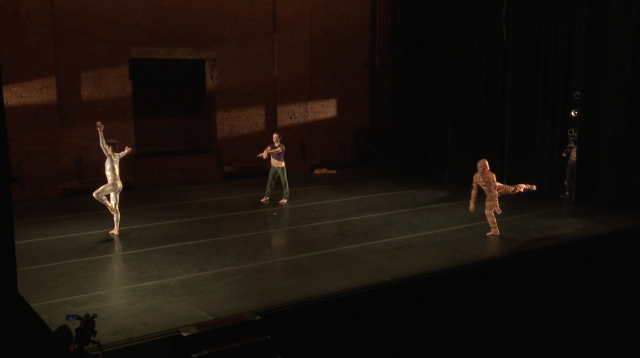
“We finally finished Finally Unfinished, but it’s never really finished,” Tanowitz announces before the curtain literally rises on Jason Collins, Christine Flores, Zachary Gonder, and Victor Lozano, who perform Gustave Le Gray, No. 2 on an empty stage. The four barefoot dancers, wearing tan shorts and T-shirts designed by Reid Barthelme and Harriet Jung, move gingerly in unison to a score by Caroline Shaw played by pianist Amy Yang; the camera shoots them from multiple angles, with closeups of their bare legs and long shots from the back of the theater.

After ten minutes, they are joined by Brittany Engel-Adams, Lindsey Jones, and Melissa Toogood for the explosion that is Finally Unfinished: Part 1. Amid piped-in crowd noises (“Field Recordings” by Dan Siegler) and recordings of cues from PTD’s 2014 appearance at the Joyce (“Cueing Sound Score,” with the disembodied voices of Laurie Benoit and Jeff Segal), Toogood takes over the stage, dressed in a full-length space-age onesie with a hood, followed by a masked cameraman in the same outfit. Soon everyone has changed costumes (including some garb that incorporates the design and color of the seats in the audience, the curtain, and the carpeting) as they dance to “Furtive Movements,” an electronic score by Ted Hearne, performed by cellist Ashley Bathgate and percussionist Ron Wiltrout. It all builds to an exhilarating crescendo until a peaceful and quiet finale with, of course, no applause.

But it’s not quite over; Finally Unfinished: Part II continues online with what PTD calls “a Digital Curio Case.” Designed by Jeremy Jacob and beginning with old footage of a clapping crowd, Part II reveals some of Tanowitz’s inspirations and creative process, including text (“Nowhere is a dead end”), cutouts of the dancers, a collection of clips from films in which characters perform playful dances using their fingers on a table (The Gold Rush, A Band Apart, Benny & Joon), a behind-the-scenes look at costumes by Barthelme and Jung and scenery by Suzanne Bocanegra, recommended reading, and more.

From the dances to the multimedia scrapbook, it’s a judicious and entertaining tribute to the Joyce using the internet as medium during a health crisis that has left us all in front of our screens, unable to experience dance and other live entertainment in person. As Tanowitz says, “It’s a different format now. / What format should it be? / We finished it for you. / It’s never finished for me.”
STAND WITH TEACHERS

Who: Stevie Van Zandt, Eddie Vedder, Margo Price, Bruce Springsteen, Sammy Hagar, Steve Buscemi, Bobby Cannavale, Lowell Levinger, Matisyahu, Whoopi Goldberg, Melle Mel, Tom Morello, Edward Norton, Vincent Pastore, Maureen Van Zandt, Trønd Fausa Aurvåg, Steinar Sagen
What: Holiday fundraiser for TeachRock
Where: TeachRock
When: Monday, December 21, $25-$150, 8:00
Why: “Little Steven’s TeachRock program brings an essential curriculum of music and culture into school and makes it available at no cost to educators. In a time of cutbacks in arts funding, Steve’s programs are keeping kids engaged in the arts, and in school — this is his greatest legacy,” Bruce Springsteen said about his longtime E Street Band cohort Stevie Van Zandt’s TeachRock, an organization dedicated to teaching arts, and specifically popular music, in schools. Part of the nonprofit Rock and Roll Forever Foundation, TeachRock has adapted to remote learning by making available special lesson packages for children of all ages.

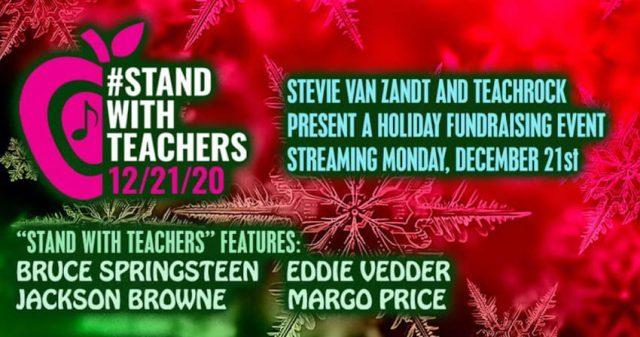
On December 21 at 8:00, Van Zandt and TeachRock will host a benefit fundraiser highlighted by performances by board members Springsteen and Jackson Browne, Eddie Vedder, Margo Price, and Matisyahu in addition to appearances by Sammy Hagar, Steve Buscemi, Bobby Cannavale, Whoopi Goldberg, Melle Mel, Tom Morello, Edward Norton, Vincent Pastore, Maureen Van Zandt, and, from Lillyhammer, Trønd Fausa Aurvåg and Steinar Sagen. Tickets are $25 or $150 to get your name added to the TeachRock Solidarity Wall. “Music connects us, even when we must be apart,” Van Zandt said in a statement. “Our amazing teachers stood by us and provided structure, emotional support, and a reassuring sense of normalcy to our children during Covid. Now we’re going to stand with teachers and provide them the resources they need to keep kids engaged, emotionally healthy, and learning.” The hourlong event will be followed by a Holiday Video Jukebox featuring songs by Little Steven and the Disciples of Soul, Darlene Love, Dean Frasier, and others.

HOMESICK

Danielle Agami looks deep inside herself in Homesick (photo courtesy Source Material)

HOMESICK
December 20 – January 10, $10-$25 (pay-what-you-can)
www.homesickthefilm.com
www.sourcematerialcollective.com

Israeli-born, LA-based dancer and choreographer Danielle Agami has reimagined her autobiographical solo piece, Framed, which had its world premiere in May 2018 at NYU Tisch School of the Arts, as the fifteen-minute film Homesick, streaming online December 20 to January 10. In the work, she looks deep inside herself as a woman and a creator, asking such questions as “What is expected for me to provide? Will dance be enough? Am I enough?” Directed by Samantha Shay and photographed by Victoria Sendra for Source Material, Homesick follows Agami as she moves from her apartment to a bar (where she is served by real-life Icelandic cocktail bartender Martin Cabejsek) to an indoor flower market (where she is joined by Jordan Klitzke) to a vast outdoor landscape and, as an encore, around Jerry Moss Plaza at the Music Center in LA.

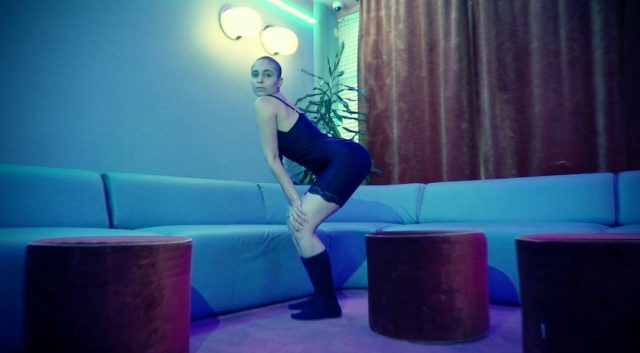
For much of the film, Agami, a former Batsheva dancer and gaga teacher who has run Ate9 Dance Company since 2012, first in Seattle, then in LA, changes between a black negligee, head shaved, to regular clothing and fuller hair, moving in fits and starts on her hands and knees, shaking her head in trancelike gestures, petting a cat, and extending her arms as if searching for freedom and love. “For me, there are two kinds of home,” she narrates. “There is the outer, and the inner. When I feel safe and peaceful in my surroundings and my mind, I feel at home, and everything falls into place.” Agami dances to a pair of haunting songs by Iceland-based Danish musician Sara Flindt, aka ZAAR, “Homesick” and “How Many Hearts.” The film is followed by a Q&A with Agami (Pick a Chair, calling glenn), Shay (In These Uncertain Times, Light), Sendra, and Flindt, moderated by CalArts professor of dance cinema Francesca Penzani.

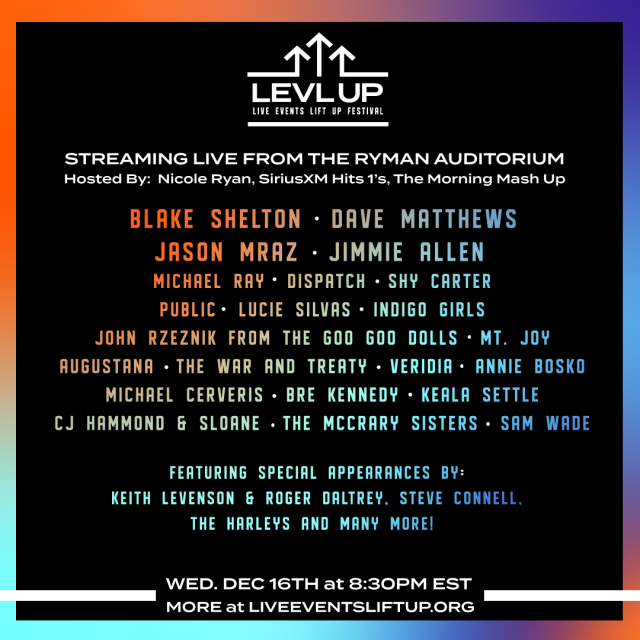
LIFT UP

Who: Blake Shelton, Dave Matthews, Jimmie Allen, Jason Mraz, Michael Ray, Shy Carter, the War and Treaty, John Rzeznik, Dispatch, Keala Settle, Mt. Joy, Augustana, Indigo Girls, Lucie Silvas, Annie Bosko, Bre Kennedy, CJ Hammond & Sloane, Veridia, Public, Michael Cerveris, the McCrary Sisters, Sam Wade, Roger Daltrey, Steve Connell, Michael McDonald, Kenny G, Jeff Tweedy, Nick Wheeler, Greta Van Fleet, Adam Gardner, Ray Parker Jr., Jerry Dipizzo, Taye Diggs, Ben Wysoki, the Harleys, Dublin Gospel Choir, Jim Sheridan, Storme Warren, Nicole Ryan
What: “A Festival of Music & Stories of Life On & Off the Road”
Where: Ryman Auditorium
When: Wednesday, December 16, free (donations encouraged), 8:30
Why: “It is so important that music fans and governments realize the impact this virus is having on millions of self-employed people who make the music industry function to bring much needed joy to our lives,” Roger Daltrey says about the effect the pandemic lockdown is having on the people who make a living supporting the work of superstar musicians. Daltrey will be appearing along with dozen of other rock, country, pop, R&B, and gospel musicians at “Lift Up,” a festival streaming live on Twitch from the Ryman Auditorium in Nashville that benefits the entertainment and events industry. The concert will feature the brand-new song “12 Million,” written by Sam Wade and LEVL UP music supervisor Keith Levenson in tribute to the crews that make music happen from behind the scenes. “Almost my whole adult life I have been touring in one shape or form and the road crews on my team and the venue crews that welcomed us and helped us put on a great show are all part of my extended touring family,” Cisco Adler said in a statement. “They really make it possible for artists like me to do what we do, and they are truly unsung heroes. They are also the first to be hit hard by a situation like this, so part of our mission at NoCap is to get shows happening again and get these good people back to work.”

THE DYBBUK

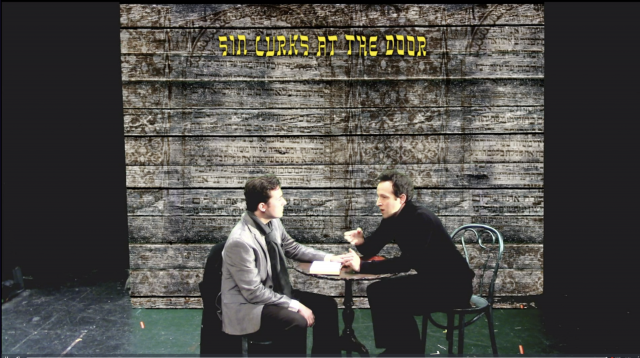
Theater for the New City is presenting a livestreamed adaptation of The Dybbuk through Sunday (screenshot by twi-ny/mdr)

Theater for the New City
December 9-13, $5-$36 (pay-what-you-can)
www.stellartickets.com
theaterforthenewcity.net

Good things come to those who wait. If there’s one thing we’ve learned during this pandemic, it’s that we need to have patience. Help is on the way, but if we as a nation follow protocols and have strong leadership, we can each make a difference, even with an administration that has turned its back on its people. We also have to be patient with the return of live theater as companies around the world experiment with Zoom, livestreaming, recording onstage without an audience, and other attempts to bring storytelling to a starving public.

So there I was on December 9, watching the hundredth-anniversary premiere of Theater for the New City’s livestreamed revival of the popular Yiddish play The Dybbuk, performed live onstage and broadcast over the Stellar platform. The chat function was on, so virtual attendees started getting ornery quickly when the show didn’t start exactly on time. And once it did, there were significant technical problems involving superimposed text, the green screening, and, most important, the sound, with a screeching electronic score drowning out the dialogue. Several people in the chat began complaining, even demanding a refund. But a solitary voice of reason explained that this is an opening night different from in-person opening nights and everyone should calm down. And she was right, because the tech crew was on the case, and after a near-disastrous beginning, the rest of the play was wonderful.

Written in 1914 by Jewish playwright S. An-ski, aka Shloyme Zaynvl Rapoport, who hailed from what is now Belarus, The Dybbuk premiered at the Elyseum Theatre in Warsaw on December 9, 1920, one month after An-ski’s death at the age of fifty-seven. Presented in association with New Yiddish Rep, this new English-language adaptation (with a fair sprinkling of Yiddish) is by NYR artistic director David Mandelbaum. The Dybbuk takes place in an old Jewish shtetl, where a long-arranged match between Menashe and Leah, the daughter of the wealthy Sender, dooms the love young student Khanan has for her. But on her wedding day, she is possessed by a spirit who will not let her marry Menashe, and the case soon comes before the judgment of the learned rabbi.

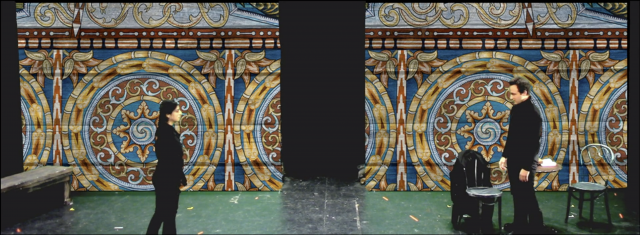
Cool backgrounds propel Theater for a New City virtual revival of classic Yiddish play (screenshot by twi-ny/mdr)

Director Jesse Freedman eventually works out the kinks in real time and gets everything in sync — with lighting by Alexander Bartieneff, sound by Eamon Goodman, and video by Tatiana Stolpovskaya — resulting in a moving and delightful production that features fun backgrounds and solid performances by Darrel Blackburn, Amy Coleman, Hannah Gee, Lev Harvey, Lucie Lalouche, Thomas Morris, and Mandelbaum as the rabbi. “A play about possession seems particularly suited to the times. The country has been possessed by the evil spirits of strife and division and could use a good exorcism to bring it back to its senses,” Mandelbaum said in a statement. “An intrepid group of artists is soldiering on through this pandemic minefield to honor the one-hundredth anniversary of this iconic play with the battle cry of their calling: ‘The show must go on.’ This will be a spiritual fusion of live performance and digital artistry. The ‘possession’ of live theater by the spirits of techno-wizardry.”

So be patient; the show will go on. It might not get off to a big start, but it packs quite a wallop by the finish.

For more on The Dybbuk, which was also made into a classic 1937 Yiddish film directed by Michał Waszyński, you can check out the Congress for Jewish Culture’s recent panel discussion “The Dybbuk at 100” on Facebook with playwright, translator, and theater historian Nahma Sandrow, Baruch College assistant professor and author Debra Caplan, and author and UT Austin senior lecturer in Yiddish Itzik Gottesman, moderated by writer, translator, actress, and theater historian Caraid O’Brien. The organization will also be presenting its own production of The Dybbuk on December 14 at 7:00 in Yiddish with Mike Burstyn, Shane Baker, Mendy Cahan, Refoyel Goldwasser, Amitai Kedar, Yelena Shmulenson, Suzanne Toren, and Michael Wex, directed by Allen Lewis Rickman; it can be seen here.

MOLIÈRE IN THE PARK: PEN/MAN/SHIP

Who: Molière in the Park theater company
What: Livestreamed performances and Q&As
Where: FIAF Facebook and Molière in the Park YouTube
When: Saturday, December 12, free with RSVP, 2:00 & 7:00 (show will be available for viewing through January 3)
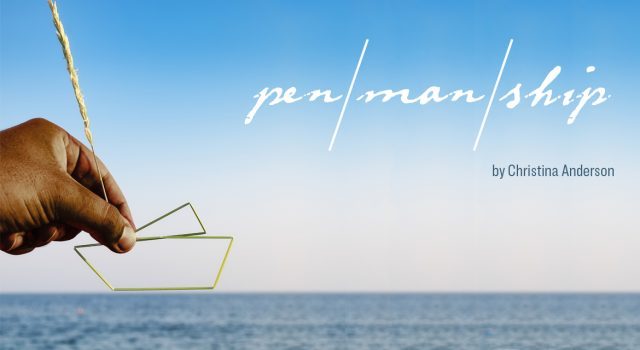
Why: After staging Zoom adaptations of three classic seventeenth-century plays by Jean-Baptiste Poquelin — better known as Molière — Brooklyn-based Molière in the Park is getting significantly more contemporary with its latest live, online production, playwright, TV writer, and educator Christina Anderson’s new work, Pen/Man/Ship. Following The Misanthrope, Tartuffe, and The School for Wives, Molière in the Park moves into the late nineteenth century with Pen/Man/Ship, which takes place in 1896 aboard a ship heading for Liberia shortly after the US Supreme Court decided in Plessy v. Ferguson to uphold the constitutionality of racial segregation under the concept of “separate but equal.” The cast features Crystal Lucas-Perry, Kevin Mambo, Jared McNeill, and Postell Pringle; the parable is directed by Molière in the Park founding artistic director Lucie Tiberghien using Liminal Entertainment Technologies’ StreamWeaver software, which takes actors out of Zoom boxes and puts them in front of backgrounds that more resemble indoor and outdoor sets while also allowing the tech crew to work together regardless of where they are. Copresented with the French Institute Alliance Française (FIAF) in partnership with the Prospect Park Alliance and the LeFrak Center at Lakeside, the play will be performed live twice on December 12, at 2:00 and 7:00, followed by Q&As with the creatives; a recording will be available for on-demand viewing through January 3.