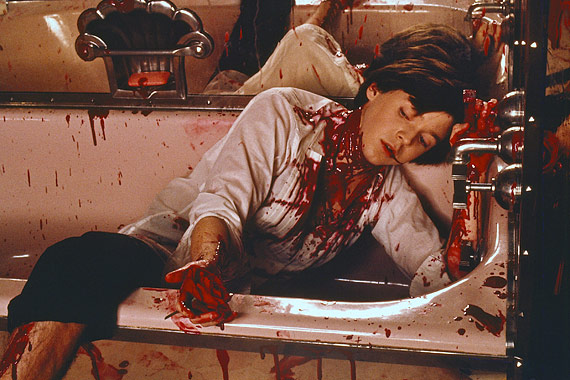
Harold (Bud Cort) has a little bit of an obsession with death in very different kind of romantic comedy that is part of Metrograph series
HAROLD AND MAUDE (Hal Ashby, 1971)
Metrograph Digital
Sunday, February 7, 8:00
Series continues through February 18 metrograph.com/screenings
New York City–based cinematographer and documentarian Kirsten Johnson has jumped into the spotlight with her latest nonfiction film, Dick Johnson Is Dead, which is garnering Oscar buzz; the film imagines multiple deaths for her father, who is suffering from dementia. The film was a follow-up to her 2016 autobiographical cinematic memoir, Cameraperson, which put her on the map after years of serving as director of photography for Laura Poitras (The Oath, Citizenfour), Michael Moore (Fahrenheit 9/11), and others. She is currently hosting “Kirsten Johnson Carte Blanche,” five specially selected films for Metrograph Digital, each uniquely dealing with life and death, including Elia Suleiman’s Divine Intervention, Yuval Hameiri’s I Think This Is the Closest to How the Footage Looked, Souleymane Cissé’s Yeelen, and Keisha Rae Witherspoon’s T.
On February 7 at 8:00, she will introduce a one-time-only live fiftieth anniversary screening of the existential cult fave Harold and Maude. Bud Cort (Harold) and Ruth Gordon (Maude) are magnificent in this glorious black comedy from director Hal Ashby (The Last Detail, Shampoo, Being There) and writer Colin Higgins (Foul Play, 9 to 5). Harold is an eighteen-year-old rich kid obsessed with death, regularly flirting with suicide. Maude is a fun-loving, free-spirited senior citizen approaching her eightieth birthday. Ashby throws in just the right amount of post-1960s social commentary, including a very funny antiwar scene, without becoming overbearing, as this could have been a maudlin piece of sentimental claptrap, but instead it’s far from it. Even the Cat Stevens soundtrack (“If You Want to Sing Out, Sing Out,” “Tea for the Tillerman,” “Where Do the Children Play?”) works beautifully. Harold and Maude is a tender, uproarious, bittersweet tale that is one of the best of its kind, completely unforgettable, enlightening, and, ultimately, life-affirming in its own odd way. While H&M will screen only on Sunday night, offering a respite from the Super Bowl frenzy, all the other films in “Kirsten Johnson Carte Blanche” will be available for several days after their initial livestream.
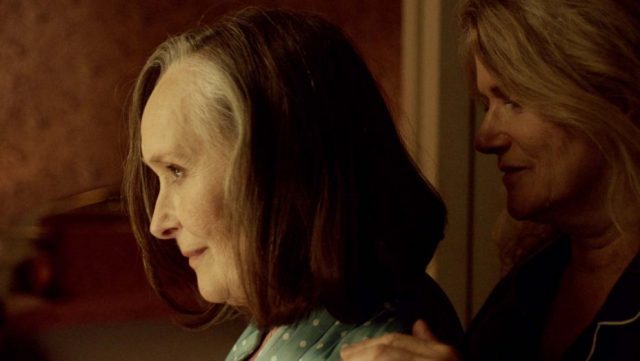
Martine Chevallier and Barbara Sukowa star as secret lovers in Filippo Meneghetti’s Two of Us
TWO OF US (DEUX) (Filippo Meneghetti, 2019)
Film Forum Virtual Cinema
Opens virtually Friday, February 5 www.twoofusfilm.com filmforum.org
“You and I have memories / longer than the road that stretches out ahead,” the Beatles sing on the 1970 Let It Be song “Two of Us,” continuing, “Two of us wearing raincoats, standing solo / in the sun / You and me chasing paper, getting nowhere / on our way back home / We’re on our way home / We’re on our way home / We’re going home.” The concept of home is at the center of Filippo Meneghetti’s heartbreakingly beautiful Two of Us, France’s official submission for the Best International Feature Film Oscar. Two of Us begins in a park around Montpelier, where two little girls are playing hide-and-seek until one mysteriously disappears. It’s a park where Nina (Barbara Sukowa) and Madeline (Martine Chevallier), affectionately known as Mado, get to enjoy being together in a way they cannot in front of Madeline’s family — the two senior citizens, who live down the hall from each other on the top floor of an apartment building, have been lovers and traveling companions for decades, secrets they have kept from Madeline’s daughter, Anne (Léa Drucker), and son, Frédéric (Jérôme Varanfrain). Madeline promises to finally tell her children about their relationship and that she and Nina are planning to move to Rome, but tragedy strikes, forcing the two women apart, both physically and metaphorically like the girls in the park, but their deeply intense and honest connection isn’t about to relent under the circumstances, which include a villainous caregiver portrayed by Muriel Bénazéraf.
Reminiscent of Michael Haneke’s gorgeously told Amour, in which an elderly couple played by Jean-Louis Trintignant and Emmanuelle Riva deal with dementia, Two of Us, which does not involve Alzheimer’s, is a magnificent love story and a gripping psychological thriller. Sukowa (Berlin Alexanderplatz, Lola) gives a sexy, harrowing performance as Nina, a determined woman who refuses to give up despite mounting obstacles, while longtime Comédie-Française star Chevallier is a revelation as Madeline, her every movement exquisitely choreographed; Aurélien Marra’s camera seems to be magnetically drawn to her eyes as they search her changed world in silence.
In his debut feature film, the Italian-born, France-based Meneghetti has crafted a love story for the ages, written specifically for Sukowa and Chevallier by Meneghetti and Malysone Bovorasmy with Florence Vignon. Nina spends much of the first part of the film darting across the hall into Mado’s unlocked apartment, no one aware they are a lesbian couple; it is like the hallway is their own red carpet ushering them into their own private fantasy. At certain angles, it appears that they are younger versions of themselves, their passion for each other helping them stay youthful. But after the event, forces conspire to keep them apart, a separation that Nina fights against, resolved to make a home for the two of them. Two of Us is an unforgettable film about place, about belonging, about a love that knows no bounds. As the Beatles also sang on the Let It Be album, “The long and winding road / That leads to your door / Will never disappear / I’ve seen that road before / It always leads me here / Lead me to your door.”
The film opens virtually at Film Forum on February 5; each forty-eight-hour link comes with a conversation with Meneghetti and Sukowa, moderated by Julianne Moore. In conjunction with Two of Us, the French title of which is simply Deux, Film Forum is streaming three other Sukowa films, Rainer Werner Fassbinder’s Lola beginning February 12 and Margarethe Von Trotta’s Hannah Arendt February 19 and Rosa Luxemburg March 5.
21st CENTURY JAPAN: FILMS FROM 2001-2020
Japan Society
February 5-25, $8-$12 for three-day rental per film, $99 for all-access pass through February 4 film.japansociety.org
Japan Society and Japan’s Agency for Cultural Affairs have teamed up for “21st Century Japan: Films from 2001-2020,” an impressive collection of Japanese works from the last twenty years, streaming February 5-25. This inaugural ACA Cinema Project consists of thirty films, from recent classics to online US premieres as well as a focus on Kiyoshi Kurosawa, including a one-hour talk with the director, moderated by Abi Sakamoto. Among the primo filmmakers being represented are Sion Sono, Yukiko Mishima, Shinya Tsukamoto, Naomi Kawase, Hirokazu Kore-eda, Yoji Yamada, and Takashi Miike, many of whom are well known to regular attendees of Japan Society’s annual summer Japan Cuts festival.
“While it’s impossible to really capture the last two decades of Japanese narrative fiction filmmaking in its full breadth, we are excited to share at least the tip of the iceberg for these three weeks in February,” Japan Society deputy director of film K. F. Watanabe said in a statement. “Online or otherwise, a large majority of these titles remain unavailable to watch with English subtitles in the U.S., so I hope this series provides an opportunity to create new fans of filmmakers such as Naoko Ogigami or Shuichi Okita and expand any preconceptions of what modern Japanese cinema can offer.” Below are select reviews; keep watching this space for more recommendations.
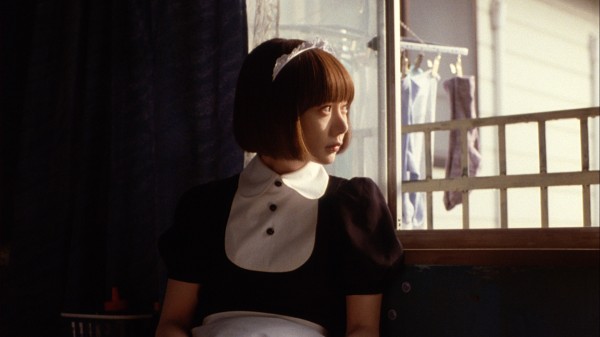
Nozomi (Bae Doona) dreams that there’s more to life in Hirokazu Kore-eda’s Air Doll
AIR DOLL (Hirokazu Kore-eda, 2009)
Over the last twenty-five years, Japanese filmmaker Hirokazu Kore-eda has compiled a remarkable resume, directing fourteen narrative features and five documentaries that investigate such themes as memory and loss. His 2009 film, Air Doll, examines loneliness through the eyes of a blow-up doll come to life. Bae Doona stars as Nozomi, a plastic sex toy owned by Hideo (Itsuji Itao), a restaurant worker who treats her like his wife, telling her about his day, sitting with her at the dinner table, and making love to her at night. But suddenly, one morning, Nozomi achieves consciousness, discovering that she has a heart, and she puts on her French maid costume and goes out into the world, learning about life by wandering through the streets and working in a video store, always returning home before Hideo and pretending to still be the doll. Adapted from a manga by Yoshiie Goda, Air Doll is another beautiful, meditative study from Kore-eda. Nozomi’s wide-eyed innocence at the joys of life comes sweet and slowly, played with a subtle wonderment by South Korean model and actress Bae (Sympathy for Mr. Vengeance, The Host). The film does, however, take one nasty turn and is a bit too long, at more than two hours. But it’s still another contemplative gem from the masterful director of Maborosi, Nobody Knows, Shoplifters, and Still Walking.
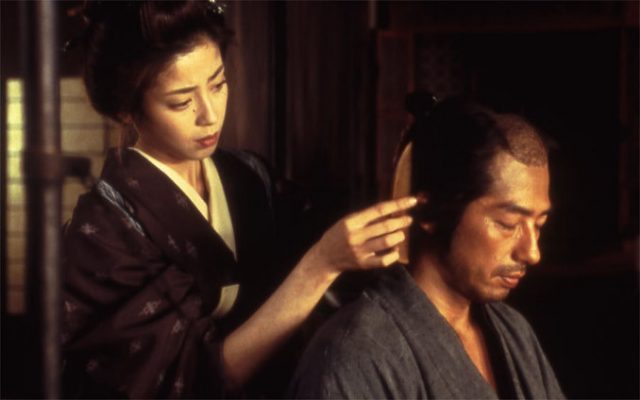
Hiroyuki Sanada gets ready to fight in Yoji Yamada’s The Twilight Samurai
THE TWILIGHT SAMURAI (Yoji Yamada, 2002)
Hiroyuki Sanada is outstanding as the title character in Yoji Yamada’s period drama, The Twilight Samurai, playing a lowly ronin who chooses to take care of his family after his wife dies, instead of wielding his sword. During the day, he works as a bean counter, then goes straight home to his aging mother and two young daughters. When he learns that a childhood friend, Tomoe (Rie Miyazawa), is divorcing her abusive husband, he ends up fighting for her honor. But instead of battling his opponent with a sharp sword, he pulls out a piece of wood. Word of his skill reaches the highest level of his clan, who wants him to kill for them, setting up an emotional and psychological inner struggle for the quiet and shy family man. The Twilight Samurai, which was nominated for a Best Foreign Language Film Oscar, is a different kind of samurai movie, focusing more on love and loss than blood and vengeance.
The great Takashi Miike adapts manga in family-friendly genre fantasy The Great Yokai War
THE GREAT YOKAI WAR (YÔKAI DAISENSÔ) (Takashi Miike, 2005)
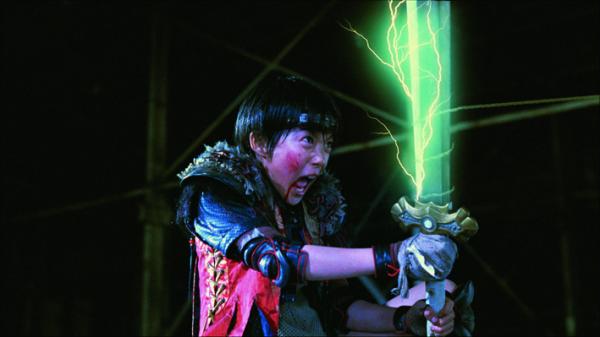
Mixing in a liberal amount of Time Bandits with The Wizard of Oz, throwing in a little Hayao Miyazaki, and adding dashes of Raiders of the Lost Ark, The Lord of the Rings, Gremlins, Return of the Jedi, Labyrinth, and even Kill Bill, Takashi Miike has wound up with an entertaining fantasy film for both kids and adults. Known more for such ultraviolent, hard-to-watch frightfests as Audition and Ichi the Killer, Miike reveals his softer side in this genre film based on a yokai manga by Shigeru Mizuki (who also plays the Demon King). Ryunosuke Kamiki is splendid as Tadashi, a young city boy taking care of his grandfather (Hiroyuki Miyasako) in a country village, where he is chosen at a local festival as the mythical Kirin Rider, the guardian of peace and friend of justice. Soon he finds himself in a real battle between good and evil, taking him from the heights of the Great Goblin’s mountain cave to the depths of a seedy underworld run by the very white Agi (Chiaki Kuriyama) and powerful mastermind Katou Yasunori (Etsushi Toyokawa). Joined by yokai spirits Kawahime (Mai Takahashi), Kawatarou (Sadao Abe), and the oh-so-cute Sunekosuri, Tadashi fights to save the human world, wielding his special sword against a phalanx of mechanical robots and other villainous creatures. At more than two hours, The Great Yokai War is at least twenty minutes too long and would have greatly benefited by the excision of one very silly subplot. But it is still a charming tale from one of the true masters of horror.
Last week, New York–based PlayCo premiered the first iteration of William Burke’s Is It Supposed to Last?, an interactive Zoom party in which attendees brought streamers, fun dress, and food and drink to a gathering that began with an ominous live piano performance of Neil Diamond’s classic “Sweet Caroline,” a favorite in bars, concert halls, sports arenas, and the internet, as evidenced by a December global singalong. But Is It Supposed to Last?, directed by Burke and Bryn Herdrich and starring Jehan O. Young and Carolina Đỗ, with music by Sugar Vendil, took a turn on the state of the world with a pair of monologues and an isolated man getting wrapped up, concluding with multiple recorded versions (Elvis!) as people decided how long they wanted to continue listening to a song that usually provides an instant connection among friends and strangers. PlayCo has vowed to do less in February, hosting four free activities before returning with the next iteration of Is It Supposed to Last? in March. It all starts February 4 at 12:30 with a gentle, guided nap led by Đỗ, addressing such questions as “Why must we, as adults, have to live with nap regrets?” and “Do you feel the siren’s call to just slip away from work into dreamland for just a lil teeny tiny nap?” On February 14 at 5:00, Justin Taylor explores self-compassion in a group meditation, advising you to love yourself even if you might be alone on Valentine’s Day. On February 17 at 11:30, Charlene Adhiambo will offer journaling tips with prompts and freewriting. And on February 28 at 8:00, you can get shaking with the virtual Social DisDance Party with Ani, Sunny, and other members of PlayCo, kicking loose as the cold, short month comes to an end.
Phases and the In-Betweens features animation, text, and video incorporating the phases of the moon into caregiving during the pandemic
PHASES AND THE IN-BETWEENS
The Shed
Through February 11, free theshed.org
Phases and the In-Betweens is a collaborative intervention on the website of the Shed, the Hudson Yards performance center that opened in 2019 and hosts music, theater, dance, art, and other programs and exhibitions. The ongoing multimedia piece changes with the phases of the moons; it began with the new moon on January 13 and was updated for the first quarter January 20; next up is the last quarter on February 4, followed by the new moon on February 11, which will signal the end of the project. Phases and the In-Betweens is created by Brothers Sick, consisting of artist, educator, and curator Ezra and photographer Noah Benus; interdisciplinary media artist Yo-Yo Lin; and poet, curator, and critic DJ Queer Shoulders (danilo machado). Incorporating animation, text, and video, the work examines issues of caregiving, disability, and lockdown as they relate to the “phases of reopening” and the inevitable return to whatever “normal” might be on the other side of the Covid-19 crisis. “For this project, at its core, we really wanted to think about what care looks like in private and public and how that relationship of care is enacted during a global pandemic,” Brothers Sick said in a statement. “From there, we reference different elements of care in isolation and public, layering and blurring the intimacy of illness and public life during precious and precarious outings. We layer and blur hierarchies of material, media, and experience. For the format, we really wanted to explore these ever-present ideas of care and sickness through a broadened presentation of digital art sharing and making, across sick, disabled, Crip time, pandemic time, celestial space and time, and across ourselves in our care networks with our collaborators.”
They accomplish that with bold imagery, words that jump out at you, and detailed medical information. They narrate, “squirm fingers / nitrile disposable sanitary / a map of new york city has joined / the right side of frame / colors change from shades of green to blue / metrics and mappings / testing and cases / patches of pink and purple and orange / we move faster to the left passing more fans, / a worker and a uniformed soldier, who waves / sterling silver ringed finger / scroll touch screen questionnaire / how much pain / how severe.” Phases and the In-Betweens is part of the Shed’s “Up Close” digital series, which has previously presented House or Home: 690 Wishes with the HawtPlates and Charlotte Brathwaite, Revelation of Proverbs by Reggie ‘Regg Roc’ Gray and the D.R.E.A.M. Ring, Go Off! Joy in Defiance with DJ April Hunt, Rashaad Newsome, Legendary Monster Mon_Teese, and Precious, Solo B by Mariana Valencia, and other programs.
RED FOLDER
Steppenwolf Now
January 27 – September 1, $75 for six online productions www.steppenwolf.org
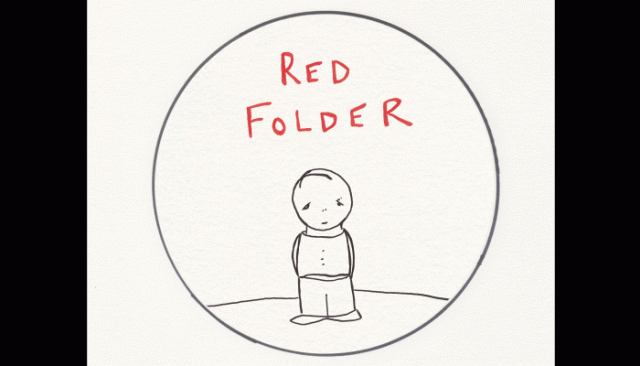
“Why aren’t you my friend?” a first grader asks his red folder in Rajiv Joseph’s devilishly clever and insightful short Red Folder, part of Steppenwolf’s online streaming portal, Steppenwolf Now. Written, directed, and illustrated by ensemble member Joseph, a Pulitzer Prize finalist and two-time Obie winner whose previous plays include Bengal Tiger at the Baghdad Zoo,Guards at the Taj, and Describe the Night,Red Folder is like an audiovisual children’s book gone mad, a deranged and demented — and repeatedly laugh-out-loud funny — story about fear of not fitting in, of loneliness and being different. “It’s something that I never would have conceived of doing outside of the restrictions that the pandemic has imposed on us,“ Joseph tells Steppenwolf artistic director Anna D. Shapiro in a video teaser.
Red Folder is a calmly told demented tale of a child’s fears in first grade
The tale takes place within a squiggly circle against a solid off-white background, with rather simplistic line-drawn characters and imagery, like a chapter of a miniature DIY graphic novel come to life. Joseph concentrates on red and black, with an occasional flash of green and yellow as anthropomorphic figures haunt the boy’s daily existence, which involves pudding, skulls, blood, a stained coffee mug, a mean teacher, and a beloved Hulk lunch box. The story is narrated in an appropriately cool, dispassionate tone by Steppenwolf’s Carrie Coon (Mary Jane,Who’s Afraid of Virginia Woolf?), accompanied by Chris P. Thompson’s original piano score, a riff on Vince Guaraldi’s music for A Charlie Brown Christmas. The eleven-minute piece was filmed and edited by Joel Moorman, with animation by Christopher Huizar; it’s essentially a memory play that will send you back to first grade and childhood’s existential dread, remembering your teacher and classmates and favorite lunch box. Hopefully what happens to the boy didn’t happen to you, although you probably experienced the same fears, the same worries, and the same overall horror that accompanies one’s first encounter with institutional authority.
Red Folder is available for streaming as part of the Steppenwolf Now package, which also features James Ijames’s two-person short Zoom play What Is Left, Burns and Isaac Gómez’s audio play Wally World; coming up next are Vivian J. O. Barnes’s Duchess! Duchess! Duchess! in March, Donnetta Lavinia Grays’s Where We Stand in April, and Sam Shepard’s Ages of the Moon in June.
THE NOURISH PROJECT
WP Theater
January 28 – February 7, free, 7:30 wptheater.org
New York City’s WP (formerly Women’s Project) Theater seeks to soothe and feed your soul with The Nourish Project, an interactive virtual presentation continuing through February 7. Conceived and directed by associate artistic director Rebecca Martínez, who was part of the team that took us on an audio tour through the Cathedral Church of St. John the Divine community in Sanctuary and helmed one of the microplays in the sensational Here We Are series, The Nourish Project is a multidisciplinary production featuring dance, music, storytelling, poetry, food, and more from a collective of BIPOC creators. Admission is free, but there are three levels of suggested donations if you can afford it, from $10 to $100; when you register, you have to select an element — water, earth, fire, or air — that will determine which breakout room you go to about halfway through the show.
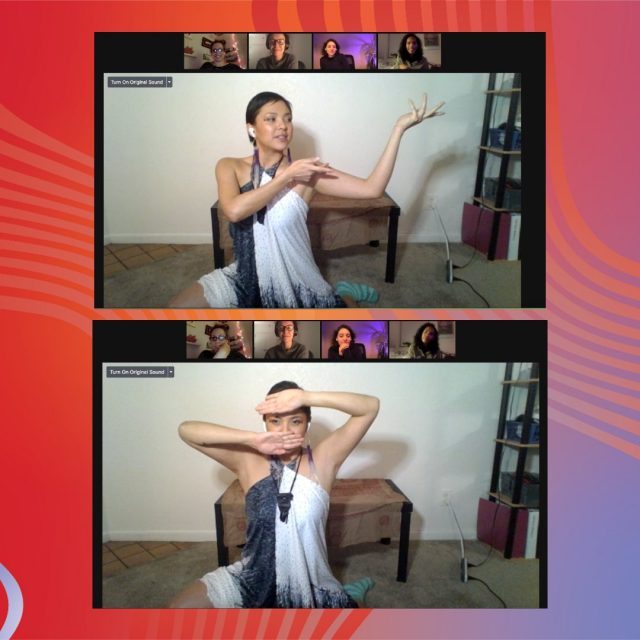
Natalie Benally is one of several BIPOC creators participating in The Nourish Project (photo courtesy WP Theater)
The seventy-minute experience includes songs by Edna Vazquez, opening and closing words written by Jaisey Bates, a cooking demonstration and song from Joaquin Lopez, poems by Latrelle Bright and Camryn Bruno, element hostings by Natalie Benally, Nikiko Masumoto, Jono Eiland, and Bright, dance by Brittany Grier, Megan J. Minturn, and Joya Powell, and other contributions from Siobhan Juanita Brown, Sage Chanell, Madeline Sayet, Dr. Michelle Tom, and Meghan “Sigvanna” Topkok. Along the way, you will be asked intimate questions in the chat, and you are encouraged to turn your camera on at several points to share a few objects visually. You will also hear such lines as “I, the spirit in constant motion, wafting across the planet ever present, holding everything that ever was” and “We are storied bodies, made of stars.” The Nourish Project is earnest, New Agey, reverential, and crunchy, with flourishes of organic spirituality and ASMR, but if that’s your thing, give it a shot. These days, you gotta find comfort and community wherever you can.