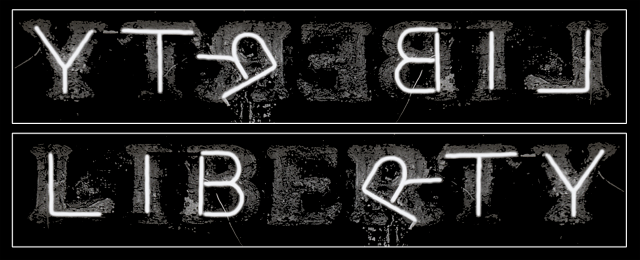
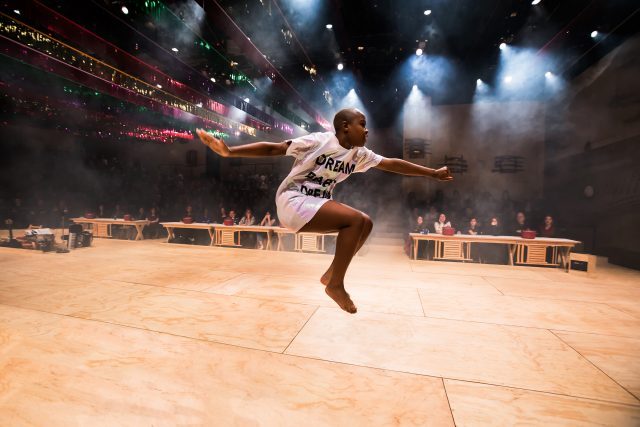
The american vicarious and the Invisible Dog Arts Center follow up their socially distanced Static Apnea with Negative Liberty / Positive Liberty, an immersive performance installation for one audience member at a time. The piece explores Latvian-born British philosopher Isaiah Berlin’s Oxford lecture delivered on Halloween 1958, “Two Concepts of Liberty: Negative & Positive.” while also incorporating Anthony Barboza’s 1966 photograph, Pensacola, Florida, of a neon sign depicting the word Liberty with a broken “E” and dangling “R,” revealing the fragility of freedom, as they both relate to current events. Berlin writes:
“To coerce a man is to deprive him of freedom – freedom from what? Almost every moralist in human history has praised freedom. Like happiness and goodness, like nature and reality, the meaning of this term is so porous that there is little interpretation that it seems able to resist. I do not propose to discuss either the history or the more than two hundred senses of this protean word, recorded by historians of ideas. I propose to examine no more than two of these senses – but those central ones, with a great deal of human history, behind them, and, I dare say, still to come. The first of these political senses of freedom or liberty (I shall use both words to mean the same), which (following much precedent) I shall call the ‘negative’ sense, is involved in the answer to the question ‘What is the area within which the subject – a person or group of persons – is or should be left to do or be what he is able to do or be, without interference by other persons?’ The second, which I shall call the positive sense, is involved in the answer to the question ‘What, or who, is the source of control or interference, that can determine someone to do, or be, one thing rather than another?’ The two questions are clearly different, even though the answers to them may overlap.”
Conceived and directed by Christopher McElroen (Debate: Baldwin vs Buckley,Static Apnea), the installation features performers Sarah Ellen Stephens and Olivia Gilliatt, with scenography by Troy Hourie, video design by Adam J. Thompson, sound by Andy Evan Cohen, and lighting by Lucrecia Briceno. Admission is free to each eight-minute session but must be reserved in advance; slots are already filling up, so you’d best sign up fast. In addition, Barboza is included in the Whitney exhibition “Working Together: The Photographers of the Kamoinge Workshop,” which continues through March 28.
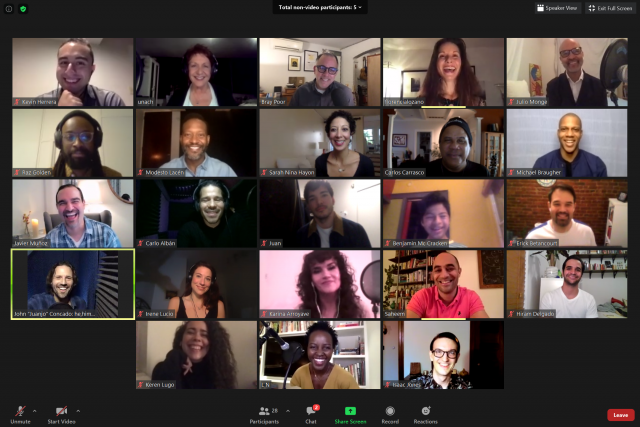
The Public Theater’s bilingual radio play Romeo y Julieta was rehearsed over Zoom (screenshot courtesy the Public Theater)
Who: Saheem Ali, Lupita Nyong’o, Juan Castano, Alfredo Michel Modenessi, Rebeca Ibarra, more What: Online premiere listening party for bilingual audio production of Romeo y Julieta Where:The Greene Space and the Public Theater When: Thursday, March 18, free with RSVP, 6:45 (stream available for one year) Why: Unsurprisingly, audio plays have made a comeback during the pandemic, with theaters in lockdown. Keen Company’s Season of Audio Theater has included finkle’s 1993 and Pearl Cleage’s Digging in the Dark, with James Anthony Tyler’s All We Need Is Us up next. Playing on Air, which predated the Covid-19 crisis, has posted such nonvisual works as Cary Gitter’s How My Grandparents Fell in Love, Daniel Reitz’s Napoleon in Exile, Naveen Bahar Choudhury’s Skin, and Dominique Morisseau’s Jezelle the Gazelle, featuring such actors as Julie White, Jesse Eisenberg, Marsha Mason, Ed Asner, Jane Kaczmarek, J. Alphonse Nicholson, and others.
Meanwhile, the Public Theater has presented Anne Washburn’s Shipwreck: A History Play About 2017 as well as the four-part Free Shakespeare on the Radio: Richard II, adapted and directed by Saheem Ali. Ali has now teamed up with playwright Ricardo Pérez González on Romeo y Julieta, a bilingual audio adaptation based Alfredo Michel Modenessi’s Spanish translation of Shakespeare’s heart-wrenching tragedy.
Colorful illustrations by Erick Dávila add visuals to bilingual radio play (courtesy the Public Theater)
The play alternates between English and Spanish; thankfully, you don’t hear every line in both languages, or else the show would be four hours long. However, the Public provides the script on its website so you can follow along and see the full translation. (The website also offers a visual guide to the cast and characters, a bilingual synopsis, colorful illustrations by Erick Dávila, and a trailer.) Presented in conjunction with WNYC Studios and the Greene Space, the radio play premieres on March 18 at 6:45 with much virtual fanfare, kicking off with a preshow greeting and cocktail demonstration (Mezcal Negroni or nonalcoholic Mojito), hosted by WNYC’s Rebeca Ibarra. Then the group listening party starts at 7:00, followed by a live talkback and Q&A with Ali, actors Lupita Nyong’o, who plays Juliet, and Juan Castano, who stars as Romeo, and translator Modenessi, moderated by Ibarra. Everything is free with advance RSVP, but you have to supply your own drinks.
The rest of the cast consists of Carlo Albán as Benvolio, Karina Arroyave as the apothecary, Erick Betancourt as Abram, Michael Braugher as Balthasar, Carlos Carrasco as Lord Montague, Ivonne Coll as the nurse, John J. Concado as Peter, Hiram Delgado as Tybalt, Guillermo Diaz as Gregory, Sarah Nina Hayon as Lady Montague, Kevin Herrera in the ensemble, Modesto Lacen as Prince Escalus and Capulet’s cousin, Florencia Lozano as Capulet, Irene Sofia Lucio as Mercutio, Keren Lugo as Sister Joan, Benjamin Luis McCracken as Paris’s page, Julio Monge as Friar Lawrence, Javier Muñoz as Paris, and David Zayas as Sampson. The original score by Michael Thurber is performed by Jon Lampley on trumpet, Eddie Barbash on alto saxophone, and Mark Dover on bass clarinet; bassist Thurber will also entertain the audience during intermission. The stream of the radio play will be available for one year.
Harvey Fierstein and the cast of Casa Valentina will reunite for MTC’s “The Show Goes On”
Who: Harvey Fierstein, Reed Birney, John Cullum, Gabriel Ebert, Tom McGowan, Patrick Page, Nick Westrate, Mare Winningham What: Cast reunion and watch party Where:Manhattan Theatre ClubYouTube When: Thursday, March 18, free, noon Why: In November, Manhattan Theatre Club kicked off a new monthly series, “The Show Goes On,” revisiting previous productions with members of the cast and crew watching filmed excerpts and talking about their experiences. In November, director Trip Cullman, narrator Rebecca Naomi Jones, music director Justin Levine, and costar Will Swenson looked at 2012’s Murder Ballad, which also featured Karen Olivo and John Ellison Conlee. In December, actors Jon Hoche and Paco Tolson explored 2016’s Vietgone, by Qui Nguyen. In January, writer-director John Patrick Shanley and star Timothée Chalamet discussed 2016’s Prodigal Son. And in February, Stephanie Berry, who played, Aunt Mama, shared insight into 2018’s Sugar in Our Wounds, written by Donja R. Love and directed by Saheem Ali.
The March edition of “The Show Goes On,” each of which runs between fifteen and twenty minutes, reunites the cast of 2014’s Casa Valentina, Harvey Fierstein’s first drama in more than a quarter century. The play, inspired by a true story, takes place in June 1962 at a Catskills bungalow where men spend weekends cross-dressing and acting like women, a safe haven where they can celebrate their feminine side. Joining in the watch party will be Fierstein and most of the original cast: Reed Birney, John Cullum, Gabriel Ebert, Tom McGowan, Patrick Page, Nick Westrate, and Mare Winningham. At the time, I wrote, “Cross-dressing might be somewhat de rigueur these days on Broadway (Kinky Boots, A Gentleman’s Guide to Love & Murder, Cabaret, Hedwig and the Angry Inch), but Fierstein, [director Joe] Mantello, and an extremely talented and beautiful cast offer a very different take on this misunderstood culture, treating it with humor, intelligence, honor, courage, and, perhaps most important, dignity.” Like its title says, the show does go on, living on YouTube after its initial airing.
On March 14, 2020, Mayor Bill de Blasio stated, “I am not ready today at this hour to say, let’s have a city with no bars, no restaurants, no rec centers, no libraries. I’m not there.” But he was there the next day, shutting down the city while allowing St. Patrick’s Day revelers one last chance to become superspreaders, letting them have one final party night on March 16. A year later, Gotham has suffered 775,000 cases and more than 30,000 deaths, so for 2021, the St. Patrick’s Day Parade will be virtual, but restaurants are back open. For those who are not planning on cramming into any pubs quite yet, there are several online gatherings to celebrate the patron saint of Ireland.
The parade, a New York City institution since 1762, will be virtual in 2021, honoring first responders and essential workers. There will be events all day long, from a livestreamed mass and a composite of previous parades to live entertainment and interviews.
The Gingold Theatrical Group, which is dedicated to the work of George Bernard Shaw, is hosting a livestreamed Irish Poetry Slam with Robert Cuccioli, Tyne Daly, Melissa Errico, Jessica Hecht, Daniel Jenkins, Andrea Marcovicci, Tonya Pinkins, Thom Sesma, Renee Taylor, Sally Wilfert, Karen Ziemba, and others taking part in an open mic night beginning at 6:00 (admission is free with advance RSVP), with people contributing poetry, songs, toasts, jokes, monologues, sayings, and more, preferably by or inspired by Irish writers. “Ordinarily, we’d be having our annual Golden Shamrock Gala on the seventeenth, but . . . nope!” Gingold artistic director David Staller said in a statement. “This shindig will take place over Zoom! Not Irish? Not a problem. On St. Pat’s, we’re ALL a little Irish. This is just a party. Not a performance. Not a fundraiser. Just a chance for us all to raise a glass and be ‘together.’”
Meanwhile, Knowledge Workings Theater Company, started in 2018 by Joe Queenan, T. J. Elliott, and Marjorie Phillips Elliott, is holding its Second Annual Virtual (Not Necessarily Virtuous) St. Patrick’s Day Celebration. Anyone can participate by making their own video, following specific instructions on YouTube here and seeing what contributors posted last year. It’s free, but it you want to donate, Knowledge suggests you do so to the Irish Rep, which is presenting JM Synge’s The Aran Islands, starring Brendan Conroy, March 16-28, including 3:00 and 8:00 screenings March 17.
On Wednesday night at 8:00 GMT, Dublin’s St. Patrick’s Day Festival concludes with Barróg Lá Fhéile Phádraig, featuring performances by Lisa O’Neill, Colm Mac Con Iomaire, Caoimhe Ní Fhlatharta, Seamus and Ronan Ó Flatharta, Diarmuid and Brian Mac Gloin, Cormac Begley, Ronan O’Snodaigh and Myles O’Reilly, Doireann, and Siún Glackin and Mohammad Syfkhan, sharing a big virtual hug extending across the Atlantic.
Who: Daniel Fish, Ted Chapin, Rebecca Naomi Jones, Patrick Vaill, Gabrielle Hamilton, Foster Hirsch What: Discussion of reworking of classic Broadway musical Where:The National Arts Club Zoom When: Monday, March 15, free with RSVP, 7:30 Why: In 2018, Daniel Fish presented his seventy-fifth-anniversary adaptation of Rodgers and Hammerstein’s beloved Oklahoma! The longtime downtowner reimagined the show with diverse casting, an intimate setting that included chili during intermission, significant tweaking of the score, and a controversial solo dance to replace Agnes de Mille’s dream ballet. In my review, I called the show, which started at St. Ann’s Warehouse before moving to Circle in the Square, an “extraordinary adaptation . . . Fish has created a masterful retelling of the 1943 original, immersing the audience in the optimism that came with the southern territory becoming a state in 1906 — but uncovering a deep layer of darkness in the rich farmland soil.”
On March 15 at 7:30, the National Arts Club is hosting the live Zoom panel discussion and Q&A “Oklahoma! Re-imagining a Classic Broadway Musical,” featuring the Tony-nominated Fish; Rodgers & Hammerstein president Ted Chapin (about halfway through the show, the woman next to me muttered, “How could Ted Chapin let this happen?”); Rebecca Naomi Jones, who played Laurey; Patrick Vaill, who portrayed Jud; Bessie winner Gabrielle Hamilton, who performed the dance that opens the second act; and moderator Foster Hirsch. (The show was nominated for eight Tonys, winning for Best Orchestrations [Daniel Kluger] and Best Revival of a Musical.) Registration is free, but donations will be accepted for the NAC Artist Fellows program.
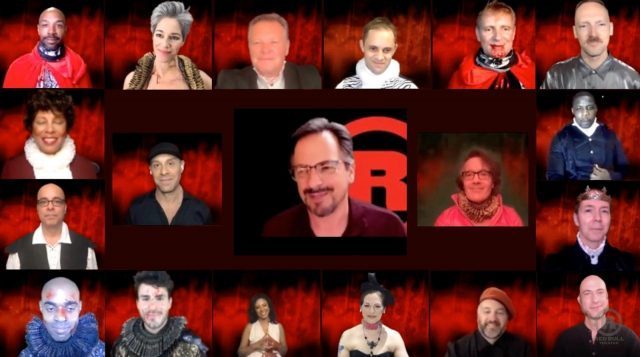
Founding artistic director Jesse Berger introduces one of Red Bull’s livestreamed readings during the pandemic (screenshot by twi-ny/mdr)
Red Bull Theater Galathea: Monday, March 15, free (suggested donation $25), 7:30 (available on demand through March 19) Galatea: Monday, March 22, free (suggested donation $25), 7:30 (available on demand through March 26) Paradise Lost: Monday, April 12 & 26, free (suggested donation $25), 7:30 www.redbulltheater.com
A year ago yesterday, New York City closed all entertainment venues, leading to endlessly sad postponements and cancellations that no one thought would last as long as it has. Theater companies were forced to examine their immediate and long-term futures: Some went into hiatus, others came up with intermittent virtual offerings, and a handful went all in, quickly developing an online streaming presence through readings, conversations, and innovative interactive live programming. One of the busiest, and most successful, has been Red Bull Theater. Founded in 2003 by artistic director Jesse Berger, Red Bull specializes in splendidly designed and costumed Jacobean works (Ben Jonson’s Volpone, John Ford’s ’Tis Pity She’s a Whore, Richard Brinsley Sheridan’s The School for Scandal) in addition to inventive contemporary adaptations (Erica Schmidt’s Mac Beth set in a girls school, Berger’s take on Gogol’s The Government Inspector, starring Michael Urie). Over its history, the troupe has also hosted more than two hundred Revelation Readings with all-star casts in various theaters, and it sponsors the Shakespeare in Schools initiative to bring the Bard to young students.
Red Bull’s virtual season kicked off in April with the first-ever “RemarkaBULL Podversation,” with Urie delivering Mercutio’s “Queen Mab” speech from Romeo and Juliet, followed by a discussion with Red Bull associate artistic director Nathan Winkelstein; subsequent Podversations have featured Chukwudi Iwuji performing “A Homely Swain” from Henry VI, Elizabeth Marvel doing “Cry Havoc” from Julius Caesar, and the phenomenal Patrick Page delving deep into Othello in “Exploring Iago.” All Podversations are available for free on YouTube, but the dozen live Zoom readings the company has streamed, from Berger’s new version of Thomas Middleton’s The Revenger’s Tragedy to Anchuli Felicia King’s modern-day Keene and Frances Burney’s The Woman Hater directed by Everett Quinton, remain online for only four days after the initial livestream. Each reading is accompanied by still-available Bull Session panels with Winkelstein and members of the cast and crew. Up next is a two-parter, John Lyly’s 1588 queer love story, Gallathea, on March 15, in collaboration with the Drama League, and MJ Kaufman’s new Galatea, on March 22, a trans love story in collaboration with WP Theater. Red Bull held its tenth annual Short New Play Festival in July, a fun virtual evening with works by Jeremy O. Harris, Theresa Rebeck, and others, with casts that included Kathleen Chalfant, Lilli Cooper, Edmund Donovan, William Jackson Harper, and Charlayne Woodard; the eleventh annual event, the theme of which is restoration, is scheduled for July 12.
A native Oregonian who was previously the assistant director of the Shakespeare Theatre Company in Washington, DC, Berger took time out of his ridiculously busy schedule to talk about Red Bull, the pandemic, and the future of theater.
Jesse Berger is front and center at a Red Bull Zoom reading (photo courtesy Red Bull Theater)
twi-ny: Red Bull has been one of the most active theaters in the country during the pandemic, going back to April. How and when was it decided to proceed full steam ahead with reunion readings and conversations?
jesse berger: It’s been almost exactly a year since the shutdown, and I think all of us went through the stages of grief at different paces — shock, denial, etc. — and out of that confoundingly confusing time and in consultation and through conversations with our wonderful team — led by our great managing director Jim Bredeson, wonderful board, terrific staff, extraordinary artistic associates, and other supporters — came the hunger for us to do something, anything, to connect our community. So . . . the original impetus was really just — get something out there that is our work that gets artists and audiences together, even if only virtually.
Just two weeks after lockdown began, on March 26, we announced the first of what has become a robust series of online activities. Since then it has simply been a learning experience that has led us to do more. For the first six months, we really just tried different ways to improve and experiment with the online experiences we were concocting. As it began to sink in over the summer that this shutdown was likely going to take a year or more, we made the decision to proceed with planning a fully virtual season for 2020–21. We probably hit our stride on these activities around October and have of course kept looking for ways to improve and innovate throughout.
twi-ny: The economic toll on theater companies has been devastating. Have these programs been financially viable for you?
jb: It has been devastating, indeed, and we count ourselves among the lucky ones because we were relatively financially healthy and relatively unencumbered when the shutdown hit. We made the decision to offer all our activities for free or pay what you can, and of course to compensate participating artists as much as we possibly can. We have found that audiences have by and large been generous in responding to this work and this method, so the programs are at minimum paying for themselves / breaking even through many small donations of $25, $10, $50. . . . Then we have hugely relied upon the larger generosity of larger donors, major institutional supporters, government support like PPP, and other foundation grants to keep the lights on and the staff fully employed. We’re grateful for the fact that we have not had to lay anyone off or furlough.
twi-ny: Red Bull has been streaming presentations several Monday nights every month going back to nearly the beginning of the lockdown, while other theaters have either been silent or put on occasional readings or talks, but not necessarily both. What’s the process like, especially gathering everyone together for the reunions, rehearsing over Zoom, and working at such a furious pace?
jb: We have a wonderful staff of four, and I appreciate you recognizing the quantity as well as the quality of the overall work output from Red Bull in this time! All I can say is that everyone is working hard, but I think it’s fair to say that no one feels particularly overwhelmed or overtaxed. We’ve simply done our best to be efficient and strategic with our efforts and our plans. As far as gathering the artists and that process, it’s not that different from the before-times — we reach out with offers to agents and/or directly to the participating artists, we make a schedule, we stick to it. The new stuff is the preplanning around what if anything needs to be sent to the actors for them to do their best work — greenscreens, microphones, internet help, lighting, etc. Nathan also schedules one-on-one tech sessions to check in with every participant so they have what they need before rehearsals start.
twi-ny: Red Bull’s bread and butter is Jacobean theater, which seems to be very relevant to what is happening today. Why do you think that is?
jb: Well, while I believe in social progress and that many things are probably better for humanity now than they were four hundred years ago, I’m also totally convinced that human beings and human relationships weren’t that different four hundred years ago. If anything, this most recent plague has brought home how similar our times are, even if the circumstances in which we live are more civilized — and thankfully we have amazing scientists making vaccines in record time. Also, I think that the Jacobeans in particular feel pretty contemporary in their outlook. These plays can be powerfully used to reflect our current society’s hypocrisies and inequities as well as its greatest hopes and aspirations.
twi-ny: In October, the amazing Patrick Page gave a master class on Iago as part of the company’s “Othello 2020” project. Have you seen his one-man show for Shakespeare Theatre Company, All the Devils Are Here? Have you watched much theater during the pandemic, and if so, has anything stuck out for you?
jb: Patrick Page is amazing, isn’t he? He’s one of the best Shakespearean actors in America, and beyond. We actually were privileged to share the New York premiere of All the Devils Are Here as a one-night benefit performance last February to a packed house at the Cherry Lane, so I know it well.
Patrick and I go way back — we both hail from an Oregon background, and we actually met when we were both working at the Utah Shakespeare Festival a number of years ago. It’s been a great experience to reconnect with him at Red Bull in NYC over the past years — he starred in our productions of The Duchess of Malfi and Coriolanus and has taught a number of acting intensives for us. He was also our 2010 Matador Award for Excellence in Classical Theater recipient. He’s great. I can’t wait to work with him again. And All the Devils Are Here on film is well worth your time, as well as Patrick’s excellent PODversation with Nathan on Iago.
I was voraciously consuming online theater in the earlier days of the pandemic, but I will admit to watching a bit less over time. Part of the reason is personal and part professional. I have two young kids at home, so finding additional time to watch things on the screen beyond keeping up with everything we are doing at Red Bull is hard. However, I loved Richard Nelson’s What Do We Need to Talk About?, Michael Urie’s Buyer & Cellar, TFANA’s Mad Forest, Jefferson Mays’s Scrooge, and Bill Irwin and Christopher Fitzgerald’s Old Globe comedy routine.
twi-ny: Do you and Nathan ever sleep?
jb: I can’t speak for Nathan, but thanks to the aforementioned wonderful two young kids at home, no — I never sleep. And yes, Red Bull’s online activity has certainly kept us a bit sleep deprived.
twi-ny: Do you have a wish list of plays you’d like to do as readings or of actors you’d like to work with online?
jb: Yes, but it’s top secret!
Jesse Berger has been a busy man during the coronavirus lockdown (photo courtesy Red Bull Theater)
twi-ny: Companies are now starting to film plays on their stage, selecting works that feature very small casts, often only one or two actors. Red Bull specializes in plays with many characters. Are there any plans to film anything onstage? How will cast size affect what plays you do once we come out of this?
jb: With the work we do, large cast sizes are often de rigueur and can make for difficult decisions when it comes to our budget. However, we have also produced plays such as Erica Schmidt’s seven-actor Mac Beth, Keith Hamilton Cobb’s two-actor American Moor, as well as Jean Genet’s The Maids, plus a ten-actor (is that small?) Coriolanus directed by Michael Sexton. As we begin to get clear guidance from the authorities and the unions that represent the artists with whom we work, we will be better situated to make decisions about if we might have to do some smaller cast plays simply as a safety necessity. And we are certainly keeping our eye on and out for some great material that will suit that bill.
twi-ny: Once theaters are back open and audiences are allowed inside, what do you think is the future of virtual productions? Do you see hybrid works continuing, or do you think online shows and readings will phase out?
jb: At the moment, I think the genie is out of the bottle, and online readings will likely continue. I suspect they will continue to be part of many theaters’ ancillary programming. I know they will be part of our future as they enable us to reach audiences worldwide with the work that is central to our mission. Of course our heart and soul will still be in the live theater experience.
twi-ny: What has sheltering in place been like for you on a personal level? Have you remained in New York City the whole time or been able to travel to see family?
jb: We were relatively lucky to be out of NYC for the first six months of the shutdown and have also been grateful to be able to be back in NYC since September. Sadly we have not yet been able to see our extended family who live all over the country, although we are Zooming with them a lot. Now that vaccines are rolling out, we are looking forward to making some plans to see everyone again in person.
twi-ny: Once you’re fully vaccinated, what’s the first thing you’re going to do that you have not been able to do since last March?
jb: So many things to do! But . . . it’s still a bit complicated, isn’t it?
Who: Kathleen Chalfant What: Benefit livestream Where:Keen Company When: Saturday, March 13, $25, 7:00 (available on demand through March 17) Why: It’s been precisely a year since the coronavirus crisis shuttered theaters across the country. With more than half a million Americans dead from Covid-19 and more than 2.6 million victims worldwide, the planet has experienced a tremendous amount of loss since the WHO declared on March 11, 2020, “We have made the assessment that Covid-19 can be characterized as a pandemic. Pandemic is not a word to use lightly or carelessly. It is a word that, if misused, can cause unreasonable fear, or unjustified acceptance that the fight is over, leading to unnecessary suffering and death.” In homage to what this year has wrought, Keen Company is presenting a livestreamed virtuaL reading of Joan Didion’s 2007 play, The Year of Magical Thinking, which she adapted from her memoir that detailed what she experienced in the twelve months and one day following the sudden death in 2003 of her husband, writer John Gregory Dunne, during which their daughter, Quintana Roo, was seriously ill with a series of health issues that began with the flu; she passed away shortly before the National Book Award–winning bestseller was published, an incident that was added to the play.
Thus, the time seems right for a reading of the one-woman show, which premiered on Broadway in 2007 at the Booth Theater, starring Vanessa Redgrave; more recently, Kathleen Turner performed the role in a 2016 run at Arena Stage. The Keen presentation features the grande dame of New York theater, five-time Obie winner Kathleen Chalfant, who in the fall of 2019 portrayed Mabel Loomis Todd in Rebecca Gilman’s one-woman play, A Woman of the World. The online show is helmed by Keen artistic director Jonathan Silverstein, who said in a statement, “I am thrilled and honored to be reunited with Kathleen Chalfant on this beautiful play. Working with Kathleen for A Walk in the Woods [in 2014] was a highlight of my career, and she is a brilliant match for Joan Didion’s moving text. Didion’s words are clear-eyed, inspiring, and resonate on this one-year anniversary of the pandemic. We will be coming to you remotely, yet this intimate reading of Didion’s play will make you feel you’re in conversation with Chalfant and Didion.” Chalfant (Wit, Angels in America) is always elegant and graceful, whether onstage, on the big and small screens, or on Zoom. The one-night-only event takes place March 13 at 7:00 and will be followed by a talkback; tickets are $25, and purchasers can access the stream through March 17 at 7:00. Proceeds will benefit Keen’s Hear/Now season of audio theater in addition to Keen Playwrights Lab and Keen Teens.
Kathleen Chalfant is exquisite in livestreamed reading of Joan Didion’s The Year of Magical Thinking for Keen Company
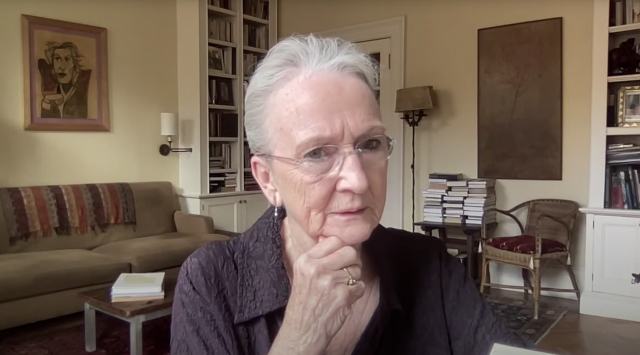
Update: Kathleen Chalfant gives an exquisite, beautiful reading of Joan Didion’s The Year of Magical Thinking for Keen Company. It is so well done you will sometimes forget you’re watching an actress performing and think you’re seeing Didion reading from her own book. Chalfant, who had contacted director David Hare about originating the part on Broadway, a role that had already been given to Vanessa Redgrave, rehearsed the play four times with director Jonathan Silverstein, including once in her home, where she delivers this performance, sitting in her living room, book in hand. She was offered a TelePrompter but found reading directly from the published play was more effective, and she’s right. She touches her chin, adjusts her glasses, pauses at a poignant moment when, by chance, ambulance sirens can be heard outside, and looks directly at the viewer, baring her character’s soul as she shares Didion’s tragic story over one hundred uncut, unedited minutes. It’s a gentle tour de force that comes at a time when we are all reflecting on a year like no other, delivered by a wonderful actress like no other. The reading is followed by a short talkback that lends further insight into this moving virtual presentation.