this week in music

MEREDITH MONK AND VOCAL ENSEMBLE: CELLULAR SONGS

(photo by Julieta Cervantes)

Meredith Monk & Vocal Ensemble will present world premiere of Celluar Songs at the BAM Harvey this week (photo by Julieta Cervantes)

Brooklyn Academy of Music
BAM Harvey Theater
651 Fulton St.
March 14-18, $25-$55
718-636-4100
www.bam.org
www.meredithmonk.org

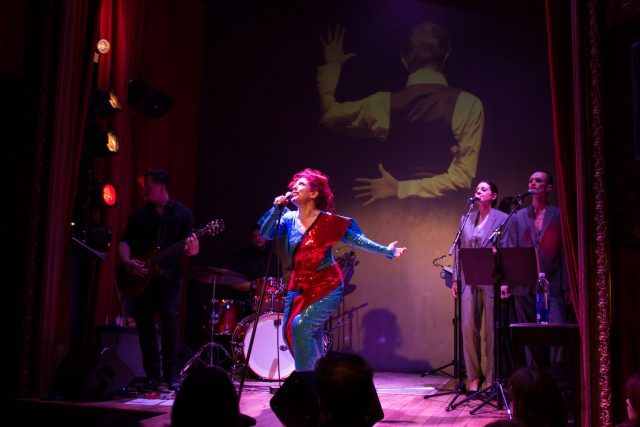
Eclectic New York City multidiscplinary artist Meredith Monk will unveil her latest work this week at BAM, presenting the world premiere of Cellular Songs at the Harvey March 14-18. The multimedia performance comprises voice, movement, light, site-specific video installation, instrumental music, and film; Monk, who made her BAM debut in 1976 with Quarry and was last at the Brooklyn institution in 2014 with On Behalf of Nature, will be joined by four members of her Vocal Ensemble, Ellen Fisher, Katie Geissinger, Allison Sniffin, and Jo Stewart in her Monk debut. The seventy-five-minute piece, which examines humanity’s interdependence with nature in a tech-driven world, features costumes and scenography by Yoshio Yabara, lighting by Joe Levasseur, sound design by Eli Walker, and video design by Kate Freer. Cellular Songs follows On Behalf of Nature, which Monk calls “a meditation on what we’re in danger of losing”; the new work is inspired by the Pulitzer Prize-winning book The Emperor of All Maladies: A Biography of Cancer by Siddartha Mukherjee. Speaking about the new work at Jim Hodges’s Queenslab last June, Monk, equating human cells to musical cells, says, “I started thinking that I was going deeper into On Behalf of Nature, going way inside the body but also from microcosm all the way to the universe to macrocosm, so it’s really that contrast and also between organic forms and the individual human beings and those realms.” You can get a sneak peek at Monk & Vocal Ensemble rehearsing Cellular Songs at Abrons Arts Center here.

THE CABINET OF DR. CALIGARI: WITH LIVE SCORE BY STEPHEN PRUTSMAN / PERFORMED LIVE BY PUCK QUARTET

THE CABINET OF DR. CALIGARI

Influential horror classic is brought back to life in stunning restoration and new live score at Baryshnikov Arts Center

THE CABINET OF DR. CALIGARI (DAS CABINET DES DR. CALIGARI) (Robert Wiene, 1920)
Baryshnikov Arts Center, Jerome Robbins Theater
450 West 37th St. between Ninth & Tenth Aves.
Wednesday, March 14, $25, 7:30
646-731-3200
bacnyc.org
www.kinolorber.com

A few years ago, Robert Wiene’s 1920 silent classic, The Cabinet of Dr. Caligari, was released in a stunning 4K restoration, giving audiences the chance to see it as if for the first time. Now you can hear it as if for the first time as well, as the Baryshnikov Arts Center will be showing it on March 14 at 7:30 with a new score by Stephen Prutsman, performed live by the Puck Quartet. Back in high school, we saw The Cabinet of Dr. Caligari for the first time in the somewhat dubious “Christian Values in Film” class. The verdict: The Cabinet of Dr. Caligari has no Christian values. But the Caligari we saw back then is rather different from the digital restoration, made from the original camera negative by the Friedrich Murnau Foundation. This sparkling Caligari is now the only way to experience this truly frightening work, one of the most influential horror films of all time. You can find elements of Paul Wegener’s The Golem, James Whale’s Frankenstein and The Bride of Frankenstein, and Todd Browning’s Dracula — all three of which followed this truly seminal film — in this twisted, unsettling psychological thriller of murder and mayhem involving the mysterious Dr. Caligari (Werner Krauss) and the creepy somnambulist he controls, Cesare (Casablanca’s Conrad Veidt), who predicts the future and eerily walks in his sleep. The tale is told in a frame story by Francis (Friedrich Fehér), who, like his best friend, Alan (Hans Heinrich von Twardowski), is in love with Jane (Lil Dagover). The only problem is that Cesare might have a thing for her as well.

A masterpiece that set the bar high for German Expressionism, The Cabinet of Dr. Caligari might have been shocking when it debuted in 1920, but it’s still shocking today, like nothing you’ve ever seen, with one of the most memorable, enigmatic villains ever put on celluloid. It’s not a traditional silent black-and-white film, instead tinted in blue and gold, with intertitles exploding in a wild green font. The sets, by Hermann Warm, Walter Reimann, and Walter Röhrig, are sharply slanted, with crazy angles and perspectives and backdrops that include unmoving shadows painted right on them; they’re obviously fake and very fragile, adding yet more levels of weirdness. Written by Hans Janowitz and Carl Mayer, photographed by Willy Hameister (irising in and out, occasionally at the same time), and directed by Wiene (Raskolnikov, Der Rosenkavalier), The Cabinet of Dr. Caligari is thick with an ominous, sinister atmosphere that is sheer pleasure; you’ll find yourself smiling at the beauty of it all even as you tense up at the hair-raising proceedings. It is that rare film that works as historical document as well as pure entertainment, a treat for cinema enthusiasts and horror fans alike, especially when the twist ending turns everything inside out and upside down.

You can get a taste for the new score in the above video; pianist, conductor, and composer Prutsman has collaborated with such groups as the St. Paul Chamber Orchestra and the Kronos Quartet, and in 2011 he wrote a new score for the Baryshnikov Arts Center’s screening of Buster Keaton’s 1924 comedy Sherlock, Jr. “I was well aware of the cardinal rule that film music ought never take attention away from the film itself; hence a complex yet cheap Schoenberg-like allusion would no doubt detract from the visual. I decided to ‘sprinkle’ dodecaphonic elements here and there,” Prutsman says of his Caligari score, “yet most of what one hears can be described as imitations of either post-romantic concert, salon, theater, or carnival music around the turn of the 19th century.” The Puck Quartet consists of violinists Lily Holgate and Kenneth Trotter, violist Katharine Dryden, and cellist Liam Veuve.

APOLOGIES FROM MEN: THE CONCERT

apologies from men

Who: Lauren Maul
What: Apologies from Men multimedia performance
Where: The People’s Improv Theater, PIT Striker Mainstage, 123 East 24th St. between Park & Lexington Aves., 212-563-7488
When: Friday, March 9, $10, 9:30
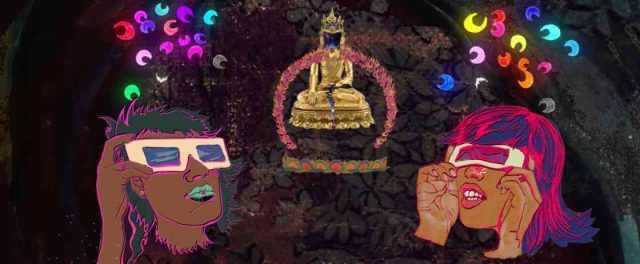
Why: In 2016, creator and composer Lauren Maul and director and choreographer Wendy Seyb made the web series Amazon Reviews: The Musical!, which took reviews written on Amazon for books, movies, toys, and other items and turned them into music videos. The Nebraska-raised, Chicago-trained, Brooklyn-based Maul is now getting a whole lot more serious — and perhaps even funnier — with Apologies from Men: The Concert, in which she takes the verbatim apologies offered by prominent male sexual harassers and predators and puts them to music, accompanied by fabulously silly, low-budget, right-on-target animated videos. Among her subjects are Louis CK, Matt Lauer, Mario Batali, Russell Simmons, Dustin Hoffman, Charlie Rose, and, of course, Harvey Weinstein. The Kevin Spacey remix video is particularly creepy, and just wait till you see who’s included in “The Men Who Have Not Apologized.” Maul will be at the PIT on March 9 for a one-time-only live performance with guitar and piano of Apologies from Men, which will also be released as an album the same day.

JOHN KELLY: TIME NO LINE

Performance artist John Kelly uses dance, music, drawing, film, photography, and more in Time No Line (photo by Theo Cote)

Performance artist John Kelly uses dance, music, drawing, film, photography, and more in Time No Line (photo by Theo Cote)

Ellen Stewart Theatre, La MaMa Experimental Theatre Club
66 East Fourth St.
Thursday – Sunday through March 11, $21-$26
212-475-7710
lamama.org
johnkellyperformance.org

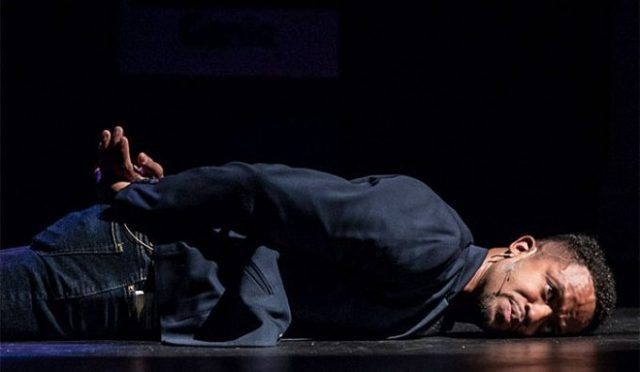
John Kelly’s latest performance piece, the autobiographical, multimedia, multidisciplinary Time No Line, not only looks back at his long, varied, and highly influential career but also honors those he’s lost along the way; his breakout era of work coincided with the AIDS epidemic, and any artistic biography today must reckon with that immense tragedy. “There are so few of my generation left to tell their stories,” Kelly reads from his journals, which he’s been keeping since 1976. So Kelly shares his own story, citing his heroes, including Egon Schiele, Maria Callas, and Gustav Mahler, while referencing such other downtown fixtures as Karen Finley, David Wojnarowicz, Nan Goldin, Charles Atlas, Ethyl Eichelberger, Tere O’Connor, the Cockettes, John Fleck, Joey Arias, and others. The New Jersey native relates episodes of his life through interpretive dance, video projections, visual text, drawing, photographs, songs, and reading from his journal at a small desk. Pages from his journal in neatly arranged rows cover a screen in back. The narrative goes back and forth through the years; “the past is not linear,” he reads. “In retrospect, it’s a patchwork of emotional triggers — how hard has it been to go back into these journals. I see my missteps — and I see my experience, whether I like it or not.” Fortunately, we get to see his experience as well, and there is a lot to like. Kelly traces his career from the ballet and the opera to creating the drag character Dagmar Onassis, the fictional daughter of Callas and Aristotle Onassis, transforming himself into Joni Mitchell, and dealing with the AIDS crisis as it swept through New York City. Third-person text projected on the screen explains, “He sees the possibility of performing ‘in drag’ as a way to be socially annoying (this is 1979) and to process a lot of youthful rage.”

John Kelly looks back at his life and art in autobiographical one-man show (photo by Theo Cote)

John Kelly looks back at his life and art in autobiographical one-man show (photo by Theo Cote)

Bullied as a child, Kelly found solace onstage, but he ultimately opted for alternative venues, such as the Pyramid Club, the Kitchen, DTW, and La MaMa. Cultural touchstones play a central part in his work; his previous shows include Diary of a Somnambulist, about Lady Macbeth and Cesare from The Cabinet of Dr. Caligari, the Obie-winning Love of a Poet, an adaptation of Robert Schumann’s Dichterliebe song cycle, The Escape Artist, based on the life of Caravaggio, and Pass the Blutwurst, Bitte, in which he portrays Schiele. He steps to the side when changing costumes as more text, family photos, and archival footage is shown on the screen; there are also two higher screens where ghostly images occasionally appear. He steps to a center microphone and sings relevant songs by Mitchell, Henry Purcell, and Charles Aznavour. He snakes along the floor and makes chalk drawings that recall Keith Haring’s style and Leonardo da Vinci’s Vitruvian Man. The pacing can be uneven, Kelly is sometimes a little too casual, and he occasionally teeters on the edge of self-indulgence, but when he gets back in the groove, he displays why he has been such a beloved figure for decades. He often talks about mirrors and self-portraits; he calls the former “the stand-in for eventual public scrutiny” and “a tool for establishing a sense of self.” Of course, Time No Line is really a complex, nonlinear self-portrait, a visual diary of the making of a man in which Kelly holds up a mirror and allows us to see the tragedy and comedy that has resulted in his unique brand of art.

In conjunction with Time No Line, which continues at La MaMa through March 11, Kelly’s Sideways into the Shadows exhibition is being held at Howl! Happening: An Arturo Vega Project at 6 East First St. through March 25, featuring hand-rendered transcriptions of journal entries and a memorial wall of portraits. “From this vantage point, it was a challenging time,” Kelly says as a survivor of the AIDS generation. “It’s still hard to get my head around it. This exhibition and Time No Line are my way to process the entire range of how my personal experiences and the arc of my artistic career intertwined into a coherent whole during a time that was both exhilarating and tragic.”

BROOKLYN MUSEUM FIRST SATURDAY: WOMEN’S HISTORY MONTH

Judy Chicago Designing the Entry Banner for The Dinner Party, 1978 (courtesy of Through the Flower Archive)

“Judy Chicago Designing the Entry Banner for ‘The Dinner Party,’” 1978 (courtesy of Through the Flower Archive)

Brooklyn Museum
200 Eastern Parkway at Washington St.
Saturday, March 3, free, 5:00 – 11:00
212-864-5400
www.brooklynmuseum.org

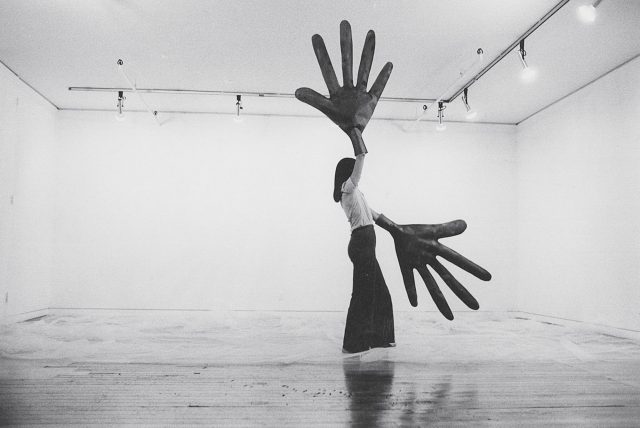
The Brooklyn Museum honors Women’s History Month with its free March First Saturday program, featuring live performances by Leikeli47, DJ Sabine Blaizin (Oyasound) with live percussion by Courtnee Roze, MICHIYAYA Dance (with Anya Clarke and Mitsuko Verdery leading a jam session), and Brown Girls Burlesque, presenting “Act Like a Lady! Strippin’ Fo’ the Culture,” with Hoodoo Hussy, Elektra Taste, Dakota Mayhem, Skye Siren, and Dirty Honey Shake dancers, hosted by Ravenessa; a book launch of Beverly Bond’s Black Girls Rock! Owning Our Magic. Rocking Our Truth. with Bond, Michaela Angela Davis, and Eunique Jones Gibson; pop-up gallery talks by teen apprentices in the “American Art” galleries; a community talk with representatives from THINK!Chinatown; Cave Canem Foundation poetry with zakia henderson-brown, Marwa Helal, and Aracelis Girmay; a hands-on art workshop inspired by Judy Chicago’s banners; a curator tour of “Roots of ‘The Dinner Party’: History in the Making” led by Carmen Hermo; and a Feminist Book Club discussion of Janet Mock’s Surpassing Certainty: What My Twenties Taught Me, with Glory Edim of Well-Read Black Girl. In addition, the galleries will be open late so you can check out “One Basquiat,” “Roots of ‘The Dinner Party’: History in the Making,” “Arts of Korea,” “Infinite Blue,” “Ahmed Mater: Mecca Journeys,” “Rodin at the Brooklyn Museum: The Body in Bronze,” “A Woman’s Afterlife: Gender Transformation in Ancient Egypt,” and more.

CONCERT FOR GEORGE

Eric Clapton, Ringo Starr, Dhani Harrison, and others come together for George Harrison tribute at Royal Albert Hall

Eric Clapton, Ringo Starr, Dhani Harrison, and others come together for George Harrison tribute at Royal Albert Hall

CONCERT FOR GEORGE (David Leland, 2002)
Beekman Theatre, 1271 Second Ave., 212-249-0807, Tuesday, February 27
Village East Cinema, 181-189 Second Ave., 212-529-6998, Tuesday, February 27
IFC Center, 323 Sixth Ave. at West Third St., 212-924-7771, Monday, March 5
www.concertforgeorge.com

On November 29, 2002, on the first anniversary of the death of George Harrison from lung cancer at the age of fifty-eight, friends and relatives of the Quiet Beatle gathered at London’s Royal Albert Hall for a tribute concert and fundraiser. Concert for George was captured on film by director David Leland and hit movie theaters in October 2003; it has now been remastered in 2K and 5.1 Stereo Surround Sound and is being rereleased on February 27 in honor of what would have been Harrison’s seventy-fifth birthday (on February 25). The stellar event was organized by Harrison’s longtime close friend Eric Clapton, with the support of Harrison’s widow, Olivia, and son, Dhani, who was onstage playing the guitar through the whole show. Among other musicians participating were Paul McCartney, Ringo Starr, Jeff Lynne, Tom Petty and the Heartbreakers, Billy Preston, Ravi Shankar, Anoushka Shankar, and Joe Brown, performing songs from Harrison’s career as a Beatle and a solo artist. It’s a real treat because many of these songs had never been played live by Harrison; the Beatles stopped touring in 1966, and Harrison avoided the road except for a problematic tour in 1974 and a brief visit to Japan in 1991. And through it all, large-scale photos of Harrison look down from above, taking in the festivities.

Beautifully photographed by Oscar-winning cinematographer Chris Menges and edited by Claire Ferguson, Concert for George opens with Hindu music, a favorite of Harrison’s, including the traditional prayer “Sarveshaam” and Ravi Shankar’s “Your Eyes” and “Arpan,” the latter composed specifically for the evening. Following a comic interlude featuring Month Python members Terry Gilliam, Terry Jones, Eric Idle, Michael Palin, Neil Innes, and bonus guest Tom Hanks — Harrison was a big Python fan and good friends with the troupe — the all-star band turns to Harrison’s music, which is performed with love and admiration and reveals his genius at melody and incorporating nontraditional choruses and guitar lines. Unfortunately, during too many of the songs, Leland (Wish You Were Here, Checking Out) cuts away from what’s happening onstage to show rehearsals and behind-the-scenes footage. While it’s fascinating to hear Petty talk about how Harrison helped write the Traveling Wilburys hit “Handle with Care” and see Ravi and Anoushka Shankar preparing for a special musical presentation, it would have been better to see such things in between songs. And indeed, the songs are revelatory, certifying Harrison’s genius as a songwriter as well as a guitarist. Starr excels on “Photograph,” which he wrote with Harrison and, as Ringo notes, takes on different meaning given the circumstances; McCartney is brilliant performing “For You Blue” on acoustic guitar and “Something” on ukulele, breathing new life into two old chestnuts; Clapton wails away on “Beware of Darkness” and “While My Guitar Gently Weeps”; and Preston, one of several men referred to as the Fifth Beatle, turns “Isn’t It a Pity?” into a powerful epic. The crack backup band boasts such great musicians as guitarists Andy Fairweather-Low and Marc Mann (who both play some sweet slide), pianists Gary Brooker and Jools Holland, bassists Dave Bronze and Klaus Voormann, percussionists Jim Keltner, Jim Capaldi, and Ray Cooper, and vocalists Katie Kissoon, Tessa Niles, and Sam Brown. It was filmed only a year after Harrison’s passing, but all the men and women onstage are enjoying themselves immensely, their joy extending into the audience as they celebrate an extraordinary man of peace and love. Concert for George is screening February 27 at the Beekman and Village East and March 5 at IFC Center; proceeds from the rerelease and DVD package will benefit the Material World Foundation, which Harrison founded in 1973 “to encourage the exploration of alternate and diverse forms of artistic expression, life views, and philosophies as well as a way to support established charities and people with special needs.”

VICTOR SJÖSTRÖM — THE SCREEN’S FIRST MASTER: HE WHO GETS SLAPPED

Lon Chaney

Lon Chaney stars as a scientist-turned-clown in Victor Sjöström’s He Who Gets Slapped

HE WHO GETS SLAPPED (Victor Sjöström, 1924)
Film Forum
209 West Houston St.
Monday, February 26, 6:20
Series continues through March 5
212-727-8110
filmforum.org

In conjunction with its Ingmar Bergman Centennial Retrospective, Film Forum is presenting “Victor Sjöström: The Screen’s First Master,” five films by the Swedish master who was Bergman’s mentor and appeared in two of his films, To Joy and Wild Strawberries. The mini-festival continues February 26 with Sjöström’s second English-language film and MGM’s first-ever picture, He Who Gets Slapped, which Sjöström wrote and directed under the Americanized last name Seastrom. Lon Chaney stars as scientist Paul Beaumont, who is excited when he makes a major discovery about the origins of humankind, but his wealthy benefactor, Baron Regnard (Marc McDermott), steals his work and presents it to the Academy, slapping Beaumont’s face to great hilarity and applause when the scientist claims it is actually his theory. After Regnard also steals Beaumont’s wife, Maria (Ruth King), the sad-sack scientist runs off and joins the circus, rising in stature as He, a clown who gets slapped over and over and over as a kind of self-flagellation, much to the delight of audiences everywhere. “Over a hundred slaps last night, He,” fellow clown Tricaud (Ford Sterling) tells him. “You lucky fellow! Soon you’ll be getting famous! But you know what they like — there’s nothing makes people laugh so hard as seeing someone else get slapped!” The distraught clown perks up when Consuelo (Norma Shearer) joins the circus as a bareback rider who will team up with Bezano (John Gilbert), but He — Beaumont doesn’t even exist anymore — gets mad when he finds out that Consuelo’s father, Count Mancini (Tully Marshall), has sold her to the circus because he is nearly broke — and shortly after that the Count is pimping his daughter off to none other than the Baron, something that neither Bezano nor He is about to let happen.

he who gets slapped poster

Based on Leonid Andreyev’s 1914 Russian play, He Who Gets Slapped is a taut psychological drama in which Sjöström and cowriter Carey Wilson explore the mind of a smart, talented man who loses his sanity, choosing to let himself be continually humiliated instead of fighting for what’s right. Sjöström (The Wind, The Phantom Carriage) and cinematographer Milton Moore add several cinematic tricks to reveal He’s mental state, including a circle of miniature clowns surrounding a globe as well as an early morphing effect that would be later developed to change Lon Chaney Jr. into a killer beast in Frankenstein Meets the Wolf Man. Chaney, the Man of a Thousand Faces, would also play a clown opposite Loretta Young in the 1928 silent film Laugh, Clown, Laugh. It is thrilling to see Gilbert and Shearer together, shortly before their stardom took off; they would also both appear in Edmund Mortimer’s The Wolf Man and Monta Bell’s The Snob that same year. Coincidentally, He Who Gets Slapped is the first film introduced by Leo the Lion, and a circus lion plays a key role in the story. Chaney will break your heart, especially when he has to deal with his own fake heart that is part of his act; even if you hate clowns, you won’t hate this one. The film, which asks the question “What is it in human nature that makes people quick to laugh when someone else gets slapped — whether the slap be spiritual, mental, or physical?” is screening February 26 at 6:20 and will be accompanied by live music by pianist Steve Sterner. The series continues with Lillian Gish in The Scarlet Letter on March 4 and The Outlaw and His Wife on March 5, both also with Sterner.