this week in music

MAGIC TRAIN: PASSENGERS PULLS INTO PAC NYC

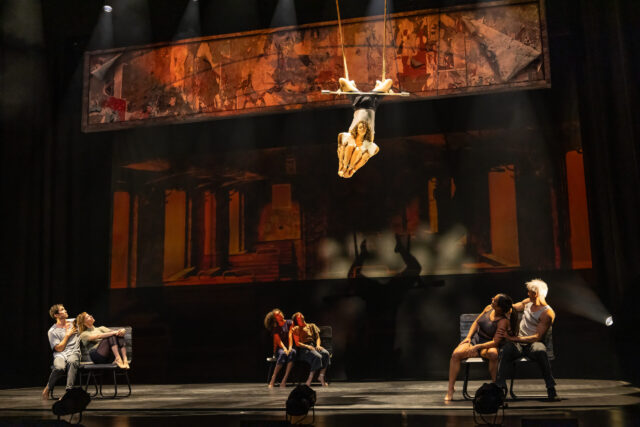
The 7 Fingers pull into PAC NYC to take audiences on an unforgettable journey (photo by Matthew Murphy)

PASSENGERS
Perelman Performing Arts Center (PAC NYC)
251 Fulton St.
Tuesday – Saturday through June 29, $43-$117
pacnyc.org
7fingers.com

“There’s something about a train that’s magic,” Richie Havens sang in a series of 1980s Amtrak commercials. The 7 Fingers troupe captures that magic and more in the breathtaking Passengers, continuing at PAC NYC through June 29.

For ninety minutes, the Montreal-based company combines circus acrobatics, gymnastics, song, dance, physical theater, and prose to take audiences on an exhilarating and affecting ride on the rails, By the end, the performers feel like characters in a play more than mere strangers on a train.

Written, directed, and spectacularly choreographed by Tony nominee Shana Carroll, Passengers begins with Kaisha Dessalines-Wright, Marie-Christine Fournier, Eduardo De Azevedo Grillo, Marco Ingaramo, Anna Kichtchenko, Maude Parent, Michael Patterson, Pablo Pramparo, Méliejade Tremblay-Bouchard, Santiago Rivera Laugerud, Sereno Aguilar Izzo, and Will Underwood bringing out chairs and aligning them as if on a train, destination unknown. Over the course of approximately twenty scenes, each one highlighted by a different discipline, they make their way through tunnels and over bridges as they run, jump, tumble, leap, twirl, and throw one another high in the air, incorporating such props as suitcases, luggage racks, clothing, and the chairs.

Kichtchenko spins multiple hula hoops, holding them out for several of the men to dive through. Contortionist Parent claps her hands to stop and restart time, altering reality in between. Fournier and Grillo perform a romantic hand-to-trap pas de deux in midair on duo trapeze to a rousing version of “Saint Louis Blues.” Dessalines-Wright sings “Train Is Coming” with Grillo on ukulele, advising, “Train is coming, and not that slow / You catch it up or you let it go / Round and round the tracks they go / When you’re back you let me know.” Dessalines-Wright discusses Einstein’s theory of relativity as it applies to speeding trains and time. Grillo pulls himself up on aerial straps, then is joined by Dessalines-Wright on duo straps. Izzo juggles a growing number of white styrofoam balls, some from inside his shirt. Kichtchenko flies with aerial silks. Ingaramo impossibly rises, balances, and slides down a Chinese pole. Three performers build vertical human chains to the song “Call,” which promises, “We will no longer / We will no longer / break apart / We will no further / We will no further / Fall.” Friends and lovers come together and say goodbye.
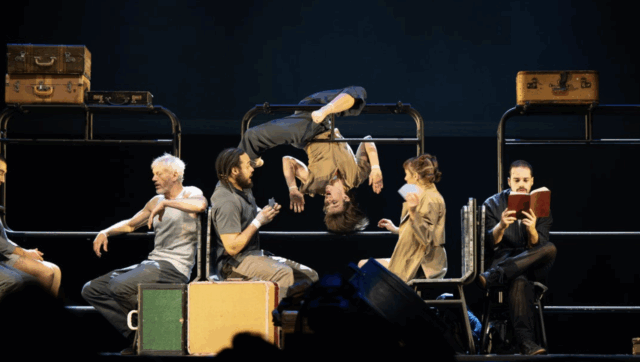
Suitcases, luggage racks, playing cards, and other props are used alongside hula hoops, aerial straps and silks, duo trapeze, and a Chinese pole in dazzling 7 Fingers show (Renee Choi Photography)

Passengers evokes Cirque du Soleil, Pina Bausch, The Music Man’s opening number, Company XIV, and STREB but is clearly its own phenomenon. Ana Cappelluto’s ever-changing set is supplemented with Johnny Ranger’s videos of passing landscapes and tunnels, some projected on a horizontal bar at the top back of the stage, along with Éric Champoux’s lighting, which creates dazzling shadows and glowing effects. Colin Gagné composed the wide-ranging original music and designed the sound with Jérôme Guilleaume.

The performers, in naturalistic costumes by Camille Thibault-Bédard, are nothing short of spectacular, celebrating remarkable feats that push the limits of what the human body can do. But Carroll (Water for Elephants) manages to make it all relatable, as train travel is still mostly an egalitarian way to get from one place to another.

In “La hora de la hora,” the song accompanying the juggling, lyricist Boogát admits, “Soy un loco más en la locomotora (I’m just another crazy person on the locomotive).”

You’d be crazy not to get on board this magic train.

[Mark Rifkin is a Brooklyn-born, Manhattan-based writer and editor; you can follow him on Substack here.]
DON’T STOP THAT PIGEON: CELEBRATING JUNE 14 ON THE HIGH LINE

PIGEON FEST
The High Line
Thirtieth St. & the Spur
Saturday, June 14, free, noon – 8:00
www.thehighline.org

What did you do on Saturday, June 14, 2025? It’s looking to be quite a memorable date.

June 14 is Flag Day, when America pays tribute to the Stars and Stripes. Although it’s not a federal holiday, it is, according to Proclamation 1335, signed in 1916 by President Woodrow Wilson, a day “with special patriotic exercises, at which means shall be taken to give significant expression to our thoughtful love of America, our comprehension of the great mission of liberty and justice to which we have devoted ourselves as a people, our pride in the history and our enthusiasm for the political programme of the nation, our determination to make it greater and purer with each generation, and our resolution to demonstrate to all the world its vital union in sentiment and purpose, accepting only those as true compatriots who feel as we do the compulsion of this supreme allegiance.” The flag was approved by the Continental Congress on June 14, 1777.

June 14 is also unofficially known as Cup Day; on June 14, 1994, the New York Rangers ended their fifty-four-year drought and won the Stanley Cup following a tough seven-game series with the Vancouver Canucks. The Broadway Blueshirts won the finale on goals by Brian Leetch, Adam Graves, and captain Mark Messier; Mike Richter stood tall between the pipes.

On June 14, 1969, German tennis champion Steffi Graf was born.

On June 14, 1963, the Soviets launched the manned spacecraft Vostok 5.

On June 14, 1940, the first train carrying Polish prisoners pulled into Auschwitz.

On June 14, 1928, Che Guevara was born.

On June 14, 1811, Uncle Tom’s Cabin author Harriet Beecher Stowe was born.

Oh, also, on June 14, 1946, Donald John Trump was born in Queens.

President Trump has decided to honor his birthday, Flag Day, and the 250th anniversary of the US Army on June 14, 2025, by holding a military parade along the National Mall in Washington, DC, consisting of 6,600 soldiers with historical weapons, 50 military aircraft, 150 vehicles, tanks, helicopters, several dozen horses, and 2 mules; the total cost is expected to be $145 million. There will be protests around the country, from the Women’s March’s “Kick Out the Clowns” to “No Kings” in nearly two thousand congressional districts.

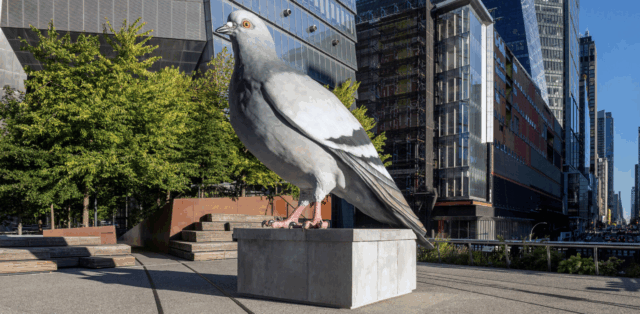
If you’re looking for something different, your best bet might just be Pigeon Fest, a party celebrating Iván Argote’s seventeen-foot-high Dinosaur, a giant pigeon sculpture at the High Line Spur at Thirtieth St. There will be artist talks, workshops, carnival games, music, a puppet show, a pageant, a bazaar, a science fair, and more, with Maria Assis Silva, Julia Rooney, Stephanie Costello, Tina Pina (Mother Pigeon), Machine Dazzle, Jameson Fitzpatrick, Lee Ranaldo, the Bird Is the Word Ensemble, and others.

Below is the complete schedule.

Iván Argote’s Dinosaur is centerpiece of High Line celebration (photo by Timothy Schenck)

The Discovery Fair, with Pop-up Pigeons!, Watercolor Workshop with Food Scraps Ink, the Birdsong Project, the Center for Book Arts, the Cornell Lab of Ornithology, the LES Ecology Center, Lofty Pigeon Books, the Mayor’s Office of Urban Agriculture (MOUA), Monument Lab, Mother Pigeon, NYC Bird Alliance, Pat McCarthy, and the Wild Bird Fund, Eastern Rail Yards, noon – 5:00

Bird Bazaar, with the Coop Carnival, Pigeon Piñata Party, Alternative Monuments for NYC, Pigeon Fan Club, NYPL Bookmobile Station and Storytime, and Best Plants for Birds on the High Line, Coach Passage at Thirtieth St., noon – 5:00

Zumba: Pigeon Dance Party, led by Maria Assis Silva, noon

Mother Pigeon’s Impeckable Puppet Show, 1:00

Pigeon Impersonation Pageant, 2:00

Panel Discussion: Building Bird-Friendly Cities, with Qiana Mickie, Christian Cooper, and Ethan Dropkin, moderated by Richard Hayden, 3:30

Artist Talk: Iván Argote and Cecilia Alemani, 4:15

Musical Concert, with Jameson Fitzpatrick, a string quartet performance by students from the Manhattan School of Music and Juilliard Pre-College Programs, the Bird Is the Word Ensemble organized by Lee Ranaldo, and a special guest headliner, 5:30 – 8:00

[Mark Rifkin is a Brooklyn-born, Manhattan-based writer and editor; you can follow him on Substack here.]
AMY LaVERE AND WILL SEXTON: MAKING MAGIC AT THE BITTER END

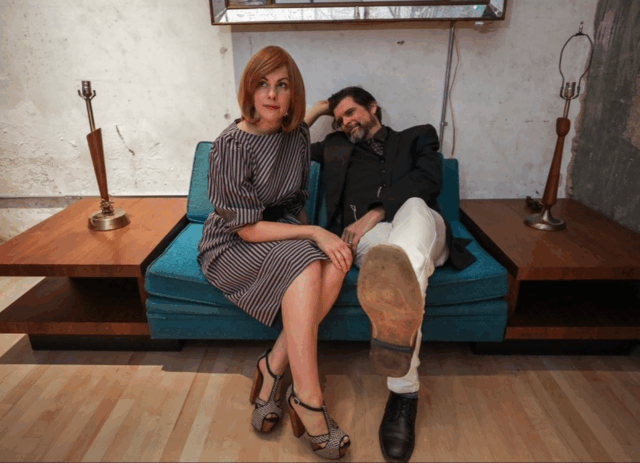
Amy LaVere and Will Sexton come to the Bottom Line on June 8

Who: Amy LaVere and Will Sexton
What: New York City concert
Where: The Bitter End, 147 Bleecker St. between Thompson St. & LaGuardia Pl.
When: Sunday, June 8, $22.73, 7:00
Why: “Maybe I was thinking of you / Maybe I think about you all the time / Whenever I see your number / Come into my telephone line / Feels like I conjured you up / Kinda like I made you call / Or maybe I’m just never not thinking about you at all / Or could we be powerful? / Do you feel the same? / If I can bring you on / Just thinking ’bout a song / I don’t wanna jump the gun / But we could be magic,” singer-songwriter and bassist Amy LaVere sings on her new single, “We Could Be Magic.”

Be on the lookout for that tune and such others as “No Battle Hymn,” “Take ’em or Leave ’em,” and “Dreamer” when LaVere and her husband, guitarist and songwriter Will Sexton, come to the Bitter End on June 8. Based in Memphis, the Shreveport-born LaVere — a budding novelist — and Austin native Sexton have been collaborating for eleven years, releasing such albums as Runaway’s Diary and Painting Blue, playing a riveting melding of Americana and indie folk. They are also part of the band Motel Mirrors, with drummer Shawn Zorn and guitarist John Paul Keith.

“Maybe we’re the ones to get it done,” LaVere sings at the conclusion of “We Could Be Magic.” You can find out if they are Sunday night at the Bitter End.

[Mark Rifkin is a Brooklyn-born, Manhattan-based writer and editor; you can follow him on Substack here.]
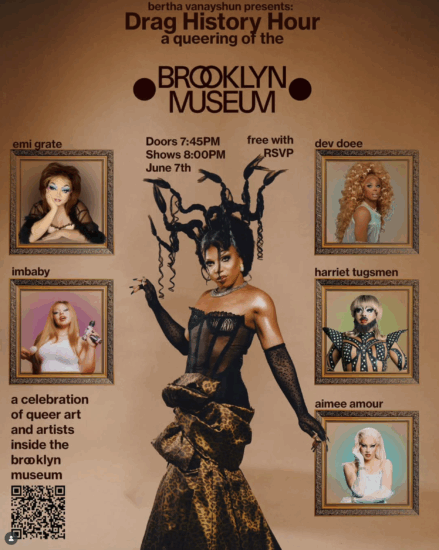
SOLID GOLD STARS: FIRST SATURDAY AT THE BROOKLYN MUSEUM

Bertha Vanayshunis will present Drag History Hour at the Brooklyn Museum on June 7

STAR-MAKERS
Brooklyn Museum
200 Eastern Parkway at Washington St.
Saturday, June 7, free with advance RSVP, 5:00 – 10:00
212-864-5400
www.brooklynmuseum.org

The Brooklyn Museum honors queer artists with its free Pride Month First Saturday program, “Star-Makers,” inspired by Oscar yi Hou’s The Arm Wrestle of Chip & Spike; aka: Star-Makers. The evening features live performances by the New York City Gay Men’s Chorus, Tasha, Boston Chery, and Undocubougie; a Drag History Hour performance lecture by Bertha Vanayshun, with Dev Doee, I’m Baby, Emi Grate, Harriet Tugsmen, and Aimee Amour; a pop-up Brooklyn market featuring Depop; a voter registration drive; a Hands-On workshop in which participants will make Pride pins; the Teen Talk “Queering the Collection”; Queer Figure Drawing with the Brooklyn Loft; and a screening of Seán Devlin’s 2023 film, Asog.

In addition, the galleries will be open late so you can check out “Nancy Elizabeth Prophet: I Will Not Bend an Inch,” “Brooklyn Abstraction: Four Artists, Four Walls,” “Consuelo Kanaga: Catch the Spirit,” “The Dinner Party by Judy Chicago,” “Breaking the Mold: Brooklyn Museum at 200,” and more.

The glittering “Solid Gold” exhibit, which comprises more than five hundred gold objects, closes July 6. Divided into such sections as “Origins of Gold,” “Design Strategies,” and “Crowned,” the exhibition includes contemporary and ancient jewelry, fashion, film clips, ceramics, paintings, illuminated manuscripts, photographs, coins, and video installations. Among the highlights are a 1930s radio, Christian Louboutin footwear, a tribute to Elizabeth Taylor and the 1963 film Cleopatra, Zadik Zadikian’s 2024 Path to Nine sculpture, Egyptian gold flakes from 1938–1759 BCE, Rembrandt’s Jan Uytenbogaert, Receiver — General (The Gold — Weigher), John Singer Sargent’s Egyptian Woman (Coin Necklace), an excerpt from King Vidor’s Cover Girl with Rita Hayworth, artifacts from James Lee Byars’s 1994 Santa Fe performance, photos by Charles “Teenie” Harris, a necklace by Alexander Calder, a nineteenth-century reclining Buddha, and dresses by the Blonds, John Galliano, Mary McFadden, Paco Rabanne, Halston, and Yves Saint Laurent. Be sure to address appropriately.

[Mark Rifkin is a Brooklyn-born, Manhattan-based writer and editor; you can follow him on Substack here.]
GHOST LIGHTS: NAT “KING” COLE’S MUSICAL FEVER DREAM

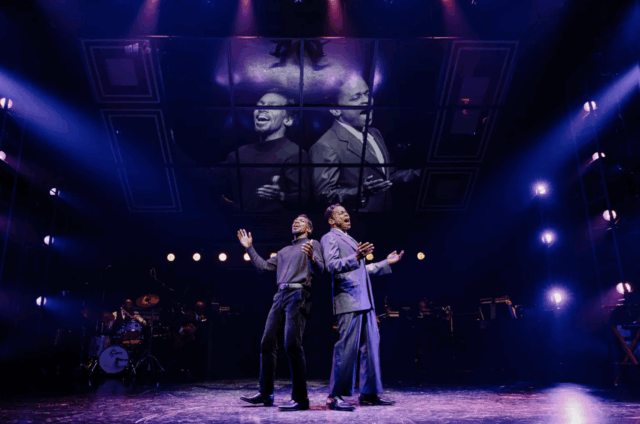
Sammy Davis Jr. (Daniel J. Watts) and Nat King Cole (Dulé Hill) form a unique partnership in Lights Out (photo by Marc J. Franklin)

LIGHTS OUT: NAT “KING” COLE
New York Theatre Workshop
79 East Fourth St. between Second & Third Aves.
Tuesday – Sunday through June 29, $49-$59
www.nytw.org

According to the Sleep Foundation, a fever dream can be “vivid and unpleasant,” involving feelings of “discomfort” that can be “unsettling.”

That’s precisely how I felt while watching the bio-jukebox musical Lights Out: Nat “King” Cole at New York Theatre Workshop.

“How is everybody doing tonight? Fine and dandy? Wonderful. Some of you thought you were going to get a nice and easy holiday show. No! Welcome to the fever dream,” Sammy Davis Jr. (Tony nominee Daniel J. Watts) tells the audience at one point. “My dear friend is wrapped up at the moment. Wrapped up in his mind. The mind is a terrible thing. Is that the way the saying goes? Anyway. When my friend is wrapped up, he does what any musician will do. He will try to work it out. Work it out in a song.”

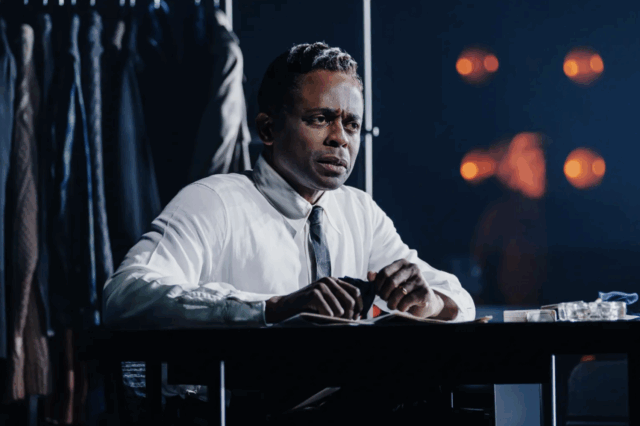
Lights Out takes place on December 17, 1957, at NBC studios in New York City, as Cole (Emmy nominee Dulé Hill), the friend Davis is referring to, is preparing for the final episode of his television variety program. Despite its critical and popular success, the year-old show could not garner a single national sponsor, primarily because it was being hosted by a Black man. “Madison Avenue is afraid of the dark,” Cole famously announced to the press.

Candy (Kathy Fitzgerald), the makeup designer, enters Cole’s dressing room, ready to apply the usual white powder that will make him look less Black, but he asks for a lighter touch this time; he’s determined to go out with his “head held high.” He walks onstage and is upset that someone has left the ghost light on, a sign of bad luck; according to theater superstition, it should only be on when the theater is empty overnight, for the spirits wandering around. As soon as he turns the light off, the narrative switches over to the fever dream, where anything can happen, from traveling into the past to speaking one’s innermost thoughts like never before.

Serving as the emcee of the dream is Davis, one of Cole’s closest friends, but in this case he is a devilish trickster, manipulating some of the action and regularly addressing the audience directly, advising Cole that they will be “taking it off the rails.” What follows is a haphazard mess of a story interspersed with classic Cole tunes from his remarkable songbook, which boasts eighty-six singles and seventeen albums in the top 40 between 1943 and 1964 and total sales of more than fifty million records.

Cole assures the stage manager (Elliott Mattox) that Peggy Lee (Ruby Lewis), who is late, will make it in time to perform the opener with him. When he gets too close to Betty Hutton (Lewis) during “Anything You Can Do,” a “Racial distance appropriateness” yardstick is thrust between them. Eartha Kitt (Krystal Joy Brown) purrs to the producer and stage manager, “Piss off!” after they tell Cole to “keep it clean.” Cole tells the eleven-year-old piano prodigy Billy Preston (Mekhi Richardson or Walter Russell III) that he could become president one day, although the cue cards use racist tropes involving sports and prison. The Randy Van Horne Singers join Cole for “It’s a Good Day,” which features the line “It’s a good day for shining your shoes / And it’s a good day for losin’ the blues,” as if Cole’s Blackness is being whitewashed.

These set pieces all pass through in a chaotic, confusing jumble, with Davis continually interrupting with an annoying demeanor. The most effective scene occurs when Cole’s long-deceased mother, Perlina (Kenita Miller), arrives to deliver love and support, singing “Orange Colored Sky” and reminding her son (played as a child by Richardson or Russell III), “Don’t let ’em get the best of you. Keep your head held high.” Another highlight is Cole and Davis tap-dancing to “Me and My Shadow” right after Cole fires his producer (Christopher Ryan Grant). “You can’t fire me. You don’t wield that kind of power!” the producer argues. Cole responds, “I absolutely-positively wield that kind of power.” Cole then kicks him out when the producer declares, “How dare you, after all I’ve done for you people.”

Cole took some heat from the Black community for not being more aggressive in fighting racism, and Lights Out posits that while he was well aware of that criticism, he opted to take a different path, by being successful and paving the way for other Black entertainers, on television and Madison Ave. During one fake commercial, Sammy and Perlina promote toothpaste, referencing the racist caricature of smiling Blacks. Sammy: “When you’re feeling down / And all you want to do is frown / Use this tube of magic / To avoid a life that’s tragic / Brush up and smile bright / Some things ain’t worth the fight.” Perlina: “I know deep down that you’re right.” Perlina and Sammy: “Next time I will try to smile bright.” Other ads are for beer and cigarettes.

Emmy nominee Dulé Hill star as Nat “King” Cole in biomusical at New York Theatre Workshop (photo by Marc J. Franklin)

Lights Out was written by Tony and Oscar nominee Colman Domingo and Patricia McGregor with a nonstop ferocity, trying to squeeze too much into ninety minutes. McGregor (Hamlet, Hurt Village) directs at a feverish pace, making it hard for the audience to catch its breath as they attempt to figure out what is going on. Clint Ramos’s TV show set is effective, with Cole’s dressing room stage right and the band in the back, but the inclusion of an angled video screen for live projections by David Bengali feels unnecessary, further hampering the abstract narrative. Katie O’Neill’s costumes range from practical to lavish, with Cole always looking superbly elegant and pristine.

The orchestrations and arrangements by John McDaniel are lovely, evoking the time period while paying respect to composer and bandleader Nelson Riddle, although some songs are performed only in part and, curiously, the producer warbles “Mona Lisa.” Edgar Godineaux’s choreography has a keen sense of humor, while Jared Grimes’s tap choreography shines.

Like most biomusicals, the script plays hard and loose with some of the facts. While Cole’s final show was on December 17, 1957, the actual guests were the Cheerleaders and Billy Eckstine, and the opening song was “When You’re Smiling.” Davis, Hutton, Kitt, and Lee all appeared on one episode of the show, but not the last one. In addition, Davis makes a joke referencing the slogan of the United Negro College Fund, “A mind is a terrible thing to waste,” but that began in 1972, seven years after Cole died; even though Davis is an otherworldly figure in the dream, everything else relates to 1957.

Hill (After Midnight, Stick Fly) beautifully captures the dichotomy tearing Cole apart inside, but Watts (Richard III, Tina: The Tina Turner Musical) overplays Davis to the point of cutting down the impact of many scenes.

The story of Nat “King” Cole, who died of lung cancer in 1965 at the age of forty-five — there is a whole lot of smoking in the show — is a crucially important one. In February 1958, Cole wrote in Ebony magazine, “For 13 months I was the Jackie Robinson of television. I was the pioneer, the test case, the Negro first. I didn’t plan it that way, but it was obvious to anyone with eyes to see that I was the only Negro on network television with his own show. On my show rode the hopes and tears and dreams of millions of people. . . . Once a week for 54 consecutive weeks I went to bat for these people. I sacrificed and drove myself. I plowed part of my salary back into the show. I turned down $500,000 in dates in order to be on the scene. I did everything I could to make the show a success. And what happened? After a trailblazing year that shattered all the old bugaboos about Negroes on TV, I found myself standing there with the bat on my shoulder. The men who dictate what Americans see and hear didn’t want to play ball.”

At one point, Cole’s daughter Natalie (Brown) duets with her father, singing “Unforgettable.” It’s a touching moment, but it’s a shame that too much of the rest of the show is forgettable.

[Mark Rifkin is a Brooklyn-born, Manhattan-based writer and editor; you can follow him on Substack here.]
PERSEVERING FOR THE TRUTH: THEATER FESTIVAL HONORS VÁCLAV HAVEL

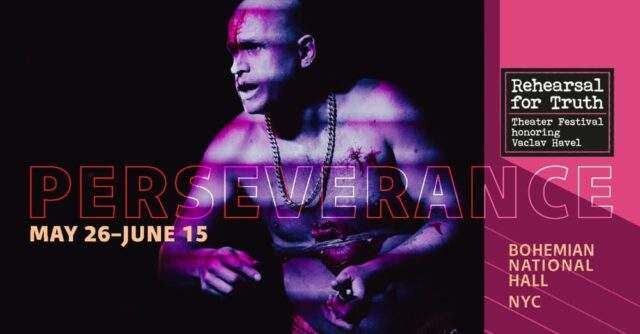
REHEARSAL FOR TRUTH INTERNATIONAL THEATER FESTIVAL: PERSEVERANCE
Bohemian National Hall (unless otherwise noted)
321 East 73rd St. between First & Second Aves.
May 26 – June 15, free – $15
rehearsalfortruth.org

Founded in 2017, Rehearsal for Truth is an annual festival that honors the legacy of Czech playwright, dissident, and president Václav Havel. Presented by the Václav Havel Center and the Bohemian Benevolent and Literary Association, This year’s iteration features theater, opera, music, poetry, and more from Czechia, Bulgaria, Belarus, Romania, Slovakia, Poland, Hungary, and other nations.

“Rehearsal for Truth is a rare opportunity to hear artistic voices from Central and Eastern Europe,” festival artistic director Edward Einhorn explained in a statement. “The theme of the 2025 edition is Perseverance. The worldwide turn towards autocracy and war is both current and historically familiar for the artists from this region, and their responses have a deep resonance now for Americans, as we experience our own crises. My hope is that the work presented in the festival can connect our experiences and help us guide us as we all try to persevere through difficult times.”

The centerpiece is the US premiere of Blood, Sweat, and Queers, a seventy-five-minute piece about intersex Czech track star Zdenek Koubek (1913–86) and fascism, coproduced by Einhorn’s Untitled Theater Company No. 61. Other highlights include Belarus Free Theatre’s King Stakh’s Wild Hunt, Alexander Manuiloff’s interactive The Decision, and an evening of music and poetry with Marketa Foukalova, Jan Zábrana, and Martin Brunner.

Havel (1936–2011) wrote such plays as The Garden Party and The Memorandum and such books as Living in Truth and Toward a Civil Society; he also wrote and directed the 2011 film Leaving. In a 1968 letter to Alexander Dubček, the first secretary of the Communist Party of Czechoslovakia, Havel explained, “Even a purely moral act that has no hope of any immediate and visible political effect can gradually and indirectly, over time, gain in political significance,” words to live by in today’s international maelstrom.

Tickets for most events are free (with a suggested donation of $10-$15) and require advance RSVP. Below is the full schedule.

Hura Collective’s Erben: Vlasy is part of Rehearsal for Truth festival honoring Václav Havel

Monday, May 26
through
Sunday, June 15

Blood, Sweat, and Queers, coproduced by Untitled Theater Company No. 61, by Tomas Dianiška, translated by Edward Einhorn and Katarina Vizina, directed by Edward Einhorn, starring Craig Anderson, Herschel Blatt, Jean Marie Keevins, Alyssa Simon, Katarina Vizina, and Hennessy Winkler, followed by a talk with Chris Harwood on May 26 and Michael Waters on May 30, $10-$20

Tuesday, May 27
Marketa Foukalova, featuring vocalist Markéta Foukalová, with poems by Jan Zábrana and music by Martin Brunner, followed by a discussion with Chris Harwood, free ($15 suggested donation), 7:00

Thursday, May 29
The Decision, interactive theater created by Alexander Manuiloff, directed by Irina Kruzhilina, Bohemian National Hall, followed by a discussion with the author, free ($15 suggested donation), 7:00

Sunday, June 1
King Stakh’s Wild Hunt, by Belarus Free Theatre, from the book by Uladzimir Karatkievich, adapted by Nicolai Khalezin, with music by Olga Podgaiskaya, directed by Natalia Kaliada, free ($10 suggested donation), 2:00

Connection, solo livestream from Salzburg, created and performed by Maryna Yakubovich, followed by a discussion and reception, free ($15 suggested donation), 5:00 – 9:30

Wednesday, June 4
The Pit, written by Matei Visneic, directed by Ana Margineanu, starring Owen Campbell, Vas Eli, and Perri Yaniv, followed by a discussion with the artists, free ($15 suggested donation), 7:00

Friday, June 6
Staged Reading: Show Trial, about Czech politician and resistance leader Milada Horáková, written by Laura Zlatos, directed by Tom Costello, followed by a discussion with the author, $15, 7:00

Saturday, June 7
Furiozo: Man Looking for Trouble, created by Piotr Sikora, followed by a reception with the artist, free ($15 suggested donation), 7:00

Sunday, June 8
Erben: Vlasy, by Hura Collective, with direction, set, puppets, and music by Hza Bažant, starring Hza Bažant and Leona Bažant Telínová, followed by a demonstration of puppetry techniques and history, free ($15 suggested donation), 5:00 & 7:00

Stella Abel will perform Psyche June 12 & 13, in English then Hungarian

Wednesday, June 11
The Amateurs, written by Lenka Garajová, directed by Šimon Ferstl, starring Šimon Ferstl, Jakub Jablonský, Lenka Libjaková, Martin ISO Krajčír, Kriss Krimm, and Tomáš Pokorný, followed by a discussion with the artists, free ($15 suggested donation), 7:00

Thursday, June 12, in English, 7:00 & 9:00
and
Friday, June 13, in Hungarian, 7:00

Psyché: Writings of an Erstwhile Poetess, from poems by Sándor Weöres, translated by David Cseh, directed by Mark Tarnoki, performed by Stella Abel, the Hungarian House, 213 East 82nd St., free (donations encouraged)

Friday, June 13
Kafka’s Ape, adapted by Phala Ookeditse, performed by Tony Miyambo, Bohemian National Hall, followed by a discussion with the artists, free ($15 suggested donation), 7:00

[Mark Rifkin is a Brooklyn-born, Manhattan-based writer and editor; you can follow him on Substack here.]
THE TALES WE TELL: JODY OBERFELDER’S STORY TIME AT WEST PARK

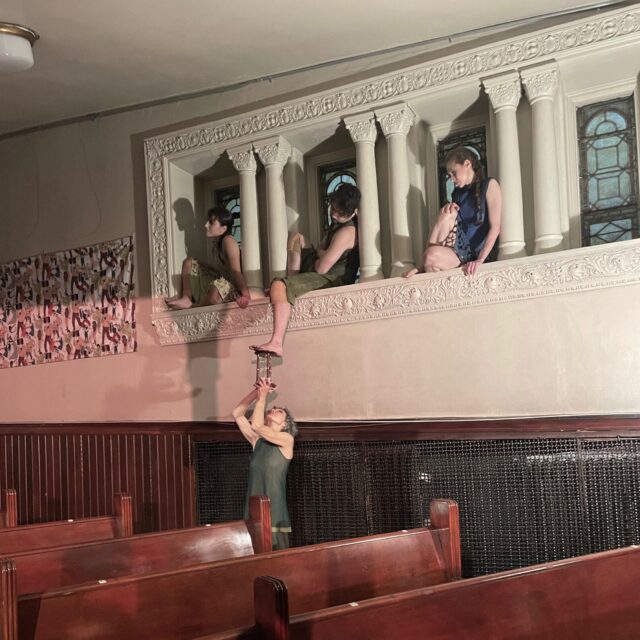
Jody Oberfelder makes use of nearly every nook and crannie of the Center at West Park for Story Time (photo by twi-ny/mdr)

STORY TIME
The Center at West Park
165 West Eighty-Sixth St. at Amsterdam Ave.
Friday, May 16, and Saturday, May 17, $24–$30, 7:30
www.centeratwestpark.org
www.jodyoberfelder.com

New York–based director, dancer, choreographer, and filmmaker Jody Oberfelder activates the endangered Center at West Park in the landmarked West Park Presbyterian Church with the inspiring, exhilarating Story Time, one of the best site-specific works of her long, distinguished career.

As the audience enters the soaring space, activity begins subtly, then with increasing urgency. Mariah Anton Arters, Caleb Patterson, and Andi Farley Shimota are at rest in niches on a windowsill but soon hop down and proceed amid the pews and columns with unbounded energy. Michael Greenberg walks slowly up and down the aisles perusing a red book, stopping to point out a line for audience members to read. A smiling Oberfelder approaches people, holding out an hourglass for them to ponder. Nyah Malone is spread across a piano, eventually sitting on the bench and playing a few notes. Shimota is in a back room, balancing apples and oranges until Caleb Patterson knocks over one of her cairns and runs away. Grace Bergere moves ever-so-carefully around the pews, magically spinning a red ball representing the globe.

The audience is encouraged to immerse themselves in the action, not just find a seat but wander around and engage with the performers (without obstructing them); for example, I tried to build a few fruit cairns myself but failed miserably. Be sure to check out Nick Cassway’s two wallpaper collages of the performers and Tine Kindermann’s stunning dioramas of fairy tale classics.

What follows are eighteen vignettes on a proscenium stage where the church altar would have been, in front of a large pipe organ. Gargoyles come to life as Bergere, who Oberfelder met when the singer was busking in Tompkins Square Park, sings her original composition “A Little Blood” on the lip of the stage. Greenberg and Arters become Merlin and Morgana, respectively, dancing to isomonstrosity’s “I Hope She Is Sleeping Well.” Shimota is a Hungarian princess and Patterson a potential suitor, interacting to Villa Delirium’s medieval-style folk ballad “Hungarian Countess” and the Parisian Marie Antoinette sex parable “Marie.”

Patterson and Shimota are tempted by Kindermann’s gingerbread cookies in a retelling of Hansel and Gretel while Kindermann sings live. Oberfelder dances with a broom, Greenberg mimics using a knife, Malone dangles a birdcage, and an apple entraps Patterson and Shimota. Bluebeard meets an ogre as Arters and Patterson perform a duet to Bergere’s “Billy,” with Bergere on harmonium and Kindermann on saw. Everyone comes together for a thrilling grand finale.

The ninety-minute Story Time boasts some of Oberfelder’s finest choreography, highlighted by breathtaking lifts and carries infused with an innate playfulness, incorporating a bevy of surprising objects and a charming scene involving small chairs and a table, with a few lovely nods to Pina Bausch. The vastly talented performers switch quickly between Katrin Schnabl’s costumes, which range from elegant dresses to a ratty hair shirt; Connor Sale’s lighting is soft and gentle.

Story Time is itself a fairy tale, an enchanting production that is part of the movement to protect and save the landmark church building while also investigating the stories we are told, and that we tell ourselves and each other, in this deeply divided time in America and around the world.

Near the conclusion, a musical interlude features Bergere on guitar as she and Kindermann sing lyrics by Oberfelder: “From the womb where they bled / In this place purple dread / But open your eyes, see / A pleasure awaits / Through myriad gates / The tail meets its head.”

Pleasures galore await all through the gates of the Center at West Park, which itself will hopefully have a happy ending.

[Mark Rifkin is a Brooklyn-born, Manhattan-based writer and editor; you can follow him on Substack here.]