this week in music

FIRST SATURDAYS: SOUL OF A NATION

Roy DeCarava, Couple Walking, gelatin silver print on paper, 1979 (© 2017 estate of Roy DeCarava)

Roy DeCarava, “Couple Walking,” gelatin silver print on paper, 1979 (© 2017 estate of Roy DeCarava)

FIRST SATURDAYS
Brooklyn Museum
200 Eastern Parkway at Washington St.
Saturday, February 2, free (some events require advance tickets), 5:00 – 11:00
212-864-5400
www.brooklynmuseum.org

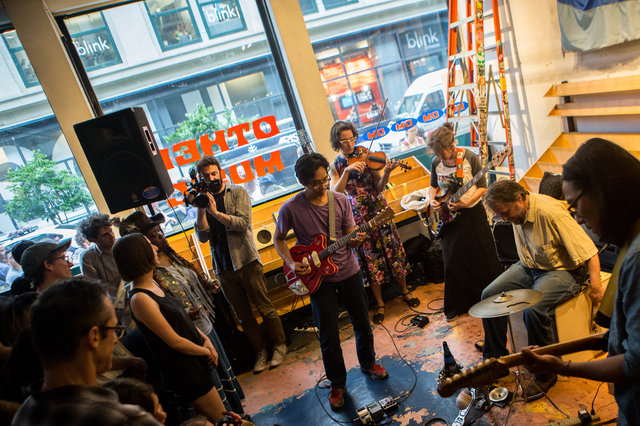
The Brooklyn Museum honors Black History Month in the February edition of its free First Saturday program. There will be live performances by Winard Harper, YahZarah (“I’m Taking You Back”), and Toshi Reagon with violinist Juliette Jones and bassist, guitarist, and vocalist Ganessa James; curator tours of “Soul of a Nation: Art in the Age of Black Power” and “Eric N. Mack: Lemme walk across the room” with Ashley James; a Learning Lesson discussion with artist Kameelah Janan Rasheed inspired by Octavia Butler’s idea of “primitive hypertext”; pop-up gallery talks of “Soul of a Nation” with teen apprentices; a screening of Mr. Soul (Melissa Haizlip & Samuel D. Pollard, 2018), introduced by the directors; a hands-on workshop in which participants can create wearable activist patches inspired by the messages of the Guerrilla Girls and AfriCOBRA; an artist talk featuring Shani Jamila’s new podcast, Lineage, with photographers Ming Smith and Russell Fredrick of the Kamoinge collective; “Soul of a Nation”–inspired poetry with Karisma Price, Naomi Extra, and Stephanie Jean of Cave Canem; an “Archives as Raw History” tour with archivist Molly Seegers; and Black Gotham Experience’s immersive Magnetic Resonance, consisting of a photo studio by Kamau Ware with styling by Charles Johnson, video collage by Kearaha Bryant, and music by GoodWill, P.U.D.G.E., and Rimarkable. In addition, the galleries will be open late so you can check out “Soul of a Nation: Art in the Age of Black Power,” “Eric N. Mack: Lemme walk across the room,” “One: Do Ho Suh,” “Half the Picture: A Feminist Look at the Collection,” “Something to Say: Brooklyn Hi-Art! Machine, Deborah Kass, Kameelah Janan Rasheed, and Hank Willis Thomas,” “Rob Wynne: FLOAT,” “Infinite Blue,” “A Woman’s Afterlife: Gender Transformation in Ancient Egypt,” “Kwang Young Chun: Aggregations,” and more.

SILENT FILMS / LIVE MUSIC

John Schaefer “Silent Films / Live Music” series returns to Brookfield Place this week

John Schaefer’s “Silent Films / Live Music” series returns to Brookfield Place this week

Brookfield Place
230 Vesey St.
January 30 – February 1, free, 7:30
www.artsbrookfield.com

In a 2011 twi-ny talk about his “Silent Films / Live Music” series at the World Financial Center Winter Garden, in which he selects silent movies to be accompanied by live scores, WNYC’s John Schaefer said, “The films seem less like period pieces themselves and more like a still-living art form.” After a hiatus, the program is back at Arts Brookfield, with Schaefer again running the show, reenergizing black-and-white silent cinema. On three successive nights, January 30 to February 1, Schaefer will present classic films with live accompaniment, beginning Wednesday with Marc Ribot performing to Charles Chaplin’s The Kid, followed Thursday by F. W. Murnau’s Nosferatu: A Symphony of Horror with music by Irene and Linda Buckley, and concluding Friday with series favorite Alloy Orchestra playing to Josef von Sternberg’s Underworld. Each screening begins at 7:30; admission is free.

THE KID

A Tramp (Charlie Chaplin) and an abandoned child (Jackie Coogan) form a family in The Kid

THE KID (Charles Chaplin, 1921)
Wednesday, January 30, free, 7:30
www.artsbrookfield.com

Charlie Chaplin’s first feature, The Kid, was a breakthrough for the British-born silent-film star, a touching and tender sixty-eight-minute triumph about a poor soul getting a second chance at life. When a baby arrives at his doorstep, a Tramp (Chaplin) first tries to ditch the boy, but he ends up taking him to his ramshackle apartment and raising him as if he were his own flesh and blood. Although he has so little, the Tramp makes sure the child, eventually played by Jackie Coogan, has food to eat, clothes to wear, and books to read. Meanwhile, the mother (Edna Purviance, Chaplin’s former lover), who has become a big star, regrets her earlier decision and wonders where her son is, setting up a heartbreaking finale. In addition to playing the starring role, Chaplin wrote, produced, directed, and edited the film and composed the score for his company, First National, wonderfully blending slapstick comedy, including a hysterical street fight with an angry neighbor, with touching melodrama as he examines poverty in post-WWI America, especially as seen through the eyes of the orphan boy, played beautifully by Coogan, who went on to marry Betty Grable, among others, and star as Uncle Fester in The Addams Family. Chaplin’s innate ability to tell a moving story primarily through images reveals his understanding of cinema’s possibilities, and The Kid holds up as one of his finest, alongside such other silent classics as 1925’s The Gold Rush and 1931’s City Lights. At Brookfield Place, Ribot will perform his 2010 score, which was commissioned for the New York Guitar Festival.

NOSFERATU

F. W. Murnau’s 1922 version of Nosferatu is a German expressionist classic

NOSFERATU: A SYMPHONY OF HORROR (NOSFERATU, EINE SYMPHONIE DES GRAUENS) (F. W. Murnau, 1922)
Thursday, January 31, free, 7:30
www.artsbrookfield.com

In F. W. Murnau’s classic horror film, Max Schreck stars as Count Orlok, a creepy, inhuman-looking Transylvanian who is meeting with real estate agent Thomas Hutter (Gustav von Wangenheim) in order to buy a house in Germany. Hutter soon learns that the count has a taste for blood, as well as lust for his wife, Ellen (Greta Schröder), whom he has left behind in Germany. When Count Orlok, a bunch of rats, and a group of coffins filled with Transylvanian earth head out on a ship bound for Wisborg, the race is on to save Ellen, and Germany. Murnau’s Nosferatu is set in an expressionist world of liminal shadows and fear, as he and cinematographers Fritz Arno Wagner and Günther Krampf continually place the menacing Orlok in oddly shaped doorways that help exaggerate his long, spiny fingers and pointed nose and ears. Unable to acquire the rights from Bram Stoker’s estate to adapt the Gothic horror novel Dracula into a film, writer Henrik Galeen (The Golem, The Student of Prague) and director Murnau (Sunrise, The Last Laugh) instead made Nosferatu, paring down the Dracula legend, changing the names of the characters, and tweaking the story in various parts. Upon its 1922 release, they were sued anyway, and all prints were destroyed except for one, ensuring the survival of what became a defining genre standard-bearer. In 1979, German auteur Werner Herzog (Woyzeck, Fitzcarraldo) paid tribute to the earlier film with Nosferatu the Vampyre, a near scene-by-scene homage to Murnau’s original but with Stoker’s character names restored, as the book was by then in the public domain. Hans Erdmann’s complete score no longer exists, so numerous musical compositions have accompanied screenings and DVD/VHS releases over the years; at Brookfield Place, Irene and Linda Buckley will present the US premiere of their score.

UNDERWORLD

Bull Weed (George Bancroft) offers Rolls Royce (Clive Brook) a new life in Josef von Sternberg’s Underworld

UNDERWORLD (Josef von Sternberg, 1927)
Friday, February 1, free, 7:30
www.artsbrookfield.com

The 2019 edition of “Silent Films / Live Music” has a grand finale February 1 with Alloy Orchestra performing to Josef von Sternberg’s 1927 silent black-and-white Underworld, generally considered the first modern gangster picture and a major influence on such films as William A. Wellman’s The Public Enemy and Mervyn LeRoy’s Little Caesar. Sternberg’s fourth film, Underworld is set in “a great city in the dead of night . . . streets lonely, moon-flooded . . . buildings empty as the cliff-dwellings of a forgotten age.” The opening shot is of a superimposed clock, emphasizing that it is two o’clock in the morning, a time when most are tucked safely in their bed at home. But not Bull Weed (George Bancroft), who has just pulled off a bank heist, only to be spotted by Rolls Royce (Clive Brook), a down-on-his-luck drunken bum. At Bull’s hangout, the Dreamland Café, his girl, Feathers (Evelyn Brent), enters, and a single strand from her extravagant getup floats down, the camera following it until it is grabbed by Rolls Royce, who is sweeping the floor. Bull’s main rival, Buck Mulligan (Fred Kohler), tries to get the attention of Feathers, upsetting his own moll, Meg (Helen Lynch). Walking out of the nightclub, Bull is greeted by an electronic billboard proclaiming, “The City Is Yours.” (Howard Hawks goes one better in his seminal 1932 film, Scarface, in which the title character, Antonio “Tony” Camonte, played by Paul Muni, is encouraged by an electronic sign that tells him, “The World Is Yours.”) Laughing, Bull playfully asks Feathers, “What’ll you have?” She scoffs at him, then Rolls Royce, a former lawyer, says, “Attila, the Hun, at the gates of Rome.” To which Bull replies, “Who’s Attila? The leader of some wop gang?” The stage has been set for the rest of the film, built around jealousy and envy as both Buck and Rolls Royce, who Bull decides to rehabilitate, fall hard for Feathers, but Bull is not about to just sit back and take it.

UNDERWORLD

Bull Weed (George Bancroft) is protective of his moll, Feathers (Evelyn Brent), in classic gangster picture

Underworld is an expressionist noir melodrama that became the template for the gangster-film genre, launching many of the major tropes, from characterization to narrative development. It’s shot in shadowy glory by Bert Glennon (Lloyd’s of London, Rio Grande) from the dark streets to a glamorous annual armistice ball and a spectacular shootout finale. Journalist, novelist, and playwright Ben Hecht (Notorious, Wuthering Heights), who based Bull on real-life Chicago criminal “Terrible” Tommy O’Connor, won the Best Writing (Original Story) Academy Award at the first Oscars; Robert N. Lee wrote the screenplay, with the adaptation by Charles Furthmann and titles by George Marion Jr. Von Sternberg went on to make such classic sound films as The Blue Angel, Shanghai Express, Blonde Venus, and The Scarlett Empress with Marlene Dietrich. He directed only one full picture by himself after 1941, the 1953 Japanese war drama Anatahan; he died in Hollywood in 1969 at the age of seventy-five.

KEVIN BEASLEY: A VIEW OF A LANDSCAPE

(photo by twi-ny/mdr)

Cotton gin motor is centerpiece of Kevin Beasley exhibition at the Whitney (photo by twi-ny/mdr)

Whitney Museum of American Art
99 Gansevoort St.
Through March 10, $18-$25
Performances January 26, February 16, and March 2, free with museum admission
212-570-3600
whitney.org

In 2011, artist and automotive enthusiast Kevin Beasley went to his family’s Virginia farm and was surprised to see that it was planted with cotton for the first time. The Yale MFA candidate picked some of the cotton and brought it home with him, wanting to incorporate the material into his work. Searching on eBay, Beasley found a 2200-pound cotton gin motor for sale in Maplesville, Alabama, where it had been in use from 1940 to 1973, overlapping with the heart of the civil rights movement; Selma, where the march to Montgomery began in 1965, is only thirty miles away from Maplesville. Beasley, now based in Brooklyn with a studio in Astoria, then combined the personal with the political and the historical to create the powerful exhibition “View of a Landscape,” continuing at the Whitney through March 10. The centerpiece of the show is the cotton gin motor, which Beasley transported from Alabama following the route of the Great Migration. At the Whitney, the motor is encased in a soundproof glass and steel vitrine in a room by itself, as if not only on display but on trial. Beasley has attached multiple audio wires to the motor, turning it into a musical instrument; the wires connect to modular synthesizers and processors in the next room, emitting electronic sounds throughout the day, evoking Robert Morris’s 1961 “Box with the Sound of Its Own Making.”

(photo by twi-ny/mdr)

“Campus” and “The Acquisition” are two of three freestanding walls that are part of Kevin Beasley’s “View of a Landscape” (photo by twi-ny/mdr)

The installation is supplemented with a trio of slab sculptures, eight-hundred-pound eight-by-ten-feet freestanding walls made of articles related to Beasley, his family, and slavery, focusing on race, labor, and ancestry. Titled “The Reunion,” “Campus,” and “The Acquisition,” they are like excavations dug out of the soil, composed of polyurethane resin, raw cotton, garbage bags, clothing, du-rags, music equipment, and elements from Beasley’s time at Yale, from his cap and gown to harlequin masks. Eli Whitney, who invented the cotton gin in 1793, was also a Yale grad; the Eli Whitney Students Program currently helps those who have taken five or more years off from school. In addition, Yale itself was named after slave trader Elihu Yale, and Eli Whitney is related to Harry Payne Whitney, who married Gertrude Vanderbilt, the founder of the Whitney Museum of American Art in 1931. The installation is a deep dig, no stone left unturned as Beasley puts it all together into a cohesive unit
.

(photo by twi-ny/mdr)

Kevin Beasley kicked off the first of several related concerts on January 12 at the Whitney (photo by twi-ny/mdr)

On January 12, Beasley, who was an artist-in-residence at the Studio Museum in Harlem in 2013-14, played the first of four concerts using the cotton gin motor, manipulating the many wires hooked up to several synthesizers in the listening room. He was joined by multi-instrumentalist, songwriter, and vocalist Taja Cheek for two hours of compelling noise. Wearing a Frederick Douglass sweatshirt and a serious mien, Beasley alternated sounds, from the industrial roar of the motor to space-age riffs, not smiling until the show was over. I sat on the large woofer near the center, which made it feel like I was experiencing it in Sensurround, the bass reverberating through my body. If it’s not completely packed, you should walk around, as different sounds are emitted from the various speakers. Recognizable words occasionally came through as well, including “Freedom” and “I’m here.” There will also be concerts (free with museum admission) on January 26 at 6:00, 7:00, and 8:00 with Eli Keszler, February 16 at 6:00 with Beasley, and March 2 at 6:00, 7:00, and 8:00 with Jlin. The line started about an hour before showtime, so get ready. And Beasley will be in conversation with Daphne Brooks and Jace Clayton on February 1 at 6:30 ($10).

MARY LEE’S CORVETTE: BLOOD ON THE TRACKS

dreaming of dylan

Joe’s Pub at the Public Theater
425 Lafayette St. at Astor Pl.
Thursday, January 24, $18, 7:00
212-967-7555
www.publictheater.org
www.maryleescorvette.com

“Ah, me, I busted out / Don’t even ask me how / I went to get some help / I walked by a Guernsey cow / Who directed me down / To the Bowery slums,” Bob Dylan sang on “Bob Dylan’s 115th Dream,” from his seminal 1965 album Bringing It All Back Home. Brooklyn-based singer, songwriter, author, and expressive arts therapist Mary Lee Kortes has turned the tables on the former Robert Zimmerman somewhat with her first book, Dreaming of Dylan: 115 Dreams about Bob (BMG, November 2018, $24.99), which she will be launching on January 24 at Joe’s Pub, around the corner from the Bowery. The Brooklyn-based singer, songwriter, author, and expressive arts therapist collected and edited 115 dreams about Dylan from a wide range of folks, from a retired Australian postman and a Chicago social scientist to Patti Smith and Scott Kempner, from a Texas plumber and an Israeli poet to journalist Geoff Ward and Sirius XM DJ Meg Griffin. One dreamer is even identified as Henry Porter, but as Dylan sang in “Brownsville Girl”: “The only thing we knew for sure about Henry Porter / Is that his name wasn’t Henry Porter.”

The book is beautifully designed, with the dreams accompanied by related photographs and drawings by Daniel Root, Kevin Walters, and others. Kortes is the leader of Mary Lee’s Corvette, who in 2002 released a terrific song-by-song cover of Blood on the Tracks, which resulted in Mary Lee opening for Dylan. At Joe’s Pub, Kortes, who has released such other records as The Songs of Beulah Rowley, Love Loss & Lunacy, and 700 Miles, will perform songs with her band and read from the book. “I’ll let you be in my dreams if I can be in yours,” Dylan sang in “Talkin’ World War III Blues.” Everyone will get the chance January 24 at Joe’s Pub.

LIVE SOUND CINEMA: DANGER: DIABOLIK (LIVE SCORE BY MORRICONE YOUTH)

Danger: Diabolik

John Philip Law plays a criminal mastermind in Mario Bava’s Danger: Diabolik

DANGER: DIABOLIK (Mario Bava, 1968)
Nitehawk Cinema
136 Metropolitan Ave. between Berry St. & Wythe Ave.
Wednesday, January 23, 7:00
718-384-3980
nitehawkcinema.com

Nitehawk Cinema’s “Live Sound Cinema” series continues January 23 with an inspired selection: Morricone Youth performing a live re-score to Mario Bava’s Danger: Diabolik. The 1968 film was the last to be spoofed on Mystery Science Theater 3000 in 1999 — the year Morricone Youth was formed — prior to its 2017 reboot on Netflix, but don’t let that fool you; it’s no mere dated piece of schlock. The longtime underground fave has been steadily increasing its cred over the last decade, and deservedly so. The psychedelic crime thriller stars John Phillip Law as Diabolik, a criminal mastermind who pulls off seemingly impossible thefts right under the noses of the Minister of the Interior (Terry-Thomas), the intrepid Inspector Ginko (Michel Piccoli), and the frustrated chief of police (Claudio Gora), who eventually turns to mob boss Valmont (Adolfo Celi) for help. Wearing a body-hugging wetsuit of a costume, Diabolik is assisted by the love of his life, the gorgeous blonde Eva Kant (Marisa Mell), plotting their derring-do in an expansive underground lair. Based on the Italian comic book series by Angela and Luciana Giussani, the story rarely makes much sense, but it’s a hoot to watch, a trippy mix of Batman, James Bond, Robin Hood, and Austin Powers.

danger diabolik 2

The film was produced by Dino De Laurentiis, who fired the initial director and main cast, which included first George Raft and then Gilbert Roland as Diabolik’s archnemesis, and at one point considered Catherine Deneuve to play Eva, but ultimately giallo master Bava (Black Sunday, Planet of the Vampires) hired Mell. If some of the sets look familiar, it may be because De Laurentiis actually reused them, as well as actors, right after Diabolik finished shooting, going straight into production on another comic book movie, Roger Vadim’s Barbarella. Diabolik also features what very well might be Ennio Morricone’s grooviest soundtrack, which becomes a character unto itself; he might be most famous for composing the scores for myriad classic Westerns, but he also wrote music for Dario Argento, Elio Petri, and Pier Paolo Pasolini. The Nitehawk presentation is a great match of film and music; you can get a taste of what you’re in for here, when Morricone Youth performed to Danger: Diabolik at Nitehawk in 2013. And Beastie Boys fans should check out their 1998 video for “Body Movin’,” a campy tribute to the movie. “Live Sound Cinema” continues February 14 with Reel Orchestrette playing a live score to Buster Keaton’s 1925 classic, Seven Chances.

MUST-SEE WEEK 2019

must see week

Multiple venues
January 21 – February 10
www.nycgo.com

The rising price of admissions in New York City got you down? You can check out some big-time Big Apple institutions January 21 to February 10 during Must-See Week, when tickets to many cultural stalwarts go BOGO, offering two-for-one discounts. Among the participating attractions are the 9/11 Tribute Museum, the Bronx Zoo, the Brooklyn Botanic Garden, the Brooklyn Museum, the Cooper Hewitt, the Empire State Building Observatory, the Intrepid, the Mount Vernon Hotel Museum & Garden, the Museum at Eldridge Street Synagogue, the Museum of Chinese in America, MoMA, the Museum of the City of New York, the New York Botanical Garden, the New York City Ballet, the Chamber Music Society of Lincoln Center, the Rink at Rockefeller Center, the UN, and more. While you can get some tickets in advance, others require in-person vouchers.

WINTER PERFORMANCE FESTIVALS: FIRST NATIONS DIALOGUES

(photo by Adele Wilkes)

Joshua Pether’s Jupiter Orbiting is part of First Nations Dialogues festival (photo by Adele Wilkes)

Multiple venues
January 5-12
www.catalystdance.com

The First Nations Dialogues Lenapehoking/New York festival takes place January 5-12 with live performances, community gatherings, discussions, and other special programs focusing on Indigenous cultures in the US, Canada, and Australia. The centerpiece is KIN, a series of events curated by Emily Johnson that includes three conversations with Paola Balla, Genevieve Grieves, and Johnson; a fabric workshop with Spiderwoman Theater cofounder Muriel Miguel; the play-reading series “Reflections of Native Voices,” with Muriel Miguel, Gloria Miguel, Carolyn Dunn, Ed Bourgeois, Henu Josephine Tarrant, Rachael Maza, and Nicholson Billey; presentations by Joshua Pether and S. J. Norman; and the outdoor ceremonial fire gathering “Kinstillatory Mappings in Light and Dark Matter.” Kicking off the Global First Nations Performance Network, First Nations Dialogues is held in partnership with the Lenape Center, Amerinda, American Indian Community House, Abrons Arts Center, American Realness, Danspace Project, La MaMa, Performance Space New York, Safe Harbors Indigenous Collective, Under the Radar, the Association of Performing Arts Presenters, and the International Society for the Performing Arts. Below are some of the highlights.

Saturday, January 5
Tëmikèkw, an honoring and welcome gathering, with Muriel Miguel, Gloria Miguel, and Deborah Ratelle of Spiderwoman Theater, Diane Fraher (Osage/Cherokee) of Amerinda, the SilverCloud Singers led by Kevin Tarrant of the Hopi and HoChunk Nations, Laura Ortman of the Apache Nation, and fancy shawl dancer Anatasia McAllister of the Colville Confederated Tribes and Hopi Nation, Danspace Project, free with RSVP, 12:30 – 4:00 pm

Saturday, January 5, 7:00
and
Sunday, January 6, 3:00

Jupiter Orbiting, by Joshua Pether, immersive movement-based work about dissociation and trauma, Performance Space New York, $15

Tuesday, January 8, 7:30
Cicatrix 1 (that which is taken/that which remains), by S. J Norman, four-hour durational ritual, Performance Space New York, $15

Wednesday, January 9, 10:00
Thursday, January 10, 10:00
Friday, January 11, 1:00

Serpentine, by Daina Ashbee, performed by Areli Moran to music composed by Jean-Françoise Blouin, La MaMa, Downstairs Theater, $20-$25

Friday, January 10, 2:00, 6:00, 8:00
Footwork/Technique, by Mariaa Randall, incorporating contemporary Aboriginal footwork and dance legacies, Performance Space New York, $15