this week in music

TIME CAPSULE: TELL-TALE HEART

Jan Tilley (photo by twi-ny/mdr) Jan Tilley will play her heart out at June 14 tribute show at the Cutting Room (photo by twi-ny/mdr)[/caption]

The Cutting Room
44 East 32nd St. between Madison & Fifth Aves.
Friday, June 14, $20-$25, 9:00
212-691-1900
thecuttingroomnyc.com
www.jantilley.com

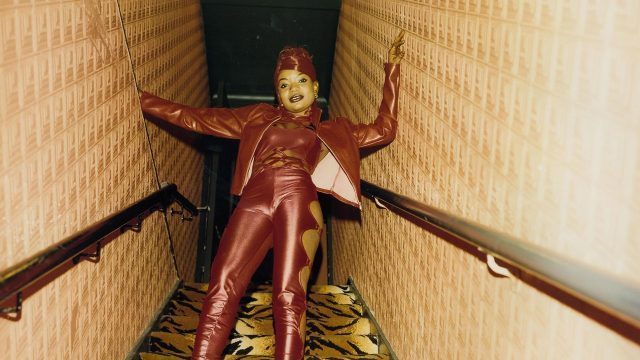
Back in March, rock & roll guitarist and singer Jan Tilley closed her Time Capsule 1970s/’80s Tribute show at the Cutting Room with a sizzling cover of Heart’s “Barracuda.” It was merely a taste of what’s to come, as Tilley, the cofounder of the Rude Girls and an early portrayer of Krzysztof in Hedwig & the Angry Inch, returns to the Cutting Room on June 14 with “Tell-Tale Heart,” an evening dedicated to the music of the Wilson sisters.

jan tilley heart

Katia Floreska, Ki Ki Hawkins, and Shannon Conley will alternate the Ann parts, with Jan performing as Nancy. The band consists of bassist Carl Limbacher, guitarist Stephen Flakus, pianist Paul Leschen, and drummer Joe DiBella. Be prepared to, well, sing your heart out with Tilley, a consummate rocker who puts on a helluva show, marching across the stage and into the audience, wearing her heart on her sleeve.

ASSEMBLY

(image courtesy Kevin Beasley)

Kevin Beasley’s Assembly takes attendees across three floors of the Kitchen (image courtesy Kevin Beasley)

The Kitchen
512 West 19th St. between Tenth & Eleventh Aves.
June 15-16, 22-23, 29-30, $10 (advance reservations recommended)
Installation on view June 21 & 28, free, 11:00 am – 6:00 pm
212-255-5793
thekitchen.org

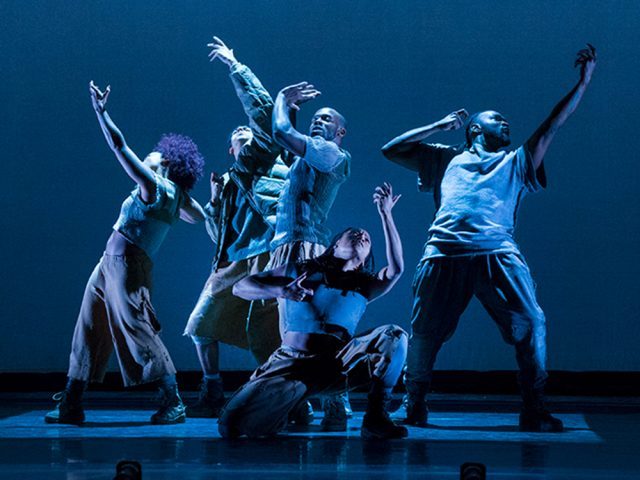
Hot on the heels of his widely hailed audiovisual Whitney exhibition, “A View of a Landscape,” which included several live performances using manipulated sounds emanating from a cotton gin motor, Yale MFA candidate Kevin Beasley is stripping down the Kitchen for the installation / performance series Assembly, taking place in newly empty rooms on three floors of the Chelsea arts institution. Beasley, in conjunction with Lumi Tan, Tim Griffin, and Nicole Kaack from the Kitchen, has created custom sound and video systems that will be activated on Saturday, June 15, 22, and 29, at 6:30, and Sunday, June 16, 23, and 30, at 4:00, in dialogue with the building itself and its position in a changing art world, specifically involving access and collectivity. The mix of musicians, dancers, performance artists, and DJs features Suzi Analogue and Pamela Z on June 15, King Britt presents Moksha Black and Richard Kennedy on June 16, Mhysa, David Thomson, and whoisskitzo on June 22, HPrizm, Robert Aiki Aubrey Lowe, and stud1nt on June 23, Lafawndah, NAR, and Angie Pittman on June 29, and Jason Moran, Logan Takahashi, and Wetware on June 30. In a statement, choreographer Thomson called his piece, Body of work, “a palimpsest. A meditation on memory, identities, and boundaries. A marking of time on the body of a transitional space.” Admission is $10, and attendees are encouraged to walk throughout the Kitchen; advance purchase is recommended. In addition, the installation will be open to the public for free on June 21 and 28 from 11:00 to 6:00.

MUSEUM MILE FESTIVAL 2019

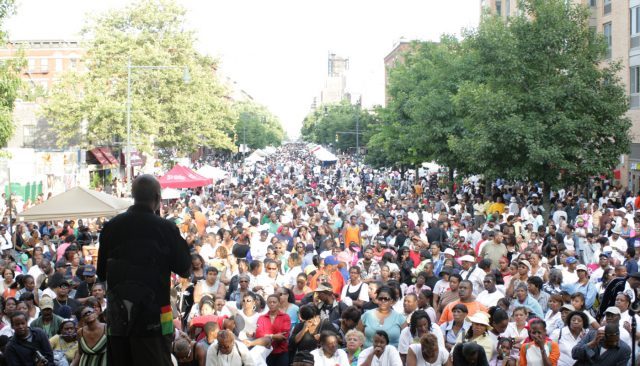
Crowds will line Fifth Avenue for Museum Mile Festival on Tuesday night

Crowds will line Fifth Avenue for Museum Mile Festival on Tuesday night

Multiple locations on Fifth Ave. between 82nd & 105th Sts.
Tuesday, June 11, free, 6:00 – 9:00 pm
www.museummilefestival.org

The forty-first annual Museum Mile Festival will take place on Tuesday, June 11, as eight arts institutions along Fifth Avenue between 82nd and 105th Sts. open their doors for free between 6:00 and 9:00. There will be live indoor or outdoor performances by Fogo Azul, Steven Bernstein’s Sexmob, Aurora Flores and Zon del Barrio, Palladium Mambo All Stars, and DJ Bembona in addition to face painting, art workshops, a birthday photo booth, and more. The participating museums (with at least one of their current shows listed here) are El Museo del Barrio (“Culture and the People: El Museo del Barrio, 1969 – 2019”), the Museum of the City of New York (“New York at Its Core,” “Pride: Photographs of Stonewall and Beyond by Fred W. McDarrah”), the Jewish Museum (“Leonard Cohen: A Crack in Everything”), the Cooper-Hewitt, National Design Museum (“Nature — The Cooper Hewitt Design Triennial”), the Guggenheim (“Implicit Tensions: Mapplethorpe Now,” “Artistic License: Six Takes on the Guggenheim Collection”), the Neue Galerie (“The Self-Portrait, from Schiele to Beckmann”), the Africa Center (“Sudan Uprising”), and the Metropolitan Museum of Art (“Play It Loud: Instruments of Rock&Roll,” “The Tale of Genji: A Japanese Classic Illuminated”), along with presentations by the New York Academy of Medicine, the Church of the Heavenly Rest, and Asia Society. Don’t try to do too much, because it can get rather crowded; just pick one or two exhibitions in one or two museums and enjoy.

TRIPTYCH (EYES OF ONE ON ANOTHER)

(photo by Richard Termine)

Bryce Dessner’s Triptych (Eyes of One on Another) runs at BAM June 6-8 (photo by Richard Termine)

BAM Howard Gilman Opera House
Peter Jay Sharp Building
230 Lafayette Ave.
June 6-8, $30-$60, 7:30
718-636-4100
www.bam.org

I was prepared to be blown away by Bryce Dessner’s Triptych (Eyes of One on Another). I’m a big fan of his artsy rock group, the National; I love (who doesn’t?) Patti Smith, whose text figures prominently in the piece; and I thoroughly enjoyed the first part of the Guggenheim’s “Implicit Tensions: Mapplethorpe Now” exhibit, which includes several images that appear in Dessner’s seventy-minute multimedia work. Perhaps my expectations were too high.

Inspired by the 1990 obscenity case against Mapplethorpe’s “The Perfect Moment” exhibit, which took place in Dessner’s hometown of Cincinnati when he was a teenager, Triptych (Eyes of One on Another) explores demons and desire, objectification and beauty, specifically in Mapplethorpe’s XYZ portfolios, which focus on sadomasochism, flowers, and African American male nudes. Accompanying the large-scale projections (by Simon Harding), which appear on a front scrim and/or the back wall, is text from the trial and writings by Smith and poet and activist Essex Hemphill, the latter a critic of Mapplethorpe’s. Dessner’s haunting, ethereal score is performed live by Roomful of Teeth (Cameron Beauchamp, Martha Cluver, Eric Dudley, Estelí Gomez, Abigail Lennox, Thomas McCargar, Thann Scoggin, and Caroline Shaw), joined by soprano Alicia Hall Moran and tenor Isaiah Robinson, the women in silvery white, the men (except for Robinson) in black. (The set and costumes are by Carlos Soto.) Brad Wells conducts, with Jessica McJunkins on violin, Tia Allen on viola, Byron Hogan on cello, Kyra Sims on French horn, Ian Tyson on clarinet and bass clarinet, Laura Barger on piano and harmonium, Donnie Johns and Victor Pablo on percussion, and James Moore on guitar.

(photo by Richard Termine)

A man cannot look up at Robert Mapplethorpe images in Triptych (Eyes of One on Another) (photo by Richard Termine)

Korde Arrington Tuttle’s libretto boasts numerous phrases that stick in the mind as they are sung and projected on walls and screens: “The devil in us all / darkness as beauty”; “Aesthetics can justify desire”; “unsavory things”; “The Artist machetes a clearance.” However, there are also quotes from the trial, which feel trivial and pedantic, especially when juxtaposed with Robinson and Roomful of Teeth’s extensive later repetition of “In america, / I place my ring / on your cock / where it belongs,” from Hemphill’s American Wedding. Among the photographs are “Dominick and Elliot,” depicting a shirtless white man holding the nether regions of a naked white man tied upside down; Mapplethorpe’s famous 1988 portrait of himself gripping a cane with a skull on it; “Jack Walls,” of a black man pointing a gun above his exposed penis; and “Cedric, N.Y.C.,” in which a black man bows his head, the light and shadows making it look like his right side is black and his left side white.

Director Kaneza Schaal is unable to bring the piece together; the words, music, and imagery feel like separate entities. Through it all, a black man wanders across the stage and into the audience, looking up at the projections, a spectator commenting on the images of black bodies by saying nothing. When the audience enters the Howard Gilman Opera House, he is sitting at the front of the stage, watching the people wander in, implicating us all. But I’m not sure in what.

EVERYTHING THAT HAPPENED AND WOULD HAPPEN

(photo by Stephanie Berger)

Heiner Goebbels explores the last hundred years of European history in Everything that happened and would happen (photo by Stephanie Berger)

Park Avenue Armory, Wade Thompson Drill Hall
643 Park Ave. at 67th St.
June 3-9, $40-$95
212-933-5812
armoryonpark.org

German composer and artist Heiner Goebbels constructs, deconstructs, and reconstructs the last hundred years of European history in Everything that happened and would happen, making its American premiere at Park Ave. Armory through June 9. Reconfigured for the armory’s Wade Thompson Drill Hall — it was originally staged in a former railway depot in Manchester — the multimedia, polyphonic spectacle starts as soon as the doors open, so be sure to get there early. The audience sits in rising rafters on the west side of the hall, watching a team of dancers in black (Juan Felipe Amaya Gonzalez, Sandhya Daemgen, Antoine Effroy, Ismeni Espejel, Montserrat Gardó Castillo, Freddy Houndekindo, Tuan Ly, Thanh Nguyễn Duy, John Rowley, Annegret Schalke, Ildikó Tóth, Tyra Wigg) carry seemingly random objects onstage — long tubes, metallic seashells, a gold sun, large cloths that they hang from above — position them carefully, then remove them.

Various people read passages from Patrik Ouředník’s 2001 Europeana: A Brief History of the Twentieth Century, a tragicomic, stream-of-consciousness look at the twentieth century, exploring war, racism, colonialism, collective memory, liberal democracy, the Holocaust, Barbie dolls, and more. Sentences are occasionally projected on hanging sheets designed with trees, maps, and architectural structures, in addition to unedited footage from Euronews’s No Comment, with no narration or context; the night we attended featured very recent live, often violent images from Syria, Colombia, and other nations. (The video design is by Rene Liebert.) In one corner smoke oozes out of a cave, creating a face. Rocks storm down in an avalanche. The dancers roll column-like plinths across the stage, pedestals without busts; later, one performer climbs on top of one and reads from Ouředník’s book.

(photo by Stephanie Berger)

Everything that happened and would happen has been reimagined for the Park Ave. Armory (photo by Stephanie Berger)

The dissonant score, from John Cage’s Europeras 1&2, is played by Camille Émaille on percussion, Gianni Gebbia on saxophone, Cécile Lartigau on ondes Martenot, Nicolas Perrin on guitar and electronics, and Léo Maurel on several specially built, unusual instruments. (The props are from Goebbels’s 2012 production of Europeras 1&2.) Willi Bopp’s stunning sound design has music and words emerging from numerous speakers throughout the hall, as if a choreographed sonic dance. Goebbels is a master of deception; while you’re watching one element, others will sneak up on you, offering surprises galore, evoking life itself — and war, specifically, but without the immediate threat. A long, narrow beam becomes a mobile trench. Black monoliths creep up out of the darkness. At one point I felt as if Birnam Wood was stealthily approaching; another reminded me of George Washington crossing the Delaware (even if it’s not from the last century). The dancers and musicians improvise, furthering the anything-can-happen atmosphere.

Perhaps what’s most invigorating about the 135-minute-plus intermissionless show — Goebbels’s third project at the armory, following Stifter’s Dinge in 2009 and De Materie in 2016 — is that despite the serious topics that are broached, abstract and not, Goebbels leaves it up to us to interpret what we are experiencing; he gives us the building blocks from which we can form our own narrative. “Everything that happened and would happen doesn’t participate in all the attempts to have yet another opinion as to the meaning of what has happened; quite the opposite. Guided by a deep mistrust in the transmission of a one-directional message, I don’t even try,” Goebbels explains in his director’s note. “Everything that happened and would happen seeks to open up a space of images, words, and sounds generous enough to avoid the impression that somebody on stage is trying to tell you what to think. It is a space for imagination and reflection, in which the construction of sense is left for everyone to assemble.”

(photo by Stephanie Berger)

Words, images, movement, and sound come together in unique, contemplative ways in Heiner Goebbels’s return to the armory (photo by Stephanie Berger)

It can be slow going, and several members of the audience did not make it to the end, which is too bad, because Everything that happened and would happen proves to be a provocative durational exploration of the past, present, and future fusing together, a multimedia barrage on the eyes and ears that demands our attention even as the mind wanders. Even when not much appears to be going on, something is, of course, mimicking life and the choices we make as we go about our day; Goebbels metaphorically hands us the controls and we watch and listen to what we want to, self-curating the presentation. Ouředník writes, “Historians said that historical memory was not part of history and memory was shifted from the historical to the psychological sphere, and this instituted a new mode of memory whereby it was no longer a question of memory of events but memory of memory.” On opening night, at the close of the show, Goebbels himself was helping the ushers steer the audience to the exits on the far side of the stage, forcing everyone to march along a battered landscape and take stock of where we are at this very moment in time, where we’ve been, and where we’re going. It’s a fitting finale to an adventurous evening of intoxicating, memorable theater.

TRIPTYCH (EYES OF ONE ON ANOTHER)

(photo by Maria Baranova)

Triptych (Eyes of One on Another) takes a unique multimedia look at the work of Robert Mapplethorpe (photo by Maria Baranova)

BAM Howard Gilman Opera House
Peter Jay Sharp Building
230 Lafayette Ave.
June 6-8, $30-$60, 7:30
718-636-4100
www.bam.org

The controversial work of the late photographer Robert Mapplethorpe has been undergoing a renaissance over the last few years, with documentaries, gallery and museum shows, and, perhaps most influentially, Patti Smith’s award-winning memoir about her life with Mapplethorpe, Just Kids. Now comes composer Bryce Dessner and librettist Korde Arrington Tuttle’s multimedia Triptych (Eyes of One on Another), playing at BAM’s Howard Gilman Opera House June 6-8. The sixty-minute theatrical oratorio is divided into three sections based on Mapplethorpe’s XYZ portfolios, which explore sadomasochism, flowers, and African American male nudes, respectively. The first part centers on Smith’s poem “The Boy Who Loved Michelangelo,” set to a Monteverdi madrigal; the second on Dessner’s personal reaction to the 1990 Mapplethorpe obscenity trial in Cincinnati, the composer’s hometown; and the third on poet and performance artist Essex Hemphill’s “The Perfect Moment,” which was critical of Mapplethorpe’s depiction of black bodies. “Aesthetics can justify desire, / but desire in turn / can provoke punishment. / Under public scrutiny / the eyes of one man / are focused on another. / Is it desire, equality, / disgust, or hatred?” he writes. Meanwhile, in a program note, dramaturg Christopher Myers asks, “Is it possible to imagine these men who are photographed with the impersonal intimacy of flowers, or bronze sculptures, as full human beings, with desires and pleasures of their own? Can we read the desire of the photographer, his conflicts and self-denials, in his steadfast commitment to a classical language that recasts leather daddies and daddy’s boys into upper middle class living room fantasies? Where in this thorny bramble of gazes, objectification, outrage, and intimacy do our own wants and expectations as an audience live?”

The production, which features giant projections of rarely shown Mapplethorpe photographs, is directed by Kaneza Schaal, with music performed live by Roomful of Teeth (Cameron Beauchamp, Martha Cluver, Eric Dudley, Estelí Gomez, Abigail Lennox, Thomas McCargar, Thann Scoggin, and Caroline Shaw), joined by soprano Alicia Hall Moran and tenor Isaiah Robinson; Brad Wells is the music director and conductor, with Jessica McJunkins on violin, Tia Allen on viola, Byron Hogan on cello, Kyra Sims on French horn, Ian Tyson on clarinet and bass clarinet, Laura Barger on piano and harmonium, Donnie Johns and Victor Pablo on percussion, and James Moore on guitar. The set and costumes are by Carlos Soto, lighting by Yuki Nakase, and video by Simon Harding. On June 7 at 6:00, the talk “Mapplethorpe in Performance with Bryce Dessner, Kaneza Schaal, and Korde Arrington Tuttle” will be held in the BAM Hillman Attic Studio.

HEINER GOEBBELS: EVERYTHING THAT HAPPENED AND WOULD HAPPEN

everything that happens

Park Avenue Armory, Wade Thompson Drill Hall
643 Park Ave. at 67th St.
June 3-9, $40-$95
212-933-5812
armoryonpark.org

In 2009, German composer and artist Heiner Goebbels brought Stifter’s Dinge to Park Avenue Armory, a work for five pianos, sans performers, an architectural, musical, kinetic collage with the voices of William S Burroughs, Malcolm X, and Claude Lévi-Strauss. In 2016, his multidisciplinary De Materie featured a lighted zeppelin and a flock of sheep. His latest spectacle to come to the Wade Thompson Drill Hall is Everything that happened and would happen, running June 3-9. Originally staged in a former railway station in Manchester, the 160-minute intermissionless piece, reconfigured for the armory, combines unedited footage from Euronews’s No Comment, music from John Cage’s “Europeras 1&2,” and text based on Patrik Ouředník’s Europeana: A Brief History of the Twentieth Century. “Heiner Goebbels is an artist who defies classification. Composer, visual artist, theatrical pioneer, philosopher, and poet of the stage, he has for decades created compelling productions using a wide variety of performers,” armory artistic director Pierre Audi said in a statement. “The Drill Hall thrives on art forms flirting with each other, teasing us, provoking us, challenging us. Goebbels is the ring master par excellence who offers us a production especially inspired by the armory space. The result is an immersive experience that leaves each of us, the spectators, with our own experience and interpretation.”

The work, which was co-commissioned by Park Avenue Armory, 14—18 Now, Artangel, and Ruhrtriennale and explores a century of world history, is conceived and directed by Goebbels, with lighting by Goebbels and John Brown, sound by Willi Bopp, and video by Rene Liebert, with five musicians (Camille Emaille, Gianni Gebbia, Cécile Lartigau, Léo Maurel, Nicolas Perrin) and twelve performers and dancers (Juan Felipe Amaya Gonzalez, Sandhya Daemgen, Antoine Effroy, Ismeni Espejel, Montserrat Gardó Castillo, Freddy Houndekindo, Tuan Ly, Thanh Nguyễn Duy, John Rowley, Annegret Schalke, Ildikó Tóth, Tyra Wigg). On June 6 at 5:30, Goebbels will take part in an artist talk with Gelsey Bell.