Who:Black Box PAC What:Free Shakespeare in Bergen County Where:Overpeck Park Amphitheater When: Weekends July 23 – August 29, free, 8:00 Why: New York City has Shakespeare in the Parking Lot’s Two Noble Kinsmen,NY Classical’s King Lear with a happy ending, the Classical Theatre of Harlem’s Seize the King, and the Public Theater’s Shakespeare in the Park presentation of Merry Wives of Windsor. But you can also catch free Bard in New Jersey, where the Black Box Performing Arts Center’s summer season begins this weekend with modern productions of Hamlet and As You Like It, continuing Thursday to Sunday through August 29 at the Overpeck Park Amphitheater in Bergen County. In addition, Black Box PAC will be hosting free “Play On!” concerts Sundays in August at the amphitheater at 4:00, including performances by Divinity & the FAM Band, Melissa Cherie, Esti Mellul, Ginny Lackey & the Hi-Fi Band, Dan Sheehan’s Rising Seas, and Andy Krikun & Jeff Doctorow. There will also be script-in-hand readings of Macbeth and The Taming of the Shrew at the Englewood Public Library on Wednesdays at 8:00 from July 28 to September 1. Admission to all events is free, with no advance RSVP necessary. As Duke Orsino declares in Twelfth Night, “If music be the food of love, play on!”
Bob Dylan’s Shadow Kingdom is available online through July 20 at midnight
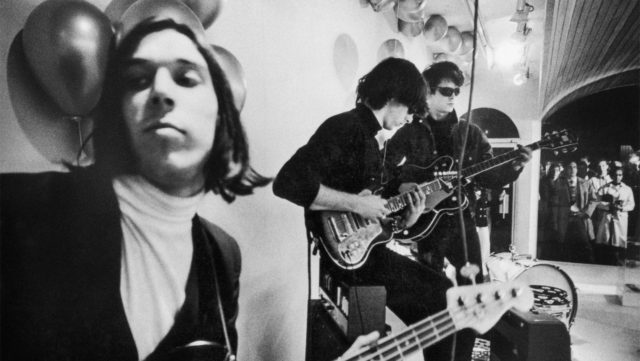
Who:Bob Dylan What: Prerecorded streaming concert film Where:veeps When: Available on demand through July 25 at 11:59 pm Why: “What was it you wanted / Tell me again so I’ll know / What’s happening in there / What’s going on in your show / What was it you wanted / Could you say it again / I’ll be back in a minute / You can tell me then,” Bob Dylan sings on “What Was It You Wanted,” one of thirteen tunes that make up his first-ever livestreamed performance, the fifty-minute prerecorded concert film Shadow Kingdom: The Early Songs of Bob Dylan, available on the online veeps platform through July 25 at 11:59 pm. There was much speculation and little information in advance as to what the stream would be, although a brief trailer gave a hint of what to expect, a clip of Dylan playing a rollicking blues version of 1971’s “Watching the River Flow” in a smoky speakeasy, filmed in black-and-white.
For decades of the Never Ending Tour, fans have learned to have no expectations when seeing Bob live; he’ll play whatever he wants, continually reinventing tracks from his extensive catalog in fascinating ways, often almost to the point of unrecognizability, but that’s all part of the excitement. The veeps chat lit up with naysayers, complaining that the show was not actually live, with a handful arguing that Dylan wasn’t even really singing, that he and his band — who were wearing masks even though the crowd, which included a number of smokers in the small, claustrophobic space, was not — were lip syncing and miming with their instruments. Some of the grumblers demanded their money back, whereas other Dylanheads declared it was the best twenty-five bucks they’d spent since music venues were shuttered back in March 2020.
The closing credits say Bob was accompanied by Janie Cowen on upright bass, Joshua Crumbly on electric bass, Shahzad Ismaily on keyboards and accordion, and Buck Meek on guitar — many in the chat wondered where regular bassist Tony Garnier and guitarist Charlie Sexton were — but online hypotheses are making the case that not only are they not actually playing the music, but it was prerecorded by a different group of musicians. What’s the truth? We’re certainly not going to get it from Dylan, who filled his must-read memoir with falsehoods that we ate up despite knowing that.
Some chatters were mad that the show was not in color; others were furious about the cigarettes, as if the smoke were coming through their screens; while others were more interested in the wedding ring Dylan was suddenly wearing. Far, far more fans were overjoyed to see Bob with a guitar in his hands — arthritis has prevented him from picking up a six-string for a bunch of years, concentrating instead on piano — and sounding better than he has in a long time, his voice clearly rested from a year and a half off the road. (But was he really singing or playing the guitar and harmonica?) The best way to experience the show is to forget about all that and just sit back and watch the music flow, like you were hanging out in Greenwich Village in the 1960s. (Unfortunately, the chat was only available during the initial stream, so when you watch it, you’ll have “to be alone with” Bob, not interacting with a rabid online audience.)
Dylan reached relatively deep into his past, pulling out new versions of such favorites as “When I Paint My Masterpiece” (masterful!), “Queen Jane Approximately” (majestic!), and “Forever Young” (eternal!) alongside such less-familiar cuts as “To Be Alone with You” from Nashville Skyline, “The Wicked Messenger” from John Wesley Harding, and “Pledging My Time” from Blonde on Blonde. Some of the tunes hadn’t been performed live in more than ten years; “What Was It You Wanted” last made a setlist in 1995.
Dylan began toying with the lyrics right from the opening number, as if adapting them to the pandemic, changing “Gotta hurry on back to my hotel room / Where I got me a date with a pretty little girl from Greece [also sung as “Botticelli’s niece”] / She promised she’d be right there with me / When I paint my masterpiece” to “Gotta hurry on back to my hotel room / Gonna wash my clothes, scrape off all of the weeds / Gonna lock the doors and turn my back on the world for a while / I’ll stay right there till I paint my masterpiece.” A few songs later, he changed “To be alone with you / Just you and me / Now won’t you tell me true / Ain’t that the way it oughta be? / To hold each other tight / The whole night through / Ev’rything is always right / When I’m alone with you” to “To be alone with you / Just you and I / Under the moon / ’Neath the star-spangled sky / I know you’re alive / And I am too / My one desire / Is to be alone with you.”
Bob Dylan is in great form in first online concert film, performing in a dark, smoky room
As at his live shows, the Bobster — who turned eighty this past May, when the film was shot in a fictional Santa Monica nightclub over a seven-day period (not, as mentioned in the credits, at the nonexistent Bon Bon Club in Marseille) — does not talk to the audience; he doesn’t introduce songs or include any concert patter. When I saw him at the Prospect Park Bandshell in 2008, the crowd nearly flipped out when he said he was glad to be back in Brooklyn, surprising us that he knew where he was. My only quibble with the stream is that the name of each song appears onscreen in big, bold letters before it is played; much of the fun at Dylan shows is trying to figure out what the next song is as it starts. I’ll never forget my best friend asking me at a 1978 concert on the Street Legal tour, “When is he going to play ‘Tangled Up in Blue’?” I had to tell him that Bob had just played it.
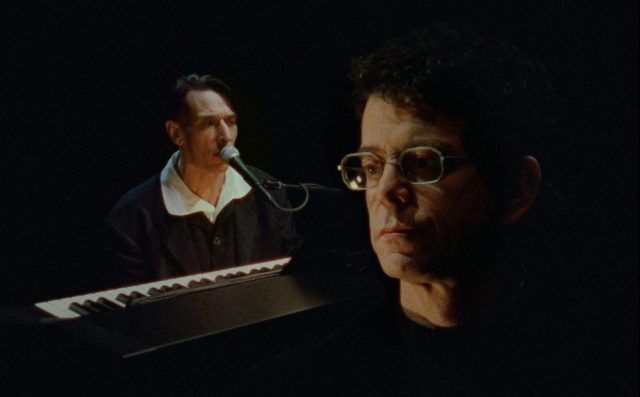
Each song in Shadow Kingdom is its own set piece, with Dylan in a different position on the stage, wearing one of several outfits. Regardless of where he is sitting or standing, the old-fashioned microphone blocks most of his mouth, furthering the chat conspiracy theory that he is lip syncing. It also prevents us from getting a better view of his extraordinary vocal phrasing, a technique that for him only improves with age, whether on his originals or standards; Dylan can shape a word like nobody else. He never moves around much during songs, but he does show off a few teeny gestures in “Queen Jane Approximately” and “Most Likely You Go Your Way,” (barely) swaying his shoulders and legs (his feet appear to be nearly glued to the floor) while making fists, pointing, and raising his arms a bit. (That’s probably not part of Dom McDougal’s choreography.) The close-knit, intimate production design is by Hannah Hurley-Espinoza and Ariel Vida, with cinematography by Lol Crawley, whose camera remains still when it is on Dylan but does occasionally pan through the band and the crowd. (By the way, just who are those people who got into the show?)
Bob Dylan is as much of a mystery as ever in streaming, limited-run concert film
The name of the show might have come from Robert E. Howard’s 1929 short story, “The Shadow Kingdom,” in which the Texas-born pulp fiction writer and Conan the Barbarian creator explains, “As he sat upon his throne in the Hall of Society and gazed upon the courtiers, the ladies, the lords, the statesmen, he seemed to see their faces as things of illusion, things unreal, existent only as shadows and mockeries of substance. Always he had seen their faces as masks, but before he had looked on them with contemptuous tolerance, thinking to see beneath the masks shallow, puny souls, avaricious, lustful, deceitful; now there was a grim undertone, a sinister meaning, a vague horror that lurked beneath the smooth masks. While he exchanged courtesies with some nobleman or councilor he seemed to see the smiling face fade like smoke and the frightful jaws of a serpent gaping there. How many of those he looked upon were horrid, inhuman monsters, plotting his death, beneath the smooth mesmeric illusion of a human face? Valusia — land of dreams and nightmares — a kingdom of the shadows, ruled by phantoms who glided back and forth behind the painted curtains, mocking the futile king who sat upon the throne — himself a shadow.” More clues from Dylan, perhaps, or yet another red herring? Does it matter?
Directed, produced, and edited by Alma Har’el, an Israeli American music video and film director who has worked with such bands as Beirut, Sigur Rós, and Balkan Beat Box and has made such films as Honey Boy,Bombay Beach, and LoveTrue, the presentation, too short at less than an hour, marvelously captures the mysterious enigma that is Robert Allen Zimmerman, the Minnesota-born folk-rock troubadour who has changed the planet with his music, reinventing himself umpteen times over his more than six-decade-long career. During the coronavirus crisis, he released the outstanding album Rough and Ready Ways, and he has now entered the streaming realm. What’s next? I certainly am not going to hold my breath waiting for a live Zoom concert or interactive Instagram talkback, but will there be a Shadow Kingdom: The Later Songs of Bob Dylan? Will the show ever be available again, on CD, LP, DVD, Spotify, etc.? Will the Never Ending Tour reemerge, after having not been seen since December 8, 2019? It’s Dylan, so it’s best not to expect anything — except something strange, something unusual, something wonderful. Whichever way he is likely to go, we worshippers are sure to follow.
Abridged online version of A Gentleman’s Guide to Love and Murder benefits Stop AAPI Hate
Who: Lea Salonga, Ali Ewoldt, Diana Phelan, Thom Sesma, Cindy Cheung, Karl Josef Co What: All-Asian-American abridged online version of A Gentleman’s Guide to Love and Murder Where:Broadway on Demand When: July 15-22, pay-what-you-wish (suggested donation $20.14 – $1,000) Why: On May 19, the National Asian American Theatre Company held a one-time-only virtual benefit reading of Thornton Wilder’s Our Town, featuring an all-Asian-American cast. Now CollaborAzian and Broadway on Demand are teaming up for an online version of Robert L. Freedman and Steven Lutvak’s A Gentleman’s Guide to Love and Murder that will benefit Stop AAPI Hate, which “tracks and responds to incidents of hate, violence, harassment, discrimination, shunning, and child bullying against Asian Americans and Pacific Islanders in the United States.” An abridged adaptation of the Broadway musical that was nominated for ten Tonys, winning three (Best Musical, Best Book of a Musical, and Best Direction of a Musical), the show will be available July 15-22. The story, based on the 1907 novel Israel Rank: The Autobiography of a Criminal by Roy Horniman and the 1949 British film Kind Hearts and Coronets, follows the exploits of a man ninth in the line of succession to his family’s dukedom who decides to get rid of the eight people above him and grab the crown for himself as revenge for how his mother was treated by them. Thom Sesma plays the endangered members of the D’Ysquith clan, with Cindy Cheung as Ms. Shingle and others, Ali Ewoldt as Phoebe D’Ysquith, producer Karl Josef Co as Monty Navarro, and producer Diane Phelan as Sibella Hallward; hosted by Tony winner Lea Salonga, the presentation is directed by Alan Muraoka, who has played Alan, the owner of Hooper’s Store on Sesame Street, for more than two decades, with music direction by Steven Cuevas, costumes by Carla Posada, props by Alesha Borbo Kilayko, and audio engineering by Jonathan Cuevas.
“Historically, Asian American artists have been marginalized in media and on stage, and productions like this help to spotlight the tremendous talent that has been overlooked. We’re here to show the world that we are here, and we are fantastic,” Salonga said in a statement. The event is being held in conjunction with the Coalition of Asian Pacifics in Entertainment, the Broadway Diversity Project, Unapologetically Asian, Leviathan Labs, Chinosity, and Tremendous Communications.
Developed during the pandemic, the curatorial platform four/four presents continues its monthly site-specific “Open Air” performance series with a new piece about mourning, healing, rebirth, and renewal, taking place July 14-15 in Green-Wood Cemetery in Brooklyn. Founded by dancer and choreographer Loni Landon and producer Rachael Pazdan, four/four has brought us “Tethered,” a ten-part multidisciplinary video project featuring collaborations with Kassa Overall, slowdanger, Gus Solomons, Zoey Anderson, Rafiq Bhatia, Ian Chang, Jacqueline Green, Jon Batiste, Lloyd Knight, and many others, which can be watched here.
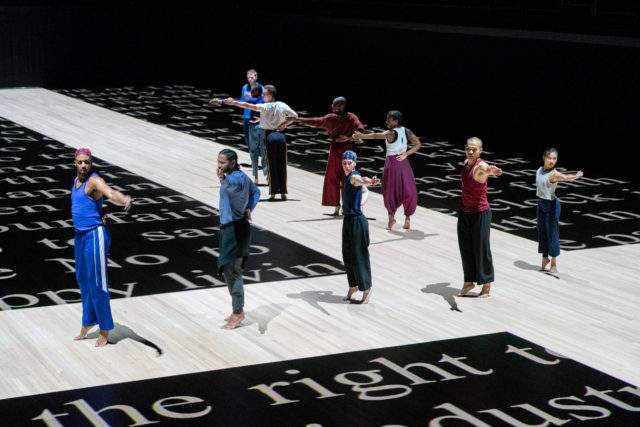
For Green-Wood, Landon has choreographed a work for seven dancers, with live music by experimental harpist Mary Lattimore, performed in Cedar Dell, the one-acre bowl-shaped natural amphitheater with graves dating back to the eighteenth century. The evening will conclude with a participatory meditative sound bath. “Open Air” began June 9 with Madison McFerrin, Samantha Figgins, and Jessica Pinkett teaming up at the Jackie Robinson Park Bandshell; up next are Melanie Charles and Kayla Farrish at the Bushwick Playground Basketball Court on August 8, followed by Moor Mother and Rena Butler at Brooklyn Bridge Park’s Pier 1 on September 21.
Pioneers Go East Collective’s Lucky Star (0.3) takes place at Judson Memorial Church July 13-30
LUCKY STAR (0.3)
Judson Memorial Church
55 Washington Square South between Thompson & Sullivan Sts.
Tuesdays, Thursdays, and Fridays, July 13-30, free with RSVP, 8:00 www.judson.org pioneersgoeast.org
Pioneers Go East Collective honors the history of DIY queer artmaking at such famed New York City venues as La MaMa, Judson Memorial Church, and the Pyramid Club in Lucky Star (0.3), a free multidisciplinary performance installation taking place Tuesdays, Thursdays, and Fridays at 8:00 at Judson from July 13 to 30. Inspired by Club 57, which was recently highlighted in the documentary Kenny Scharf: When Worlds Collide, the in-person work consists of five episodes featuring dance/performance artists Shaina and Bryan Baira, Bree Breeden, Daniel Diaz, Beth Graczyk, and Joey Kipp and nightlife icon Agosto Machado. Lucky Star (0.3) was written by creative director Gian Marco Riccardo Lo Forte and production designer Philip Treviño, with choreography by Ori Flomin, film by Jon Burklund and video designer Kathleen Kelley, set design and fabrication by Mark Tambella, and sound by Marielle Iljazoski and Ryan William Downey.
“Lucky Star was born by a desire to make art in a new time,” the collective said in a statement. “We pay homage to creators and legends whose trailblazing work has solidified ways for us to survive as artists reimagining our approach to sharing our work in the age of social media and instant gratification. We term the project a meta-creative journey inviting viewers to engage in an emergent process of collective liberation.” Inspired by Walt Whitman’s poem “Pioneers, O Pioneers!” (“O you youths, Western youths, / So impatient, full of action, full of manly pride and friendship, / Plain I see you Western youths, see you tramping with the foremost, / Pioneers! O pioneers!”), Pioneers Go East Collective was founded in 2010 to “empower a collective of thought-provoking, adventurous, and proud LGBTQ artists . . . dedicated to Latinx, BIPOC, and immigrant artists and teaching artists and their communities in all five boroughs, [exploring] stories of vulnerability and courage for social change.” Admission to Lucky Star (0.3) is free with advance RSVP.
Who:John Schaefer,Michael Harrison, W. H. S. Gebel, Ashley Bathgate, Tim Fain What: Online album release party and discussion Where:Arts Letters & Numbers YouTube When: Wednesday, June 30, free with RSVP, 7:00 Why: “I wanted to show how beautiful simple harmonies can be, especially in just intonation . . . and [to create a work] that would serve as an introduction inviting listeners and musicians to start perceiving just intonation as an infinite harmonic system encompassing limitless possibilities on a spectrum between simplicity and complexity,” contemporary classical composer and pianist Michael Harrison says about his new album, Seven Sacred Names (Cantaloupe Music, June 2021). On June 30 at 7:00, Harrison, a Guggenheim Fellow, will celebrate the album’s release with an online party and discussion featuring cellist Ashley Bathgate and violinist Tim Fain, who both play on the record, and author, astrophysicist, and modern Sufi mystic W. H. S. Gebel, who wrote the liner notes and whose book Nature’s Hidden Dimension: Envisioning the Inner Life of the Universe served as inspiration to Harrison. Seven Sacred Names is a song cycle consisting of seven compositions and a reprise about “an awakening primal Self,” according to Gebel; the songs include “”Hayy: Revealing the Tones,” “Alim: Polyphonic Raga Malkauns,” “Qadr: Etude in Raga Bhimpalasi,” and “Sami: The Acoustic Constellation,” with such guests as Roomful of Teeth, Ina Filip, violist Caleb Burhans, tabla percussionist Ritvik Yaparpalvi, and composer/dhrupad/vocalist Payton MacDonald.
Harrison writes about one of the songs, “‘Al Mureed’ is the fourth of the seven names and signifies the birth of desire, the motivation needed to direct the will which awakens as a response to the dawning of relationship. The created world has become more interesting because now there is love, lover, and beloved; there is the possibility of relationship and of learning about and understanding the divine qualities as they manifest by sensing their vibration.” The event, which is presented by Arts Letters & Numbers as part of the “SunShip: The Arc That Makes the Flood Possible” exhibition for the CITYX Venice Italian Virtual Pavilion at the seventeenth Venice Architecture Biennale and is free with advance RSVP, will be hosted by John Schaefer of WNYC’s New Sounds.
The collaborative Harlem Air Shaft features art, dance, music, spoken word, and activism
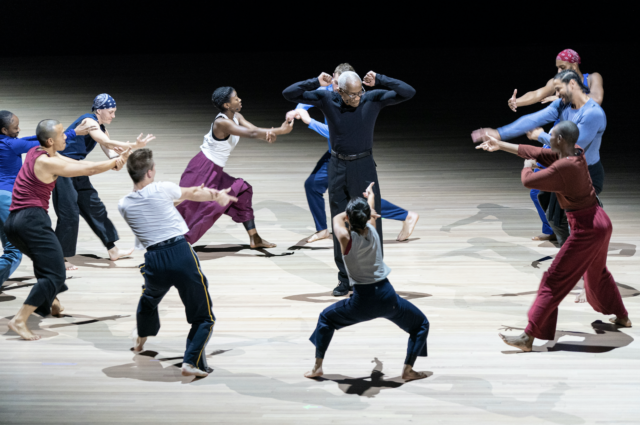
Who: James Brandon Lewis, Thomas Sayers Ellis, Kwami Coleman, Todd Bryant Weeks, Bianca Cosentino, Dolores Sanchez, Emily Tellier, Omari Wiles What:Experimental multidisciplinary street performance ritual exploring links between jazz and memory in Harlem Where: 126th & 125th Sts. between Fifth & Madison Aves. When: Thursday, June 24, free, 5:00 Why: Conceived by new media artist Justin Randolph Thompson, choreographer Stefanie Nelson, and visual artist Bradly Dever Treadaway, Harlem Air Shaft takes place on June 24 at 5:00, a forty-minute live performance that recalls the rent parties of the 1930s and 1940s. Melding jazz and memory through ritual, the improvisatory, immersive piece features dancers Bianca Cosentino, Dolores Sanchez, Emily Tellier, and Omari Wiles, saxophonist James Brandon Lewis, poet Thomas Sayers Ellis, musicologist Kwami Coleman, and jazz union representative Todd Bryant Weeks, paying tribute to the community and local jazz history, including Duke Ellington (whose 1940 composition lends its name to the work), in the neighborhood where Art Kane took his famous “A Great Day in Harlem” photo.
“With Harlem Air Shaft, I continue the work that started with Friskin’ the Whiskers – a performance project I initiated in 2014 which focuses on bringing together people connected to the jazz community to highlight the economic realities in which jazz musicians have to function,” Thompson said in a statement. “Jazz and economy have a long and complicated history where strategies for developing new systems of community support have always been prevalent. The pandemic made evident to all what many of us already knew. To me, the various forms of cultural production as represented by practitioners from different fields in this piece speaks to the constant need for reminding ourselves about art’s inherent social dimension.” Nelson added, “I have a longstanding interest in the fleeting nature of memory, which I have been exploring in numerous projects with my dance ensemble. Justin, who has been my collaborator over the years, gave me an idea of presenting this concept in the context of jazz and the history of this unique neighborhood. We would like for this piece to inspire the memory of Harlem’s resilient past for a more hopeful, community-driven, creative future.” Admission is free, with no RSVP required.