this week in music

TOMÁS SARACENO: PARTICULAR MATTER(S) / SILENT AUTUMN

Spiders and their webs are at the center of Tomás Saraceno’s immersive, multimedia exhibitions at the Shed and Tanya Bonakdar Gallery (photo by twi-ny/mdr)

TOMÁS SARACENO: PARTICULAR MATTER(S)
The Shed
545 West 30th St. at Eleventh Ave.
Tuesday – Sunday through April 17
Upper level + gallery: $42; lower level + gallery: $35; gallery exhibition only: $12
646-455-3494
theshed.org
studiotomassaraceno.org

The integration of art, technology, nature, and the environment is central to Argentina-born artist Tomás Saraceno’s discipline, currently on display in a pair of complex immersive exhibitions in the city. In “Silent Autumn” at Tanya Bonakdar in Chelsea and “Particular Matter(s)” at the Shed in Hudson Yards, Saraceno investigates toxic air and water, the reuse of plastic bags, rampant consumerism, and, most of all, spiders though collaborations with MIT and NASA, among others, attempting to find ways to fix a broken planet in this out-of-control Capitalocene era.

In a 2014 lecture he gave at MIT, Saraceno discussed the “sociability” of spiders. “It’s very similar to humans,” he said. “Spiders are social because they have enough space and food. But if you put a lot of social spiders in a very tiny space, they are not social. They eat each other. They’re pretty much like humans. There are forty-three thousand species of spider and only twenty are social. Knowing that sociability is a big trend for the survival of the planet, no one really understands this. What we do is try to make [the spiders] operate and work, one with the other, the solitary and the social.” It sounds all too close as humanity emerges from a global pandemic.

Continuing through April 17, “Particular Matter(s)” leads visitors on an audiovisual journey through the kingdom of the spiders. Webs of At-tent(s)ion consists of seven encased hybrid spider webs, hanging in midair and lit so it appears that they’re glowing in the dark. Each case is like its own universe, with different species of spider building on what others started, resulting in magical architectural structures made of spider silk and carbon fibers.

Radio Galena turns a crystal into a wireless radio receptor. Printed Matter(s) reproduces cosmic dust from 1982 in a series of ten photos printed using black carbon PM2.5 pollution extracted from the air in Mumbai; they are arranged loosely on a wall, as if they might blow away and break up into shreds, like the atmosphere being destroyed by pollution. Particular Matter(s) is a light beam that reveals how much dust is in the air that we breathe, poisoned by the burning of fossil fuels.

Arachnomancy features a deck of thirty-three tarot-like meteorological “oracle” cards, printed on carbon-footprint-neutral paper, spread out across a table, based on the beliefs of the spider diviners of Somié, Cameroon, who make cards out of leaves, forecasting weather events. The cards include images of maps, plants, human figures, and webs, with such titles as “Bad News,” “Planetary Drift,” “Invertebrate Rights,” “Entanglement,” and “Fortunate Webbing.” Dangling above the table is a web built by two Cyrtophora citricola spiders that looks like you could rip it apart with a soft breath.

Inspired by the writings of science journalist Harriet A. Washington, We Do Not All Breathe the Same Air uses black carbon, soot, and PM2.5 and PM10 to reveal how pollution impacts air quality in different parts of the country, adversely affecting BIPOC and poorer areas. A red sliding sheet laser brings spider webs to life in a long horizontal window in How to entangle the universe in a spider/web,? which resembles a trip through the human circulatory system or into a far-off galaxy. The concept of spider ballooning and visitors’ movement combine to create music in Sounding the Air, an installation in which five threads of spider silk form an aeolian instrument that emits sonic frequencies when it encounters heat, wind, body movement, and other elements.

A Thermodynamic Imaginary is a room filled with many wonders of Saraceno’s oeuvre, a fantasy world comprising sculpture, projected video (Tata Inti and Living at the bottom of the ocean of air), shadows, reflections, large bubbles, and more, like its own galaxy in what the artist calls the Aerocene: “a stateless state, both tethered and free floating; a community, an open source initiative; a name for change, and an era to live and breathe in.”

On the fourth floor, you have to remove your shoes to walk into Museo Aero Solar, devised by Saraceno and Alberto Pesavento in 2007, an ecological balloon composed of plastic bags sewn together, their brands and trademarks visible, seeking to eventually eliminate the use of fossil fuels by providing sustainable, free-floating options. The gallery also includes documentation of the project and such items as an Aerocene Backpack and flight starter kits.

The centerpiece of “Particular Matter(s)” is Free the Air: How to hear the universe in a spider/web, a live eight-minute concert held in an almost blindingly white two-level, ninety-five-foot diameter floating sculpture, commissioned by the Shed for this exhibition. The limited audience gets misted as they enter the foggy space, which contains 450,000 cubic feet of air and features a large-scale net made of steel and thick wire that evokes a giant spider web on which people lie down; it’s a rather tenuous trampoline with gaps in it, so if you jump, it will affect not only your balance but others’ as well, so don’t play around too much. If you’re on the lower level, you can look up to see the people above you, almost walking on air.

Darkness ensues and the concert in four movements begins, prerecorded sound waves and vibrations of spiders interacting with their webs that are impacted by the audience’s presence, incorporating Sounding the Air, Webs of At-tent(s)ion, and other items in “Particular Matter(s).” It’s a welcoming atmosphere of interspecies communion and coexistence that plots a course for ways to save our increasingly fragile planet using our innate spider-sense and expanding our idea of what home is.

Advance tickets are necessary for the special experience and sell out quickly, so act fast. As part of the Shed program “Matter(s) for Conversation and Action,” on March 30 at 6:00 there will be a free Zoom panel discussion, “Invention, Experimentation, and Radical Imagination,” with MIT professor Caroline A. Jones, climate scientist Dr. Kate Marvel, and Vassar professor Molly Nesbit, moderated by designer, teacher, and entrepreneur Sandra Goldmark, followed on April 13 at noon by “Rights of Nature, Activism, and Change” with lawyer Alicia Chalabe, Dartmouth professor N. Bruce Duthu, and sociologist and writer Maristella Svampa, moderated by Columbia Law School professor Michael B. Gerrard.

Tomás Saraceno gallery show at Tanya Bonakdar complements Shed exhibition (photo courtesy Tanya Bonakdar Gallery)

TOMÁS SARACENO: SILENT AUTUMN
Tanya Bonakdar Gallery
521 West 21st St. between Tenth & Eleventh Aves.
Tuesday – Saturday through March 26, free, 10:00 am – 6:00 pm
www.tanyabonakdargallery.com

In conjunction with the Shed show, Tanya Bonakdar is presenting “Silent Autumn” through March 26. The title plays off Rachel Carson’s seminal 1962 book, Silent Spring, a “fable for tomorrow” that called for the elimination of such chemicals as DDT in order to maintain a living, breathing Earth. The exhibit begins with An Open Letter for Invertebrate Rights, in which Spider/Webs explain, “Do not be afraid. Let us move from arachnophobia to arachnophilia by sensing new threads of connectivity, or else face the eternal silence of extinction.”

Visitors must put booties over their shoes in order to enter Algo-r(h)i(y)thms, a musical instrument comprising a vast network of webs, the strings of which make warming sounds when plucked. You can either create your own solo or work in tandem with others for a more ornate score. Surrounding the instrument are Arachne’s handwoven Spider/Web Map of Andrómeda, with a duet of Nephila inaurata — four weeks and ensemble of Cyrtophora citricola — three weeks and Cosmic Filaments, intricate black-and-white architectural drawings of web universes.

The title diptychs (and one triptych) pair framed leaves glued to inkjet paper next to framed photographs of the leaves; the two works initially look identical, but over time the real leaves will fade and disintegrate while the picture endures. Silent Spring comprises four panels of pressed poppy flowers from contaminated soil near Saraceno’s Berlin-Rummelsburg studio, with shutters that protect them from the sun, although they too will fade; the dirt was polluted by a photographic film and dye manufacturer, so the piece is very much part of Saraceno’s personalized mission of recycling and sustainability.

In the same room, three stainless-steel and wood sculptures hang from the ceiling at different heights, evoking the much larger structures Saraceno installed on the Met roof for “Cloud City” in 2012 as well as the Silent Autumn framed leaves. In a smaller room, the blown glass pieces Pneuma, Aeolus, Aeroscale, and Aerosolar Serpens probe breathing, physical presence, and the brittleness of existence. Other works continue Saraceno’s exploration of overconsumption, pollution, climate change, and the future of life on the planet — and throughout the universe.

Saraceno is a genius at bringing us into his world by creating fascinating objects that are ravishing to look at, then hitting us with the heavily researched science behind it all as he attempts to save the world. But he can only do it with our help.

COAL COUNTRY

The characters of Coal Country listen to Steve Earle sing about a horrific mining disaster (photo by Joan Marcus)

COAL COUNTRY
Cherry Lane Mainstage Theatre
38 Commerce St.
Tuesday – Sunday through April 17, $39-$77
212-989-2020
www.cherrylanetheatre.org
coalcountrymusical.com

Coal Country is a damning portrait of much that’s wrong in America today, a tale of corporate greed, corruption, union busting, an unequal justice system, and a lack of compassion for one’s fellow human beings. And it’s all true.

On April 5, 2010, more than two dozen men died in the Upper Big Branch Mine disaster in Raleigh County, West Virginia. Jessica Blank and Erik Jensen’s documentary play is set at the end of the trial of Massey Energy CEO Don Blankenship, who ran the mine. The action begins as Judge Berger (Kym Gomes) has opened the floor for relatives and colleagues to share their stories of what happened before, during, and after the horrific event, the worst mining disaster in the United States in forty years. The audience serves as a kind of jury as the characters speak verbatim dialogue, word for word what the real men and women of Raleigh County said.

Patti Stover (Mary Bacon) talks about her chance at second love with Gregory Steven Brock, who went to the mine that day even though he wasn’t feeling well because he couldn’t afford to take time off. Tommy Davis (Michael Laurence) worked in the mines with his brother Timmy and nephews Cory and Josh; like many people who lived in the company town, mining went back generations.

Roosevelt Lynch Jr. (Ezra Knight) would pass by his father every morning, one having just finished a shift, the other about to start one. Dr. Judy Petersen’s (Deirdre Madigan) brother Dean did everything with his twin brother, Gene, but shortly after they both began in the mine, Gene quit while Dean stayed on.

Gary Quarles (Thomas Kopache) shares the story of his son in Coal Country (photo by Joan Marcus)

Gary Quarles’s (Thomas Kopache) son was tired of working off the dangerous longwall. “I’d say Massey ran outlaw from the day Blankenship brought ’em in,” Gary says about the hiring of nonunion employees. “We always said that Massey Energy was his third world country, and Don was the dictator.”

The de-facto leader of the group is Stanley Stewart, known as Goose (Carl Palmer), a third-generation miner whose grandfather was killed on the job. Goose told his wife, Mindi (Amelia Campbell), about how he could see trouble was brewing because of how the new ownership was dealing with basic health and safety issues. “My first twenty years was union. This was the strongest union place in the world before Massey came in,” Goose says. Gary adds, “And I’ll tell you what, you didn’t worry ’bout gettin’ fired by speakin’ up.”

Throughout the play, Grammy-winning folk-country-rock troubadour and activist Steve Earle plays related songs from his chair in the front right corner of the stage, switching between acoustic guitar and banjo. He sometimes gets up and joins the cast, who occasionally sing lines and choruses with him. Earle’s score ranges from the traditional folk song “John Henry,” about an African American “steel drivin’ man” battling a steam drill in the Big Bend Tunnel in West Virginia in the nineteenth century, to “Heaven Ain’t Goin Nowhere,” “The Devil Put the Coal in the Ground,” and “It’s About Blood.”

In “Union, God, and Country,” Earle asks the audience to sing along to these key lines: “Union, god, and country / West Virginia gold and blue / Union, god, and country / was all we ever knew.” Earle also performs his 2013 bluegrass song “The Mountain,” in which he explains, “I was born on this mountain / This mountain’s my home / And she holds me and keeps me from worry and woe / Well, they took everything that she gave / Now they’re gone / But I’ll die on this mountain / This mountain’s my home.” I’ve seen Earle numerous times over the years, from the Ritz and the Bottom Line to the Blue Note, the Lone Star Roadhouse, and Judson Church, and he is an inspired choice for Coal Country; he also served as composer and onstage narrator in Richard Maxwell’s existential Western Samara for Soho Rep. in 2017. On April 5, 2020, Earle played the songs of Coal Country in a free Facebook Live concert and has recorded them for the album Ghosts of West Virginia. (Wednesday night shows will be followed by a discussion with Earle on March 16 and 30 and Blank and members of the cast on March 23 and April 6.)

Dr. Judy Petersen (Deirdre Madigan) and Mindi Stewart (Amelia Campbell) wait for word of their relatives in Coal Country (photo by Joan Marcus)

An Audible production that had to cut short its premiere run at the Public in March 2020 because of the pandemic lockdown, the ninety-minute Coal Country has made a successful transition to the Cherry Lane. Richard Hoover’s wood-based set at times places the audience inside the mine, with David Lander’s lighting signaling trouble behind the slats of broken wood in the back. Movement director Adesola Osakalumi guides the actors on- and offstage as they rearrange various benches, providing much-needed breaks between emotional moments.

Married partners Blank and Jensen previously collaborated on such projects as The Exonerated, in which an ensemble reads the words of innocent men and women on death row, and The Line, a virtual Public Theater presentation from July 2020 in which an all-star cast told the verbatim stories of health-care workers and first responders in the early days of the Covid-19 crisis.

In Coal Country, Blank and Jensen do a magnificent job of integrating the individual stories, weaving them together to form a compelling narrative that will have you at the edge of your seat, even if you know exactly what happened. The scenes in which the characters are waiting on news of the fate of their loved ones are unforgettable, especially seen now, after two years of a global health crisis that has killed nearly a million Americans, many of whom died alone, their relatives forbidden to be with them. It’s a uniquely American tale, one that comes amid extreme partisanship, polarization, and divisiveness, but it doesn’t matter where you fall on the political spectrum to be deeply moved and infuriated by its overarching message.

As Earle sings, “It’s about fathers / It’s about sons / It’s about lovers / Wakin’ up in the middle of the night alone / It’s about muscle / It’s about bone / It’s about a river running thicker than water ’cause / It’s about blood.”

UPLOAD

UPLOAD
Park Ave. Armory, Wade Thompson Drill Hall
643 Park Ave. at Sixty-Seventh St.
March 22-30, $45-$150, 7:30 / 8:00
www.armoryonpark.org
www.vanderaa.net

Dutch composer Michel van der Aa returns to Park Ave. Armory this month with the North American premiere of Upload, a multimedia opera running March 22-30 in the Wade Thompson Drill Hall. The hybrid work uses film and motion capture technology to tell the story of a father and daughter seeking digital consciousness, an exciting follow-up to Rashaad Newsome’s recently concluded Assembly installation at the armory, which was hosted by the AI known as Being the Digital Griot.

Previously presented at the Dutch National Opera and the Bregenz Festival in Austria, the eighty-five-minute Upload features soprano Julia Bullock as the daughter and baritone Roderick Williams as the father in person, with Katja Herbers as a psychiatrist and Ashley Zukerman as a CEO in prerecorded flashbacks shot by cinematographer Joost Rietdijk. The score is performed by the Cologne-based Ensemble Musikfabrik under the direction of Otto Tausk; the set and lighting are by Theun Mosk, with motion capture and graphics by Darien Brito and special effects by Julius Horsthuis.

Composer, director, and librettist van der Aa was last at the armory with 2017’s Blank Out, in which Williams appeared onscreen in a story loosely based on the life and career of bilingual South African poet Ingrid Jonker. “Park Ave. Armory is one of my favorite performance spaces in the world,” van der Aa said in a statement. “When it presented Blank Out, I was inspired by the response from the armory’s open-minded and diverse audiences. Upload was developed with the Armory in mind.” There will be an artist talk with van der Aa, moderated by performance artist Marina Abramović, on March 22 at 6:00 ($15).

WAVES ACROSS TIME: TRADITIONAL DANCE AND MUSIC OF OKINAWA

“Waves Across Time: Traditional Dance and Music of Okinawa” comes to Japan Society March 18-19 (photo © Yohei Oshiro)

Who: Okinawan dancers and musicians
What: Performance honoring the golden anniversary of Okinawa being returned to Japan following US WWII occupation
Where: Japan Society, 333 East 47th St. at First Ave.
When: Friday, March 18, and Saturday, March 19, $42, 7:30
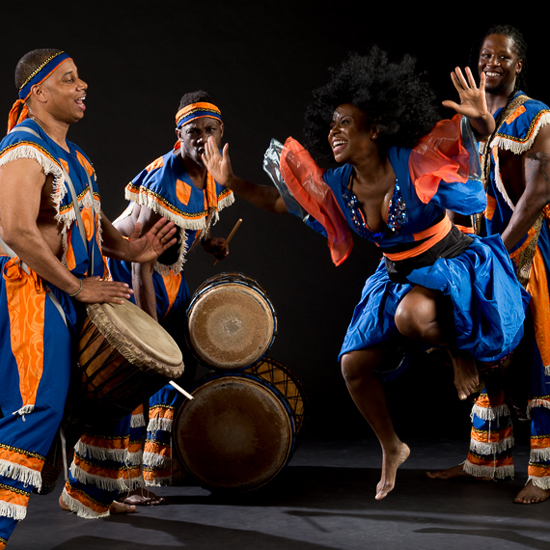
Why: On June 17, 1971, the last of the Ryukyu Islands was returned to Japanese control. “Waves Across Time: Traditional Dance and Music of Okinawa” is touring the United States, paying tribute to the fiftieth anniversary of that event with an evening of traditional music and dance that comes to Japan Society on March 18 and 19. Michihiko Kakazu, the artistic director of the National Theatre Okinawa, has curated a diverse program that includes several types of traditional storytelling featuring a select group of performers wearing lavish, colorful bingata costumes, created using a unique Okinawan dyeing process.

“Waves Across Time” begins with excerpts from the noh-inspired kumiodori masterpiece Manzai Techiuchi; “Sakamoto-bushi” features two women using castanets called yotsudake, followed by a dance between brothers disguised as buskers, and concluding with “Shinobi no ba,” a secret rendezvous that includes solos for the thirteen-stringed koto and the fue. The program continues with several zo odori works, folk dances that originated in the nineteenth century and grew in popularity in the late 1920s after the Meiji era, consisting of solos, duets, and ensemble pieces about traditional village life (Murasakae), true love, and martial arts. The music will be performed live on the snakeskin-covered three-stringed sanshin and other traditional instruments. Each performance will be preceded by a lecture on Okinawa by ethnomusicologist Dr. James Rhys Edwards at 6:30; Japan Society will also host the workshop “Introduction to Okinawan Dance,” led by Kakazu and members of the troupe, on March 19 at 11:00 ($50) and “Okinawan Dance Workshop for Families” on March 20 at 10:30 ($40 per family).

SERGEY ANTONOV, CELLO, AND NARGIZ ALIYAROVA, PIANO, AT CARNEGIE HALL

Pianist Nargiz Aliyarova and cellist Sergey Antonov will perform an all-Chopin concert at Carnegie Hall on March 15

Who: Nargiz Aliyarova, Sergey Antonov
What: Benefit concert of Chopin music
Where: Carnegie Hall, Weill Recital Hall, 881 Seventh Ave. at West 57th St.
When: Tuesday, March 15, $30-$60, 8:00
Why: “I am so excited,” New York–based Azerbaijani pianist Nargiz Aliyarova told me recently about making her Carnegie Hall debut. “Any musician in the world would be happy to be on this stage!” Aliyarova, who is also a professor with a doctorate in art, will be joined by US-based cellist Sergey Antonov in a special all-Chopin program at Weill Recital Hall on March 15. The concert is being presented by the National Music & Global Culture Society, a nonprofit organization founded by Aliyarova “to unite our multicultural community through the advocacy of music from around the world,” focusing on providing lessons to disadvantaged youth, hosting contests and festivals, and publishing a quarterly online magazine.

Aliyarova, who began giving recitals at the age of nine and was awarded a diploma “for outstanding contribution to the legacy of Frédéric Chopin” by the Polish government in 2010, has released three albums of works by Mozart, Beethoven, Haydn, and Chopin in addition to two CDs of Azerbaijani music, including compositions by Jovdet Hajiyev, Gara Garayev, Franghiz Alizadeh, Vagif Mustafazadeh, and Javanshit Guliyev. The Russian-born, Grammy-nominated Antonov, a gold medal winner at the XIII International Tchaikovsky Competition in Moscow in 2007, began playing the cello when he was five; he has released Elegy with pianist Ilya Kazantsev, Strauss & Rachmaninov: Sonatas for Cello & Piano, and an album of music by Robert Schumann. He is also a member of the Hermitage Piano Trio with Kazantsev and violinist Misha Keylin.

The Carnegie Hall program features an exciting mix of works by Chopin, the Polish Romantic composer and pianist who passed away in 1849 at the age of thirty-nine. Aliyarova and Antonov will be performing Polonaise Brillante for cello and piano Op. 3, Sonata for cello and piano Op. 65, Nocturne Op. post in C sharp Minor, Waltz Op. 34 N.2 in A minor, Waltz Op. 64 N.2 in C sharp Minor, Ballade in F minor, Op. 52, and the world premiere of Chopin and August Franchomme’s Grand Duo concertant in E major, B. 70, arranged for cello and piano by Lala Jafarova. Antonov and Aliyarova previously played together at the International Mugham Center in the Azerbaijani capital of Baku in September 2021, performing works by Chopin and Claude Debussy. The Carnegie Hall concert by these internationally renowned musicians is both a respite from the latest news and a reminder of how important it is “to unite our multicultural community through the advocacy of music from around the world.”

A BENEFIT FOR UKRAINE

Who: Eugene Hütz, Gogol Bordello, Craig Finn & Franz Nicolay, Jesse Malin, Lady Lamb, Marc Roberge, Matisyahu, Patti Smith, Stephin Merritt, Suzanne Vega, more
What: Benefit concert for Ukraine and the Come Back Alive Foundation
Where: City Winery on Mandolin
When: Thursday, March 10, $20, 8:00
Why: City Winery’s all-star benefit for Ukraine sold out almost instantly, but you can still catch it from the comfort of your own home while donating to help a sovereign nation deeply in need of support, with nearly two million refugees seeking new places to live. City Winery will be livestreaming the show, raising funds for Ukraine and the Come Back Alive Foundation, an organization, founded in 2014, that declares: “Ukraine is the Shield of Europe. We believe that a threat to freedom anywhere is a threat to freedom everywhere. We are here defending the values we share across Europe and the world. We are doing our best to make sure Putin’s values do not spread further, even beyond our borders. Our Army is strong and determined, but they are underequipped.”

For a mere twenty bucks, you can watch a parade of musicians take the stage at the Far West Side venue, hosted by Eugene Hütz and his band, Gogol Bordello; Hütz was born in Ukraine to a Russian father and a Ukrainian mother. “Ukraine belongs to Ukrainians! We are an ancient independent nation distinctly and forever different from this criminally insane neighbor,” Hütz said in a statement. “The proof you all see now in the fierce mind-blowing battle that the world is witnessing, a battle of Ukrainian people’s choice of freedom and democracy against a psychotic totalitarian regime next door. Please help us to win this battle, help us to end this catastrophe immediately and bring the intruder to justice. Please stand with Ukraine in the battle for its democracy and freedom. Please donate and fundraise with us. Ukraine needs all of you. All your support counts.”

The lineup, so far, includes Craig Finn and Franz Nicolay of the Hold Steady, Jesse Malin, Lady Lamb, Marc Roberge of O.A.R., Matisyahu, Patti Smith, Stephin Merritt of the Magnetic Fields, and Suzanne Vega. You can also join the waitlist to see the concert live and in person. Хай живе, вільна Україна!

WOMEN THAT ROCK: INTERNATIONAL WOMEN’S DAY

Who: Rozzi, Demi Ramos, Stalking Gia, Cloe Wilder, Ok Cowgirl, Scarlet Fiorella
What: Concert in honor of International Women’s Day
Where: Knitting Factory, 361 Metropolitan Ave.
When: Wednesday, March 9, $25, 8:00
Why: The theme of International Women’s Day 2022, taking place March 9, is #BreakTheBias, with a mission to: “Imagine a gender equal world. A world free of bias, stereotypes, and discrimination. A world that is diverse, equitable, and inclusive. A world where difference is valued and celebrated. Together we can forge women’s equality.” Women That Rock, which has been presenting femme-focused concerts since 2018, returns to the Knitting Factory in Brooklyn, the site of its inaugural show, on March 9 for a live event featuring performances by Rozzi, Demi Ramos, Stalking Gia, Cloe Wilder, Ok Cowgirl, and Scarlet Fiorella. WTR “seeks to lift up badass grrrls making waves in the music world and to foster a community of womxn supporting one another through music,” so expect a badass night.