Brooklyn-based multidisciplinary artist Tim Fite has completed his “Ain’t” trilogy, which began with 2005’s Gone Ain’t Gone and continued with 2008’s Fair Ain’t Fair, with the utterly delightful Ain’t Ain’t Ain’t (Anti-, March 6). “I’m a bully / A big badass bully / Do what I say / or get thrown the fuck out the way / I’m a big old bully,” Fite sings on “Bully,” but he’s nothing of the sort, as seen in the above short about his creative process. The visual artist and musician, who has also written storybooks and hosted the video series Gunshow!, goes back to his high school years on Ain’t Ain’t Ain’t , incorporating the ironic, acerbic wit of Randy Newman with the vocal phrasings of Craig Finn to create a mournful yet loving song cycle that deals with puppy love, the thrill of going joyriding, bullying, and other teenage jubilations and disasters, steeped in playful percussion and offbeat sounds. “Let’s live while we can / ’cause we may never be teenagers again,” he sings on “We Are All Teenagers.” Fite will be celebrating the release of Ain’t Ain’t Ain’t, which also includes such exquisitely arranged tracks as “Hold Me All Night,” “Telephone Booth,” and “Talking to the Air,” on March 8 at Union Hall in Brooklyn with the Woes.
this week in music
THINKSWISS: GENÈVE MEETS NEW YORK

Foofwa d’Imobilité will pay tribute to Pina Bausch, Merce Cunningham, and Michael Jackson as part of ThinkSwiss festival
A FESTIVAL OF GLOBAL IDEAS BORN IN GENEVA: JEAN CALVIN, JEAN-JACQUES ROUSSEAU, ALBERT GALLATIN, HENRY DUNANT
Multiple locations
March 6-12, free – $35
212-599-5700, ext 1061
www.thinkswissny.org
“The world of reality has its limits; the world of imagination is boundless,” Geneva philosopher Jean-Jacques Rousseau wrote nearly three centuries ago. The Social Contract author’s native country is celebrating the three hundredth anniversary of the master thinker’s birth with a series of events around the world, including this month’s ThinkSwiss Festival of Global Ideas Born in Geneva. Examining issues that impact both America and Switzerland, the week-long festival includes live music and dance, panel discussions, literary readings, film screenings, and art exhibits, most of which are free but require advance RSVP. Things get under way on March 6 ($10) with a screening of Swiss director Jacob Berger’s 2002 feature film Loving Father (Aime Ton Père) and his 2002 short I Think About Alain Tanner (Je pense à Alain Tanner) as part of FIAF’s weekly CinémaTuesdays series, with Berger on hand to participate in a Q&A at 7:00. On March 7, the American Red Cross will host “Can the Geneva Conventions Still Protect Civilians and Non-Combatants in Contemporary Warfare?” a roundtable with Philip Gourevitch, Colonel (ret.) Dick Jackson, Roger Mayou, and Gabor Rona, moderated by Walter A. Füllemann. On March 8, the exhibition “L’Esprit de Genève by Its Posters” will open at Posters Please, and the NYU Presidential Medal Ceremony will include a conversation between honoree Michel Butor and Lois Oppenheim examining “L’Esprit de Genève: From Albert Gallatin to Michel Butor.” On March 9 ($35, lunch included), Adam Gopnik will moderate the discussion “A la Table de Rousseau: What Is Progressive About Education Today?” at FIAF with Butor, Megan Laverty, Jean-Michel Olivier, and Shimon Waronker, followed by “How to Read Rousseau in the 21st Century,” led by François Jacob. Also on March 9 ($25), Pascal Couchepin, Thomas Kean, Eliot Spitzer, Benjamin Barber, Guillaume Chenevière, Victor Gourevitch, Amin Husain, Laura Flanders, Nannerl Keohane, Dr. Khalil Gibran Muhammad, and Simon Schama will occupy the Celeste Bartos Forum at the New York Public Library for “Occupy Rousseau: Inequality & Social Justice,” which seeks to answer the question “What would Jean-Jacques Rousseau say about our democracies if he were among us today?” On March 10, pianist Louis Schwizgebel, cellist Lionel Cottet, and violinist François Sochard will perform the U.S. premiere of “Variations on a Theme by J.J. Rousseau” by Friedrich W. Kalkbrenner and André-François Marescotti, Ravel’s “Ondine,” Brahms’s “Scherzo in C Minor” and “Hungarian Dances Nos. 1, 2, 6 and 7,” Mendelssohn’s “Piano Trio No. 1, Op. 49,” and Liszt’s “Les Cloches de Genève” in the program “Soloists from L’Orchestre International de Genève” at Merkin Concert Hall. On March 11 at 4:00, Foofwa d’Imobilité will pay tribute to dance legends Pina Bausch, Merce Cunningham, and Michael Jackson in “Pina Jackson in Mercemoriam” at the Kitchen, and the Marc Perrenoud Trio will perform at 7:00 at the Allen Room. And on March 12, Rebecca MacKinnon will moderate “Breaking Through Internet Censorship” at the Cooper Union with Stéphane Koch, Ebtihal Mubarak, Thérèse Obrecht, Anas Qtiesh, and a surprise guest, and journalist and writer Jean-Michel Olivier will give a lecture in French at the Haskell Library at FIAF.
TICKET ALERT: NEW YORK METS 2012 SEASON
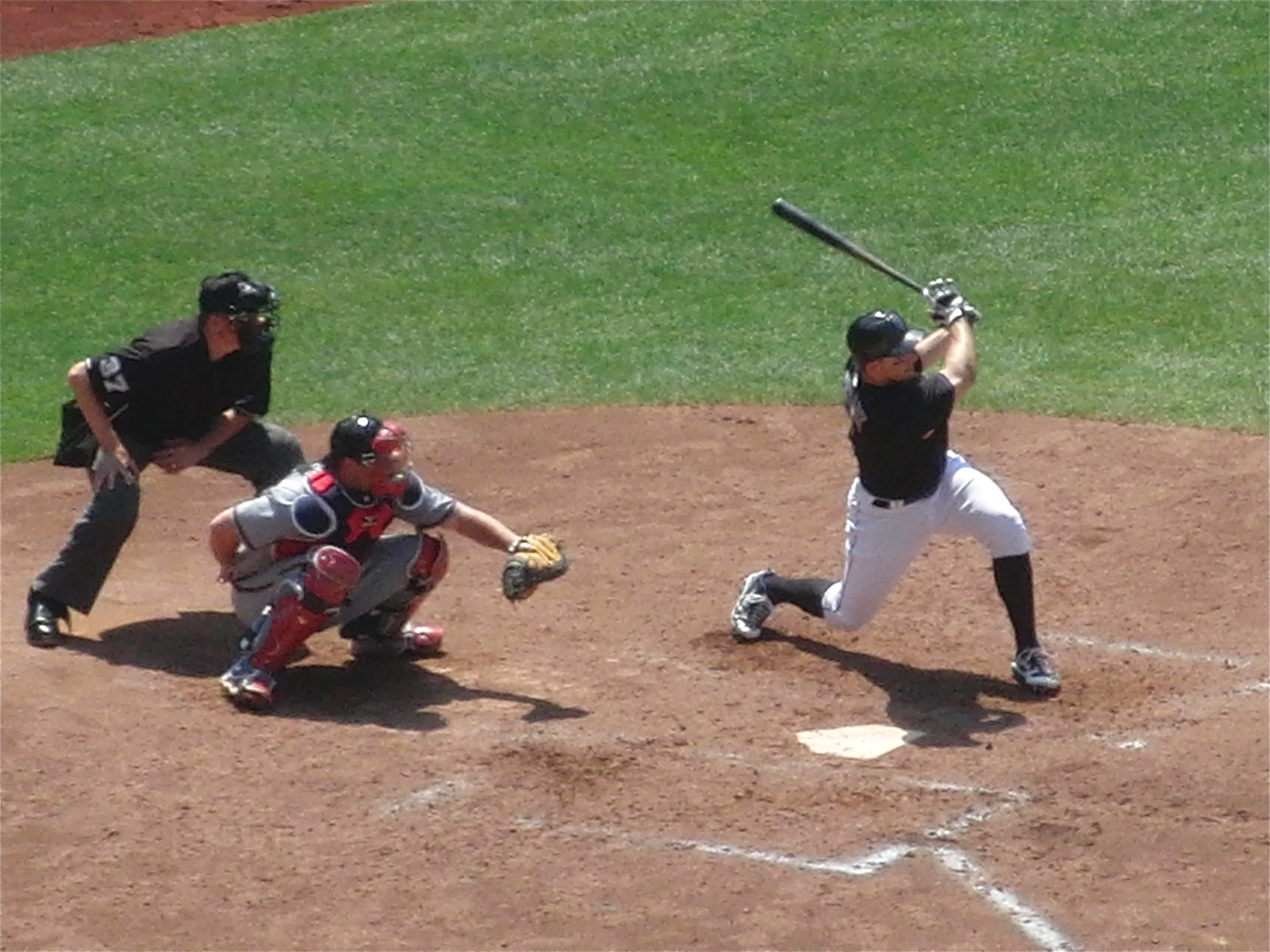
The Mets are looking for David Wright to get back in the swing of things this season (photo by twi-ny/mdr)
Citi Field
123-01 Roosevelt Ave. at 126th St.
Monday, March 5, 10:00 am
718-507-TIXX
www.newyorkmetscom
Fifty years ago, Casey Stengel’s Mets were not quite so amazin’, famously going 40-120 in their inaugural season, still a record of futility for America’s pastime. They’re currently in the doldrums again, finishing 70-92, 79-83, and 77-85 the last three years, a lot closer to last place than to first each season. Mired in a financial crisis, they let their best player go to a division rival and brought in the fences at Citi Field, hoping to increase the power numbers of such players as David Wright, Ike Davis, and Jason Bay. But much of the 2012 season will depend on the ability of lefty ace Johan Santana to pitch at the high level he’s accustomed to — as well as his ability to take the mound at all. And even with ten of the thirty Major League teams now making the playoffs, it’s still highly unlikely that the Amazin’s will be playing past the October 3 finale against the Marlins. Single-game tickets for the Mets’ hopefully celebratory fiftieth anniversary season go on sale this morning, but don’t expect the servers to crash like Kraftwerk playing MoMA. Among this year’s giveaways and promotions are texting gloves on April 7, a Tom Seaver bobblehead on April 22, a Rusty Staub bobblehead on May 26, the return of Banner Day on May 27, a Keith Hernandez bobblehead on June 17, fireworks on July 3, a Mr. Met poster on July 8, Merengue Night on August 24, and a Mike Piazza bobblehead on August 25. In addition, the Friday-night concert series includes postgame shows by REO Speedwagon on June 15, Cheap Trick on July 20, and MercyMe on August 10
BJORK: BIOPHILIA LIVE
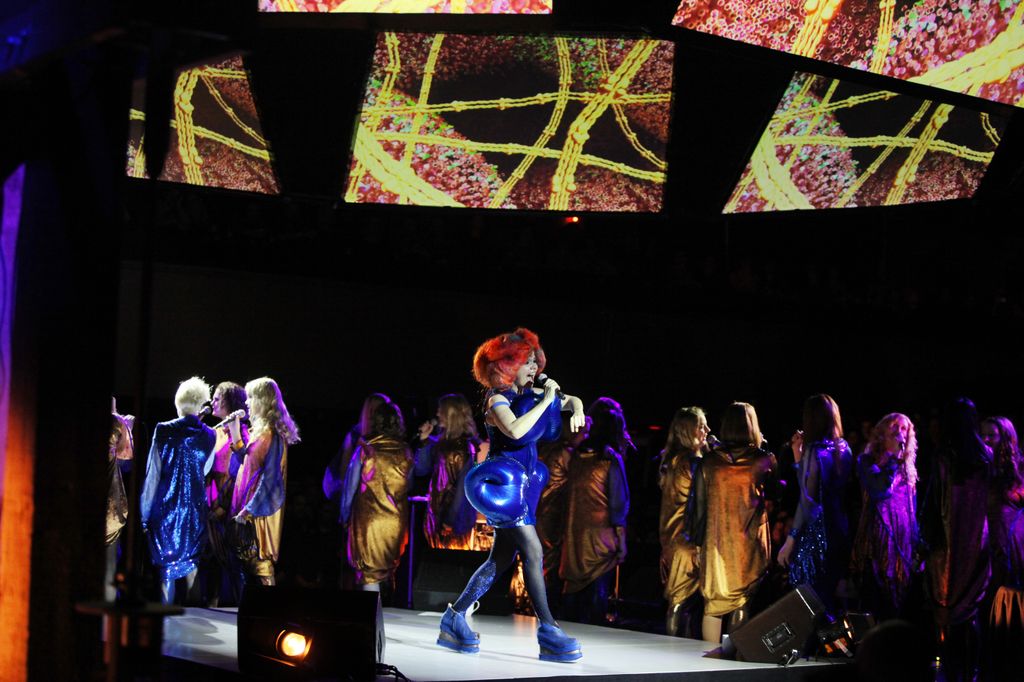
Björk brings together music, nature, and technology in captivating ways in multimedia BIOPHILIA Live
Roseland Ballroom
239 West 52nd St. between Broadway & Eighth Aves.
Monday, March 5, $75-$150
212-247-0200
www.roselandballroom.com
www.bjork.com
On Monday, March 5, Björk Guðmundsdóttir concludes a monthlong New York City residency that began with five shows at the New York Hall of Science, along with an educational program for children, followed by five more at the Roseland Ballroom. Melding together music, nature, and technology, Björk’s latest project, Biophilia, is a fascinating journey into art and science, a thrilling multimedia trip that travels from deep inside the human body into the vast cosmos and beyond. “The reason why Biophilia is on such a grand scale is that I can’t even attempt to explain sound and the world of rhythm and scales without looking into the solar system and atoms,” the forty-six-year-old former leader of the Icelandic band the Sugarcubes explains in the concert program. “For me that’s sort of the same world.” “Biophilia Live” is a captivating ninety-minute production that features all of the new album in addition to some older Björk favorites. Each of the Biophilia songs is introduced by the recorded voice of Sir David Attenborough and accompanied by animated videos projected from the innovative app onto eight two-sided screens hanging in a circle above the performers: Björk, percussionist Manu Delago, electronics master Matt Robertson, harpist Zeena Parkins, and the twenty-woman Icelandic chorus Graduale Nobili.
At Roseland, the stage has been moved to the center of the dance floor, and fans either sit or stand on all four sides, making for an involving and intimate experience. “My romantic genes is dominant / And it hungers for union / Universal intimacy / All embracing,” Björk sings on “Thunderbolt,” the opening track from Biophilia, and that’s exactly what she achieves in the show, an embracing intimacy that features a bevy of offbeat and unusual instruments, some adapted and/or invented specifically for Biophilia, from a gravity harp and a gameleste to a hang and a Tesla coil that turns electric bolts into sound. “To risk all is the end all and the beginning all,” she adds on “Moon,” as the show moves from the Big Bang far out into the future. Wearing a freaky reddish orange wig, elevator shoes, and a deep blue polyester sheath wildly padded at chest and hips, Björk uses all four sides of the stage, and the obvious fun she’s having spreads throughout the energized crowd. She playfully tosses in a few older songs, including Vespertine’s “Hidden Place” and its B-side, “Generous Palmstroke,” before going full-out for the encores, which on February 28 began with 1995’s dreamlike “Possibly Maybe,” then turned Roseland into a dance rave, closing the show with rollicking versions of 2008’s “Náttúra” and “Declare Independence” that had everyone up and grooving. If you can, grab the general admission side-stage seating and arrive early to get in the first row, which offers a spectacular view, the best seats we have ever had for a concert.
SUNDAY SESSIONS

Mårten Spångberg will be at MoMA PS1 for a special performance and book signing (photo by Gaetano Cammarota)
MoMA PS1
22-25 Jackson Ave. at 46th Ave.
Sunday, March 4, 1:00 – 6:00
Series continues through May 13
Suggested admission: $10 (free for MoMA ticket holders within thirty days of ticket)
718-784-2084
www.ps1.org
MoMA PS1’s weekly Sunday Sessions continues on March 4 with another afternoon of diverse, cutting-edge programming. Darren Bader, whose sculptures are on view in “Images” (and where salad is served on Saturdays and Mondays), will present “E-Party” under the Performance Dome, an exploration of the letter E[e] with Enya and Ed Hardy at 1:00, Michelangelo Antonioni’s L’Eclisse at 2:30, and an experimental dance party at 4:30 with DJs Justin Strauss, Darshan Jesrani, and Domie Nation. At 3:00 in the Mini-Kunsthalle, dancer-choreographer Maria Hassabi has invited Swedish multidisciplinary artist Mårten Spångberg to give an hour-long comedic lecture in conjunction with the publication of his latest book, Spangbergianism, followed by a discussion moderated by André Lepecki. “It’s an exorcism, an attempt to engage in the lowest and dirtiest truths, delusions, opportunisms and what we don’t talk about. It shows no mercy,” Spångberg writes in the preface. Also at 3:00, ARTBOOK @ MOMA PS1 will present Lars Müller in conversation with Steven Holl in the museum lobby, followed by a book signing of Steven Holl: Color Light Time and Steven Holl: Scale. In addition, be sure to check out the current exhibitions, which include “Darren Bader: Images,” “Clifford Owens: Anthology,” “Frances Stark: My Best Thing,” and shows by Henry Taylor, Surasi Kusolwong, Rania Stephan, and the art collective Chim↑Pom.
FIRST SATURDAYS: FIERCE, PHENOMENAL WOMEN
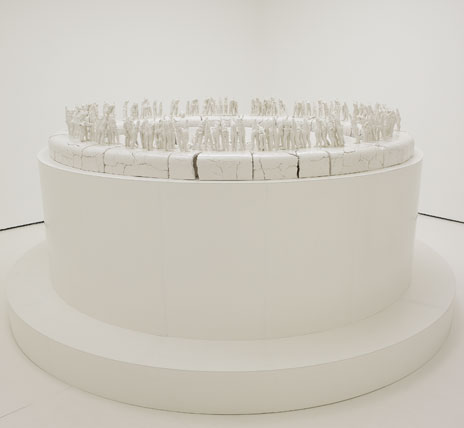
Rachel Kneebone, “The Descent,” porcelain, 2008 (© Rachel Kneebone; photo by Stephen White, courtesy White Cube)
Brooklyn Museum
200 Eastern Parkway at Washington St.
Saturday, March 3, free, 5:00 – 11:00 (some events require free tickets distributed in advance at the Visitor Center)
212-864-5400
www.brooklynmuseum.org
The Brooklyn Museum honors “Fierce, Phenomenal Women” in its March First Saturday programming with a series of events celebrating the second sex. The evening will feature live performances by Alakande! Spread Joy!, Making Friendz, Fredericks Brown, the Brooklyn Ballet, and Queen Godis, artist and curator talks with Mary Lucier, Kate Gilmore, and Catherine Morris, a book talk with author Sara Marcus, a presentation of “The Bad Feminist Readings,” a newspaper illustration workshop, a dance party hosted by DJs Reborn, Moni, Selly, and shErOck, and an action station where visitors can contribute to a community panel inspired by Judy Chicago’s “The Dinner Party.” In addition, the galleries will be open late, giving visitors plenty of opportunity to check out “Playing House,” “Rachel Kneebone: Regarding Rodin,” “Raw/Cooked: Shura Chernozatonskaya,” “Newspaper Fiction: The New York Journalism of Djuna Barnes, 1913–1919,” “Question Bridge: Black Males,” and “19th-Century Modern.”
ROTARY CLUB
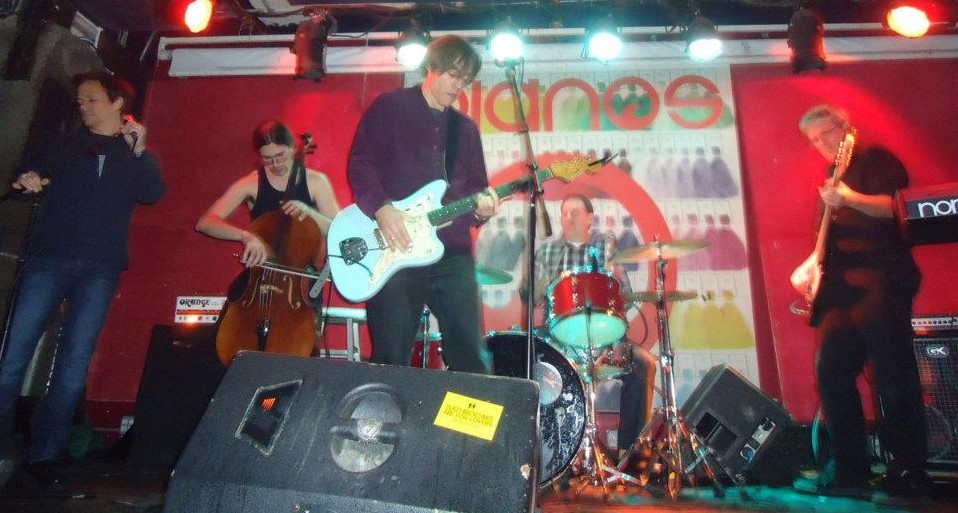
Rotary Club will celebrate the release of SECOND YEAR IN SWINE in Red Hook on Saturday night
Red Hook Bait and Tackle
320 Van Brunt St.
Saturday, March 3, 9:00
www.rotaryclubnyc.com
www.redhookbaitandtackle.com
Among the many ways iTunes and other internet-based programs and websites have changed how we listen to music is by allowing us to create massive, nearly endless playlists of thousands of songs that just keep going. While there are some people out there who still flip over an LP to hear side two or eject one CD to put in another one, most of us double click and just let the music play, and play, and play, sometimes without even knowing the name of the band or the specific song rumbling through our heads. The art of the album has gotten lost in the shuffle. So when we were listening to Rotary Club’s new record, Second Year in Swine (Woodside, February 28, 2012), we found ourselves letting the music drift into the next band on our playlist, not realizing it until several songs in. But we are not pointing this out to say that Rotary Club does not have its own distinctive sound; in fact, they play a wide range of infectious indie pop that makes it hard to pigeonhole them into the flavor of the day. And it just so happens that we have taken to that next band on our playlist much as we have taken to Rotary Club, whose self-professed influences run the gamut from Syd Barrett and the Beatles to Love and the Kinks, from John Fahey to Brian Eno and Pere Ubu; to that mix we’d throw in Steely Dan, Thunderclap Newman, Cracker, and Richard Thompson. In fact, their previous record, 2007’s Vis-à-Vis, and the new one were produced by bassist extraordinaire Tony Maimone, who has worked over the years with Pere Ubu, the Mekons, They Might Be Giants, Ani DiFranco, Bob Mould, Frank Black, Megan Reilly, and many others, creating his own wide-ranging iTunes playlist. The result is a diverse little gem that is like its own iPod shuffle playlist; you never know what you’re going to hear next as Second Year in Swine veers from jazzy interludes and southern blues to wah-wah instrumentals and bright, cheery pop. “You know you want that second cup / of diminishing returns / Determined to repeat yourself / watch your flagship crash and burn / Rewards are worth the work / for these laurels can’t be bought / pushed or shoved or slipped / between the cracks / out a welcome that you’ve worn,” leader Tom Devaney sings on “Diminishing Returns,” and indeed, multiple listens to Second Year in Swine offer no such diminishing returns, instead providing plenty of rewarding moments. Rotary Club will be celebrating the release of the new album on March 3 at Red Hook Bait and Tackle, featuring former Boston boy and Fung Wah regular Devaney, who plays guitar with a unique finger-picking style, along with drummer Mike Savage, cellist Mike Lunapiena, bassist J. Johnson, and keyboardist Billy Donahue. Oh, and that next band on our iTunes? Actually, we’ve just circled back to the beginning of Second Year in Swine, starting all over again with “Get a Room,” so we can’t remember their name right now.