this week in music

OZU 120 — A COMPLETE RETROSPECTIVE

Film Forum is hosting a complete retrospective of the work of Yasujirō Ozu in honor of the 120th anniversary of his birth and 60th anniversary of his death

OZU 120: A COMPLETE RETROSPECTIVE
Film Forum
209 West Houston St.
June 9-29
212-727-8110
www.filmforum.org

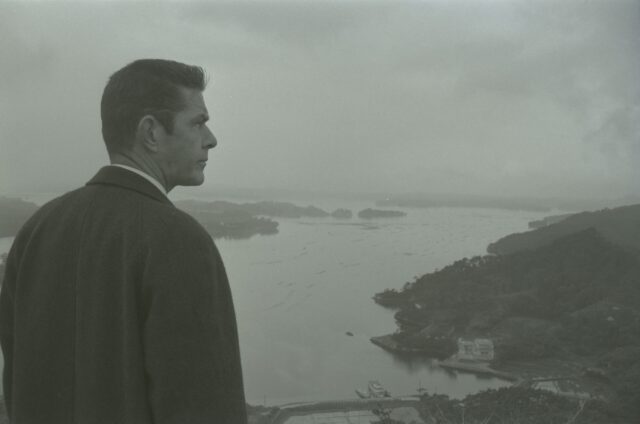
While it is never a bad time to celebrate the genius of Japanese auteur Yasujirō Ozu, now seems a particularly potent moment, with partisan politics and social media tearing friends and families apart, corporations gaining more and more power and wealth, and education under attack across America. From June 9 to 29, Film Forum is hosting “Ozu 120: A Complete Retrospective,” consisting of all three dozen of his extant works, in honor of the 120th anniversary of his birth, on December 12, 1903, and the 60th anniversary of his death on his birthday in 1963. It is no coincidence that six of the films have references to family members in their titles and another dozen involve youth and the passing of time over the course of a day and the seasons of the year.

The Tokyo-born writer, cameraman, and director made poignant “common people’s dramas,” known as shomin-geki, that penetrated deeply into the relationships among husbands and wives, children and parents, and bosses and employees, presenting honest portraits with care and intelligence. Interestingly, Ozu never married and never had kids of his own. His magnificent, meditative films feature long interior takes, little action, and few camera movements, letting the story unfold at its own pace, often photographed from low camera angles that came to be called tatami shots, from the point of view of someone kneeling on a tatami mat.

On June 19, the screenings of I Was Born, But . . . and a fragment of the short film A Straightforward Boy will be accompanied by live music by pianist and composer Makia Matsumura and a performance by master benshi Ichiro Kataoka. The June 20 showing of Tokyo Twilight will be introduced by Asian-American International Film Festival programming manager Kris Montello. Keep watching this space for more reviews of films from this must-see retrospective.

LATE SPRING

Father (Chishu Ryu) and daughter (Setsuko Hara) contemplate their future in Yasujirō Ozu masterpiece

LATE SPRING (BANSHUN) (Yasujirō Ozu, 1949)
Film Forum
June 9, 10, 11, 13, 28
filmforum.org

A masterpiece from start to finish, Yasujirō Ozu’s Late Spring marked a late spring of sorts in the Japanese auteur’s career as he moved into a new, post-WWII phase of his long exploration of Japanese family life and the middle class. Based on Kazuo Hirotsu’s novel Father and Daughter, the black-and-white film, written by Ozu with longtime collaborator Kogo Noda, tells the story of twenty-seven-year-old Noriko (Setsuko Hara), who lives at home with her widower father, Shukichi Somiya (Chishu Ryu), a university professor who has carved out a very simple existence for himself. Her aunt, Masa (Haruko Sugimura), thinks Noriko should get married, but she prefers caring for her father, who she believes would be lost without her. But when Somiya starts dropping hints that he might remarry, like his friend and colleague Jo Onodera (Masao Mishima) did — a deed that Noriko finds unbecoming and “filthy” — Noriko has to take another look at her future.

Late Spring is a monument of simplicity and economy while also being a complex, multilayered tale whose every moment offers unlimited rewards. From the placement and minimal movement of the camera to the design of the set to the carefully choreographed acting, Ozu infuses the work with meaning, examining not only the on-screen relationship between father and daughter but the intimate relationship between the film and the viewer. Ozu has a firm grasp on the state of the Japanese family as some of the characters try to hold on to old-fashioned culture and tradition while recovering from the war’s devastation and facing the modernism that is taking over.

LATE SPRING

Late Spring is part of month-long festival at Film Forum celebrating the work of director Yasujirō Ozu

Hara, who also starred as a character named Noriko in Ozu’s Early Summer and Tokyo Story, is magnificent as a young woman averse to change, forced to reconsider her supposed happy existence. And Ryu, who appeared in more than fifty Ozu films, is once again a model of restraint as the father, who only wants what is best for his daughter. Working within the censorship code of the Allied occupation and playing with narrative cinematic conventions of time and space, Ozu examines such dichotomies as marriage and divorce, the town and the city, parents and children, the changing roles of men and women in Japanese society, and the old and the young as postwar capitalism enters the picture, themes that are evident through much of his remarkable and unique oeuvre.

PASSING FANCY

Takeshi Sakamato makes the first of many appearances as Kihachi in Yasujirō Ozu’s Passing Fancy

PASSING FANCY (DEKIGOKORO) (出来ごころ) (Yasujirō Ozu, 1933)
Film Forum
Sunday, June 11, 4:40
filmforum.org

Yasujirō Ozu might not have been keen on the latest technology — he made silent films until 1936, and his first color film was in 1958, near the end of his career — but there’s nothing old-fashioned about his mastery of camera and storytelling, as evidenced by one of his lesser-known comedy-dramas, Passing Fancy. Takeshi Sakamato stars as Kihachi, a character that would go on to appear in such other Ozu works as A Story of Floating Weeds, An Inn in Tokyo, and Record of a Tenement Gentleman. The film opens at a rōkyoku performance, where the audience is sitting on the floor on a hot day, mopping their brows and fanning themselves; Kihachi has an ever-present cloth on his head, looking clownish, a small boy with an injured eye who turns out to be his son, Tomio (Tokkankozo), sleeping by him. Foreshadowing Bresson-ian precision, Ozu and cinematographers Hideo Shigehara and Shojiro Sugimoto follow a small, lost change purse as several men inspect it, hoping to find money in it, then toss it away when it comes up empty. The scene establishes the pace and tone of the film, identifies Kihachi as the protagonist, and shows that there will be limited translated text and dialogue; in fact, Ozu never reveals what happened to Tomio’s eye. After the performance, Kihachi and his friend and coworker at the local brewery, Jiro (Den Obinata), meet a destitute young woman named Harue (Nobuko Fushimi). An intertitle explains, “Everyone years for love. Love sets our thoughts in flight.” Kihachi, a poor, single father, helps Harue get a place to stay and a job with restaurant owner Otome (Chouko Iida), hoping that Harue will become interested in him, but she instead takes a liking to the younger Jiro, who wants nothing to do with the whole situation, believing that Harue is using them.

PASSING FANCY

The relationship between father (Takeshi Sakamato) and son (Tokkankozo) is at the heart of Passing Fancy

Ozu follows them all through their daily trials and tribulations — with hysterical comic bits, including how Tomio wakes up Kihachi and Jiro to make sure they’re not late for work — but things take a serious turn when the boy becomes seriously ill and Kihachi cannot afford to pay for the care he requires. Winner of the 1934 Japanese Kinema Junpo Award for Best Film — Ozu also won in 1933 for I Was Born, But . . . and 1935 for A Story of Floating WeedsPassing Fancy is filled with gorgeous touches, as Ozu reveals the stark poverty in prewar Japan, focuses on class difference and illiteracy, and displays tender family relationships, all built around Kihachi’s impossible, very funny courtship of Harue and his bonding with Tomio, since love trumps all. And yes, that man on the boat is Chishū Ryū, who appeared in all but two of Ozu’s fifty-four films.

Wataru Hirayama (Shin Saburi) is a conflicted father-matchmaker in Yasujirō Ozu’s first color film, EQUINOX FLOWER

Wataru Hirayama (Shin Saburi) is a conflicted father-matchmaker in Yasujirō Ozu’s first color film, Equinox Flower

EQUINOX FLOWER (HIGANBANA) (Yasujirō Ozu, 1958)
Film Forum
June 14, 17, 18
filmforum.org

Yasujirō Ozu’s first film in color, at the studio’s request, is another engagingly told exploration of the changing relationship between parents and children, the traditional and the modern, in postwar Japan. Both funny and elegiac, Equinox Flower opens with businessman Wataru Hirayama (Shin Saburi) giving a surprisingly personal speech at a friend’s daughter’s wedding, explaining that he is envious that the newlyweds are truly in love, as opposed to his marriage, which was arranged for him and his wife, Kiyoko (Kinuyo Tanaka). Hirayama is later approached by an old middle school friend, Mikami (Ozu regular Chishu Ryu), who wants him to speak with his daughter, Fumiko (Yoshiko Kuga), who has left home to be with a man against her father’s will. Meanwhile, Yukiko (Fujiko Yamamoto), a friend of Hirayama’s elder daughter, Setsuko (Ineko Arima), is constantly being set up by her gossipy mother, Hatsu (Chieko Naniwa). Hirayama does not seem to be instantly against what Fumiko and Yukiko want for themselves, but when a young salaryman named Taniguchi (Keiji Sada) asks Hirayama for permission to marry his older daughter, Setsuko (Ineko Arima), Hirayama stands firmly against their wedding, claiming that he will decide Setsuko’s future. “Can’t I find my own happiness?” Setsuko cries out.

The widening gap between father and daughter represents the modernization Japan is experiencing, but the past is always close at hand; Ozu and longtime cowriter Kōgo Noda even have Taniguchi being transferred to Hiroshima, the scene of such tragedy and devastation. Yet there is still a lighthearted aspect to Equinox Flower, and Ozu and cinematographer Yuharu Atsuta embrace the use of color, including beautiful outdoor scenes of Hirayama and Kiyoko looking out across a river and mountain, a train station sign warning of dangerous winds, the flashing neon RCA Victor building, and laundry floating against a cloudy blue sky. The interiors are carefully designed as well, with objects of various colors arranged like still-life paintings, particularly a red teapot that shows up in numerous shots. And Kiyoko’s seemingly offhanded adjustment of a broom hanging on the wall is unforgettable. But at the center of it all is Saburi’s marvelously gentle performance as a proud man caught between the past, the present, and the future.

THE END OF SUMMER

Ganjirō Nakamura is a sheer delight as the unpredictable patriarch of the Kohayagawa family in The End of Summer

THE END OF SUMMER (KOHAYAGAWA-KE NO AKI) (Yasujirō Ozu, 1961)
Film Forum
June 23, 24, 27
www.filmforum.org

Yasujirō Ozu’s next-to-last film, 1961’s The End of Summer, is a poignant examination of growing old in a changing Japan; Ozu would make only one more film, 1962’s An Autumn Afternoon, before passing away on his sixtieth birthday in December 1963. Ganjirō Nakamura is absolutely endearing as Manbei Kohayagawa, the family patriarch who heads a small sake brewery. The aging grandfather has been mysteriously disappearing for periods of time, secretly visiting his old girlfriend, Sasaki (Chieko Naniwa), and her daughter, Yuriko (Reiko Dan), who might or might not be his. In the meantime, Manbei’s brother-in-law, Kitagawa (Daisuke Katō), is trying to set up Manbei’s widowed daughter-in-law, Akiko (Setsuko Hara), with businessman Isomura Eiichirou (Hisaya Morishige), while also attempting to find a proper suitor for Manbei’s youngest daughter, Noriko (Yoko Tsukasa), a typist with strong feelings for a coworker who has moved to Sapporo. Manbei’s other daughter, Fumiko (Michiyo Aratama), is married to Hisao (Keiju Kobayashi), who works at the brewery and is concerned about Manbei’s suddenly unpredictable behavior. When Manbei suffers a heart attack, everyone is forced to look at their own lives, both personal and professional, as the single women consider their suitors and the men contemplate the future of the business, which might involve selling out to a larger company. “The Kohayagawa family is complicated indeed,” Hisao’s colleague tells him when trying to figure out who’s who, an inside joke about the complex relationships developed by Ozu and longtime cowriter Kôgo Noda in the film as well as in the casting.

Akiko (Setsuko Hara) and Noriko (Yoko Tsukasa) represent old and new Japan in Ozu’s penultimate film

Akiko (Setsuko Hara) and Noriko (Yoko Tsukasa) represent old and new Japan in Ozu’s penultimate film

The End of Summer tells a far more serious story than Late Spring and many other Ozu films that deal with matchmaking and middle-class Japanese life, both pre- and postwar. The perpetually smiling Hara, who played unrelated women named Noriko in three previous Ozu films, once again plays a young widow named Akiko here, as she did in Late Autumn, while Tsukasa, who played Hara’s daughter in Late Autumn, now takes over the name of Noriko as Akiko’s sister. Late Autumn also featured a character named Yuriko Sasaki, played by Mariko Okada, who went on to play a woman named Akiko in Ozu’s final film, An Autumn Afternoon. Got that? Ozu’s fifth film in color, The End of Summer uses several beautiful establishing shots that incorporate flashing light and bold hues — including a neon sign that declares “New Japan” — photographed by Asakazu Nakai (Seven Samurai, Throne of Blood, Ran), as well as numerous carefully designed set pieces that place the old and the new in direct contrast, primarily when Akiko and Noriko are alone, the former in a kimono, the latter in more modern dress. But at the center of it all is Nakamura, who plays Manbei with a childlike glee, as if Ozu is equating birth and death, the beginning and the end.

A trio of yentas in LATE AUTUMN

Nobuo Nakamura, Ryuji Kita, and Shin Saburi play a trio of matchmaking yentas in Ozu’s Late Autumn

LATE AUTUMN (AKIBIYORI) (Yasujirō Ozu, 1960)
Film Forum
June 23, 24, 28
filmforum.org

Yasujirō Ozu revisits one of his greatest triumphs, 1949’s Late Spring, in the 1960 drama Late Autumn, the Japanese auteur’s fourth color film and his third-to-last work. Whereas the black-and-white Late Spring is about a widowed father (Chishu Ryu) and his unmarried adult daughter (Setsuko Hara) contemplating their futures, Late Autumn deals with young widow Akiko Miwa (Hara again) and her daughter, Ayako (Yoku Tsukasa). At a ceremony honoring the seventh anniversary of Mr. Miwa’s death, several of his old friends gather together and are soon plotting to marry off both the younger Akiko, whom they all had crushes on, and twenty-four-year-old Ayako. The three businessmen — Soichi Mamiya (Shin Saburi), Shuzo Taguchi (Nobuo Nakamura), and Seiichiro Hirayama (Ryuji Kita) — serve as a kind of comedic Greek chorus, matchmaking and arguing like a trio of yentas, while Akiko and Ayako maintain creepy smiles as the men lay out their misguided, unwelcome plans.

Mamiya makes numerous attempts to fix Ayako up with one of his employees, Shotaru Goto (Keiji Sada), but Ayako wants none of it, preferring the freedom and independence displayed by her best friend, Yoko (Yuriko Tashiro), who represents the new generation in Japan. At the same time, their matchmaking for Akiko borders on the slapstick. Based on a story by Ton Satomi, Late Autumn, written by Ozu with longtime collaborator Kôgo Noda, is a relatively lighthearted film from the master, with sly jokes and playful references while examining a Japan that is in the midst of significant societal change in the postwar era. Kojun Saitô’s Hollywood-esque score is often bombastically melodramatic, but Yuuharu Atsuta’s cinematography keeps things well grounded with Ozu’s trademark low-angle, unmoving shots amid carefully designed interior sets.

FREE TICKET ALERT: RIVER TO RIVER FESTIVAL 2023

Molly Lieber and Eleanor Smith will present Zero Station at R2R 2023 (photo courtesy LMCC)

RIVER TO RIVER FESTIVAL
Multiple downtown venues
June 9-18, free
Some events require advance RSVP beginning June 1 at noon
lmcc.net/river-to-river

The twenty-second annual River to River Festival runs June 9-18, ten days of cutting-edge art, dance, music, tours, and participatory events at such locations as the Seaport, the Clemente, Governors Island, and Battery Park City. Everything is free, although advance RSVP is recommended or required for several happenings; tickets are available beginning June 1 at noon.

This year’s festival is also a celebration of the fiftieth anniversary of the Lower Manhattan Cultural Council (LMCC), the sponsoring organization that has been a resource for independent artists since 1973; many alumni are involved in R2R 2023 to honor that milestone.

This year’s lineup includes Molly Lieber and Eleanor Smith continuing their exploration of hypersexualization, trauma, and othering in Zero Station. Antonio Ramos and the Gangbangers stage the dance-theater ceremony CEREMONIA, focusing on cultural misappropriation and reappropriation. Seventeen artists will share one-on-one encounters through a lottery in Lotto Royale. Scholar and historian Linda Jacobs will lead walking tours of Little Syria on Washington St. And Guinean musician and activist Natu Camara will close things out with a grand finale concert in Rockefeller Park.

Tickets are sure to go fast, so don’t hesitate if you want to catch any of these unique and special presentations. Below is the full schedule.

Friday, June 9
through
Friday, June 30

Exhibition: “El Camino: Stories of Migration,” by Nuevayorkinos, Fulton Market building windows at the Seaport, opening June 9 at 4:00

Saturday, June 10
and
Sunday, June 11, 11:00 am – 5:00 pm

Participatory Tape Installation: Mahicantuck, “River that flows two ways,” by Marta Blair, Belvedere Plaza, Battery Park City

Saturday, June 10
and
Sunday, June 11, 1:00 – 6:00

Performance Lottery: Lotto Royale, one-on-one encounters with luciana achugar, Lauren Bakst, Amelia Bande, Raha Behnam, mayfield brooks, Moriah Evans, Julia Gladstone, Nile Harris, Niall Jones, Jennifer Monson, Elliot Reed, Alex Rodabaugh, nibia pastrana santiago, Keioui Keijaun Thomas, ms. z tye, Mariana Valencia, and Anh Vo, RSVP required

Saturday, June 10
through
Sunday, June 18

Studio Residency and Public Program: Archive Barchive, by AUNTS, with talks, performances, toasts, and other gatherings, Studio A4, the Arts Center at Governors Island

Marta Blair invites the community to participate in River to River installation (photo courtesy Marta Blair)

Sunday, June 11, 11:00 am
Tuesday, June 13, 11:00 am
Thursday, June 15, 11:00 am
and
Saturday, June 17, 3:00

Walking Tours: Little Syria, New York: Walking Tours of Washington Street, with Linda Jacobs of the Washington Street Historical Society, Washington St. & Battery Pl., RSVP recommended

Monday, June 12, 7:30
Performance: Zero Station, by Molly Lieber and Eleanor Smith, Flamboyan Theater, the Clemente, RSVP recommended

Thursday, June 15, 7:00
Performance: CEREMONIA, by Antonio Ramos and the Gangbangers, La Plaza, the Clemente, RSVP required

Friday, June 16, 4:00
Performance: Talk to Me About Water, by Amelia Winger-Bearskin, Lower Gallery, the Arts Center at Governors Island, 110 Andes Rd., RSVP required

Friday, June 16, 7:00
Performance: duel c, by Andros Zins-Browne, Outlook Hill, Governors Island, RSVP required

Saturday, June 17, noon – 6:00
Open Residency: LMCC’s Workspace Open Studios, 101 Greenwich St., RSVP recommended

Saturday, June 17, 4:00
Poetry in the Park: al Qalam: Poetry in the Park featuring New York Arabic Orchestra, with Hani Bawardi and Rita Zihenni, the Battery Labyrinth

Saturday, June 17, 6:30
Performance: River to River 2023 Closing Concert with Natu Camara, Rockefeller Park, Battery Park City

YOSHIKO CHUMA AND THE SCHOOL OF HARD KNOCKS: SHOCKWAVE DELAY

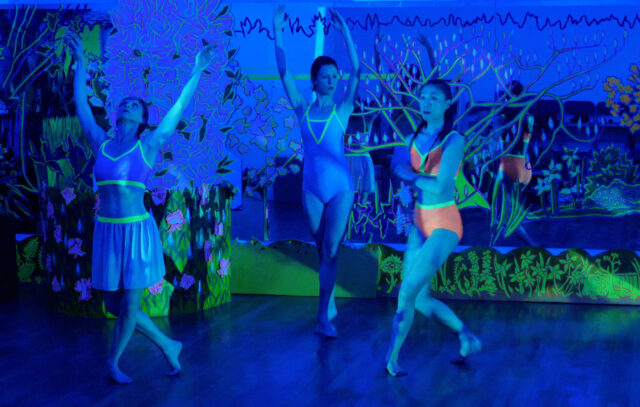
Ursula Eagly is one of many collaborators in Yoshiko Chuma’s Shockwave Delay, which explores war and utopia (photo © Julie Lemberger)

SHOCKWAVE DELAY
La MaMa Experimental Theatre Club
The Ellen Stewart Theatre
66 East Fourth St. between Second Ave. & Bowery
June 1-11, $35-$40 (use code FAM10 for $10 tickets)
212-475-7710
www.lamama.org

In her artistic statement for her latest show, Shockwave Delay, Bessie-winning multidisciplinary artist and creator Yoshiko Chuma explains, “My work has been called ‘choreographed chaos.’ I have intentionally avoided presenting an ordered universe in my work because I don’t see an ordered universe in my life. I don’t usually think of myself as a choreographer. Sometimes, I think of myself as a counterpoint composer, pitting note against note, placing several singular voices in parallel motion, creating a new harmony. Sometimes, I still consider myself a journalist because my work tends to begin with an outside point of view. I’m interested in the little personal issues of everyday life and how they can affect survival. It is a struggle for me to expand my concepts into something larger that an audience can share. I am always looking for a twist or a variance. Some people have called my work ‘spectacle,’ but I don’t think in these terms. ‘Organized happening’ is a term that might better suit me.”

Running at La Mama June 1-11, Shockwave Delay should be a fascinating “organized happening,” in part a culmination of a forty-year oeuvre but not a retrospective. The world premiere consists of ten unscripted docudramas overlapping twenty chapters melding sound, text, and movement, considering war and utopia in relationship to the circle of life through music, film dance, and theater, early iterations of which have been staged at numerous venues over the last handful of years. It will be performed by a rotating cast of actors (Jim Fletcher, Eileen Myles, Kate Valk), dancers (Agnê Auželyte, Ursula Eagly, Claire Fleury, Mizuho Kappa, Stephanie Maher, Miriam Parker, Emily Pope, Owen Prum, Ryuji Yamaguchi, Yoshiko Chuma), musicians (Robert Black, Jason Kao Hwang, Christopher McIntyre, Dane Terry, Aliya Ultan), and other special guests, ensuring that every performance will be unique. The team also includes visual artists Tim Clifford, Claire Fleury, Elizabeth Kresch. Jake Margolin & Nick Vaughan, Van Wifvat, and Kelly Bugden and photographers Hugh Burckhardt and Julie Lemberger. The June 11 finale will be followed by an auction of archival items accumulated by the School of Hard Knocks since its founding in New York City in 1982. In addition, forty artists and collaborators will be named to Chuma’s “Final Exam: Graduation.”

The Osaka-born Chuma adds, “It has been seventy-nine years since WWII, but Japan still smells of occupation, as if it is a US colony. The United States is my home, but the country’s aggressive influence over the world intrigues me artistically. In the sixties and early seventies, there were a growing number of anti-American and anti-war demonstrations in Japan. I was swept up in this sentiment and attended and ultimately led a number of demonstrations. A demonstration is a like a ‘production,’ and this was truly where I received my artistic training. I was not the type to stand in front of a microphone and rally the crowd, so I did the publicity papers for the demonstrations. I was a silent agitator. I still am an agitator, both silent and not so silent. Art can be revolutionary, but is not always. Art must be guided, and there are limits. I can organize people in space, but it’s hard to organize people in life.”

There’s no telling what might happen at each show, so don’t delay to get tickets to what promises to be a series of unpredictable and awe-inspiring events.

JUKEBOX HEROES: A BEAUTIFUL NOISE / & JULIET

Young and old Neil Diamond (Will Swenson and Mark Jacoby) explore their life and legacy in A Beautiful Noise (photo by Julieta Cervantes)

A BEAUTIFUL NOISE: THE NEIL DIAMOND MUSICAL
Broadhurst Theatre
235 West Forty-Fourth St. between Broadway & Eighth Aves.
Tuesday – Sunday through January 7, $84.50-$318.50
abeautifulnoisethemusical.com

There are few things I dread more in theater than jukebox bio musicals, which generally consist of a fawning, glossed-over book and mediocre orchestrations of famous songs that always sound better on the albums made by the star who’s being celebrated. For every well-received Jersey Boys, about Frankie Valli and the Four Seasons, there are unfortunate, overblown, clichéd shows about Michael Jackson, Cher, Tina Turner, the Temptations, Donna Summer, and Carole King. That’s not a good track record.

But every once in a while an extremely clever jukebox musical hits Broadway, taking familiar, existing songs and building an exciting and original story around them. Rock of Ages was a hugely entertaining tale constructed out of songs by such ’70s dinosaurs as Styx, Journey, REO Speedwagon, Foreigner, and Quarterflash. American Idiot re-created the fictional narrative of a Green Day concept album without Broadway-fying the music. Jagged Little Pill examined American suburbia through Alanis Morissette’s oeuvre. And Head Over Heels smoothly inserted hits by the Go-Go’s into a little-known Elizabethan drama like they were a natural fit.

A Beautiful Noise: The Neil Diamond Musical, scheduled to run through January 7 at the Broadhurst, is a major disappointment. The frame story is that the Brooklyn-born Diamond (Mark Jacoby) is meeting with a therapist (Linda Powell) to explore key moments in his life and career. “This isn’t going to work,” he tells her. He’s not kidding.

The book, by four-time Oscar nominee Anthony McCarten (The Collaboration, The Two Popes), goes back and forth between the present day, as Diamond begins to open up to his doctor, who is making him revisit his songs in the huge volume The Complete Lyrics of Neil Diamond, and the past, as his younger self (Will Swenson) rises from shy Brill Building songwriter to folkie to pop superstar. Along the way we meet his parents, Rose (Bri Sudia) and Kieve (Tom Alan Robbins), his early supporter Ellie Greenwich (Bri Sudia), predatory producer Bert Berns (Robbins), and the women who would become his wives, Jaye Posner (Jessie Fisher), Marcia Murphey (Robyn Hurder), and Katie (unseen).

Neil Diamond (Will Swenson) goes for the glitter in jukebox bio musical (photo by Julieta Cervantes)

Tony-winning director Michael Mayer (Spring Awakening, Hedwig and the Angry Inch) can’t find the right rhythm as the narrative meanders, and Tony-nominee Swenson (Hair, Les Misérables) swaggers as Diamond but is unable to embody him as the show presents us with spiritless versions of “I’m a Believer,” “Solitary Man,” “Song Sung Blue,” “Cherry, Cherry,” “Love on the Rocks,” “America,” “Cracklin’ Rosie,” and the obligatory singalong “Sweet Caroline.” (The arrangements are by Sonny Paladino, with orchestrations by Paladino, Bob Gaudio, and Brian Usifer.)

David Rockwell’s set is plenty flashy, with bright lighting by Kevin Adams, standard choreography by Steven Hoggett, and a wide range of costumes by Emilio Sosa. I found myself more involved with the woman a few rows in front of me who kept taking her phone out to video several songs than the actual narrative.

“I don’t . . . I don’t like to talk about myself,” Diamond tells the doctor early on. A Beautiful Noise doesn’t have that much to say about Diamond that we don’t already know (or need to know), so if you really need to hear his music — and you should, because his catalog is one of the best in the business — stream one of his albums or find a tribute band playing in your area.

A delightful cast parties its way through & Juliet (photo by Matthew Murphy)

& JULIET
Stephen Sondheim Theatre
124 West Forty-Third St. between Sixth & Seventh Aves.
Tuesday – Sunday through April 21, $89-$338
andjulietbroadway.com

Meanwhile, something inspiring and exhilarating is happening over at the Stephen Sondheim Theatre, where they are taking a new spin on the Bard, whose catalog is unquestionably the best in the business. David West Read’s & Juliet does a fantastic job with a sensational concept: Anne Hathaway (Betsy Wolfe) argues that her husband, William Shakespeare (Stark Sands), screwed up the ending of Romeo and Juliet, and she has decided to change it so Juliet (Lorna Courtney) actually survives and is now in search of a new life, without Romeo (Ben Jackson Walker).

Soutra Gilmour’s lively set prepares the audience from the start, with the curtainless stage containing a large neon sign of the title, the word Romeo having fallen off, as well as a glistening jukebox ready to fill the room with great music. Bill Sherman’s orchestrations and arrangements will delight you, no matter what your preconceived feelings are about the Backstreet Boys, Britney Spears, Robyn, Demi Lovato, Katy Perry, *NSYNC, and Justin Timberlake. But for good measure, Bon Jovi, Ellie Goulding, and P!nk are added to the mix (and Céline Dion!).

However, the songs were not chosen randomly; they were all written or cowritten by Swedish producer Max Martin, who’s clearly an experienced hitmaker of the highest order. (The conceit of sticking with one songwriter’s work doesn’t always pan out, as evidenced by Bat Out of Hell, with famously bombastic songs Jim Steinman wrote for Meat Loaf and others.)

The story begins in Elizabethan England, as Will is about to present the world premiere of Romeo and Juliet, but Anne steps in the way, asking, “What if . . . Juliet didn’t kill herself? . . . I mean, what do I know, but it seems like she’s got her whole life ahead of her, she’s only had one boyfriend. Maybe she doesn’t kill herself just because he killed himself?”

Against his better judgment, Will collaborates on the new plot, making Romeo a serial cheater and creating a new best friend for Juliet, a gender-neutral character named May (Justin David Sullivan). To avoid being sent to a nunnery by her parents (Nicholas Edwards and Veronica Otim), Juliet takes off for Paris with May and Angélique (Justin David Sullivan and Melanie La Barrie), her nurse and confidante. Anne writes herself into the play and portrays the carriage driver.

In Paris, they go to a Renaissance Ball, where Juliet meets a musician named François DuBois (Philippe Arroyo, although I saw the excellent understudy Brandon Antonio), whose testosterone-fueled father, Lance (Paulo Szot), is the host of the fancy soirée. “As you can see, I play the virginal,” François tells Juliet, who responds, “Me too. I feel like doing it once shouldn’t count.”

Juliet (Lorna Courtney) looks for love in charming Broadway musical (photo by Matthew Murphy)

Pretty soon there’s all kinds of couplings and uncouplings going on as Angélique and Juliet sing “Oops! . . . I Did It Again,” May and François lead the company through “I Kissed a Girl,” Anne and Juliet duet on “That’s the Way It Is,” Lance, François, and May team up on “Shape of My Heart,” and everyone joins in on “Can’t Stop the Feeling!”

Directed with virtuoso aplomb by Luke Sheppard (The Secret Diary of Adrian Mole, In the Heights), who turns the proceedings into a kind of affectionate adult fairy tale, & Juliet is a rousing success. It tackles misogyny, homophobia, gender bias, and other forms of social injustice with a playful sense of humor and a genuine heart, from Paloma Young’s elegant costumes, which mix the traditional with the modern, Howard Hudson’s frenzied lighting, Andrzej Goulding’s dazzling projections, and Gareth Owen’s explosive sound. Jennifer Weber’s appropriately energetic choreography keeps it all moving through Gilmour’s set, which includes miniature landmarks, fun furniture, and, yes, a balcony.

Native New Yorker Lorna Courtney (Dear Evan Hansen, West Side Story) is thoroughly engaging as Juliet, a young woman ready to take control of her own life. Sullivan portrays May with a touching bittersweetness, and La Barrie is eminently likable as Angélique, who remains by Juliet’s side even when she thinks she’s making some very bad choices. Two-time Tony nominee Sands (Kinky Boots, To Kill a Mockingbird) and Wolfe (The Mystery of Edwin Drood, Falsettos) make a great pairing as a husband and wife battling over more than just theatrical conventions and expectations.

At its heart, the wonderful show is centered around Emmy winner Read’s (Schitt’s Creek, The Performers) terrific book, which provides plenty of room for character development while never missing an opportunity for a clever literary laugh.

At one point, Juliet declares, “This is already the best night ever, and all we’ve done is leave my bedroom!” Angélique explains, “Juliet, we have to go. If your parents see you, you’ll be forced to join the nunnery.” Anne cuts in, proclaiming, “Well, we will have none of that.” Angélique asks, “What?” May says, “Ew.”

“Sorry, my husband makes puns. It’s a force of habit,” Anne clarifies, even explaining the joke for those who might not have gotten it immediately.

There’s nothing to apologize for.

BOB DYLAN BIRTHDAY BASH

Who: Near Dead Experience, Philosophers, Chest Fever
What: Concert celebrating Robert Allen Zimmerman’s eighty-second birthday
Where: Brooklyn Bowl, 61 Wythe Ave.
When: Wednesday, May 24, $15, 8:00
Why: In July 1987, Bob Dylan teamed up with the Grateful Dead for a half dozen stadium shows in the United States. Last month, Dylan’s Never Ending Tour traveled to Tokyo, where Bob surprised everyone by adding slot to his otherwise iron-tight setlist for covers of the Dead’s “Truckin’,” “Brokedown Palace,” and “Not Fade Away” (originally by Buddy Holly and the Crickets). So it’s only fitting that GD tribute bands Near Dead Experience and Philosophers (aka Phil and the Osophers) will be at Brooklyn Bowl on May 24 for a bash celebrating Dylan’s completion of his latest revolution around the sun. In addition, Chest Fever, which plays the songs of the Band with Robbie Robertson’s blessing, is on the bill, focusing on the songs Dylan and the Band recorded together, primarily on Before the Flood and The Basement Tapes, as well as their own tunes.

It also happens to be my birthday, so I’m requesting Jerry’s version of “Tangled Up in Blue”; meanwhile, Dead & Company have announced that they’re hanging it up following their summer tour, with their last shows ever July 14-16 in San Francisco, adding a bittersweet tinge to the birthday bash, which will also feature surprise guests. I was at the above show, at the Meadowlands on July 12, 1987, where the camaraderie between Dylan and the Grateful Dead is clearly evident, so evident that Bob asked to join the group in 1988 and maybe again in 1995.

RECANATI-KAPLAN TALKS: GRAHAM NASH

A Graham Nash self-portrait from 1972 is one of two dozens works on view at City Winery (photo courtesy City Winery / Graham Nash)

Who: Graham Nash, Anthony DeCurtis
What: Live and livestreamed conversation
Where: 92nd St. Y Center of Culture & Arts, 1395 Lexington Ave. between 91st & 92nd St., Buttenwieser Hall at the Arnhold Center and online
When: Thursday, June 1, $25 online, $35 in person, 8:30
Why: On “A Better Life,” the second song on Now, his first album of new material in seven years, two-time Rock and Roll Hall of Famer Graham Nash sings, “Let’s make it a better life, leave it for the kids / It’s a lovely place, welcome home to the human race / We can make it a better life — one we can be proud of / So that at the end of the day, I hope we hear them say / that we left them a better life.” In his most recent book, A Life in Focus: The Photography of Graham Nash (November 2021, Insight Editions, $60), the musician, visual artist, and social activist explains, “I’ve been taking photographs longer than I’ve been making music.”

Coming off three shows at City Winery in which he played songs from throughout his long and distinguished career, the eighty-one-year-old Nash will be at the 92nd St. Y on June 1 at 8:30, in conversation with Rolling Stone contributor Anthony DeCurtis. Now contains such other tracks as “Right Now,” “Golden Idols,” and “I Watched It All Come Down”; meanwhile, two dozen of his pictures are on view through July 11 at City Winery in the exhibition “Graham Nash: Enduring Images,” including photos of Columbus Circle, David Crosby, Balboa Park, Johnny Cash, Jerry Garcia, Joni Mitchell, Neil Young, and an old house in Santa Cruz. At the 92nd St. Y talk, which can be attended in person or online, Nash will also perform some songs from the new record, demonstrating once again how he’s made this life better for all of us.

THE REBECCA LUKER SONGBOOK: A BENEFIT CONCERT

Who: Julie Benko, Andréa Burns, Carolee Carmello, Nikki Renée Daniels, Laura Darrell, Ali Ewoldt, Marina Kondo, Emilie Kouatchou, Bryce Pinkham, Scarlett Strallen, Jessica Vosk, Sally Wilfert, more
What: Tribute to Broadway favorite Rebecca Luker
Where: Symphony Space, 2537 Broadway at Ninety-Fifth St.
When: Monday, May 22, $35-$250, 8:00
Why: On May 10, 2018, Alabama-born Broadway star Rebecca Luker presented “Project Broadway: The Rebecca Luker Songbook” at Symphony Space, a concert featuring the world premiere of eighteen songs written specifically for her by such composers as Deborah Abramson, Sam Davis, Stephen Flaherty, Jenny Giering, Sheldon Harnick, Henry Krieger, Andrew Lippa, Matthew Sklar, and Joseph Thalken. The three-time Tony nominee (Show Boat, The Music Man, Mary Poppins) announced in 2020 that she had ALS, and she died on December 23 of that year, survived by her husband, Tony winner Danny Burstein, and his two sons.

On May 22, a wonderful collection of Broadway stars will honor Luker and the fifth anniversary of “The Rebecca Luker Songbook” when they gather at Symphony Space and debut twenty-four different songs written for Luker, by Carmel Dean, Scott Eyerly, Giering, Mike Heitzman and Ilene Reid, Krieger, Lippa, David Loud, Martin Lowe, Joshua Rosenblum, Sam Willmott, and others. (The project included more than eighty original numbers.) Among those performing will be Julie Benko, Andréa Burns, Carolee Carmello, Nikki Renée Daniels, Laura Darrell, Ali Ewoldt, Marina Kondo, Emilie Kouatchou, Bryce Pinkham, Scarlett Strallen, Jessica Vosk, and Sally Wilfert; Thalken will serve as music director, with Deborah Avery on clarinet, Katherine Cherbas on cello, Craig Magnano on guitar and ukulele, and Benny Koonyevsky on percussion. The concert will raise funds for Project ALS, which “identifies and funds the most promising scientific research that will lead to the first effective treatments and a cure for ALS. We recruit the world’s best scientists and doctors to work together — rationally and aggressively — to develop a better understanding of the ALS disease process and, in parallel, better therapeutic strategies.” Tickets range from $35 to $250; the concert, directed by producer Annette Jolles, will also be livestreamed for $35.