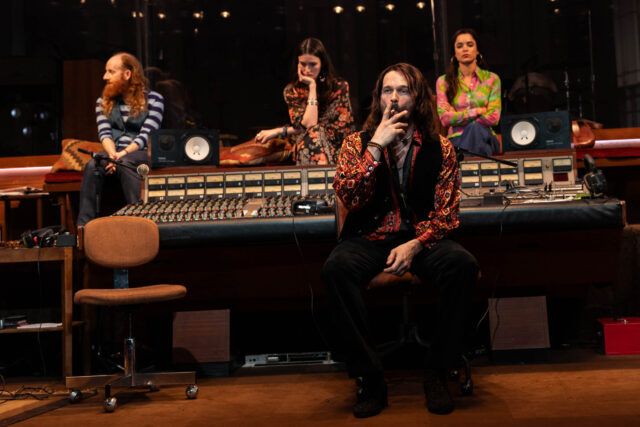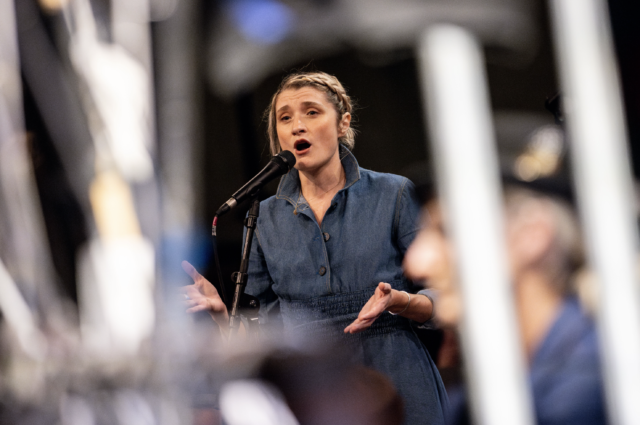
Who: Jimmy Vivino, Mark Barden, Sheryl Crow, Peter Frampton, Kevin Bacon, Bernie Williams, Rozzi, the Dumes, the Alternate Routes, Jen Chapin, Aztec Two-Step 2.0, more What:Benefit concert for Sandy Hook Promise celebrating film launch Where:NYU Skirball Center for the Performing Arts, 566 La Guardia Pl. between Third & Fourth Sts. When: Thursday, December 7, $81-$256, 7:30 Why: “Music succeeds when politics and religion fail,” Darryl “DMC” McDaniels says in A Father’s Promise: The Story of a Father’s Promise to End Gun Violence, a documentary opening December 8 at LOOK Dine-In Cinema W57. Directed by Rick Korn and executive produced by Sheryl Crow, the film follows musician Mark Barden as he takes action after his seven-year-old son Daniel was one of twenty-six people murdered at Sandy Hook Elementary in Newtown, Connecticut, on December 14, 2012.
Barden, cofounder of Sandy Hook Promise, and filmmaker Korn teamed up with Matthew Reich and Neal Saini to form Artist for Action to Prevent Gun Violence. On December 7 at NYU Skirball, Barden and the Promise Band will join musical director Jimmy Vivino and a group of all-stars to celebrate the launch of the film; among the special guests performing live will be Crow, Peter Frampton, Kevin Bacon, Bernie Williams, Rozzi, the Dumes, the Alternate Routes, Jen Chapin, and Aztec Two-Step 2.0. The evening will be filmed for a future documentary, continuing to raise funds and awareness about the horrors of gun violence, the leading cause of death for children and teens in America.
[Mark Rifkin is a Brooklyn-born, Manhattan-based writer and editor; you can follow him on Substack here.]
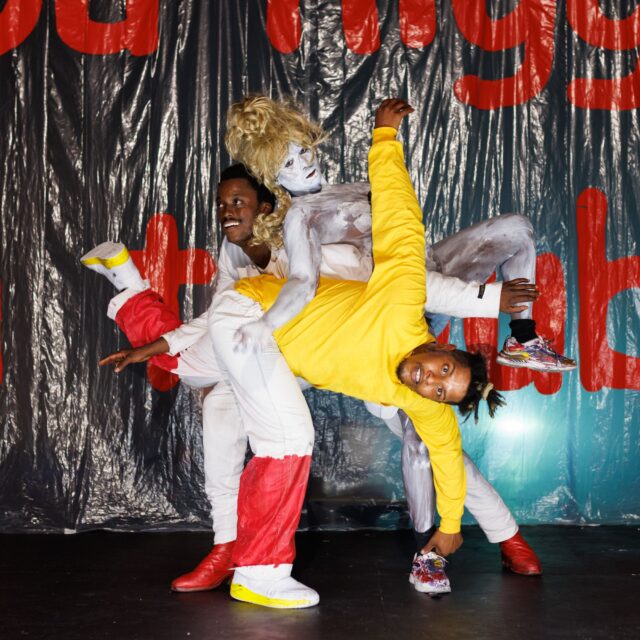
Alvin Ailey American Dance Theater’s Y. Lebrun, P. Coker, X. Mack, and R. Maurice in Alvin Ailey’s For “Bird” — with Love (photo by Dario Calmese)
ALVIN AILEY AMERICAN DANCE THEATER
New York City Center
131 West 55th St. between Sixth & Seventh Aves.
November 29 – December 31, $42-$172 www.alvinailey.org www.nycitycenter.org
No matter what’s going on in the world — and in case you haven’t noticed, right now there’s a whole lot — when the end of November rolls around, you can count on Alvin Ailey American Dance Theater to provide a much-needed respite with its always exciting and entertaining end-of-year season at New York City Center. This time around the company is celebrating its sixty-fifth anniversary by presenting more than two dozen works, including world premieres by first-time AAADT choreographers Amy Hall Garner (CENTURY) and former Ailey dancer Elizabeth Roxas-Dobrish (Me, Myself and You) and new productions of Hans van Manen’s Solo, Alonzo King’s Following the Subtle Current Upstream, Ronald K. Brown’s Dancing Spirit, and Jamar Roberts’s Ode.
Kyle Abraham’s Are You in Your Feelings? is part of Ailey season at City Center (photo by Paul Kolnik)
The programs are divided into “Premiere Night,” “Ailey Classics,” “All Ailey,” “Live Music,” “All New,” and “Pioneering Women of Ailey”; the opening-night gala, honoring former Ailey dancer, choreographer, and artistic director Judith Jamison, pairs a performance of Revelations with a live choir and a world premiere with Tony, Grammy, and Emmy winner and Oscar nominee Cynthia Erivo.
The personal CENTURY was inspired by Garner’s grandfather and is set to music by Ray Charles, Count Basie, the Dirty Dozen Brass Band, and others; Me, Myself and You explores reminiscence, love, and loss. “Pioneering Women of Ailey” pays tribute to Jamison, Carmen de Lavallade, Denise Jefferson, and Sylvia Waters, while rising jazz stars will perform live December 15-17. Among the other highlights the company of thirty-three dancers will perform are Paul Taylor’s DUET, Alvin Ailey and Mary Barnett’s Survivors, Roberts’s In a Sentimental Mood, and Kyle Abraham’s Are You in Your Feelings? After twelve years as artistic director, Robert Battle announced that he is stepping down immediately because of health concerns; longtime Ailey dancer and associate artistic director Matthew Rushing will take over temporarily until the board chooses a full-time successor; among Battle’s works for the company are Ella,For Four,In/Side,Love Stories,Mass, and Unfold.
Tariq Trotter (photo by Joshua Kissi) will discuss his new new memoir at BAM with Jon Stewart this week
Who:Tariq Trotter (Black Thought), Jon Stewart What: Book launch and conversation Where:Brooklyn Academy of Music, Harvey Theater at the BAM Strong, 651 Fulton St., 30 Lafayette Ave. between Ashland Pl. & St. Felix St. When: Tuesday, November 14, $44-$68, 8:00 Why: “The story of my life starts with the fire. A lot of people know I burned down my family’s home when I was six years old, but are not aware of the magnitude of that moment — and all that began to unravel after it. That, I have never spoken of publicly, and rarely even to those closest to me,” Tariq Trotter, aka Black Thought, writes at the beginning of his new memoir, The Upcycled Self: A Memoir on the Art of Becoming Who We Are (One World, November 2023, $26.99). “You sometimes hear stories about people who have ‘lost it all’ and rebuilt their lives, but what I learned at a young age is that sometimes shit is just lost forever, or the cracks are so bad the building blocks never quite Lego-fit the way they once did. We lost everything we had in that fire. Yes, material goods are just ‘things,’ but the things we collect and value — especially when we’re young, or broke, or struggling — are extensions of who we are. Our visible, tangible losses, then, represent something deeper. In the fire, we lost ourselves.”
Written with Jasmine Martin, the book features such chapters as “A Creative Reckoning,” “Family,” “An Epidemic,” “New City, New Self,” and “The (Square) Roots” as Trotter traces the arc of his life and career. Born in Philadelphia in 1973, Trotter was a graffiti artist and drug dealer before hooking up with Ahmir “Questlove” Thompson in high school and Malik B. in college and finding success as a rapper and MC in the Roots while also establishing a solo career as a musician, actor, film producer, and stage composer and lyricist. He also leads the Roots as the house band on The Tonight Show Starring Jimmy Fallon.
On November 14 at 8:00, Trotter will be at BAM’s Harvey Theater, discussing the book with talk show legend and activist Jon Stewart, the former host of The Daily Show and The Problem with Jon Stewart, which is ending after just two seasons over creative differences with Apple about coverage of China and AI. The $68 tickets come with a copy of Trotter’s book, in which he also writes, “Our lives are a response to the call of our childhoods. Somewhere in the echoes of the past, we find our truest selves. Who am I? Who are you?”
Who:Warren Zanes What: Literary and music discussion Where:The National Arts Club, 15 Gramercy Park South When: Wednesday, November 8, free with RSVP, 8:00 Why: Following the international success of his international 1980–81 River tour through North America and Western Europe totaling 140 dates, New Jersey native Bruce Springsteen went into his bedroom on January 3, 1982, with a Teac four-track cassette machine and recorded fifteen songs by himself, then mixed them with an Echoplex. He carried the cassette, sans case, around with him for a few weeks, intending to teach the E Street Band the tunes that could be their next album. It was eventually decided that the songs worked best as they were, and on September 30, 1982, Nebraska was released. In ten songs over forty-one minutes — including “Atlantic City,” “Johnny 99,” “Open All Night,” and “Reason to Believe” — Springsteen took a stark look at Reagan’s America. Two years later, Bruce and the band would explode with Born in the USA — the title song was originally part of the bedroom recordings — but Nebraska has stood the test of time, filled with characters who are still searching for the American dream.
In the spring of 2021, Springsteen invited music journalist and Del Fuegos cofounder Warren Zanes to his Colts Neck home to discuss the evolution and legacy of Nebraska, in time for its fortieth anniversary; the result is Deliver Me from Nowhere: The Making of Bruce Springsteen’s Nebraska (Crown, May 2023, $28). In the first chapter, Zanes writes, “I wanted to know where Nebraska came from, what it led to. It sat between two of Springsteen’s most celebrated recordings, in its own quiet and turmoil. He described it to me as ‘an accident start to finish’ but also as the album that ‘still might be [his] best.’ The recording came from a place and a time in which Springsteen was facing troubles in his life, troubles that had no name as of yet. Wordsworth defines poetry as ‘the spontaneous overflow of powerful feelings . . . recollected in tranquillity.’ Quite differently, Nebraska came from the middle of that ‘overflow,’ was not a thing ‘recollected in tranquillity.’ It came from the heart of trouble and led to still more, its stark character the lasting reward. Nebraska was unfinished, imperfect, delivered into a world hovering at the threshold of the digital, when technology would allow recorded music to hang itself on perfect time, carry perfect pitch, but also risk losing its connection to the unfixed and unfixable. Springsteen’s manager, Jon Landau, recalled for me, over several afternoons at his Westchester home, the way in which Nebraska arrived. Chuck Plotkin, among Springsteen’s producers and a key player in the last stages of Nebraska’s creation, would talk about the anxious labor of trying to make the album conform to industry standards. But Springsteen knew the most by far, because it came from his bedroom.”
Bruce Springsteen and Warren Zanes discuss the making of Nebraska (photo courtesy Warren Zanes)
On November 8, Zanes will be at the National Arts Club to talk about the book, which features such chapters as “The Rhinoceros Club,” “The King of Pop and the Beer Can,” and “Darkness on the Edge of Bed.” The first question Zanes asks Bruce is “Are there any photographs of the room where you recorded Nebraska?” Bruce says no. Zanes writes, “I wanted to see that room because something important was made there, and I wanted to know if by looking at a photograph of the space, I could see traces of what happened, the outlines of Nebraska. And maybe those photographic traces could bring it back to life for me, a resurrection. Photographs of his previous place, the Holmdel farmhouse, are easy to find online. Whether you see Springsteen in them or not, whether the amps and guitars are in the room or not, you look at them knowing who was there once and what got done at the time, Darkness on the Edge of Town and much of The River. The rooms begin to breathe.”
[Mark Rifkin is a Brooklyn-born, Manhattan-based writer and editor; you can follow him on Substack here.]
Raven Chacon and Laura Ortman will perform a free show in Brooklyn Bridge Park on November 5
Who:Laura Ortman & Raven Chacon What: Live concert presented by Public Art Fund Where:Empire Fulton Ferry Lawn, Brooklyn Bridge Park When: Sunday, November 5, free (advance RSVP recommended), 4:00 Why: Following an earlier rainout, Laura Ortman (White Mountain Apache) and Raven Chacon (Navajo) will activate Nicholas Galanin’s Brooklyn Bridge Park sculpture, In every language there is Land / En cada lengua hay una Tierra, with a free concert on November 5 at 5:00. Chacon is a Pulitzer Prize–winning composer, performer, and installation artist based in Red Hook and Albuquerque, while Ortman is a multi-instrumentalist and composer who has collaborated with Tony Conrad, Jock Soto, Nanobah Becker, Okkyung Lee, Martin Bisi, Jeffrey Gibson, Caroline Monnet, New Red Order, and many others.
Discussing the large-scale immersive piece, Galanin, who is based in Sitka, Alaska, said in a promotional video, “Creative sovereignty and creating work is a form of reclamation of our ideas, our knowledge, our language, our place, while including other perspectives and other ideas and other people’s experiences to be accessed through that work too.”
Ortman and Chacon have worked together previously, including at Ende Tymes X in Brooklyn, the American Academy in Berlin, the Center for Contemporary Arts in Santa Fe, and other locations. In Brooklyn Bridge Park, they will present an improvisational site-specific performance incorporating local field recordings and a mix of instruments. Admission is free, though advance registration is recommended, and attendees are encouraged to bring a blanket to sit on.
[Mark Rifkin is a Brooklyn-born, Manhattan-based writer and editor; you can follow him on Substack here.]
Who:Nick Cave,Seán O’Hagan What: Book signings and solo concerts Where:The Strand,92nd St. Y,Kings Theatre,Beacon Theatre When: Book signings October 5, concerts October 6-8 Why: At the beginning of Faith, Hope and Carnage (Picador, September 19, $20), Irish journalist Seán O’Hagan tells Australian musician, composer, and author Nick Cave, “I’m surprised you agreed to do this given that you haven’t done any interviews for a long time.” Cave replies, “Well, who wants to do an interview? Interviews, in general, suck. Really. They eat you up. I hate them. The whole premise is so demeaning: you have a new album out, or new film to promote, or a book to sell. After a while, you just get worn away by your own story. I guess, at some point, I just realised that doing that kind of interview was of no real benefit to me. It only ever took something away. I always had to recover a bit afterwards. It was like I had to go looking for myself again. So five or so years ago I just gave them up.” O’Hagan asks, “So how do you feel about this undertaking?” Cave answers, “I don’t know. I do like having a conversation. I like to talk, to engage with people. And we’ve always had our big, sprawling conversations, so when you suggested it, I was kind of intrigued to see where it would go. Let’s see, shall we?”
Divided into such chapters as “A Beautiful Kind of Freedom,” “Love and a Certain Dissonance,” “A Radical Intimacy,” “A Sense of Shared Defiance,” and “The Astonishing Idea,” Faith, Hope and Carnage was assembled from forty hours of conversations between Cave and O’Hagan (Freddie Mercury: The Great Pretender). The two spoke about his childhood, family, and tragedy; absences, absolution, and addiction; Cave’s bands (the Birthday Party, Grinderman, the Bad Seeds), albums (The Boatman’s Call,Skeleton Tree,Carnage), and books (The Death of Bunny Munro,The Sick Bag Song); the pandemic; the Red Hand Files, where Cave answers one of the hundreds of letters he receives each week from fans; and grief — Cave has suffered immeasurable loss over the last eight years, including the passing of his two sons, his mother, and numerous friends and colleagues. “If this is a book that outlines a dramatic creative and personal transformation in the face of great personal catastrophe, it is also shot through with a sense of life’s precariousness,” O’Hagan writes in the afterword.
Cave will be in New York City this week in support of the paperback edition of the book. He will be at the Strand on October 5 at 11:30 am for a conversation and signing with O’Hagan, followed by a talk and Q&A that night at the 92nd St. Y’s Kaufmann Concert Hall at 7:30. Cave’s Live in North America solo tour — on which he’ll be joined by Radiohead bassist Colin Greenwood — comes to the Kings Theatre in Brooklyn on October 6 and the Beacon in Manhattan on October 7-8,. I’ve seen him play solo, with the Bad Seeds, with Grinderman, and with Warren Ellis, and his shows are always like nothing you’ve ever experienced before.
[Mark Rifkin is a Brooklyn-born, Manhattan-based writer and editor; you can follow him on Substack here.]
John Cage’s unique relationship with Japan and Japanese culture will be celebrated in Japan Society series (photo by Yasuhiro Yoshioka / courtesy of Sogetsu Foundation)
JOHN CAGE’S JAPAN
Japan Society
333 East 47th St. at First Ave.
Thursday, September 28, and Friday, September 29, $28-$35, 7:30
Saturday, October 21, Thursday, November 16, Thursday, December 7, $32-$40
212-715-1258 www.japansociety.org
“If John Cage had not encountered Japanese culture, there would have been no John Cage!” Japan Society artistic director Yoko Shioya recently declared.
In 1989, experimental composer John Cage was awarded the Kyoto Prize in the category of Creative Arts and Moral Sciences; the citation, presented in Kyoto, Japan, noted that he was “a rebel against Western music. . . . His creative activities and philosophy of art have truly constituted a revolution in culture. . . . Mr. John Cage has stood in the vanguard of change in the postwar Western musical world, and has continually demonstrated his leadership among the most avant-garde group of composers.” Cage, who was born in Los Angeles in 1912, first visited Japan in 1962; he returned in 1964, 1976, and several times in the 1980s. Not only was Cage impacted by Japanese art and culture — he was particularly interested in Zen Buddhism — but he was a major influence on such Japanese composers as Tōru Takemitsu, Toshiro Mayuzumi, Yoko Ono, and Yuji Takahashi, in what was called “Jon Kēji shokku,” or John Cage Shock.
Japan Society pays tribute to the relationship between Cage and Japan in the series “John Cage’s Japan,” which kicks off September 28-29 with Paul Lazar’s Cage Shuffle. From 1958 to 1960, Cage wrote and recorded a series of sixty-second real-life anecdotes called Indeterminacy. At Japan Society, Lazar, the cofounder of Big Dance Theater, will perform pieces related to Japan and the East; using an iPhone — “a device that John Cage invented,” Lazar jokes in the above video — Lazar will have Cage’s recordings of the stories piped into his earbuds and will repeat them out loud, along with quotes from such Cage contemporaries as D. T. Suzuki, Isamu Noguchi, and Hidekazu Yoshida. Meanwhile, Lazar will be moving to choreography by BDT cofounder and Tony winner Annie-B Parson. The movement is fixed but the text is random, creating the kind of chance Cage was celebrated for. The September 29 show will be followed by an artist Q&A.
On October 21, “John Cage’s Ryoanji” features the composer’s 1983 work, inspired by the Zen rock garden at Kyoto’s Ryoanji Temple. Directed by Tomomi Adachi, it will be performed by International Contemporary Ensemble in New York City (with Michael Lormand on trombone, Lizzie Burns on double bass, and Clara Warnaar on percussion), joined virtually from a teahouse in Kanazawa City by Hitomi Nakamura on the ancient hichiriki woodwind and Maki Ota on vocals. The multimedia concert, with 3D projections by Dr. Tsutomu Fujinami, will be preceded by a lecture from Cage scholar James Pritchett at 7:30.
Adachi’s “Noh-opera / Noh-tation: Decoding John Cage’s Unrealized Project” takes place on November 16 at 7:30, for which Adachi used AI to compose music and lyrics based on Buddhist koans for Cage’s unrealized Noh-opera: Or the Complete Musical Works of Marcel Duchamp. The work will be performed by vocalist Gelsey Bell, noh actor Wakako Matsuda, and Adachi with ICE’s Alice Teyssier on flute, James Austin Smith on oboe, Campbell MacDonald on clarinet, Rebekah Heller on bassoon, and Lormand on trombone and will be followed by an artist Q&A.
The series concludes on December 7 with “Cage Shock: Homage to His First Japan Visit,” consisting of a lecture by Dr. Pritchett, live performances of 1951’s Haiku, 1958’s Aria and Solo for Piano with Fontana Mix, and 1962’s 0’00” by Cage, Toshi Ichiyanagi’s 1962 Sapporo, which Cage conducted, and soundscapes by Tania Caroline Chen and Victoria Shen, with ICE’s Kyle Armburst on viola, Wendy Richman on viola, and Katinka Kleijn and Michael Nicolason on cello.
“I must express my deep and sincere gratitude to John Cage,” Takemitsu wrote. “The reason for this is that in my own life, in my own development, for a long period I struggled to avoid being ‘Japanese,’ to avoid ‘Japanese’ qualities. It was largely through my contact with John Cage that I came to recognize the value of my own tradition.” At Japan Society this fall, we can all express our deep and sincere gratitude to John Cage.