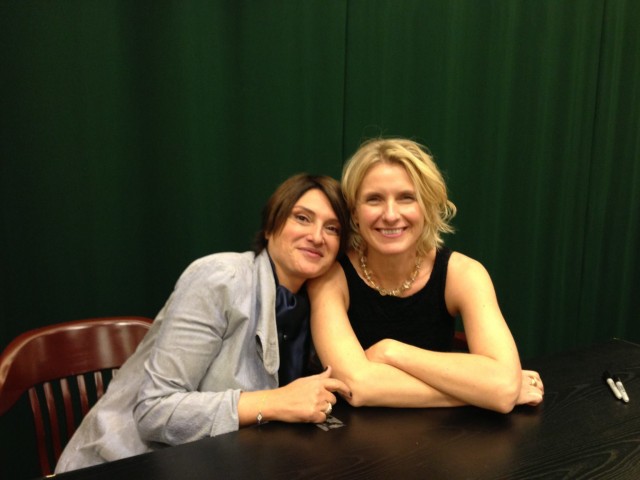
Rayya Elias and Elizabeth Gilbert will be at powerHouse on April 2 for launch of HARLEY LOCO paperback (photo by Bill Miller)
RAYYA ELIAS IN CONVERSATION WITH ELIZABETH GILBERT
powerHouse Arena
37 Main St. at Water St., Brooklyn
Wednesday, April 2, free (advance RSVP appreciated), 7:00
718-666-3049
www.powerhousearena.com
www.rayyaelias.com
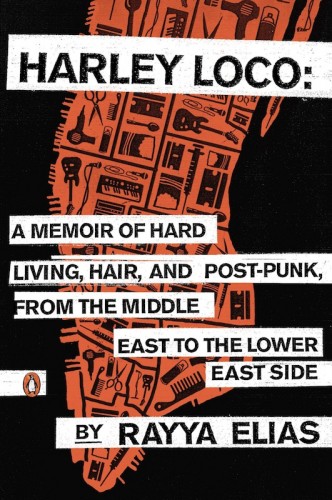
“This book is the story of my life,” Rayya Elias writes in the first chapter of the painfully poignant yet ultimately inspiring Harley Loco: A Memoir of Hard Living, Hair, and Post-Punk, from the Middle East to the Lower East Side (Penguin, March 2014, $16). “This is my truth, and it may not be pretty, but I own it.” Pretty it isn’t, as the Syrian-born Elias details her battles with drug addiction, her time in prison, her struggles with sexual identity, and her eventual recovery from a shocking rock bottom. Clean since August 1997, Elias is a gregarious woman with an infectious personality that lights up a room. She “always wanted to be the center of attention,” she notes in the book, and she’s spent much of the last year doing just that, promoting Harley Loco — the title refers to her Rikers Island nickname — around the world. A musician, filmmaker, hair stylist, and major football fan, Elias will be at Brooklyn’s powerHouse Arena on April 2 for the launch of the paperback edition of her memoir. She will once again be joined by her close friend Elizabeth Gilbert, the bestselling author of such books as The Signature of All Things and Eat, Pray, Love who wrote the introduction to Harley Loco. Last fall, we appeared on Elias’s sports-and-fantasy podcast, “Football Riffs and Chicks,” and now she is returning the favor, answering intimate questions for a very personal twi-ny talk.
twi-ny: You just lost your pitbull, Ricky. How are you doing?
Rayya Elias: Well, the grief comes and goes. It’s only been a few days since he passed, so I’m still in shock, I think. Ricky was my kid and companion for thirteen years, so there is a huge gaping hole in my heart. We were meant for each other; he was beaten up quite dramatically (used as a bait dog), and he had the scars to prove it, yet he was so good inside. We did quite a bit of healing together.
twi-ny: For the last year, you’ve spent a lot of time on the road promoting your memoir. What’s that experience been like, especially as you have to keep going back over some very difficult times in your life?
Rayya Elias: Writing the book was the ultimate cathartic experience for exercising those demons. Sometimes, when I was in the midst of working on the book, I doubted my own memory because it was almost too much to grasp. It got pretty deep.
twi-ny: What’s been the best part of the tour?
Rayya Elias: When I was on the road promoting it, it became like a testimonial. My favorite part was that people came out of the woodwork to tell me their stories, whether it was an eighteen-year-old child who had gone missing due to drugs or a gray-haired lady who related to being fat as a kid or being bullied as a teenager. So many people wanted to be heard because they related to many parts of my story. That’s what really kept me in the zone.
twi-ny: How about the worst?
Rayya Elias: There is no worst. Honestly, I love all of it. It’s something I’ve longed for, so I’m taking it all in, the hotels, the road food, even the airports, and especially when friends I haven’t seen in years show up at a reading/performance, I love it.
twi-ny: Is there a question that you’ve been surprised you haven’t been asked yet?
Rayya Elias: Not really; people have pretty much dissected it. I was really happy that a college radio station in Brisbane, Australia, asked about methadone detox. No one in the States really bothered giving that one any thought. I was pretty grateful, as I have a strong opinion about it!
twi-ny: You’re very good friends with Elizabeth Gilbert. How did the two of you meet?
Rayya Elias: Liz and I have been friends since the year 2000. She came into my studio and needed an intervention. Not a drug intervention like I was used to, but a hair intervention. I cut her hair and we told each other stories. She was writing for GQ at the time and asked me to style a story that Mary Ellen Mark was shooting. We clicked on a level that neither of us really understood. It was deep, and very real, and she became a part of my life. Then, many years later, she bullied me into writing my memoir. Ha!
twi-ny: Do you want to offer a sneak peek at the powerHouse event? For example, will you have your guitar with you?
Rayya Elias: I will absolutely have my guitar, and I will play a few songs. A new one is called “Touch the Ground,” inspired by Liz’s book The Signature of All Things. I recorded it, and with Barb Morrison producing, it sounds amazing.
twi-ny: Last November, we appeared on “Football Riffs and Chicks.” That was a lot of fun. Will there be another season?
Rayya Elias: I loved having you and Ellen on “FR&C”; it was so much fun. Yes, I will definitely do it again; this year I will concentrate a little more on fantasy, I think.
twi-ny: Your fantasy football team, which is named the Pittbulls, after Ricky, finished in a three-way tie for the best record in our fantasy football league. Were you happy with your team’s performance?
Rayya Elias: I’m never happy with my team’s performance unless I win. My guys were getting hurt every week, so I really had to study and pick up the next best available athlete for the position. It was hard going. I can’t imagine what the real live sport is like for the coaches. That’s why I’m in awe of the game.
twi-ny: You were born in Syria and still have family there; how has the political situation there affected them and you?
Rayya Elias: It’s been extremely difficult. The country is torn, my family is torn, my heart is broken for the Syria I visited just four years ago. I spent Christmas and New Year’s with family in Aleppo and Damascus. Now they are struggling and I haven’t heard from some of them in quite some time. No one saw it coming because the country seemed to be on the verge of a tourism breakout and everything seemed to be going well.
twi-ny: Okay, so you’re a writer, musician, hair stylist, podcast host, filmmaker, and big-time football fan; what’s next for you?
Rayya Elias: I’m wrapping my head around a new book, a novel of sorts. I’ve never tried to write fiction, but I’m gonna give it a whirl. Music is something that is constant in my life, so that’s a given. The rest is up to what inspires me. I’m the type of person who loves to be involved in creative endeavors and make stuff. Once an idea enters my head and my heart, it starts to take over my being, and once it’s too much to hold in, then I gotta let it out. If I can’t keep it in, I gotta let it out!