There’s no way we can ever stop loving a crazy live band that celebrates “drinking, smoking weed & all types of ill shit,” so we have a fondness for local hip-hop funk rockers Shinobi Ninja, who also have a song called “Rusty Stab” and a video-game EP titled Shinobi Ninja Attacks! Over the last few weeks, we’ve been following their road trip as they travel around making new music with a Monster Go DJ portable unit and seek to escape from New York. On November 22, Duke Sims, Baby G, Maniak Mike, Alien Lex, Axis Powers, and Terminator Dave will be at Cameo Gallery in Brooklyn for the Monster Van Album Release Party, joined by Sunshine Gun Club, Cowboys 2 Girls, and City of the Sun. On “What If Times,” Shinobi Ninja asks, “What if times don’t get no better than this?” With Shinobi Ninja, times always get better. The gang will also be back in town on December 28 for a big show with Fishbone and Nonstop to Cairo at the Gramercy.
this week in music
MONSANTO IS THE DEVIL
Joe’s Pub at the Public Theater
425 Lafayette St. at Astor Pl.
Sunday, November 23, 30, and December 7, 14, 21, $15, 2:00
212-967-7555
www.publictheater.org
www.revbilly.com
Over the past year, anti-consumerist activists Reverend Billy and the Stop Shopping Choir have been battling against corporations’ role in climate change. “The activism is content for the play,” they explain on their website, using cash register exorcisms, retail interventions, cell phone operas, live performances, and protest marches to help save the world from imminent destruction, taking inspiration from the opening scene of John Huston’s The Night of the Iguana. They’ve been fighting for Earth Justice for fifteen years, and that journey continues with their latest show, Monsanto Is the Devil, running Sunday afternoons at Joe’s Pub from November 23 through December 21, led by director Savitri D. and musical director Nehemiah Luckett and joined by the Not Buying It Band. The eco-televangelist will also be leading his minions on a march on Monsanto’s St. Louis headquarters as they enjoy an organic Thanksgiving dinner on the company’s lawn, after which they will spend Black Friday in Ferguson, Missouri. “Monsanto is a right-wing apocalyptic fundamentalist religion; all the big corporations, all the big nature-hating corporations, are. That’s something we have to understand,” Reverend Billy preaches, adding, “When you deal with Monsanto, we can’t be polite.” The reverend and his choir, which protested the state of the honeybee in The HoneyBeeLujah Show earlier this year at Joe’s Pub, are unlikely to be polite as they take on the self-described Sustainable Agriculture Company’s use of pesticides, GMO crops, and other controversial methods and dealings. The Shopocalypse continues….
PULP: A FILM ABOUT LIFE, DEATH AND SUPERMARKETS
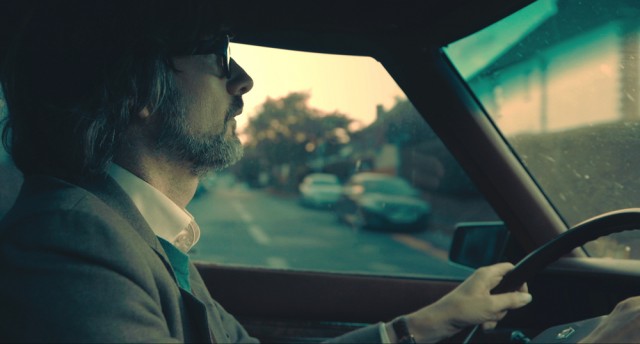
Jarvis Cocker takes a ride through his hometown of Sheffield as he prepares for Pulp farewell concert
PULP: A FILM ABOUT LIFE, DEATH & SUPERMARKETS (Florian Habicht, 2013)
IFC Center
323 Sixth Ave. at West Third St.
Opens Wednesday, November 19
212-924-7771
www.ifccenter.com
www.pulpthefilm.com
 Florian Habicht’s Pulp: A Film About Life, Death & Supermarkets is a brilliant inside look at the long-lasting relationship between a band and its hometown. In December 2012, British alternative band Pulp returned to the place of its birth, the rugged, working-class city of Sheffield in the north of England, for what was being billed as its last-ever concert on dry land. Pulp frontman Jarvis Cocker hooked up with Habicht (Love Story, Woodenhead), conceiving a project in which the time and place, along with the fans, would be just as important as the band and its music, if not more so. In the nonchronological film, Habicht cuts between archival footage of Pulp, clips from the final concert, interviews on the street with old and young fans, and brief chats with Pulp tour manager Liam Rippon and the other band members: guitarist Mark Webber, keyboardist Candida Doyle, bassist Steve Mackey, and drummer Nick Banks, who are pretty much taking it all in stride. But at the center of it all is the soft-spoken, enigmatic Cocker, who founded Pulp back in 1978 when he was fifteen years old.
Habicht shows Cocker biking and driving through Sheffield, discussing his first job working for a fishmonger in a mall, and, most thrillingly, fixing a flat tire on his less-than-fancy car. The theme song of the documentary is Pulp’s “Common People,” in which a woman tells Cocker, “I want to live like common people / I want to do whatever common people do / I want to sleep with common people / I want to sleep with common people like you.” Is it possible for a rock star to be “common people”? It doesn’t really matter as Cocker reestablishes his connection to Sheffield. “We stopped playing in 2001 or 2002 or whatever it was, and I did feel that the way it finished was kind of a bit, I don’t know, not right,” he says in the film. “It didn’t feel like a good ending. . . . So I know that tidying up isn’t the greatest rock-and-roll motivation, but I did want to kind of tidy things up and give the story a happy ending.” It is all very happy indeed, as Habicht also delves into such Pulp favorites as “This Is Hardcore” and “Help the Aged” as well as “Disco 2000,” “Underwear,” and “Sheffield: Sex City.” The band, which released seven studio albums during its career, from 1983’s It through 2001’s We Love Life, has no arguments or complaints, just positive attitudes that make Pulp a thoroughly exhilarating experience.
BILL MORRISON — COMPOSITIONS: BILL FRISELL, RON MILES, TONY SCHERR, AND KENNY WOLLESEN PERFORM LIVE WITH “THE GREAT FLOOD”
BILL FRISELL, RON MILES, TONY SCHERR, AND KENNY WOLLESEN PERFORM LIVE WITH THE GREAT FLOOD (Bill Morrison, 2011)
MoMA Film, Museum of Modern Art
11 West 53rd St. between Fifth & Sixth Aves.
Friday, November 21, 8:00
Tickets: $12, in person only, may be applied to museum admission within thirty days, same-day screenings free with museum admission, available at Film and Media Desk beginning at 9:30 am
212-708-9400
www.moma.org
www.icarusfilms.com
Sound and image meld together beautifully in Bill Morrison’s meditative, elegiac The Great Flood. Inspired by John M. Barry’s 1997 book Rising Tide: The Great Mississippi Flood of 1927 and How It Changed America, Morrison teamed up with improvisational musician Bill Frisell on the project. The two had previously worked together on a pair of short works, The Mesmerist and The Film of Her, after meeting at the Village Vanguard when Morrison was a dishwasher at the jazz club where Frisell was playing. Morrison (Decasia, The Miners’ Hymns), who specializes in using deteriorated and degraded archival footage and experimental scores, scoured the National Archives, the Library of Congress, the Hoover Presidential Library, and other sources to come up with remarkable scenes of the flooding of the Mississippi in 1927. Divided into such chapters as “Sharecroppers,” “Swollen Tributaries,” “Evacuation,” “Aftermath,” and “Watershed,” with snippets of informational text but without narration, the film follows the southern blacks who were most affected by the massive flood, being forced to shore up the levees around white areas, losing their own homes, and ultimately heading north as part of the Great Migration, bringing the Delta blues with them.
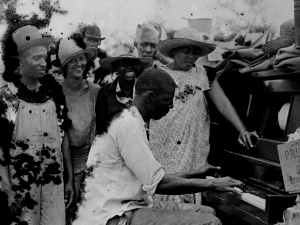
Special MoMA screening of THE GREAT FLOOD will feature live musical accompaniment
Guitarist Frisell, joined by Ron Miles on cornet, Tony Scherr on guitar and bass, and Kenny Wollesen on drums and vibes, has composed a gorgeous, moving score, heavily influenced by a trip his band and Morrison took in early 2011 up the Mississippi, with the group playing in multiple cities while the river threatened to flood again. Each chapter, from an overhead view of a computerized map that details the 1927 flood to a fast and furious foray through the Sears Roebuck catalog, from a Baptist church procession to a series of rare clips of such bluesmen as Big Bill Broonzy, Son House, Sonny Boy Williamson, and Robert Lockwood, features a different piece of music, highlighted by Frisell’s always inventive guitar and Miles’s deeply expressive horn. Of course, as the images pass by, it’s impossible not to think of Hurricanes Katrina and Sandy and be awed by the devastating power of nature, as well as realize how little has changed with regard to the reaction of politicians and who the victims tend to be. But the film is rarely mournful; instead, there’s often a celebratory quality about it, centered on people’s natural instinct to survive. The Great Flood is screening November 21 at 8:00, concluding MoMA’s “Bill Morrison: Compositions,” with Frisell, Miles, Scherr, and Wollesen performing the score live as a special treat. In addition, MoMA’s rotating “Bill Morrison: Re-Compositions” exhibition currently features “Decomposing Loops,” consisting of excerpts from Light Is Calling, Just Ancient Loops, and Decasia, through December 8.
VIDEO OF THE DAY: “SHE GUTTA” BY MYKKI BLANCO
This is not your bubby’s Jewish Museum. On November 20, the latest edition of the Upper East Side institution’s “The Wind Up” features Mykki Blanco, the cross-gender rapper, poet, and performance artist also known as Michael David Quattlebaum Jr. As Quattlebaum, he has written From the Silence of Duchamp to the Noise of Boys, a compilation of twenty-three poems including “The Intimacy of Being,” “Freak Jerk,” “Black Boys Are Flowers Too,” and “I Am Young Please Forgive Me,” several of which have been turned into songs by her band, Mykki Blanco & the Mutant Angels, which has released such albums as Betty Rubble: The Initiation and the three-track EP Spring/Summer 2014. In “Poem I” he writes, “I am not a man of reason / And that is exact / I am precisely not a man of logic / And that is inarguable / At some point my soul left me / It was all very casual, you know, in / that way things can sometimes be / It grew tired of my body, I suppose.” Blanco will appear in Scheuer Auditorium along with DJ P. Morris in conjunction with the Abstract Expressionist exhibition “From the Margins: Lee Krasner and Norman Lewis, 1945–1952”; the evening will also include spin art T-shirt making, a painting station, a beer and wine bar, and exhibition tours.
SOUTH ASIAN INTERNATIONAL FILM FESTIVAL 2014
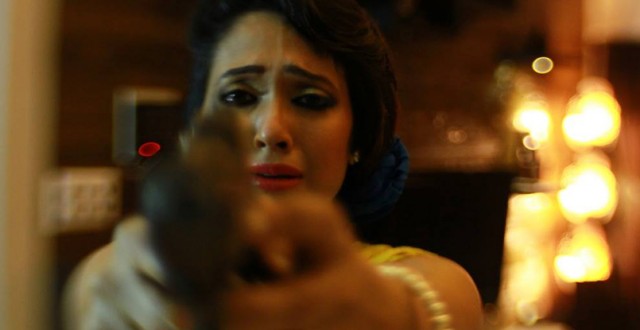
Karthik Subbaraj’s JIGARTHANDA opens the eleventh South Asian International Film Festival this week
SAIFF 2014
SVA Theatre, AMC Loews 19th St., Carlton Hotel, Joe’s Pub
November 18-23, $15-$125
www.saiff.org
The eleventh edition of the South Asian International Film Festival, which was founded by Shilen Amin to present works from India, Pakistan, Sri Lanka, Bangladesh, and Nepal and from within the Indian Diaspora, takes place November 18-23, consisting of eight feature films, four shorts, after-parties, receptions, and live music. The opening-night selection, X., is one of several festival films dealing with the art of the movies themselves, made by eleven Indian directors sharing in telling the story of a filmmaker by exploring his sexual past. In Karthik Subbaraj’s Jigarthanda (Cold Heart), a young director tries to make a reality gangster flick (Subbaraj will participate in a Q&A following the November 21 world premiere screening at the SVA Theatre), while a Bollywood writer heads to Hollywood in the centerpiece world premiere of Raj Nidimoru and Krishna D.K.’s Happy Ending. Other films include Shrihari Sathe’s Ek Hazarachi Note, Kanu Behl’s Titli, and Nabeel Qureshi’s closing-night, Karachi-set Na Maloom Afraad, which will also be followed by a Q&A. Wednesday night’s after-party at Joe’s Pub will be highlighted by a live performance by Raveena Aurora, while filmgoers are invited to mingle with the filmmakers at the closing-night cocktail reception on Sunday.
VIDEO OF THE DAY: “PLEASE DON’T TELL MY LOVER” BY EMPIRES
“And so I killed my idols / They’re dead in the vinyl / Oh, the piece came out of my soul / It’s a recital / Now she won’t understand / the dark side of my heart / all the part-time wonders,” Sean Van Vleet sings on Empires’ “Please Don’t Tell My Lover,” one of eleven tracks on the band’s major label debut, Orphan (Chop Shop / Island, September 2014). For the follow-up to 2012’s Garage Hymns, the Chicago four-piece headed to Texas to work with Grammy-nominated producer John Congleton, resulting in an anthemic record of power pop that pays tribute to such late-1980s/early 1990 idols as My Bloody Valentine, U2, Talking Heads, Nick Cave and the Bad Seeds, and even Chris Isaak. The album, which can currently be streamed here, also features such big-sounding songs as “Silverfire,” “Hostage,” “Honeyblood,” and “Stay Lonely.” Lead singer and songwriter Van Vleet, guitarists Tom Conrad and Mike Robinson, and drummer Max Steger will be at Baby’s All Right on November 14 with Cold Fronts and NGHBRS; admission is free with RSVP.