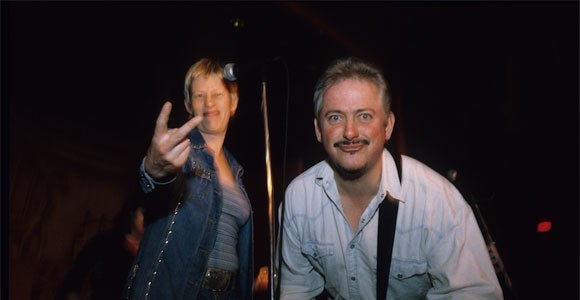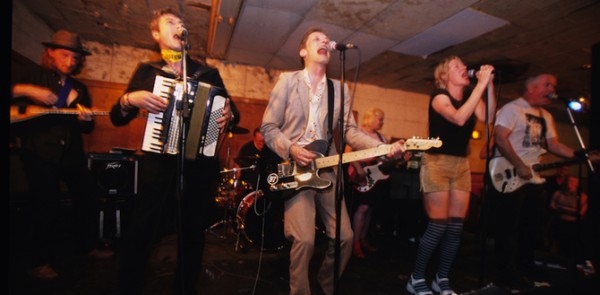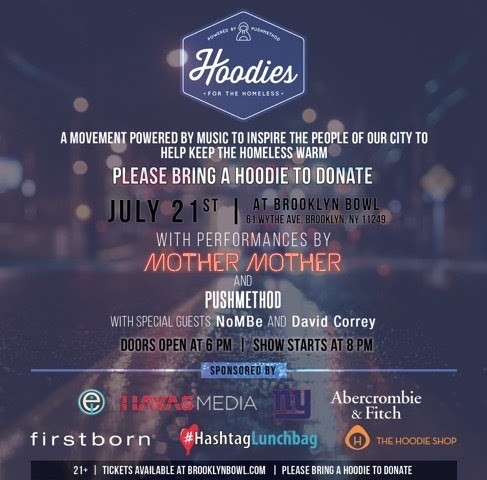
Who: Mother Mother and PushMethod, with special guests NoMBe and David Correy
What: Hoodies for the Homeless
Where: Brooklyn Bowl, 61 Wythe Ave. between North Eleventh & Twelfth Sts.
When: Tuesday, July 21, $10, 8:00
Why: It might be blazing hot outside right now, but there are a whole lot of homeless New Yorkers who could use additional clothing when the weather gets much cooler. Wanting to do more than just give spare change to people living on the street and in shelters, PushMethod leader Tavis Sage Eaton started Hoodies for the Homeless, a grassroots initiative whose mission is “to help provide warm clothing for the less fortunate during the winter months as well as to raise awareness about the amounts of people that are displaced and how to help them.” Hoodies 4 the Homeless’s next event is July 21 at Brooklyn Bowl, where fans are encouraged to bring a new or gently used hoodie to donate to the cause. If you can’t make it to the show, you can contribute by buying a hoodie from Wreck Shop Movement, which will be donating a hoodie for each one purchased. (Plus, each hoodie comes with a sticker, a pin, and music downloads from a Wreck Shop recording artist.)
this week in music
HIGH LINE ART: SUMMER 2015

New book HIGH ART: PUBLIC ART ON THE HIGH LINE looks at history of art and performance on repurposed elevated railway
The High Line
Eleventh Ave. from 34th St. to Gansevoort St.
Open daily, free, 7:00 am – 11:00 pm
www.thehighline.org
a walk across the high line, summer 2015
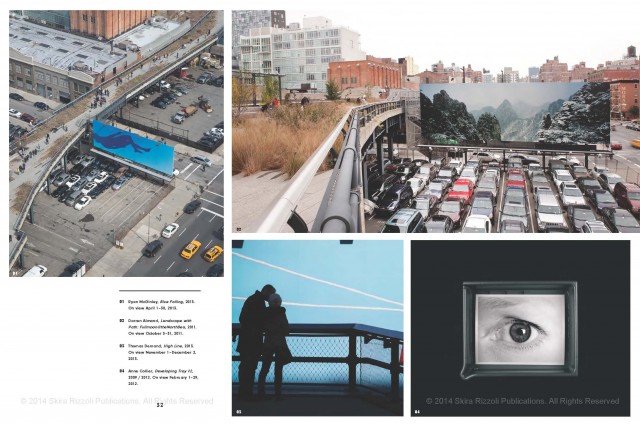
The High Line itself is a glorious work of art. The transformation of the abandoned West Side elevated railway into a public park thirty feet aboveground, weaving from Thirty-Fourth St. and the West Side Highway to Gansevoort St. by near the entrance to the new Whitney, has led to what has deservedly become one of the city’s must-see, most picturesque locations, a place for plants and trees, food and drink, rest and relaxation, and site-specific public art. In her opening essay in the lovely book High Art: Public Art on the High Line (Skira Rizzoli, May 2015, $45), High Line Art curator and director Cecilia Alemani describes the values she has instilled in the art program: “a dedication to bringing important contemporary art to a wide and diverse audience; a desire to surprise viewers with artworks that utilize public channels of communication in new and challenging ways, prompting them to question the role and function of images in public space; and a conviction that artworks are first and foremost sites of encounter and exchange of opinions and experiences.” The full-color book details the history of art on the High Line, which continues to thrillingly achieve Alemani’s goals, from group shows and film screenings to live performances and participatory events — many of which have been covered here on twi-ny — from Sara Sze’s “Still Life with Landscape (Model for a Habitat)” and Stephen Vitiello’s “A Bell for Every Minute” to Trisha Brown Dance Company’s Roof Piece and Alison Knowles’s “Make a Salad.” The large-size paperback also includes a round-table discussion between Alemani and several other curators of public art that takes a fascinating view of how the discipline is changing and how the art is commissioned and perceived. “We want to bring museum-quality works to the High Line and to make them available to our visitors, free of charge,” Alemani tells fellow curators Nicholas Baume, Sara Reisman, Manon Slome, Nato Thompson, and moderator Renaud Proch. “As simple as it sounds, this is a vision that usually resonates with many supporters who share with us a belief in art not only as a form of civic responsibility but also as a basic right that should be equally available to anyone.”

Visitors are invited to contribute to Olafur Eliasson’s “collectivity project” on the High Line (photo by twi-ny/mdr)
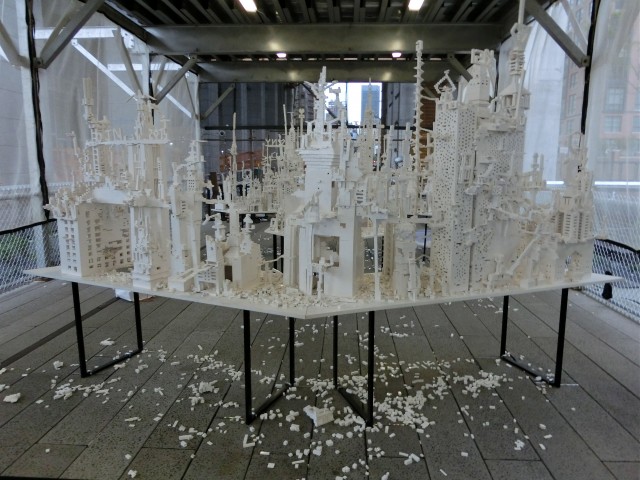
The current art on the High Line is representative of Alemani’s mission. Starting on the north side, Adrián Villar Rojas’s “The Evolution of God” (through July 31) comprises thirteen cement and clay blocks that have been slowly breaking apart and disintegrating since September 2014. Embedded at different levels in the blocks, which are just to the inside of the walking path, are such artifacts as sneakers, bones, and clothing, mimicking an architectural dig that is evolving; meanwhile, new growth is popping up in the blocks’ crevices, signaling life among death, like the High Line itself. “Panorama” (through March 2016) consists of works by a dozen artists that meld into and comment on the High Line’s natural and constructed environment. While “The Evolution of God” falls apart, Olafur Eliasson’s “The collectivity project” (through September 30) rises up, two tons of white Lego bricks that visitors are invited to play with, building imaginary cityscapes amid an area that is seeing actual heavy construction all around its perimeters. Gabriel Sierra’s “Untitled (All Branches Are Firewood)” summarizes the growth of the High Line both physically and in the popular aesthetic, comprising bright yellow measuring sticks that could be seen easily in May but have now been nearly completely overgrown by plants and trees. Kris Martin’s “Altar” turns Jan and Hubert van Eyck’s Ghent altarpiece “Adoration of the Mystic Lamb” into a celebration of New York City as a religion unto itself. Ryan Gander’s “To employ the mistress . . . It’s a French toff thing” is a classical-style bust of his wife’s body and upper torso that doubles as a water fountain in which visitors have to try to catch the water as it streams through the air. (Also watch out for Gander’s bronze wallet and cell phone that were left on a bench, as well as a sound piece, “Zooming Out / Toodaloo.”) Damián Ortega’s “Physical Graffiti” is a trio of tags made out of rebar that use the open air, instead of a city train or wall, as a canvas. Andro Wekua’s arched “Window” overlooking Chelsea Piers has now virtually disappeared behind rising plants. You should be able to find your building in Yutaka Sone’s dazzlingly intricate “Little Manhattan New York, New York,” carved in marble. The hardest piece to locate is Katrín Sigurðardóttir’s ecologically minded “Bouvetoya,” a white blob hanging underneath the High Line as you exit by the Whitney, reminiscent of all sorts of things, natural and unnatural, that grow on the undersides of New York structures.

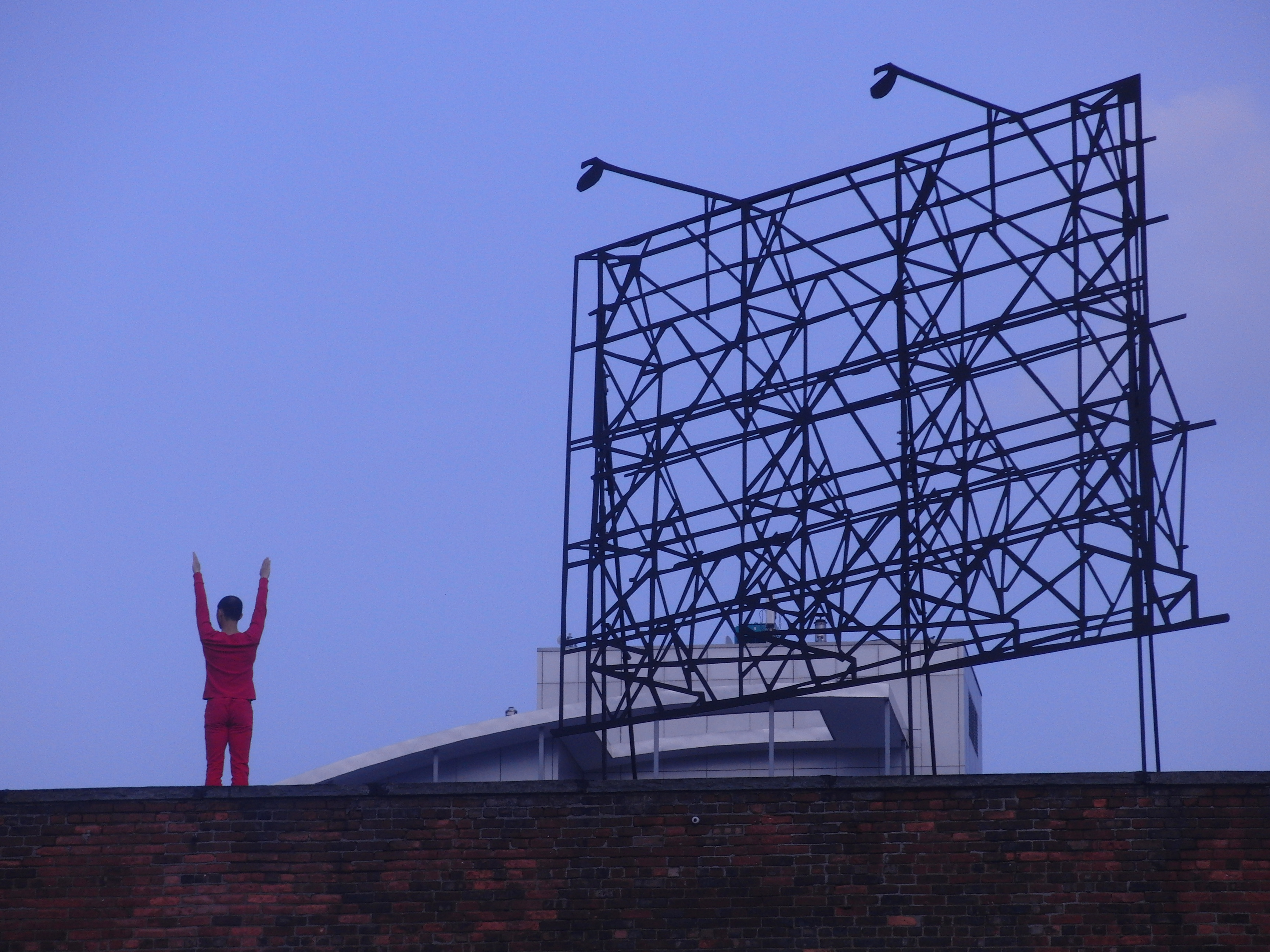
Trisha Brown Dance Company’s “Roof Piece” has been a highlight of the High Line’s innovative performance art programming (photo by twi-ny/mdr)
The High Line has also become home to exciting live performances. Last week, Francisca Benitez’s “As you lean on me and I lean on you, we move forward” combined sign language and improvisation in three chapters in three locations on three different nights. This week Aki Sasamoto’s Food Rental moves into the elevated park, taking place July 21-23 at 7:00 at the Rail Yards by the Thirtieth St. & Eleventh Ave. side. The Japan-born, New York City-based Sasamoto, whose theatrical installation “Strange Attractors” was presented at the 2010 Whitney Biennial, will be serving “micro performances and playful narrative demonstrations” from a specially built food cart, doling out unusual little plays with unexpected sets and props. Admission is free, and no RSVP is required. Afterward, you should check out the latest film screening at High Line Channel 14 in the Fourteenth St. Passage, “Before the GIF,” a series of old-style animation works by Nathalie Djurberg and Hans Berg (I’m a Wild Animal, I’m Saving This Egg for Later), Kota Ezawa (Take Off), Lauren Kelley (True Falsetto), Allison Schulnik (Eager), SUN Hun (Shock of Time, People’s Republic of Zoo), and Keiichi Tanaami (OH! YOKO!). In her High Art essay, “The Seriousness of Play: Performance on the High Line,” Adrienne Edwards writes, “Performance on the High Line is an aleatory collision of chance and unanticipated experiences that is the very pulse of the art form itself. Artists and audiences alike are immersed in the unknown possibilities of the bucolic park and its circumferential stages, which enable encounters in the realm of the swerve, which is to say that performance in this particular vector has a unique, more experimental valence, one in which the artists realize a space of the commons through fleeting structures of social choreography.” Yes, a walk across the High Line itself is like performance art, a social choreography unlike any other in this city filled with public art and social choreography.
SOMETHING ELSE: A CELEBRATION OF ORNETTE COLEMAN ON FILM — ORNETTE: MADE IN AMERICA / CHAPPAQUA

Shirley Clarke’s portrait of free jazz legend Ornette Coleman is screening in Brooklyn in a beautiful 35mm restoration
ORNETTE: MADE IN AMERICA (Shirley Clarke, 1985) & CHAPPAQUA (Conrad Rooks, 1966)
Spectacle
124 South Third St. between Bedford Ave. & Berry St.
July 17-23, $5
212-924-7771
www.spectacletheater.com
www.milestonefilms.com
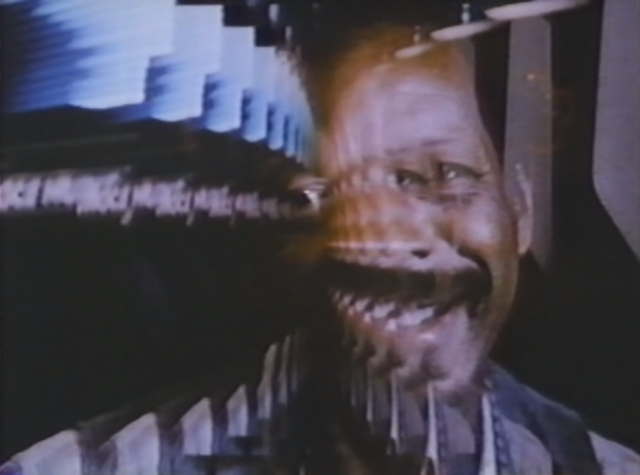
In September 1983, innovative saxophonist and Fort Worth, Texas, native Ornette Coleman received a key to the city of his hometown and then helped open the new Caravan of Dreams arts center by performing the world premiere of “Skies of America,” a specially commissioned work that teamed Coleman and his band, Prime Time, with the Fort Worth Symphony. Director Shirley Clarke uses this celebratory event as the central focus of her 1985 documentary, Ornette: Made in America, which was recently released in a beautiful new 35mm restoration overseen by Milestone Films as part of its continuing Project Shirley, which began with a dazzling new print of Clarke’s 1962 film about jazz and drugs, The Connection. In Ornette: Made in America, Clarke combines footage she shot of Coleman back in the 1960s for a never-completed film with new material that offers an inside look at Coleman and his relationship with his son, Denardo, a musical prodigy who has played drums with his father for decades, since he was a young boy. Clarke also includes staged scenes of young versions of Coleman wandering through his old neighborhood of Fort Worth, then turning to the camera to deliver determined stares, in addition to shots of a theater troupe dancing joyously down the street, Coleman performing through the years in San Francisco, New York City, and Nigeria, and interactions with such prominent figures as music critic Robert Palmer, artist Brion Gysin, writer William S. Burroughs, and architect Buckminster Fuller, who had a profound influence on Coleman’s unique free jazz sound. “As Buck says, you can’t see outside yourself, but we do have imagination,” Coleman explains inside a geodesic dome. “The expression of all individual imagination is what I call harmolodics, and each being’s imagination is their own unison, and there are as many unisons as there are stars in the sky.” Clarke puts the film together like one of Coleman’s free jazz compositions, filled with harmolodics, going from black-and-white to color and back again, cutting between interviews and live performances, moving from relaxing images to propulsive moments, and regularly bordering on the goofy, including talking heads in an animated television set, brief explanatory text in marquee scrolls, and shots of Coleman riding a spacecraft over the surface of the moon. Despite such silliness, Ornette: Made in America is a thrilling portrait of a national treasure, a one-of-a-kind musician who was still playing his unique brand of music into his eighties, right up until his death last month.
Brooklyn’s Spectacle Theater is paying tribute to Coleman with the special presentation “Something Else: A Celebration of Ornette Coleman on Film,” running July 17-22 and consisting of daily screenings of Ornette: Made in America along with Pierre Hébert’s 1968 fourteen-minute short, Population Explosion, with a score by Coleman, and Conrad Rooks’s 1966 forty-eight-minute cult film, Chappaqua, which was supposed to use Coleman’s specifically commissioned “Chappaqua Suite,” but Rooks decided to replace it because it was too good; however, Spectacle will be showing the film with Coleman’s original composition. In addition, a separate program will feature Andrew Lampert’s 2012 film, All Magic Sands/Chappaqua, which pairs Coleman’s “Chappaqua Suite” with footage from producer Al Gannaway’s never-completed religious adventure story.
GEORGE CLINTON AND PARLIAMENT FUNKADELIC: SHAKE THE GATE TOUR
SummerStage: Wednesday, July 15, Queensbridge Park, free, 7:00
BAM’s R&B Festival at MetroTech: Thursday, July 16, MetroTech Commons, free, 12 noon
Paramount: Sunday, July 19, Huntington, $25-$65, 9:00
georgeclinton.com
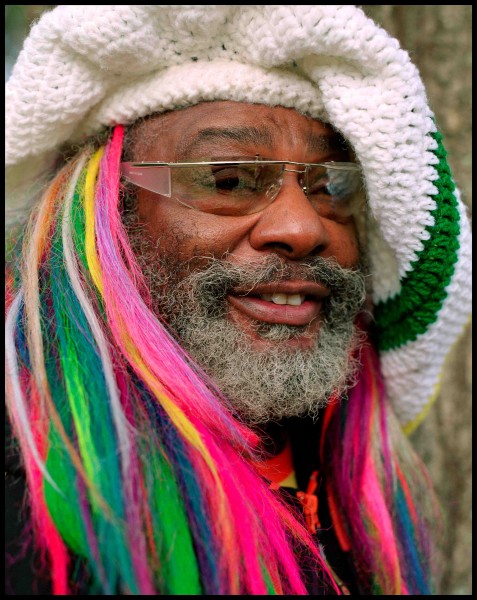
Climb aboard the Mothership for free in Queens when George Clinton brings his legendary funk ensemble and outrageous stage show to the East River on a summer night. Performing on Wednesday as part of the City Parks Foundation SummerStage series in Queensbridge Park (on the Queens side of the East River, with a view of Roosevelt Island, just a few blocks from the 21st St. stop on the F train), Clinton and his Shake the Gate Tour will also appear for free on Thursday at noon in Brooklyn as part of BAM’s R&B Festival at MetroTech and then in a ticketed show at the Paramount in Huntington on Sunday night. But there may be no better place to see Clinton — who turns seventy-four next week — play such mind-bending classics of funk as “Atomic Dog,” “Loopzilla,” and “Do Fries Go with That Shake?” than on a sweaty July night outdoors. The creator of both Parliament and Funkadelic in the 1970s, he and collaborators including Maceo Parker, Bernie Worrell, and Bootsy Collins were responsible for monster dance-floor hits such as “Flashlight,” “One Nation Under a Groove,” and the epic 1970 album Free Your Mind . . . and Your Ass Will Follow. Mixing R&B with the psychedelic guitar stylings of Jimi Hendrix, Cream, and others, Clinton was among the chief creators of funk as we know it, submerged for a time beneath the shiny disco of the ’80s, emerging triumphant again in the ’90s and the new millennium as rap and hip-hop artists such as Outkast, Busta Rhymes, Fishbone, and especially Dr. Dre have sampled him countless times. Youngsters know “Loopzilla” from the soundtrack of the video game Grand Theft Auto, as well as many other Clinton songs used on TV and in movies. As he has stated: “Funk is the DNA of hip-hop and rap” and “Sure, sample my stuff. . . . Ain’t a better time to get paid than when you’re my age. You know what to do with money. You don’t buy as much pussy or drugs with it — you just buy some.” Caught for years in a morass of licensing, copyright, and ownership issues, Clinton has been forced to limit his recent output; the latest is 2014’s (First Ya Gotta) Shake the Gate, available only on iTunes and as a three-CD Amazon set. Although musical director Garry “Starchild” Marshall Shider (aka Diaper Man) left for the next world in 2010, and in keeping with the brilliant chaos that swirls around the band, the lineup can be fluid, the current slate of Mothership members consists of many, such as guitarist Michael “Kid Funkadelic” Hampton, who have played with Parliament Funkadelic since the 1970s. Keep an ear open for “Maggot Brain”; that’ll be Hampton on lead guitar, as it has been for decades. In his 2014 memoir, Brothas Be, Yo Like George, Ain’t That Funkin’ Kinda Hard on You? (Atria, October 2014, $27), Clinton titles his introduction “Let’s Take It to the Stage (1978),” and thankfully, nearly forty years later, he’s still doing it, with three area shows in five days.
4KNOTS VIDEO OF THE DAY: “COLORS IN THE WHITES OF YOUR EYES” BY HEAVEN
Who: Surfbort, Heaven, Heaters, Meatbodies, Happyness, Screaming Females, Mikal Cronin, Twin Peaks, Stephen Malkmus and the Jicks, and Super Furry Animals
What: Fifth annual Village Voice 4Knots Music Festival
Where: Pier 84, Hudson River Park, West 44th St. at 12th Ave.
When: Saturday, July 11, general admission $25, VIP $50, 12 noon – 10:00
Why: At most outdoor music festivals, there’s almost nobody there for the first few groups, save for a few family members, a coupla friends, a photographer or two, and one dude who is determined to hold his front-and-center spot for the next ten hours. But if you choose to show up for only the bigger-name bands at 4Knots, you’ll be missing out on the wild and unpredictable Surfbort and the somewhat calmer Brooklyn dream popsters Heaven, who will be taking the stage while many in their home borough are just starting to get out of bed. Guitarist and singer Matt Sumrow and drummer Mikey Jones let some of their influences show on their 2013 Covers EP, which featured versions of New Order’s “Bizarre Love Triangle,” Fleetwood Mac’s “Go Your Own Way,” and the Kinks’ “See My Friends,” followed shortly thereafter by their debut full-length, Telepathic Love, which boasts such tracks as “Colors in the Whites of Your Eyes,” “Falling Apple,” “Mountains Move,” and “Southern Rain.” Sumrow, Jones, Yoi Fujita, and Ian Fenger will be going on at 12:40 on Saturday; try not to show them your love telepathically and instead by cheering them on at the pier.
Surfbort — 12:00
Heaven — 12:40
Heaters — 1:25
Meatbodies — 2:05
Happyness — 2:45
Screaming Females — 3:45
Mikal Cronin — 4:45
Twin Peaks — 5:45
Stephen Malkmus and the Jicks — 6:45
Super Furry Animals — 8:30
4KNOTS VIDEO OF THE DAY: “REGAN’S LOST WEEKEND (PORNO QUEEN)” BY HAPPYNESS
Who: Surfbort, Heaven, Heaters, Meatbodies, Happyness, Screaming Females, Mikal Cronin, Twin Peaks, Stephen Malkmus and the Jicks, and Super Furry Animals
What: Fifth annual Village Voice 4Knots Music Festival
Where: Pier 84, Hudson River Park, West 44th St. at 12th Ave.
When: Saturday, July 11, general admission $25, VIP $50, 12 noon – 10:00
Why: British indie three-piece Happyness will be at 4Knots on Saturday, highlighting their slacker-rock songs from their debut full-length, Weird Little Birthday (Bar/None, May 2015), on which they establish their voice and raison d’être. “I’m an anarchist, communist, feminist, phlebotomist, yeah, right,” they explain on “It’s on You.” Guitarist and vocalist Benji Compston, bassist and vocalist Jonny Allan, and drummer Ash Cooper cowrote all the songs on the album, which includes such fabulously named tracks as “Montreal Rock Band Somewhere,” “Pumpkin Noir,” “Great Minds Think Alike, All Brains Taste the Same,” “Baby, Jesus (Jelly Boy),” and the subtly epic title track. If you missed Happyness at last fall’s CMJ Music Festival, you can catch them in Hudson River Park on July 11, slotted between Meatbodies and Screaming Females.
Surfbort — 12:00
Heaven — 12:40
Heaters — 1:25
Meatbodies — 2:05
Happyness — 2:45
Screaming Females — 3:45
Mikal Cronin — 4:45
Twin Peaks — 5:45
Stephen Malkmus and the Jicks — 6:45
Super Furry Animals — 8:30
BASTILLE DAY ON 60th STREET 2015

Can-Can dancers are part of the fun at annual Bastille Day festivities on 60th St. (photo copyright Sasha Arutyunova, 2014)
60th St. between Fifth & Lexington Aves.
Sunday, July 12, free, 12 noon – 5:00 pm
www.bastilledaynyc.com
On July 14, 1789, a Parisian mob stormed the Bastille prison, a symbolic victory that kicked off the French Revolution and the establishment of the Declaration of the Rights of Man and of the Citizen. Ever since, July 14 has been a national holiday celebrating liberté, égalité, and fraternité. In New York City, the Bastille Day festivities are set for Sunday, July 12, along Sixtieth St., where the French Institute Alliance Française hosts its annual daylong party of food, music, dance, and other special activities. There will be a Wine, Cheese, Cocktails, and Beer Tasting in FIAF’s Tinker Auditorium from 12 noon to 4:30 ($25), as well as luxurious ninety-minute Champagne & Chocolate Tastings in Le Skyroom at 12:30 and 3:00 ($65) featuring delights from Moët & Chandon, Veuve Clicquot, Ruinart, La Caravelle, Piper-Heidsieck, Pommery, Chocolat Moderne, Neuhaus, Valrhona, and Le Cirque. The annual raffle ($5 per ticket) can win you such prizes as trips to France and New Orleans, concert tickets, beauty treatments and gift baskets, and more. Food and drink will be available from Bar Bordeaux, Financier, Barraca, Rotisserie Georgette, the Crepe Café, François Payard, Épicerie Boulud, Mille-feuille, Ponty Bistro, Maison de l’Éclair, Macaron Parlour, le Souk, and others. Among those taking the stage will be DJ Ol’ Stark (12 noon), Can-Can dancers (12:45 & 1:30), Benjamin Swax (1:00), Ginkgoa (2:00), the Hungry March Band (3:15), and the Arpège Choir of the Saint-Joseph de Cluny School in Martinique (4:00). The festivities also include a fencing demonstration by the Sheridan Fencing Academy, free half-hour French language workshops for beginners as well as advanced experts, the annual Citroën Car Show, and family-friendly film screenings in Florence Gould Hall, with shorts by Michel Ocelot and studios in Poitou-Charentes and the 2013 feature film Minuscule, Valley of the Lost Ants by Hélène Giraud and Thomas Szabo. So there will be plenty of opportunities to immerse yourself in French culture at this always entertaining block party.