this week in music

NYC DUMPLING FESTIVAL

Dumpling eating contest is centerpiece of festival (photo by twi-ny/mdr)

Sara D. Roosevelt Park
East Houston St. between Forsythe & Chrystie Sts.
Saturday, September 26, 12 noon – 5:00 pm
Tasting tickets: $20 for four plates
www.dumplingfestival.com

Nearly every culture makes some kind of dumpling, involving meat and/or vegetables tucked inside a wrapper made of flour or rice. So the NYC Dumpling Festival, held on the outskirts of Chinatown in Sara D. Roosevelt Park, is not merely a celebration of the Chinese delicacy but of dough-encased delights from all over the world. In past years, you could find such “dumplings” as pierogi, ravioli, empanada, mandoo, bao, shumai, and momo. The twelfth annual festivities, emceed by Danielle Chang and Anita Marks and featuring a special appearance by competitive eating favorite Takeru Kobayashi, includes fare from Dumpling Go, Bibigo, Tang’s Natural, Mika, TBaar, and festival sponsor Chef One, which serves frozen bagged dumplings. Of course, the highlight is the dumpling eating contest; last year’s men’s champion, James “the Bear” McDonald, downed eighty-six dumplings in two minutes, while women’s champ Molly Schuyler beat the Bear with a record ninety. In addition, there will be live performances by beatboxer Sung Lee, Korean drummers KTMDI (Janggu), the Lion Dance Crew from Wan Chi Ming Hung Gar Institute, Bellyqueen, and Yut and the Hot Four. All proceeds from the festival benefit the Food Bank for New York City, so you won’t have to feel too guilty about stuffing your face, if you’re patient enough to navigate the long lines.

CROSSING THE LINE: CHAMBRE

(photo by Julieta Cervantes)

Jack Ferver reimagines Jean Genet’s THE MAIDS in performance installation at the New Museum (photo by Julieta Cervantes)

New Museum Theater
235 Bowery at Prince St.
Installation: September 23 – October 4
Performances: September 24-25, October 1-2, 7:00, and September 26-27, October 3-4, 3:00, $15
www.fiaf.org
www.jackferver.org

No one tells a story quite like Jack Ferver. In such deeply personal psychodramas as Rumble Ghost, Night Light Bright Light, and Two Alike, the Wisconsin-born, New York-based performer shares intimate, cathartic memories brought to life through a loving pop-culture lens. Melding dance, spoken word, electronic sound scores, and visual art, Ferver explores suicide, abused queer youth, rape, and other serious topics while incorporating references to Tennessee Williams, Poltergeist, Fred Herko, Cleopatra, Madonna, and the 1985 cult film Return to Oz. In Chambre, which runs September 24 to October 4 at the New Museum as part of FIAF’s Crossing the Line festival, Ferver turns to Jean Genet’s The Maids, the 1947 play inspired by a pair of real-life sisters, Christine and Léa Papin, who committed a horrific crime in France in 1933. For the project, which includes eight live performances, Ferver is working with several of his longtime collaborators; the music is composed by Roarke Menzies, the costumes are designed by Reid Bartelme, the art installation (which is on view during museum hours throughout the show’s run) is by Marc Swanson, and Ferver will be joined onstage by Michelle Mola and Jacob Slominski.

Jack Ferver and Marc Swanson will present CHAMBRE as part of FIAFs annual Crossing the Line festival (photo by Julieta Cervantes)

Jack Ferver and longtime collaborators will present CHAMBRE as part of FIAF’s annual Crossing the Line festival (photo by Julieta Cervantes)

“While I’ve been mulling over the material for Chambre for years, we started our first residency at Baryshnikov [Arts Center] two years ago this month. It’s been exciting, to say the least, for me to see how much it has changed,” Ferver told twi-ny about the evolution of the show. “This iteration of Chambre at the New Museum is very different from our premiere at Bard [last year]. The context of the museum obviously has factored into it. Marc and I also originally envisioned it for the white cube. The space is more intimate than where we have performed it so far. Marc’s installation becomes a room in a room, and it is changing the performance, creating a more nuanced, vulnerable, and frightening experience for me. Michelle, Jacob, and I have already started rehearsing in the space. The script and choreography are changing as the psyche of the piece changes in the space of the New Museum.” Menzies added, “The evolution of the score for this work was interesting. I wrote maybe three separate scores before arriving at the final version. A lot of the first music cues I created really capitalized on the notion that this is a murder story. Originally, the main theme had this very suspenseful beat and dark, brooding piano melodies — very campy, and very much in the language of Friday the 13th or Halloween, which has one of the great horror scores in cinema. But I think I ended up scrapping all of those references in lieu of much more raw, uncomfortable, barely recognizable sounds that I created by manipulating and contorting recordings of my voice. As we got to the core of the work, it became clear that the real source of the horror in this piece isn’t the murder but the horror of being embodied, the horror of having to live in this cruel, terrible world. All we really have to escape that horror are the endless games we play.” Sounds like classic Jack Ferver to us, so we can’t wait to catch this highly anticipated New York City premiere.

REVOLUTION OF THE EYE: MODERN ART AND THE BIRTH OF AMERICAN TELEVISION

(photo by David Heald)

Jewish Museum show explores relationship between early television and modern art (photo by David Heald)

The Jewish Museum
1109 Fifth Ave. at 92nd St.
Thursday – Tuesday through September 27, $7.50-$15 (children eighteen and under free; free admission Saturday 11:00 am – 5:45 pm, pay-what-you-wish Thursday 5:00 – 8:00)
212-423-3200
thejewishmuseum.org

I am a proud TV baby, born into the first generation that treated television like a cherished member of the family. I actually took great offense that my bonus sibling — it was much more than a mere babysitter to me — was referred to as the boob tube and that many people claimed that watching too much of what I even as a kid considered a legitimate art form was bad for your physical and mental well-being. In Annie Hall, Alvy Singer (Woody Allen) famously explains to his actor pal, Rob (Tony Roberts), and girlfriend, Annie (Diane Keaton), why it’s so clean in California: “They don’t throw their garbage away. They make it into television shows.” Which leads me to the Jewish Museum’s fun and fascinating new look at the medium, the informative and entertaining exhibition “Revolution of the Eye: Modern Art and the Birth of American Television,” continuing through September 27. “Rarely is TV discussed in terms of art — and when it is, critics have usually focused on the ways television has influenced high art, or been critiqued and ridiculed by it,” UMBC Center for Art, Design, and Visual Culture executive director Symmes Gardner writes in his foreword to the catalog. “Yet as network television now shares the stage with other forms of broadcasting and video dissemination, we can see the ways in which this popular, commercial mechanism aided art, responded to art — and was, many times, itself art.”

Exhibition includes clip of Salvador Dali appearance on WHATS MY LINE? (© Fremantle Media)

Exhibition includes clip of Salvador Dali appearance on WHAT’S MY LINE? (© Fremantle Media)

The multimedia show follows the development of television from the 1940s through the 1970s, tracing the impact that modern art had on the telly, which in turn influenced contemporary American society. Lovingly curated by Maurice Berger — although a bit noisy, with too many of the sounds bouncing off one another — the exhibition explores links between Rod Serling’s anthology series The Twilight Zone and surrealism (including a startling comparison of the opening title sequence to clips of short films by Marcel Duchamp, Fernand Léger, and René Clair), and Ernie Kovacs and Dada (and how the comic master was among the first to exploit the technology of the medium itself while playfully attacking the corporations that sponsored it). The development of television logos, advertising, and title sequences turns out to be quite a tale, involving such cutting-edge graphic designers as Saul Bass and established artists as Ben Shahn. Rowan and Martin’s Laugh-In is seen in conjunction with Pop, Op, and psychedelic art, while the tongue-in-cheek Batman series is compared to the comic-book Pop art of Roy Lichtenstein. Even Dinah Shore and Ed Sullivan make the cut, the latter’s mod sets matched with sculptures by Sol Lewitt, Donald Judd, and Robert Morris. The exhibit also has rare clips of artists on television, including Salvador Dali, Andy Warhol, Alexander Calder, Willem de Kooning, John Cage, Duchamp, Shahn, and Lichtenstein, although they are all far too short, but a segment of Aline Saarinen’s Sunday Show with Alberto Giacometti is a real treat. There are also works by Lee Friedlander (mocking the medium), Georgia O’Keeffe, Man Ray, Robert Motherwell, Eero Saarinen (Aline’s husband), Agnes Martin, and others, in addition to sections devoted to Winky Dink and You, which invited kids to be artists using the television screen, and the Museum of Modern Art’s Television Project, which sought to place the medium in a higher art form, something that the Jewish Museum has ably accomplished in this splendid exhibit that justifies my longtime love affair with the boob tube.

OKINAWAN VIBES: TRADITIONAL DANCE FROM OKINAW, WITH LIVE MUSIC

Japan Society
333 East 47th St. at First Ave.
Friday, September 18, and Saturday, September 19, $40, 7:30
212-715-1258
www.japansociety.org

As part of its 2015-16 performing arts season, Japan Society is celebrating the history of culture of Okinawa, located in the Ryukyu island chain south of mainland Japan, with the three-month series “Okinawan Vibes.” The festival begins September 18-19 with “Traditional Dance from Okinawa, with Live Music,” copresented with Yokohama Noh Theater. The event features dancers Satoru Arakaki, Sayuri Chibana, Izumi Higa, Kota Kawamitsu, Sonoyo Noha, Yoshikazu Sanabe, and Ayano Yamashiro and musicians Shingo Nakamine, Kazuki Tamashiro, Hiroya Yokome, Hokuto Ikema, Hideo Miyagi, Natsuko Morita, and Satoshi Higa from Okinawa Prefectural University of Arts performing a quartet of court and folk dances from during and immediately after the Ryukyu Kingdom (fifteenth to nineteenth centuries), including the women’s dance onna odori, the masked classical dance shundo, and folk dances known as zo odori; the dancers will be wearing such extravagantly colored costumes as the bingata, the hanagasa, and kasuri kimonos, while the musicians will be playing the taiko, the koto, the sanshin, the kokyu, and the fue. Each evening will be preceded by a lecture led by Dr. James Rhys Edwards and will be followed by a meet-the-artists reception. In addition, Japan Society is hosting an Okinawan dance and music workshop on September 19 ($45, 4:00), in which participants will learn about the karaya dance and sanshin and see an onnagata demonstration. “Okinawan Vibes” continues with Go Takamine’s rarely shown Paradise View on October 2, “Obake Family Day: Experience Japan’s Ghosts & Goblins” on November 1, “Explore Okinawa: Art, Culture, and Cuisine from the Ryukyu Islands” on November 3, the lecture “Okinawa, the Birthplace of Karate” on November 7, and the workshop “Creating Bingata, Okinawa’s Vibrant Textile” on November 8.

AUTUMN MOON FESTIVAL AND MORE

autumn moon festival

A CELEBRATION OF ASIAN CULTURE
Snug Harbor Cultural Center & Botanical Garden
1000 Richmond Terrace, Staten Island
Saturday, September 19, $8-$10, 12 noon – 4:00 pm
718-425-3504
snug-harbor.org

On September 19, Staten Island’s beautiful Snug Harbor Cultural Center & Botanical Garden will be hosting its sixteenth annual Autumn Moon Festival, an afternoon of special programs celebrating the Asian harvest. Taking place in the Chinese Scholar’s Garden, the festival will include an arts and crafts family workshop, a performance of Rabbit Days and Dumplings by Elena Moon Park and Friends, traditional music and dance, Asian-inspired food, martial arts and Tai Chi demonstrations, calligraphy lessons, and more. In addition, on Saturday and Sunday, Snug Harbor is holding a party for the grand opening of the Staten Island Museum, with games, live music, crafts, science, food, and more; admission for that is free. And finally, on Saturday at 2:00 and 8:00 and Sunday at 2:00, the Harbor Lights Theater Company will be presenting Rent in the Music Hall ($35-$45); the production continues through October 4.

THE WARRIORS CONEY ISLAND REUNION

You can come out and play with the Warriors as many of the actors return to Coney Island for a special reunion on September 13

THE WARRIORS (Walter Hill, 1979)
Surf Pavilion
3029 Stillwell Ave., Coney Island
Sunday, September 13, $20-$25, 10:00 am
surfpavilion.com
www.warriorsmovie.co.uk

In the classic cult film The Warriors, a Coney Island gang has to return home after a disastrous gathering in the Bronx. On September 13, many of the actors from the film will be returning to Coney as well for a special reunion screening taking place at Surf Pavilion on Stillwell Ave., including Michael Beck (Swan), Dorsey Wright (Cleon), David Harris (Cochise), Bryan Tyler (Snow), Thomas G. Waites (Fox), Terry Michos (Vermin), Deborah Van Valkenburgh (Mercy), Jery Hewitt (Furies leader Muson), Apache Ramos (of the Orphans), and others. The film opens at a huge gang meeting in the Bronx (actually shot in Riverside Park), where the Warriors are wrongly accused of having killed Cyrus (Roger Hill), an outspoken leader trying to band all the warring factions together to form one huge force that can take over New York City borough by borough. The Warriors then must make it back to their home turf, Coney Island, with every gang in New York lying in wait for them to pass through their territory. This iconic New York City gang movie is based on Sol Yurick’s novel, which in turn is loosely based on Xenophon’s Anabasis, which told of the ancient Greeks’ retreat from Persia. Beck stars as Swan, who becomes the de-facto leader of the Warriors after Cleon gets taken down early. Battling Swan for control is Ajax (James Remar) and tough-talking Mercy. Serving as a Greek chorus is Lynne (Law & Order) Thigpen as a radio DJ, and, yes, that young woman out too late in Central Park is eventual Oscar winner Mercedes Ruehl.

Among the cartoony gangs of New York who try to stop the Warriors are the roller-skating Punks, the pathetic Orphans, the militaristic Gramercy Riffs, the all-girl Lizzies, the ragtag Rogues, and the inimitable Baseball Furies. Another main character is New York City itself, especially the subway system. Presented by the LSRR Tour and the Village Voice, the special conclave will include autograph signings, meet-and-greets, a cosplay contest, and live performances by the Gotham City Mashers and Sick of It All. If you can’t come out and play-ee-ay on September 13, The Warriors is also having its annual Coney Island Film Festival screening on September 19 at Sideshows by the Seashore ($10, 10:30 pm).

TREE OF CODES

tree of codes

Park Ave. Armory
643 Park Ave. between 66th & 67th Sts.
September 14-21, $30-$90
212-933-5812
armoryonpark.org

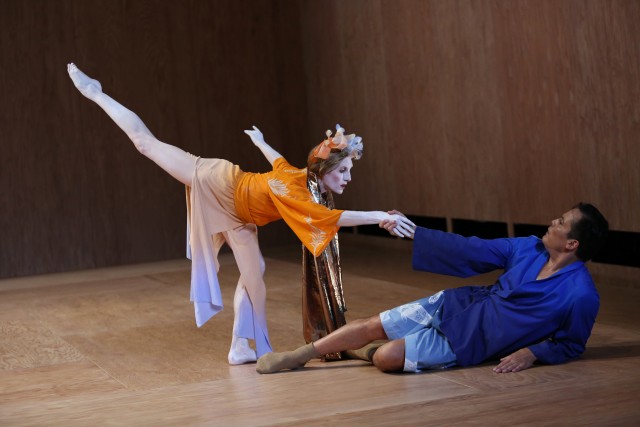
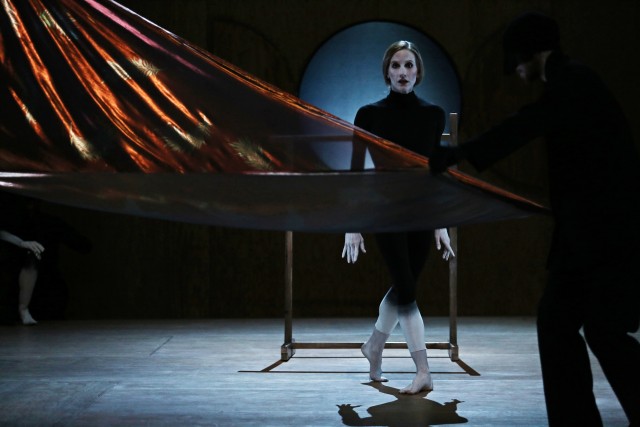
Codes are one-to-one correspondences, messages that have been transformed from one communication into another. Tree of Codes, originally presented earlier this summer at the Manchester International Festival, is a seventy-five-minute contemporary ballet that uses light, sound, color, mirrors, and movement in unique ways, transforming Jonathan Safran Foer’s 2010 book, Tree of Codes, into something entirely other. Foer’s book is a work of art that is both a literary narrative and sculptural object; every page of the paperback boasts a different die-cut as surprising word combinations continually reveal themselves. Foer’s three-dimensional story begins with Bruno Schulz’s Street of Crocodiles — which has previously been adapted by the Quay Brothers into a classically creepy stop-motion animation film — and Foer then cut out words to create a whole new tale. British choreographer Wayne McGregor (Infra, Chroma), London-born DJ and music producer Jamie xx (We’re New Here, In Colour), and Danish-Icelandic artist Olafur Eliasson (“The Collectivity Project” on the High Line, “NYC Waterfalls”) have turned Tree of Codes into a site-specific multidisciplinary performance piece, featuring members of the Paris Opera Ballet and McGregor’s company, that will take place in New York City’s most creative space, the Wade Thompson Drill Hall at the Park Avenue Armory, from September 14 to 21. “At the armory, we are always encouraging artists to push the limits of their specific disciplines. Wayne McGregor, Olafur Eliasson, and Jaime xx are each pioneers in their respective fields, and their collective vision for Tree of Codes asks us to bend our preconceived notions of traditional ballet and also the world around us,” armory president and executive producer Rebecca Robertson said in a statement. The armory has previously hosted work by the Merce Cunningham Dance Company, the Trisha Brown Dance Company, Shen Wei Dance Arts, STREB Extreme Action, Massive Attack, Christian Boltanski, Ann Hamilton, Tom Sachs, Paul McCarthy, Ryoji Ikeda, and many others, who have taken great advantage of the fifty-five-thousand square-foot space. Tree of Codes is likely to do the same.