this week in music

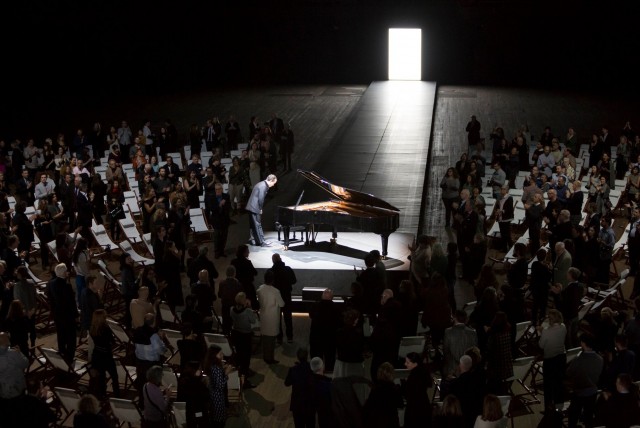
REFUSE THE HOUR

(photo by John Hodgkiss)

William Kentridge leads a troupe of dancers, vocalists, and musicians through a multimedia journey into the concept of time and space in REFUSE THE HOUR (photo by John Hodgkiss)

NEXT WAVE FESTIVAL
Brooklyn Academy of Music
BAM Harvey Theater
651 Fulton St.
October 22-25, $52-$110
718-636-4100
www.bam.org

At one point in William Kentridge’s multimedia, multidisciplinary chamber opera, Refiuse the Hour, projections of three large metronomes all move at different speeds, an apt metaphor for the eighty-minute piece as a whole, a wildly inventive and unpredictable presentation of sounds and images built around such concepts as time, anti-entropy, science, and art in addition to coincidence and fate. “I walk around the studio, waiting for these fragments that have come in to appear, and make sense, repeating the elements again and again,” Kentridge says, standing onstage in his trademark white button-down shirt and black pants and shoes in front of a projection of himself walking through his studio. The dialogue, with dramaturgy by Harvard history of science and physics professor Peter Galison, collides with the imagery in abstract ways, as beautiful and mesmerizing as it is confusing and chaotic. Kentridge serves as storyteller, discussing the Perseus myth and black holes, as well as a kind of conductor — the hand of the artist is often visible in his drawings and films — interacting with kinetic sculptures and the other members of the cast, which include dancer and choreographer Dada Masilo, vocalists Ann Masina and Joanna Dudley, actor Thato Motlhaolwa, and musicians Adam Howard, Tlale Makhene, Waldo Alexander, Dan Selsick, Vicenzo Pasquariello, and Thobeka Thukane, performing a score by Kentridge’s longtime collaborator, composer Philip Miller. Meanwhile, a percussion kit hangs from above, mysteriously chiming in. Sabine Theunissen’s ragtag set feels right at home at the BAM Harvey, wonderfully integrating Catherine Meyburgh’s video design, Greta Goiris’s costumes, and Luc de Wit’s choreographed movement of humans and machines. A companion piece to his immersive, deeply intellectual yet playful exhibition “The Refusal of Time,” Refuse the Hour refuses categorization, instead leading the audience down a dramatic rabbit hole where science and art intersect in a complex yet delightful symphony of words, images, movement, and music. “Can we hold our breath against time?” Kentridge asks. Refuse the Hour is nothing if not breathtaking itself, challenging the notion of performance as only Kentridge can. (For more on Kentridge’s current invasion of New York City, go here.)

PHOTOGRAPH: RINGO STARR AT THE STRAND

ringo starr photograph

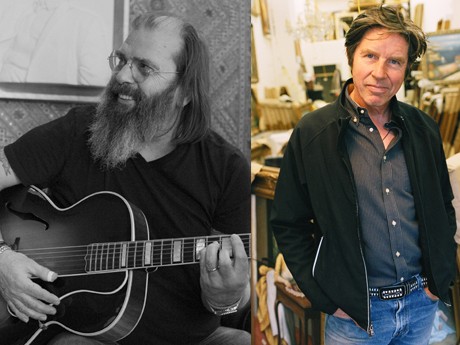
Who: Ringo Starr and Steven Van Zandt
What: Illustrated discussion celebrating recent release of Ringo Starr’s memoirs, Photograph (Genesis, September 21, $50)
Where: The Strand, 828 Broadway at Twelfth St., 212-473-1452
When: Monday, October 26, free with advance purchase of Photograph, 2:00
Why: On his 1973 solo album, Down and Out, former Beatles drummer Ringo Starr sang, “Every time I see your face / It reminds me of the places we used to go / But all I’ve got is a photograph / And I realize you’re not coming back anymore.” Forty-two years later, he has published his memoirs in a book filled with stories and photographs from throughout his childhood and music career. On October 26, he will be at the Strand to talk about the book and his life, in conversation with Steven Van Zandt. The event is limited to the first two hundred people who have purchased the book from the Strand in advance; although Ringo will not be signing the books, each one comes with a limited edition bookplate with a reproduction of his signature. “These are shots that no one else could have. I just had the camera with me a lot of the time,” Ringo says about the photos in the book. “There’s a lot of shots of ‘the boys’ that only I could have taken. Together they chart the story of four lads from Liverpool trying to live normal lives amidst the frenzy that surrounded them.” Ringo will be back in town on October 31 with his All Starr Band for a Halloween show at the Kings Theatre in Brooklyn that concludes their month-long North American Tour in conjunction with Ringo’s latest album, Postcards from Paradise.

PERFORMA 15

(photo by Alan Prada / courtesy of LUomo Vogue)

Francesco Vezzoli and David Hallberg’s FORTUNA DESPERATA kicks off tenth anniversary of biannual Performa arts festival (photo by Alan Prada / courtesy of L’Uomo Vogue)

Multiple venues
November 1-22, free – $500
15.performa-arts.org

Performa is celebrating the tenth anniversary of its biennial with another diverse lineup of live, cutting-edge performances, taking place at venues in Manhattan and Brooklyn. The festivities begin November 1 with a special opening-night benefit gala presentation ($250-$500) of Francesco Vezzoli and David Hallberg’s Renaissance-inspired Performa commission, Fortuna Desperata, at St. Bart’s and conclude November 22 with a Grand Finale party ($45) at Hôtel Americano, with the awarding of the Malcolm McLaren prize, which has previously gone to Ragnar Kjartansson and Ryan McNamara. One of the key participants this year is dancer and choreographer Jérôme Bel, whose Ballet (New York) ($15-$25) will be at the Marian Goodman Gallery November 6-7, the Martha Graham Studio Theater November 14-15, and El Museo del Barrio November 19; Bel will also teach a free Artist Class on November 5 at the Performa Hub at 47 Walker St. and will sit down for the free conversation “Don’t Just Sit There; Talking About Dance” with Performa head RoseLee Goldberg and the great Yvonne Rainer at Albertine on November 8. Meanwhile, from November 1 to November 18, Ryan Gander’s Ernest Hawker will feature an actor portraying the British artist’s future self at various Performa events; he will also give a free Artist Talk at the Performa Hub on November 2 at 3:00 with curator Mark Beasley. Below are ten other highlights of this always fascinating festival.

Friday, November 6
and
Saturday, November 7

Volmir Cordeiro: Inês, Danspace Project, $15-$20, 9:00

Saturday, November 7
Simon Fujiwara and Christodoulos Panayiotou: Lafayette Anticipation Session, featuring welcome speeches, screening of Fujiwara’s New Pompidou followed by a discussion with Fujiwara and Stuart Comer, and Panayiotou’s lecture-performance Dying on Stage with Jean Capeille, Performa Hub, free, 3:00 – 7:00

Opening of My Silent One (In the Sweetness of Time), live exhibition environment by Doveman and Tom Kalin, Participant Inc., free, 6:00 pm – 12 midnight

Saturday, November 7
and
Sunday, November 8

Arnold Schönberg’s Erwartung — A Performance by Robin Rhode, Times Square between Forty-Second & Forty-Third Sts., free, 4:30

Thursday, November 12
and
Friday, November 13

Erika Vogt: Artist Theater Program, live exhibition with collaborators Math Bass, Shannon Ebner, and Adam Putnam, Roulette, $20-$25, 9:00

Claudia de Serpa Soares, Jim White, and Eve Sussman join together for MORE UP A TREE at BAM (photo by Eve Sussman)

Claudia de Serpa Soares, Jim White, and Eve Sussman join together for MORE UP A TREE at BAM (photo by Eve Sussman)

Friday, November 13
through
Sunday, November 15

Jesper Just: Untitled multimedia performance installation in collaboration with FOS, venue and price to be announced, 5:30

Monday, November 16
through
Sunday, November 22

Oscar Murillo: Lucky dip, live work about production, protest, and displacement, Alexander Hamilton U.S. Custom House, free, 12 noon – 5:00 pm

Thursday, November 19
“Unorthodox: On Art II,” with Austė, Brian Belott, Meriem Bennani, Brian DeGraw, Tommy Hartung, Nick Payne, Jeni Spota, Jamian Juliano Villani, and others, the Jewish Museum, free with pay-what-you-wish admission, 6:00

Thursday, November 19
through
Saturday, November 21

More up a Tree, by Claudia de Serpa Soares, Eve Sussman, and Jim White, BAM Next Wave Festival, BAM Fisher Fishman Space, $25, 7:30

Saturday, November 21
Ilija Šoškić: Maximum Energy — Minimum Time, re-creation of past works in commemoration of the suicide of Russian Soviet poet Vladimir Mayakovsky, WhiteBox, free, 6:00

FRIDA KAHLO: ART, GARDEN, LIFE

New York Botanical Garden re-creates Frida Kahlos Casa Azul studio and garden (photo by twi-ny/mdr)

New York Botanical Garden re-creates Frida Kahlo and Diego Rivera’s Casa Azul studio and garden (photo by twi-ny/mdr)

The New York Botanical Garden
Enid A. Haupt Conservatory
2900 Southern Blvd., Bronx
Tuesday – Sunday through November 1, $8-$25
718-817-8700
www.nybg.org/frida
frida kahlo: art garden life slideshow

Don’t let the cold weather scare you away from seeing the New York Botanical Garden’s beautiful celebration of Mexican painter Frida Kahlo’s passionate relationship with the natural world. “Frida Kahlo: Art, Garden, Life,” on view at the Bronx institution through November 1, is a wide-ranging tribute to the artist, including paintings, photographs, a historical timeline, a re-creation of her garden and studio, known as La Casa Azul, and special programs. “When we began to research Frida Kahlo, we wanted to delve into the story of the woman who has been examined through her pain and suffering and paint her in a different light,” NYBG associate vice president of exhibitions and public engagement Karen Daubmann writes in her catalog essay, “Making Frida Kahlo’s Garden in New York: The Conservatory Exhibition.” She continues, “We wanted to learn more about the iconic face that is emblazoned on canvases, the strong and fierce-looking dark-haired, dark-eyed woman who used to be known as Diego Rivera’s wife and is now known simply as Frida. The more we researched, the more intrigued we became. . . . We were fascinated by the incredible detail of Kahlo’s curated life.” That curated life is lovingly explored in the exhibition, which features fourteen of the artist’s paintings in the LuEsther T. Mertz Library’s art gallery, including “Portrait of Luther Burbank,” in which Kahlo depicts the famed botanist emerging from the root of a tree; the vulvic “Sun and Life”; “Two Nudes in the Forest,” which was originally called “The Earth Itself”; and the sensational “Self-Portrait with Thorn Necklace and Hummingbird,” in which Kahlo, in between her first and second marriages to Rivera, paints herself surrounded by flowers, a dead hummingbird, a monkey, butterflies, and a black cat, a symbolic representation of life, death, and rebirth. The path to the next part of the show, in the Enid A. Haupt Conservatory, is lined with poems by Nobel Prize–winning Mexican poet Octavio Paz, including “The Religious Fig” and “Nightfall.” Paz was in fact not a big fan of Kahlo’s and Rivera’s; “Diego and Frida ought not to be subjects of beatification but objects of study — and of repentance . . . the weaknesses, taints, and defects that show up in the works of Diego and Frida are moral in origin,” Paz wrote in Essays on Mexican Art. “The two of them betrayed their great gifts, and this can be seen in their painting.”

Pyramid is centerpiece of Casa Azul re-creation (photo by twi-ny/mdr)

Pyramid is centerpiece of Casa Azul re-creation (photo by twi-ny/mdr)

The centerpiece of the exhibition is La Casa Azul, a reconstruction of Kahlo’s studio and garden at her family home in Mexico City, which is now a museum. The conservatory is filled with folk art objects, religious ex-voto paintings, Mexican plants described in both English and Spanish (and inspired by archival photographs), and re-creations of the Frog Fountain with its mosaic floor, Kahlo’s desk and easel, and the strikingly colorful Casa Azul pyramid, holding dozens of Mexican cacti and succulents. The conservatory exhibition was designed by Scott Pask, the three-time Tony-winning designer of The Book of Mormon, The Coast of Utopia, and The Pillowman. Outside the conservatory, by the lily pond, is a fence of organ pipe cacti, like the one Kahlo had at her San Ángel house. “Frida Kahlo: Art, Garden, Life” immerses you in the world of this fascinating artist, who passed away in 1954 at the age of forty-seven. In conjunction with the exhibition, the NYBG is hosting special programming through closing day. On Saturdays and Sundays at 1:00, there is live music and dance in Ross Hall and throughout the garden, with performances by such groups as Mexico Beyond Mariachi, the Villalobos Brothers, Flor de Toloache, and Calpulli Danza Mexicana. “Cooking with Frida” takes place in the Ruth Rea Howell Family Garden on Wednesdays, Saturday, and Sundays at 2:00 & 4:00. The daily “Frida’s Fall Harvest” consists of family-friendly activities in the Everett Children’s Adventure Garden, including a puppet show and playhouse kitchen; the children’s garden will be open till 9:30 on October 23 for “Frida for Families: A Spooky Nighttime Adventure.” Also daily (but not for kids), “Spotlight on Agave: A Tequila Story” presents the history and tradition of the Mexican spirit. October 22 is “Frida al Fresco Evening” LGBT Night, with live music, stilt dancers, and Mexican food and drink. On October 24-25 and October 31 – November 1, things get scary with Día De Los Muertos Weekends, featuring skeletal processions, stilt dancers, skull face painting, and more. The “¡Cámara, Acción!” film series continues on Sundays at 3:00 in Ross Hall with Alonso Ruiz Palacios’s Güeros on October 25 and Francisco Franco’s Last Call on November 1. Also on November 1, there will be a live performance by two male models interacting with Humberto Spíndola’s “Two Fridas” sculptural installation, based on Kahlo’s 1939 double portrait in which two versions of her sit next to each other, holding hands.

IMPROVISATION AND STATEMENTS OF FREEDOM IN JAZZ AND MOVEMENT

Choreographer Kyle Abraham and jazz drummer Otis Brown III will team up for outdoor sound and movement workshop in Times Square on October 12

Choreographer Kyle Abraham and jazz drummer Otis Brown III will team up for outdoor sound and movement workshop in Times Square on October 12

Who: Kyle Abraham and Otis Brown III
What: “Improvisation and Statements of Freedom in Jazz and Movement”
Where: Broadway Plaza, Times Square, Broadway between 42nd & 43rd Sts.
When: Monday, October 12, free, 2:00 – 4:30
Why: From November 10 to 15, MacArthur Fellow Kyle Abraham’s Abraham.In.Motion company will perform at the Joyce, in a program with live music that includes Absent Matter, a collaboration with jazz drummer Otis Brown III, a New Jersey native whose debut album, The Thought of You, was released by Revive/Blue Note last year. Brown will also be part of the Robert Glasper Trio, which will play live to Abraham’s The Gettin’ at the Joyce. You can get a taste of what’s to come on October 12, when Abraham and Brown team up for a free workshop in Times Square, for dancers and nondancers alike. “Improvisation and Statements of Freedom in Jazz and Movement” uses sound and dance to explore social change; to participate in the workshop, you can register by contacting Arts@TimesSquareNYC.org.

TWI-NY TALK: ROARKE MENZIES

(photo by Dusdin Condren)

Roarke Menzies will celebrate the release of his debut album with an intimate party October 10 at Bunna Cafe (photo by Dusdin Condren)

Bunna Cafe
1084 Flushing Ave., Brooklyn
Saturday, October 10, free, 11:00 pm
www.roarkemenzies.com
bunnaethiopia.net

Vancouver-born, Brooklyn-based multidisciplinary artist, composer, and producer Roarke Menzies knows about collaboration. For the past ten years, Menzies has been working with dancers, storytellers, choreographers, visual artists, and film directors, creating soundscapes and scores primarily using electronics, vocals, and his body. He’s been involved in projects at the Kitchen, the New Museum, Jacob’s Pillow, Abrons Arts Center, the Bushwick Starr, and the Vancouver Biennale in addition to composing music for a VICE web pilot and an award-winning educational app for children. But now Menzies, a self-described “sonic explorer,” is entering new territory, putting himself front and center with the release of his debut album, Shapes (October 13, Coup de Glotte). The record features six soundscapes, running in length from 2:11 (“Man in the Myler”) to 13:58 (“Music for Spatial Shift”), that take listeners on an ethereal journey through space and time, from the gentle, lilting “Those Pretty Lights” to the echoing, wind-strewn “Pulse Inflections.” Earlier this year, we did a twi-ny talk with Menzies and Rome about their show Philadelphia and Other Stories. Now we go it alone with Menzies, as he discusses sonic phenomena and the material world, his rather heady reading list, Aboriginal artist Warlimpirrnga Tjapaltjarri, and more.

twi-ny: We first met five years ago, when artist Nuala Clarke invited us, along with several others, to perform at her art opening, “You Delight Me,” on Shelter Island. How’s life been treating you since then?

Roarke Menzies: Yeah, that was a lovely event. Nuala contacted me out of the blue. We’d never met before. I was working on some music with my brother in LA and got an email from her asking me to participate. I think she’d found something of mine online.

I’ve been so lucky, in a lot of ways. I get approached to work on a lot of compelling projects, and between that and my other jobs [in performing arts management] I’m able to earn enough to support myself and pursue creative endeavors.

(photos by Paul Rome)

Roarke Menzies expands his horizons with new album, SHAPES (photos by Paul Rome)

twi-ny: I’m really enjoying your debut album, Shapes, which takes listeners on a fascinating sonic journey. You wrote and play all the music as well as handle the production, recording, and mixing. How long did it take you to put it all together?

RM: That’s awesome. I’m glad you’re enjoying it. These are works that have developed slowly over the past several years. The earliest recorded material on there is from late 2009 and has been revisited and reworked a number of times. I’ve put a lot of thought and care into these tracks. It’s a lot of work, but it’s definitely a labor of love.

twi-ny: You describe Shapes as both creating space and filling it up. Can you expand on that a little?

RM: I’m actually referring not just to the sounds on Shapes but to sound in general, and how we interpret sound phenomena in relation to our sense of space.

If you’re on an underground subway platform, every sound you hear reverberates in ways that inform your sense of that space. Even without visual cues, your mind can put together the cavernous space you’re in. That same effect can be simulated artificially using reverb. Sound designers and engineers make practical use of it all the time, in film or radio, for instance, creating the sense of size or the characteristics of the space you’re “in” using only sound. But that space doesn’t actually exist, at least not in the way “existence” is generally understood. It’s a fiction fabricated using particular signs and signals that your mind interprets as a space.

In other instances, the sheer “density,” “mass” or “volume” of a sound can create this feeling that it’s there in front of you — “a sound filled the room” — like you could just reach out and touch it in the same way you can touch a glass of whiskey or a person on the cheek. But sound doesn’t really behave that way either.

One of the curious aspects in working with sound as a material is that it’s not, in fact, material. And yet it seems to have this power to at times convince us of its materiality, even if just temporarily, and to completely change our sense of the material world around us. I’m interested in how those processes play out.

twi-ny: Where do you get your sonic inspirations? I have a feeling that when you traverse the city, you listen to all the cacophony and noise in a different way than the rest of us, gathering ideas for your work.

RM: I’m definitely a sound-obsessed person, and I’m often mesmerized and perplexed by the city’s sound culture. I do a lot of listening and a lot of reading. I find reading fuels my creative life like nothing else, whether articles, essays, books, blog posts, Wikipedia entries. Ben Lerner’s novel 10:04 is a recent favorite, and I have a long reading list that I’m slowly working through of texts related to performance, sound and technocultural studies. I think the next will be Brandon LaBelle’s Lexicon of the Mouth: Poetics and Politics of Voice and the Oral Imaginary.

twi-ny: That’s some heavy stuff. Shapes includes a tribute to the great La Monte Young. Who are some of your other musical influences?

RM: I feel like my influences are all over the place — Arvo Pärt, Portishead, Fluxus, Sam Cooke’s gospel recordings with the Soul Stirrers, Deerhunter’s Cryptograms, Geinoh Yamashirogumi’s soundtrack for Akira, Kanye West’s 808s & Heartbreak, the choral works of Morten Lauridsen, the rugged lands of early RZA, the pop masterpieces of Max Martin, the subterranean cityscapes of Burial, the codeine-soaked tapescapes of DJ Screw, the Courvoisier-soaked jiggyscapes of early 2000s Neptunes, etc. I’m a huge music appreciator.

twi-ny: Who do you listen to on your iPod?

RM: All that being said, there’s really not a lot of it on my iPhone. Other than work-related stuff and that U2 album we were all force-fed (I never bothered to listen to or erase it), all I’ve got on there at the moment is Cocteau Twins, Arthur Russell, Nico Muhly, Tim Hecker, Oneohtrix Point Never, James Blake, a vintage Soweto compilation, and a few mixes from the UK music publication The Wire.

twi-ny: What about seeing live music?

RM: Recent highlights that come to mind include Tyondai Braxton’s new Hive project at the Kitchen, FKA Twigs’ Congregata for Red Bull Music Academy, a riveting set from Pharmakon at St. Vitus, the experimental synth duo Long Distance Poison at Pioneer Works, and an improvised set from saxophonist Colin Stetson, bassist Trevor Dunn, and drummer Greg Fox (of Zs) at Outpost.

twi-ny: You also compose scores and soundscapes for Paul Rome’s story presentations, Jack Ferver’s multidisciplinary performances, and such choreographers as Adam Barruch and Meredith Glisson. How does your creative process differ for such diverse projects, or do you approach them all the same?

RM: My approach can be radically different, depending on the project and the working styles of the people involved. I try to learn the vocabulary and codes — “When they say this, they mean this” — then develop an understanding for what will best support the work.

twi-ny: You’ll be celebrating the release of your debut album, Shapes, with a party on October 10 at Bunna Cafe in Brooklyn, and you’ll be joined by Rome, Katie Mullins, and David Kammerer. What do you have planned for the event?

RM: I’m planning a very warm, intimate event. Bunna’s a great Ethiopian restaurant with a small stage. It’s a favorite spot of mine. We’ll likely open the evening with an Ethiopian coffee ceremony. Then Paul will read a new story he’s been working on, David and Katie will each play a few new songs of theirs, and I’ll perform a short solo set. The performances will be relatively brief since the focus is really to celebrate with friends.

I actually have a really exciting last-minute addition to the night’s festivities. The Ghanaian xylophone virtuoso SK Kakraba is going to come to Bunna after his show at Bossa Nova Civic Club for an informal late night solo set. I have to thank my good friend Mike Visser (of Imaginary Tricks) for arranging that one. It’s going to be a really special night.

twi-ny: What do you do when you take a break from music, if you ever take breaks from music?

RM: I definitely take lots of breaks. When I’m not at work or focusing on a specific project, I don’t like to be holed up in my studio for no reason. I like to get out and see things, or spend time with friends and loved ones.

I recently saw an incredible painting show at Salon 94 on the Bowery. It’s the first solo show in the US by an Australian Aboriginal artist named Warlimpirrnga Tjapaltjarri, who along with his family was living nomadically until they were “discovered” in the ’80s. [Ed. note: The show, “Maparntjarra,” continues at Salon 94 through October 24.] Apparently this guy is revered as an important leader and healer among Australian tribes and is also considered one of the most important innovators in contemporary indigenous art from Australia. All I can say is it was one of the most powerful experiences I’ve ever had at a painting show, incredibly inspiring.

CINDERELLA: A BAROQUE BURLESQUE BALLET

(photo by Phillip Van  Nostrand)

Austin McCormick and Company XIV give a whole new look to beloved fairy tale (photo by Phillip Van Nostrand)

Minetta Lane Theatre
18 Minetta Lane between MacDougal St. & Sixth Ave.
Tuesday – Sunday through November 15, $40-$100
companyxiv.com
minettalanenyc.com

New York-based Company XIV brings a rather decidedly decadent edge to Cinderella, the anti-Disney version of Charles Perrault’s 1697 fairy tale about an orphaned and abused girl on the cusp of womanhood, seeking her Prince Charming despite severe family dysfunction. Billed as a “Baroque Burlesque Ballet,” this Cinderella boasts bold sexuality, acrobatics, cross-dressing, pole dancing, and a wildly imaginative score, all brought together by company artistic director Austin McCormick. Outfitted in Zane Pihlstrom’s dazzling, body-baring costumes that quote drag ball and S&M style — Pihlstrom also designed the small set, which features a lush curtain topped by a glittering crown, a baroque backdrop, and a fun-house mirror — the twelve dancers put on a dazzling show, with Allison Ulrich as Cinderella, Steven Trumon Gray as the strikingly handsome prince, Marcy Richardson and Brett Umlauf as the dastardly stepsisters, Katrina Cunningham as the heroic Fairy Godmother (who takes nurturing to a new extreme), and Davon Rainey as the devious stepmother, a fearlessly erotic combination of Tim Curry in The Rocky Horror Picture Show and Billy Porter in Kinky Boots as conceived by the Marquise de Sade and Louis XIV. The two-hour-plus show, with two intermissions, contains almost no dialogue; instead, details of the plot are revealed by performers Hilly Bodin, Lea Helle, Jakob Karr, Nicholas Katen, Malik Kitchen, and Mark Osmundsen, who walk across the stage with two-sided chalkboards announcing scenes and acts in addition to their other roles. Jeanette Yew’s lighting shows off the heated dancing and eye-opening costumes to great effect.

(photo by Phillip Van  Nostrand)

Company XIV reimagining of CINDERELLA is a decidedly adult undertaking (photo by Phillip Van Nostrand)

Highlights include a virtuoso solo by Rainey, a provocative duet between Ulrich and Cunningham, the beautifully choreographed ball scene, and a cage dance by Ulrich, turning the standard fairy-tale musical inside out with more than a touch of strip-club bravado. The score contains eerie versions of such songs as Lorde’s “Royals,” Lana Del Rey’s “Born to Die,” Roxy Music’s “Love Is the Drug,” and Nicki Minaj’s “Get on Your Knees,” as well as works by Prokofiev, Tchaikovsky, Verdi, and Irving Berlin. During the two intermissions, the performers display their vast talents in out-of-character burlesque vignettes that are well worth sticking around for. Company XIV has previously staged such compelling, cutting-edge shows as Rococco Rouge and Lover. Muse. Mockingbird. Whore, and in November they’ll be bringing back their popular Nutcracker Rouge, with their rendition of Snow White scheduled for January. We can’t wait to see what this immensely skilled and adventurous company has in store for that.