Who: The Julie Ruin
What: Panorama festival
Where: Randall’s Island Park, the Pavilion
When: Saturday, July 23, $125, 2:50
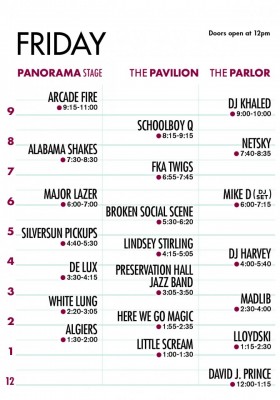
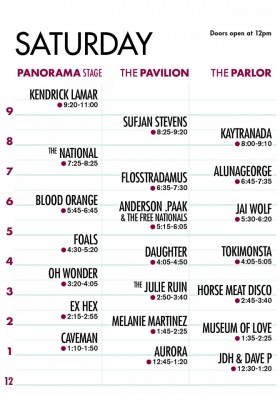
Why: Former Bikini Kill and Le Tigre legend Kathleen Hanna might declare, “I’m done,” on the Julie Ruin’s second album, Hit Reset (July 8, Hardly Art), but the riot grrrl cofounder’s career is far from over. “I’m not here to please you or beg on my knees or be the villain on your show,” she sings on “I’m Done,” adding, “I’m sick of waiting around to be heard from six feet underground.” The track is one of thirteen new tunes on the record, the follow-up to 2013’s Run Fast; the album also features such songs as “Be Nice,” “Rather Not,” and “I Decide.” On the band’s official website, Hanna, whose intriguing life was documented in the 2013 documentary The Punk Singer, notes, “I’ve written about my personal bouts with illness, abuse, sexism, and how hard it is for me to walk away from people even when they are toxic Tasmanian Devils before, but not in this way. Some songs were so close to me I had to stop singing in practice and while recording because I was crying. It’s rare to work with a group of people you feel okay doing that with. But there was laughter too.” Hanna, Kathi Wilcox, Carmine Covelli, and Sara Landeau will be at the Panorama music, art, food, and technology festival on Saturday, playing the Pavilion at 2:50; that day’s bill also includes Flosstradamus, Blood Orange, the National, Sufjan Stevens, and Kendrick Lamar. You can find the full schedule and set times for all three days here.
this week in music
PANORAMA NYC FOOD
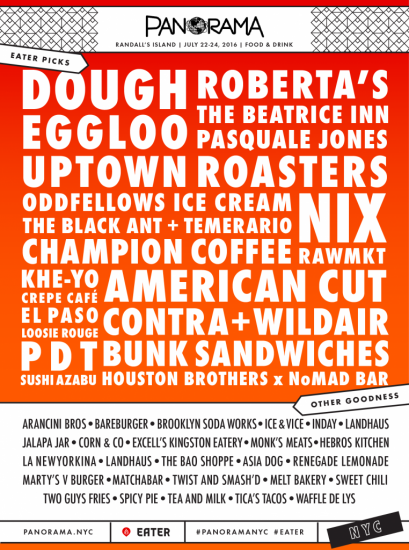
Panorama: Music Art Technology
Randall’s Island Park
July 22-24, $125 per day ($230 VIP), $369 for three-day pass ($699 VIP), ferry $25 per day, shuttle $30 per day
www.panorama.nyc
Once upon a time, the food at all-day music festivals was little more than hot dogs, burgers, cotton candy, soda, and pretzels. But the foodie revolution has changed all that, and now festivals of all genres rely on artisinal food trucks and booths to feed hungry concertgoers. Panorama NYC is right on top of the trend with some of the best food vendors in the five boroughs. Taking place July 22-24 on Randall’s Island with such performers as Arcade Fire, Sia, LCD Soundsystem, the National, Kendrick Lamar, Alabama Shakes, and Sufjan Stevens, Panorama also boasts a pretty impressive gourmet lineup of nearly four dozen eateries. Among the food purveyors, with gluten-free and vegan options available, of course, are American Cut, Arancini Bros., Asia Dog, Bareburger, the Beatrice Inn, Dough, Khe-Yo, Landhaus, MatchaBar, Melt Bakery, the NoMad, Pasquale Jones, Roberta’s, Sushi Azabu, Tica’s Tacos, and Waffle de Lys. Although you don’t go to such festivals as Panorama for the food, it’s a lot more fun when you can chow down on some quality eats and drinks while watching eleven hours of music in the hot sun.
PANORAMA NYC VIDEO OF THE DAY: BROKEN SOCIAL SCENE
Who: Broken Social Scene
What: Panorama festival
Where: Randall’s Island Park, the Pavilion
When: Friday, July 22, $125, 5:30
Why: The joyous indie Canadian musical collective known as Broken Social Scene, built by and around Kevin Drew and Brendan Canning, has consisted of a varying panoply of mainly Toronto-based talent with up to nineteen members onstage at times playing an eclectic array of instruments and featuring an ever-changing roster of female singers on tour. But after three well-received albums in four years (2001-05) and one more in 2010, BSS hasn’t released a new record, and it hasn’t performed live in the U.S. since 2011. (The band played a memorable headlining set at the Siren Festival in Coney Island back in 2008.) All that changed last week when the band appeared at a small show at Chicago’s Metro, followed by a full-on concert at the Pitchfork Festival. Exactly one week later they repeat the feat in New York with a small, sold-out Thursday night show at the Music Hall of Williamsburg and a subsequent Friday festival appearance on the Pavilion stage at the Panorama art, music, food, and technology festival, with such other performers as fka Twigs, Silversun Pickups, Alabama Shakes, Here We Go Magic, the Preservation Hall Jazz Band, White Lung, and Arcade Fire. You can find the full schedule and set times for all three days here.
SUMMER SOUNDS: STEVE SHAIMAN AND SWINGTIME BIG BAND
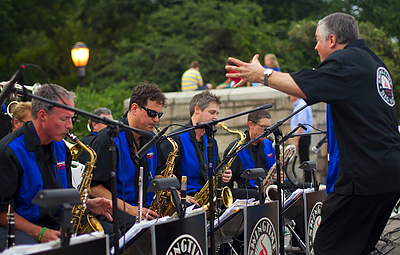
Steve Shaiman and Swingtime Big Band return for their annual summer gig in Carl Schurz Park on July 20
Who: Steve Shaiman and Swingtime Big Band
What: Summer Sounds Series at Carl Schurz Park
Where: John Finley Walk, East River Promenade, top of the 86th Street Grand Staircase
When: Wednesday, July 20, free, 7:00
Why: New York-based Swingtime Big Band, purveyors of “Authentic Swing in Living Color,” will be performing a free outdoor concert on July 20 at John Finley Walk in the shadow of Gracie Mansion as part of the Summer Sounds Series in Carl Schurz Park. Led by artistic director, saxophonist, and clarinetist Steve Shaiman, Swingtime’s seventh annual Summer Sounds show will feature the new program “By George,” big band arrangements of George Gershwin tunes from the Great American Songbook. The twenty-member Swingtime Big Band, which consists of reeds, trombones, trumpets, two vocalists, and bass, guitar, drums, and piano, has a busy couple of weeks ahead, with upcoming performances in West Hempstead, Greenport, Rocky Point, Westhampton, and Holbrook on Long Island.
PANORAMA NYC VIDEO OF THE DAY: “GOOD TO LOVE” BY FKA TWIGS
Who: FKA Twigs
What: Panorama Music Art Technology festival
Where: Randall’s Island Park, the Pavilion
When: Friday, July 22, $125, 6:55
Why: British artist FKA Twigs, formerly known as Tahliah Debrett Barnett, self-released her first four-song EP just four years ago, and she hasn’t been off the music cognoscenti’s radar since. Her last two works, LP1 and M3LL155X (pronounced “Melissa”), landed on Pitchfork’s Best New Album list two years in a row. FKA Twigs has been busy on the festival circuit this summer, in July alone playing Pemberton and WayHome in Canada, Pitchfork in Chicago, Flow in Helsinki, and, on July 22, Panorama on Randall’s Island. The singer and dancer, born in Gloucestershire in 1988, is known for her spectacular choreography and deep artistic mystique; a typical Q&A features her and world-renowned curator and art critic Hans-Ulrich Obrist discussing various dimensions of her work, often described as performance theater. Although the celebrity gossip mill is churning because of her rumored possible breakup with fiancée Robert Pattinson over Kristen Stewart, what’s far more important is that she recently unveiled a new show, called “Radiant Me²,” featuring new songs, creative dancing, and her trademark dazzling visuals. The former “Video Girl,” who danced with Kylie Minogue, Ed Sheeran, and Jessie J before beginning her solo career, has also released two other EPs, EP1 and EP2, and keeps gaining momentum with such singles as “Two Weeks,” “Pendulum,” and “Good to Love.” In the past couple of years, she has been described as fearless and a loner while not limiting herself to genres or boundaries; you can watch her continue to spread her wings this weekend when she plays the Pavilion at the Panorama art, music, food, and technology festival on Friday, with such other performers as Broken Social Scene, Silversun Pickups, Alabama Shakes, Here We Go Magic, the Preservation Hall Jazz Band, and Arcade Fire. You can find the full schedule and set times here.
PANORAMA NYC VIDEO OF THE DAY: “ALL MY FRIENDS” BY LCD SOUNDSYSTEM
Who: LCD Soundsystem
What: Panorama headlining set
Where: Randall’s Island Park, Panorama Stage
When: Sunday, July 24, $125, 9:10
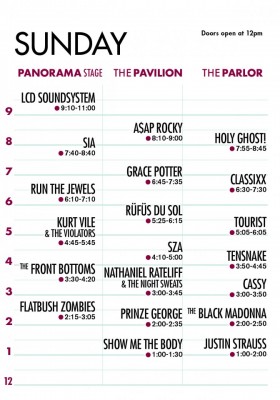
Why: On April 2, 2011, we were inside Madison Square Garden, wishing a fond farewell to dance-punk icons LCD Soundsystem as the innovative and influential band played its final show ever. “And to tell the truth / Oh, this could be the last time / So here we go / Like a sales force into the night,” lead singer James Murphy sang during one of the group’s biggest songs, “All My Friends.” In July 2012, a documentary of that grand finale was released, Shut Up and Play the Hits, with Murphy looking like he might already be regretting breaking up the band. But as he also declares in “All My Friends”: “Though when we’re running out of the drugs / And the conversation’s winding away / I wouldn’t trade one stupid decision / For another five years of life.” And yes, five years after that last stand at MSG, LCD Soundsystem returned, playing a couple of tiny shows at Webster Hall this past March, followed by summer festival gigs. On July 24, they’ll be back in their home city, headlining the third day of Panorama NYC, which takes place Friday, Saturday, and Sunday on Randall’s Island. (You can see the full schedule and set times below.) So what happened to bring Murphy, Pat Mahoney, Tyler Pope, Nancy Whang, Matthew Thornley, Al Doyle, Gavin R. Russom, David Scott Stone, Phil Mossman, J. D. Mark, and Phil Skarich back together? Murphy shared the details on the band’s website.
“i asked pat and nancy to come over to my apartment for coffee and told them: ‘i’m going to record some music. should i make up a band name, or make a “james murphy” record, or should it be lcd?’ we all thought a good amount about it. we have had lives for the past 5 years, which has been nice, and those guys have made amazing music with museum of love, the juan maclean, and all sorts of other things. i’d managed to do a bunch of fun, dumb stuff which mostly annoyed people who were into the band because, well, subway turnstiles and a coffee aren’t lcd, basically. at any rate, they both said ‘let’s make an lcd record.’”
So the band is doing its thing again, playing live shows and making new music, so we couldn’t be more excited to see them at Panorama on Sunday night. You might also find us on the Despacio dance floor, an immersive music environment created by Murphy, David and Stephen Dewaele of Soulwax, and recording engineer John Klett.
THE RUBIN BLOCK PARTY
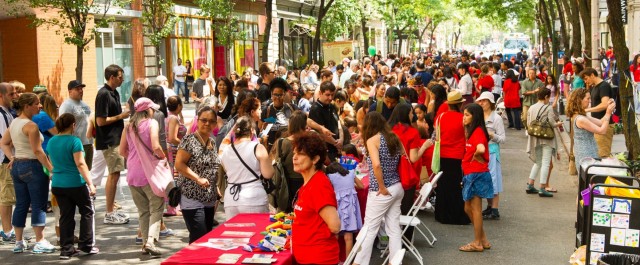
Rubin Block Party will have Nepalese-inspired theme this year (photo courtesy Rubin Museum of Art)
Rubin Museum of Art
West 17th St. between Sixth & Seventh Aves.
Sunday, July 17, free (including free museum admission all day), 1:00 – 4:00
rubinmuseum.org
Block parties are a type of social ritual, so it is rather apropos that the Rubin Museum of Art’s annual summer block party, taking place on July 17 on Seventeenth St., is being held in conjunction with the exhibition “Nepalese Seasons: Rain and Ritual,” which runs through March of next year. Hopefully it won’t rain between 1:00 and 4:00, when the museum will host Nepalese-inspired music and dance by Dikyi, Sonam Rinzin with Brooklyn Raga Massive, and Kabina Maharjan Singh and her son; educational activities with KathaSatha, Walung Community of North America, Yulha Fund (“Voice of the Himalayas”), and Mero Gaon; traditional Nepali dress demonstrations with Adhikaar; interactive weaving demonstrations with Grassroots Movement in Nepal; yoga with Susan Verde; art workshops in which participants can make rainsticks, frog masks, pinwheels, prayer flags, flower garlands, and hybrid animals; an interactive “Karma Chain” weather ritual; henna tattoos; Himalayan food from Café Serai; ice cream from Van Leeuwen; and more. In addition, the museum will be open for free all day long (11:00 am – 6:00 pm), so you can check out such exhibits as “Gateway to Himalayan Art,” “Masterworks of Himalayan Art,” “Genesis Breyer P-Orridge,” and “Sacred Spaces” in addition to “Nepalese Seasons: Rain and Ritual,” with museum tours and gallery searches for children. Namaste!