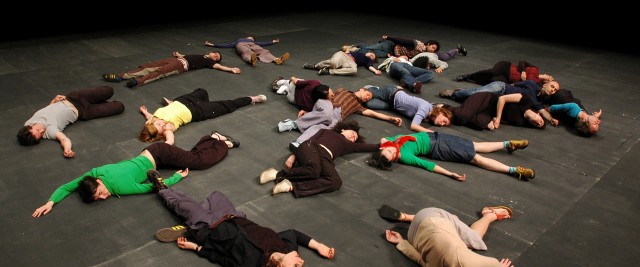
Jérôme Bel’s THE SHOW MUST GO ON will go on at the Joyce as part of FIAF’s tenth annual Crossing the Line festival
French Institute Alliance Française and other locations
Florence Gould Hall, 55 East 59th St. between Madison & Park Aves.
FIAF Gallery, 22 East 60th St. between Madison & Park Aves.
September 22 – November 3, free – $55
212-355-6160
crossingthelinefestival.org
www.fiaf.org
We can’t help but get excited for FIAF’s annual multidisciplinary fall festival, Crossing the Line, now celebrating its tenth anniversary. Every summer, we eagerly await the advance announcement of what they’ll be presenting, then scour the lineup for the most unusual events to make sure we see them. This year is another stellar collection of cutting-edge international dance and theater, beginning September 22 and 24 with screenings of concluding episodes seven, eight, and nine of Nature Theater of Oklahoma’s epic Life and Times at Anthology Film Archives ($11), along with a Thursday night party in FIAF’s Florence Gould Hall ($10) that begins with a screening of the eighth chapter of Kristin Worrall’s rather ordinary life, with the artists themselves serving up PB&Js. The festival features a special focus on French choreographer Jérôme Bel, who will be involved in four programs, beginning October 17 (free with RSVP) with a screening of his short biographical film on Paris Opera dancer Véronique Doisneau, followed by a discussion with Bel and Ana Janevski. Bel’s award-winning The Show Must Go On will go on at the Joyce October 20-22 ($36-$46), with Bel hanging around for a Curtain Chat after the 2:00 show on October 22. Bel will present the New York premiere of his controversial eponymous 1995 signature work at the Kitchen October 27-29 ($20) while also moving over to the Museum of Modern Art October 27-31 (free with museum admission) for Artist’s Choice: MoMA Dance Company, a site-specific piece for MoMA’s Marron Atrium that will be performed by members of the MoMA staff.
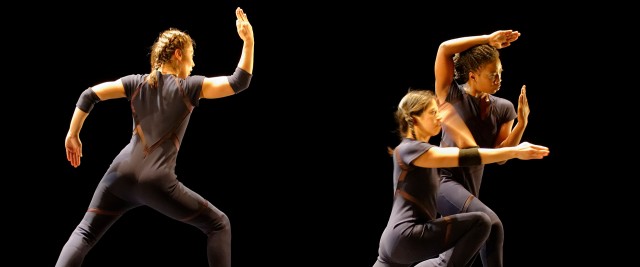
Tenth annual Crossing the Line festival features special focus on breakdance world champion Anne Nguyen, including U.S. premiere of AUTARCIE (….): A SEARCH FOR SELF-SUFFICIENCY
Breakdance world champion Anne Nguyen is making her U.S. debut with a pair of works: the free Graphic Cyphers will take place September 23 at Roberto Clemente Plaza in the Bronx at 2:00 and in Times Square September 25 at 2:30 and 4:30, while Autarcie (….): a search for self-sufficiency has its American debut September 29 to October 1 ($20) at Gibney Dance. “I seek to reconcile the peculiarities of hip-hop with demanding theatrical performance to question the place of human beings in the modern-day world,” Nguyen says; you can hear more from her at the October 1 artist talk “Towards Cultural Equity: The Artist’s Perspective” (free with RSVP) with fellow panelists David Thomson, Mohamed El Khatib, and Rokafella, moderated by George Emilio Sanchez. The UK’s Forced Entertainment, which is “interested in confusion as well as laughter,” will likely dish out a healthy portion of both at the New York premiere of Tomorrow’s Parties in Florence Gould Hall September 28 and 30 and October 1 ($20). From September 30 to October 2 ($35-$55), Venice Biennale lifetime achievement award winner Romeo Castellucci will deliver the one-man show Julius Caesar. Spared Parts, making the most of Federal Hall’s marble columns. This past June, dancer-choreographer Maria Hassabi gave an informal preview of her latest work, Staged, on the High Line; she will now bring the final piece down to the Kitchen, below the High Line, where it will be performed by Simon Courchel, Jessie Gold, Hristoula Harakas, and Oisín Monaghan October 4-8 ($20).
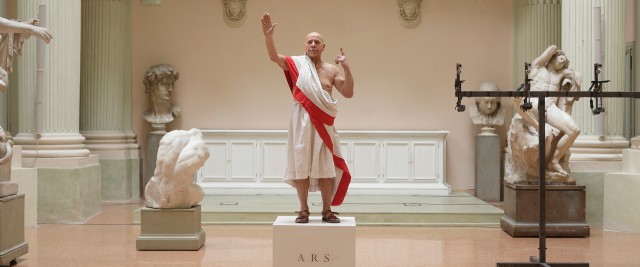
Romeo Castellucci will make his New York City debut channeling Julius Caesar at Federal Hall
On October 6-8 and 13-15 ($35), drag fabulist Dickie Beau will conjure up Marilyn Monroe, Judy Garland, and Richard Meryman at Abrons Arts Center for Blackouts. [Ed. note: All performances of Blackouts have been canceled because of unexpected travel circumstances.] Also on October 13-15 ($20), Lora Juodkaite and Annie Hanaeur will perform the U.S. premiere of Rachid Ouramdane’s Tordre (Wrought) at Baryshnikov Arts Center; CTL veteran Ouramdane will take part in the October 15 artist talk “Towards Cultural Equity: The Institutional Perspective” (free with RSVP) with keynote speaker Patrick Weil, panelists Firoz Ladak and Zeyba Rahman, and moderator Thomas Lax. On October 25 (free with RSVP), Aaron Landsman will host Perfect City, in which a group of young people from the Lower East Side will gather at Abrons Arts Center and discuss what the future holds in store for them, particularly in their neighborhood. The festival ends on November 3 with My Barbarian’s Post-Party Dream State Caucus at the New Museum (free with RSVP), held in conjunction with the exhibition “The Audience Is Always Right.” Throughout the festival, you can check out Mathieu Bernard-Reymond’s “Transform” art exhibit in the FIAF Gallery, and Tim Etchells’s multichannel video installation “Eyes Looking” will be projected at 11:59 each night in Times Square as October’s Midnight Moment.