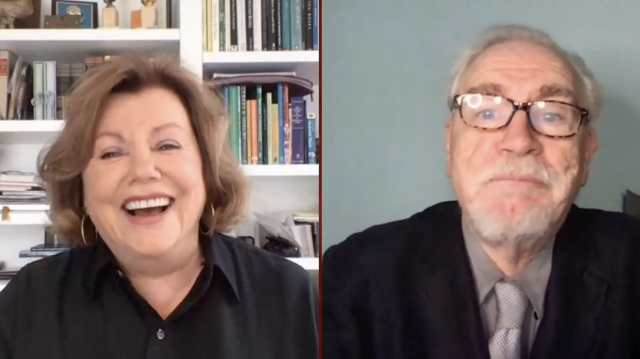
Who: Kathryn Hunter, Damian Lewis, Clarke Peters, Lesley Sharp, Jason Isaacs, Nyasha Hatendi, Brian F. O’Byrne, Nick Holder, Bryan Doerries What: Live Zoom theatrical production and discussion from Theater of War Where: Zoom link sent with advance registration When: Thursday, September 3, free with RSVP, 2:00 Why: One of the best Zoom presentations of the pandemic has been Theater of War’s The Oedipus Project, in which Frances McDormand, John Turturro, Oscar Isaac, Jeffrey Wright, Frankie Faison, David Strathairn, Glenn Davis, Marjolaine Goldsmith, and Jumaane Williams gave a live, powerful dramatic reading of scenes from Sophocles’s fifth-century BCE classic, Oedipus the King, from wherever they were sheltering in place. (Isaac delivered an unforgettable finale as the tortured king.) The event was introduced by Theater of War cofounder and adapter/director Bryan Doerries, who also led a postshow discussion relating the play to the Covid-19 crisis.
The organization now heads virtually across the pond for an all-star UK edition of The Oedipus Project, featuring Kathryn Hunter, Damian Lewis, Clarke Peters, Lesley Sharp, Jason Isaacs, Nyasha Hatendi, Brian F. O’Byrne, and Nick Holder. The production will take place September 3 at 2:00 and will also conclude with a discussion facilitated by Doerries with four community panelists, focusing on the subjects of aging, dementia, elder care, and family dynamics, examining the play — which Shakespeare wrote, perhaps while self-isolating, during the 1606 plague, when theaters had shut down — in context with the current pandemic.
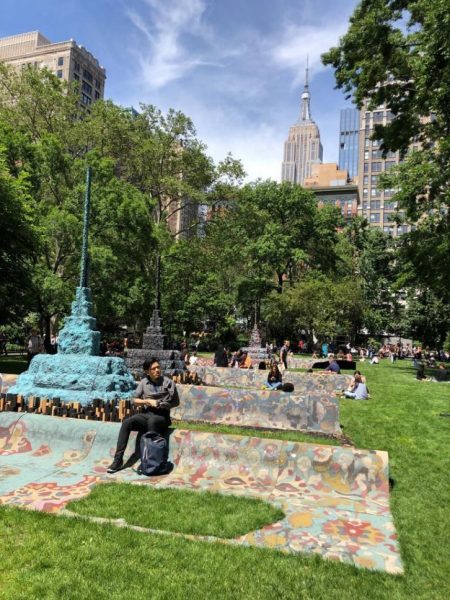
Who:Leonardo Drew, Mary Sabbatino What: “Galerie Lelong Conversations” Where:Galerie Lelong Zoom When: Wednesday, September 2, free with advance registration, 2:00 Why: “Galerie Lelong Conversations” continues September 2 with Tallahassee-born, Bridgeport-raised, Brooklyn-based sculptor Leonardo Drew, who will be speaking from his studio with gallery vice president and partner Mary Sabbatino. They will be focusing on Drew’s newest projects in addition to his first outdoor installation, City in the Grass, a striking amalgam of miniature buildings on undulating carpets with holes where grass can grow through.
In his artist statement about the commission, which was on view in Madison Square Park from June to December of last year, Drew explained, “Reaching. It’s all about reaching. Life lays out its plan, but you need to reach to achieve. My journey to realize City in the Grass is a life diagram filled with twists, turns, thrills, and doors blown wide open. What I had in mind and where I ended up are vastly different . . . for all the right reasons. Working outside and understanding the poetic and concrete concerns is a learning curve that needed to be addressed. The idea of meeting the existing (historic) skyscrapers with a vertical/monumental structure was quickly scrapped. . . . What if we switched the perspective? How the kids in my neighborhood read my works on the floor of my studio convinced me that this was the direction. Gulliver, Lilliput. From cinema, The Wizard of Oz, Metropolis . . . The details are explained in the piece itself. Imagining that my philosophy of viewers being complicit in the completion of the art could be made whole is truly a revelation in this particular work. While they walk on it, lie on it, climb on it, they add to (and subtract from) the new iteration ‘the new self of the work.’ Could not and would not have it any other way.” The work is currently on view at the North Carolina Museum of Art. You can watch previous “Galerie Lelong Conversations” with Kate Shepherd here and Jaume Plensa here.
Who: Marsha Mason, Brian Cox What: Special benefit reading of Jerome Kilty’s Dear Liar Where:Bucks County Playhouse When: Tuesday, September 1, $25 in advance, $35 day of show, 7:00 Why: “The perfect love affair is one which is conducted entirely by post,” George Bernard Shaw claimed, and he had just such an epistolary relationship with Mrs. Patrick Campbell, aka Mrs. Pat, an actress who appeared in several of his plays and for whom Shaw created the role of Eliza Doolittle in Pygmalion. Their letters, which encompass forty years, were published in 1952, two years after Shaw’s death, and actor, director, and playwright Kilty adapted their exchanges for the stage in 1957. On September 1, Bucks County Playhouse will be hosting a livestreamed virtual reading of the play, with four-time Oscar and Grammy and Emmy nominee Marsha Mason and Emmy and two-time Olivier Award winner Brian Cox, directed by Obie and Drama Desk winner Mark Brokaw. Mason and Cox join a parade of stars who’ve taken on the roles: The play came to New York City in 1960, starring Katharine Cornell as Mrs. Pat and Brian Aherne as Shaw, was made into a 1964 television movie with Zoe Caldwell and Barry Morse, and was turned into a 1981 film with Jane Alexander and Edward Herrmann.
Marsha Mason and Brian Cox star in virtual benefit reading of Dear Liar
The reading translates wonderfully to Zoom, with Mason (The Goodbye Girl, Chapter Two) and Cox (Rat in the Skull, Succession) performing from where they are sheltering in place. The two are an utter delight to watch; one of the toughest parts of getting online plays to work is for the actors to make a connection not only with the audience but with each other, and Mason and Cox accomplish that with an infectious enthusiasm; they are truly enjoying every minute of being together, even though they are in different locations, and the viewer can’t help but become part of the rapturous celebration of the written word. Kilty structured the play so it’s not merely a reading of letters but a fabulous conversation between two people with rather large egos, with occasional narration. “All I ask is to have my own way in everything,” Shaw commands. Mrs. Pat explains, “Oh, when you are tender like this, a thousand cherubs peek out from under your purple and black wings. Oh, it’s getting difficult not to love you more than I ought to love you. Offend me, quickly, to pull me together again but don’t come here.” They discuss theater, America, the casting of Henry Higgins, age, jealousy, illness, libel, the publication of these very letters, and their families in a thrilling battle of the sexes, gleefully directed by Brokaw (How I Learned to Drive,Heisenberg), who cheerfully plays around with Zoom boxes.
Mason is a delight as Mrs. Pat, whom Shaw calls Stella, taking a slightly more subtle approach than Cox, whose charismatic portrayal of Shaw, whom Mrs. Pat calls Joey, is gloriously bombastic. He can barely contain himself within his Zoom square while Mason watches him ever so eagerly, perhaps having even more fun than we are. Cox has been a pandemic all-star; the New York City resident has been spending time at his Columbia County country house, where he did a magnificent dramatic reading of a section of James Joyce’s Ulysses for Symphony Space’s Virtual Bloomsday on Broadway, sitting outside near the woods, wearing a Panama hat, and involved his wife, Nicole Ansari-Cox, and sons Orson and Torin in Melis Aker’s hysterical short play Fractio Panis for the Homebound Project, which should land them their own family reality show. (When Shaw mentions in Dear Liar that a doctor has “stabbed in the seat” to cure him of a sickness, it recalls Cox’s demands for an “ass thermometer” in Fractio Panis.) The Dear Liar reading benefits the Bucks County Playhouse Pandemic Campaign; tickets are $25 in advance and $35 the day of the performance.
Ursula von Rydingsvard, seen here in her Williamsburg studio, will take part in virtual webinar on September 1
Who:Ursula von Rydingsvard, Amanda Gluibizzi, Jason Rosenfeld, Vi Khi Nao What: Virtual webinar Where:The Brooklyn Rail Zoom When: Tuesday, September 1, free with RSVP, 1:00 Why: I had long ago fallen love with the extraordinary sculptures of German-born, Brooklyn-based artist Ursula von Rydingsvard, monumental wooden works that breathe with the glory and complexity of life. But I fell in love all over again upon seeing Into Her Own, Daniel Traub’s intimate and revealing portrait of von Rydingsvard’s difficult life and artistic adventures; screening virtually through Film Forum, it was followed by a live Q&A that further showed von Rydingsvard to be an extraordinary human being, charming and engaging, open and honest. (You can watch the discussion here.) On September 1, in conjunction with her longtime gallery, Galerie Lelong & Co., the Brooklyn Rail will be hosting a live Zoom talk with von Rydingsvard, in conversation with Rail ArtSeen editor Amanda Gluibizzi and Rail editor-at-large Jason Rosenfeld. The event, which is free and will conclude with a poem from Vi Khi Nao, is part of the Rail’s “New Social Environment” series, which features such upcoming programs as “Common Ground: A Conversation with Dwight Bullard,” “Yto Barrada with Yasi Alipour,” and “Andy Goldsworthy with Jason Rosenfeld.”
Who: Christine Andreas, Sarah Uriarte Berry, Christina Bianco, Chuck Cooper, Robert Cuccioli, Marc De la Cruz, George Dvorsky, Anita Gillette, Jason Graae, Ann Harada, Leah Hocking, Richard Jay-Alexander, Judy Kaye, Jeff Keller, Eddie Korbich, Michael McCormick, N’Kenge, Barry Pearl, Gabriella Pizzolo, Stephanie Pope, Faith Prince, Courtney Reed, T. Oliver Reid, Steve Rosen, Jennifer Sanchez, Analise Scarpaci, Tony Sheldon, Ryan Silverman, Paulo Szot, Ben Vereen What: Benefit for the Actors Fund, hosted by Theater Pizzazz Where:Metropolitan Zoom When: Monday, August 31, $20, 7:00 Why: On August 31 at 7:00, Sandi Durell’s Theater Pizzazz, an entertainment website dedicated to live music and theater, is presenting the world premiere of the video “The Theatre Will Survive,” a song created during the pandemic to celebrate the resiliency of the industry. The lyrics are by Michael Colby, with music and orchestrations by Ned Paul Ginsburg. The cast features such award winners and favorites as Chuck Cooper, Anita Gillette, Judy Kaye, Stephanie Pope, Faith Prince, Courtney Reed, Paulo Szot, and Ben Vereen. The evening will include a live chat with many of the participants; all proceeds benefit the Actors Fund’s Covid-19 Emergency Relief Fund.
Who: Jenn Colella, Lilli Cooper, Chilina Kennedy, Ezra Menas, Melanie Field, Jessie Shelton, Anna Crivelli, Danielle Chaves, Hannah Van Sciver, Madeleine Barker, Em Weinstein, Emily Johnson-Erday, Sophia Choi, Stephanie Cohen, Rebecca Adelsheim What: Live, virtual benefit concert Where:soldiergirls.org When: Monday, August 31, free with RSVP (donations accepted), 7:00 Why: An all-star cast will participate in Rattlestick Playwrights Theater’s live, virtual concert staging of the new “lesbian musical sex comedy” SOLDIERGIRLS. Tickets are free, but donations will be accepted to support SPART*A (Service Members, Partners, Allies for Respect and Tolerance for All), the mission of which “is to advocate for our actively serving transgender military members, veterans, and their families.” The two-person show features book and lyrics by 2019-20 Rattlestick artistic fellow Em Weinstein and music by Emily Johnson-Erday, inspired by actual letters and found and original text from personnel serving in the Women’s Army Corps during World War II. The sixty-minute presentation will include behind-the-scenes information from the creators as well as costume designer Sophia Choi, set designer Stephanie Cohen, and dramaturg Rebecca Adelsheim; among the performers are Jenn Colella, Lilli Cooper, Chilina Kennedy, Ezra Menas, Melanie Field, and Jessie Shelton. You can find out more about the show in this inside look from PBS.
Epicentro takes a look at paradise, imperialism, war, slavery, freedom, utopia, and the power of cinema in Cuba
Who: Hubert Sauper, Eric Hynes, Beth Gilligan What:Epicentro (Hubert Sauper, 2019) Where:Museum of the Moving Image (August 28 – September 13, $12) When: Sunday, August 30, free, 3:00; Saturday, September 5, free, 3:00 Why: Nothing was ever the same once Christopher Columbus and the Europeans arrived in Cuba on October 28, 1492. Oscar-nominated filmmaker Hubert Sauper explores more than five hundred years of Cuban history in the poetic and intimately honest Epicentro, which opens virtually August 28 through the Museum of the Moving Image here in New York City. Hubert Sauper (Darwin’s Nightmare,We Come as Friends) wanders through the streets of the island nation, taking his camera into apartments and businesses as he passes by burned-out buildings and cars, speaking with men, women, and children about such complex issues as utopia, dystopia, imperialism, racism, slavery, and freedom, relating it all to the invention of film. “Cinema projects our soul. Cinema moves humans to emotion,” a man tells a group of young students while screening documentary images of military battles and Georges Méliès’s fantastical 1902 A Trip to the Moon. The kids boo as America raises its flag in Cuba at the end of the Spanish-American War. “Havana means heaven, the dwelling place of angels, and it was the epicenter of three dystopian chapters of history: slave trade, colonization, and globalization of power, ingredients of modern empire,” Sauper narrates.
The film was inspired by Johannes Schmidl’s 2014 book, Energie und Utopie, and it isn’t hard for Sauper to find the indomitable energy of the Cuban people. Sauper eschews talking-head experts, historians, politicians, and well-known faces and instead lets the people tell their own story, especially two young girls who are wise beyond their years. At one point they have a rather remarkable conversation about Americans. “What happens here in Cuba is that we Cubans are used to . . . it is because they are treating other people like . . . they are superior to us, and they have more money and more of everything. They are richer than us. Some of us don’t know what goes on abroad,” one says. The other adds, “Some Cubans think that they are coming to harm us and treat us badly.” First girl: “Now there is that damned Trump.” Second girl: “Trump cares about nobody . . . he has no feelings.” First girl: “He does not lift the embargo, talks about the bad things in Cuba, and he closed the borders to migrants.” Later, on a rooftop, the first girl explains, “Nobody should be treated as if they were trash. Because black just like white means being a person.” As serious as the girls can get, however, they are later shown having a ball as they dress up and take pictures of each other pretending to be fashion models.
Sauper, who wrote, directed, photographed, and co-edited the film (with Yves Deschamps), also encounters prostitutes; a single mother; lots of people driving classic old cars from the Mafia era; a crowd mourning the death of Fidel Castro; a white photographer who refuses to pay his subjects (“to be photographed by me is an honor”); Oona Castilla Chaplin, Charlie Chaplin’s granddaughter, who teaches the kids about acting and music; and a tango-loving Bavarian man who notes, “Travelers who come here are people who have already traveled the world. And they are on a quest for the yet undiscovered paradise.” Meanwhile, a man in a bar complains, “I’d like to say that tourists are humanity, are human beings in their worst possible form. What kind of future is built by tourism? None. It only devours the future. It devours the past and culture, it renders everything superficial, into stupidity, into a relationship of power, constantly. . . . How much does making cinema resemble tourism?” But more than anything, Sauper captures the innate love Cubans have of their country, their history, their culture, and life itself. Their eyes glow with an infectious spirit even when they’re immersed in poverty, always ready to make the best of a situation, particularly the children, whom Sauper refers to in the credits as “little prophets.”
“Cuba is the beauty for the whole world,” a man says while pointing out the tiny island nation on a giant floor map in a theater. And Epicentro, winner of the Sundance World Cinema Grand Jury Prize for Documentary, is one beauty of a film.
On August 30 at 3:00, the Museum of the Moving Image will host a live Q&A with Sauper, moderated by film curator Eric Hynes, followed on September 5 at 3:00 by a live Q&A with Sauper and Coolidge Corner Theatre director of development and marketing Beth Gilligan.