this week in (live)streaming

#IVOTED HEADCOUNT FESTIVAL

Who: Trey Anastasio, the Disco Biscuits, Fantastic Negrito, Umphrey’s McGee, Jim James, Citizen Cope, Billie Eilish, MGMT, Jerry Douglas, Jim James, Taking Back Sunday, GEM, Jeff Tweedy, Rise Against, the Dresden Dolls, Colin Meloy, the Polyphonic Spree, Shawn Colvin, Bush, Jukebox the Ghost, Drive-by Truckers, Phantom Planet, DJ Logic, more
What: Virtual festival in support of get-out-the-vote efforts
Where: ivotedconcerts.com
When: Tuesday, November 3, free with RSVP, noon – late
Why: Although we are unlikely to know who is president on November 3, all of us who voted can at least know that we honored our responsibility to participate in our democracy, especially with voter suppression on the rise. The nonpartisan, nonprofit HeadCount is celebrating the end of the election with #iVoted, a virtual music festival featuring hundreds of bands, performing live, sending in videos, or taking part in conversations, divided into eighteen themed stages depending on where they’re from or where they are trending, including the battleground states of Michigan, Wisconsin, Pennsylvania, Florida, Texas, and Ohio as well as college campuses. The event will conclude with the Everyone Orchestra — Andrew Borger of Pink Martini, JP Downer of Portland Cello Project, Sarah Clarke of Dirty Revival, Asher Fulero of Emancipator Ensemble, Steve Berlin of Los Lobos, and Nick Werth, conducted by Matt Butler — performing the two-set “Soundtrack to History,” followed by a dance party with DJ Logic. You’re also encouraged to send in a selfie outside a polling place or voting by mail. Among those making appearances are Trey Anastasio, the Disco Biscuits, Jim James, Citizen Cope, Billie Eilish, MGMT, GEM, Jeff Tweedy, Rise Against, the Dresden Dolls, Colin Meloy, the Polyphonic Spree, Shawn Colvin, Bush, Jukebox the Ghost, Drive-by Truckers, and Phantom Planet.

MINISTRY OF TRUTH: 1984/2020 EXHIBITION AND Q&A

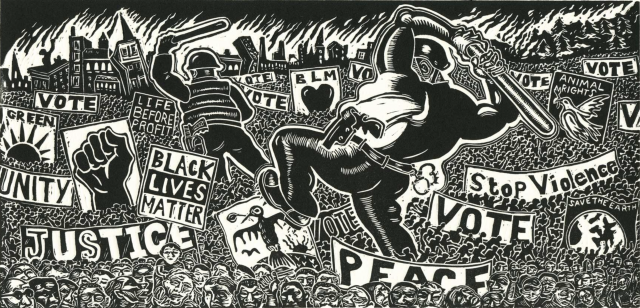
Sue Coe’s “We Are Many. They Are Few.” can be found at Morgan Ave. & Harrison St. in Brooklyn (photo courtesy Art at a Time Like This)

Who: Abigail de Ville, Marilyn Minter, Deborah Kass, Ruj Greigarn, Barbara Pollack, Anne Verhallen
What: “What Have Artists Contributed to the 2020 Election?” live, online discussion about new outdoor exhibition
Where: Art at a Time Like This Zoom
When: Monday, November 2, free with RSVP (donations accepted), 7:00 (exhibition continues through at least November 20)
Why: On March 17, just at the start of the pandemic lockdown, Barbara Pollack and Anne Verhallen launched Art at a Time Like This, a website that asked the question, “How can you think of art at a time like this?,” kicking off months of daily postings of politically charged old and new works by dozens of major artists, in addition to lively Zoom discussions exploring the role of art and the artist in the age of Covid-19. Pollack and Verhallen have now moved their activism outdoors with the ambitious “Ministry of Truth: 1984/2020,” a collection of twenty billboards located across the five boroughs, featuring new, civically conscious designs by an impressive group of emerging and established artists. The winners were chosen out of twelve hundred submissions, some through an open call, by Pollack and Verhallen with the Bronx Museum’s Jerome LaMaar, independent curator Larry Ossei-Mensah, Carmen Hermo of the Brooklyn Museum, and the Queens Museum’s Sophia Marisa Lucas, resulting in a wide range of diverse works from graduate students and international stars, responding to the failures of the current administration.

V. L. Cox reveals “The End Hate Doors” at 21st St. & 44th Rd. in Queens (photo courtesy Art at a Time Like This)

“I think what has been our way of working is that over the course of seven or eight months, we’ve always had a direct response to the moment, and so the way we worked was also very much in the moment,” Verhallen said during a recent Zoom interview. “The first day that we launched the online exhibition, we didn’t know that we were going to make it into a nonprofit, but everything was very organic, and so was this first public project. This is the first of many to come, hopefully.”

Pollack and Verhallen make no bones about the goal of “Ministry of Truth: 1984/2020,” which was organized by Art at a Time Like This with Save Art Space. The name of the exhibition refers to a trio of slogans emblazoned on the white pyramid that is the Ministry of Truth in George Orwell’s 1984: “War Is Peace.” “Freedom Is Slavery.” “Ignorance Is Strength.”

“One of our main goals is to demonstrate that artists have ideas that need to be brought into the political conversation, that they envision other ways of looking at things, alternative ways of looking at things, and solutions for the future that are not part of the political debate,” Pollack said. “So we thought with the election coming up, we needed to provide some kind of special platform for art in response to crisis.”
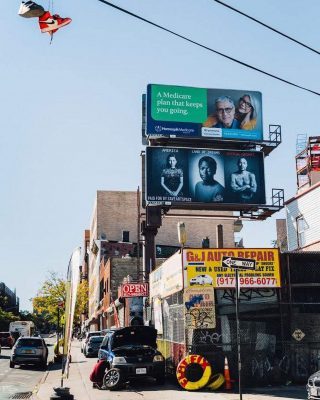
Shirin Neshat’s “America Land of Dreams” interacts with other signage at Grand St. & Catherine St. in Brooklyn (photo courtesy Art at a Time Like This)

In an email blast, they declared, “Early voting has started and this administration has taken to the courts to cut mail-in deadlines. Other absurd restrictions and rules encouraging voter intimidation are also in the courts, facing decisions by Trump-appointed federal judges. So to ensure your vote is counted, get to your polling place early or drop off ballots before next Tuesday. Let’s hope for a clear-cut decision that leaves no question of the outcome. . . . On your way to your polling place, take a look around you. You’ll probably find one of the billboards in ‘Ministry of Truth: 1984/2020’ along your way.”

You can rent a car, take public transportation, or get on a bike and trek around to see as many of the billboards as you can; there are ten in Brooklyn, four in Queens, three in the Bronx, two in Staten Island, and one in Manhattan. (You can find the complete map here.) On Atlantic Ave. and Classon Ave., Deborah Kass proclaims, “Yo Vote!” in bold yellow letters on a blue background. Marilyn Minter calls for “Justice Now!” (Eleventh Ave. & Forty-Fifth St.) in glam graffiti. Sue Coe’s “We Are Many. They Are Few.” (Morgan Ave. and Harrison St.) is a graphic black-and-white depiction of two giant cops trampling over a Black Lives Matter rally as a city burns in the background. Helina Metaferia’s “Headdresses 6” (Webster Ave. and East 173rd St.) reveals a black woman’s headdress to include leaders of the Black Power Movement. Mel Chin’s “Flag of America 2020” (Jackson Ave. at the Pulaski Bridge) shows Old Glory with the stars divided in two, twenty-five on each side, while Holly Ballard Martz also incorporates the Stars and Stripes in “The Greatest Show on Earth” (Calyer St. and McGuinness Blvd.), complete with a “No Exit” sign. And in Ruj Greigarn’s “The Marching” (Myrtle Ave. and Cornelia St.), a nonbinary person in a blue blouse, black pants, and black high-heeled boots walks down the street carrying a rainbow flag. Other billboards by Shirin Neshat, Dread Scott, Abigail de Ville, Dan Perjovschi, Aaron Gilbert, Akinbo Akinnouye, Guerrilla Girls BroadBand, Lola Flash, Angela Portillo, Rachel Hsu, Holly Martz, Terry Berkowitz, V. L. Cox, and Ileana Hernandez also involve dissent, racism, hate, injustice, immigration, police brutality, and an America that is supposed to be the land of dreams.

“Sometimes it’s hard to find words around everything that’s happening, and artists are so attuned to how our communities feel,” Verhallen said over Zoom. “So besides giving the artist a voice in a public space, it also provides the audience with a sense of camaraderie and catharsis.”

Lola Flash’s “i pray” makes its point at Utica Ave. & Atlantic Ave. in Brooklyn (photo courtesy Art at a Time Like This)

Talking about reviewing the submissions, Pollack notes, “It was this great outpouring of humanity. It was really moving to look through them. It was amazing how much people had to say.”

Verhallen adds, “Both Barbara and I got really emotional when we went through it because it really felt like an outpouring of people’s hearts. The last couple of months, there’s been a real demonstration from voices that have been unheard, so it was quite an experience to go through the works.”

On November 2 at 7:00, election eve, Pollack and Verhallen will host the live, interactive Zoom discussion “What Have Artists Contributed to the 2020 Election?,” joined by Greigarn, de Ville, Minter, and Kass, each of whom has previously contributed work to Art at a Time Like This. Admission is free with RSVP.

Oh, and no matter where you are, be sure to vote, because that’s what all of this is about.

A PERFORMANCE ON SCREEN: A TOUCH OF THE POET

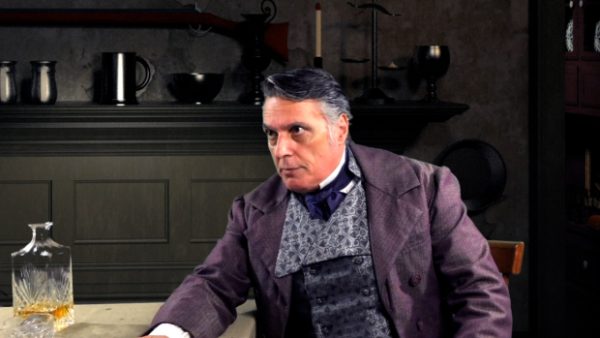
Tony nominee Robert Cuccioli stars as a tavern owner tortured by what he thinks could have been in A Touch of the Poet (photo courtesy Irish Rep)

Irish Rep Online
Saturday, October 31, free with RSVP (suggested donation $25), 3:00 & 8:00
Sunday, November 1, free with RSVP (suggested donation $25), 3:00
irishrep.org

The Irish Rep was four weeks into rehearsal for its spring revival of Eugene O’Neill’s A Touch of the Poet when the pandemic lockdown shuttered theaters across the city. Since the coronavirus hit, the Manhattan-based troupe has emerged as perhaps the most successful in the country at creating unique and innovative virtual productions, which it calls “performances on screen.” For A Touch of the Poet, the troupe was able to ship Alejo Vietti’s costumes to wherever the actors were sheltering in place, from New York and New Jersey to South Dakota, Tennessee, and Berlin, as well as use Robert Charles Vallance’s hair and wig design, Joe Dulude’s makeup, Ryan Rumery’s original music, and even Charlie Corcoran’s set. The original in-person production credits list fight direction by Rick Sordolet, which would seem impossible to replicate in an online presentation in which no two actors are in the same room and possibly not even in the same state or country. Yet there are several convincing instances of physical confrontations in the show, a tribute to how far the Irish Rep has taken its virtual expertise, pushing the envelope well beyond actors reading their lines in little Zoom boxes from their living rooms or kitchens. (Not that there’s anything wrong with that.)

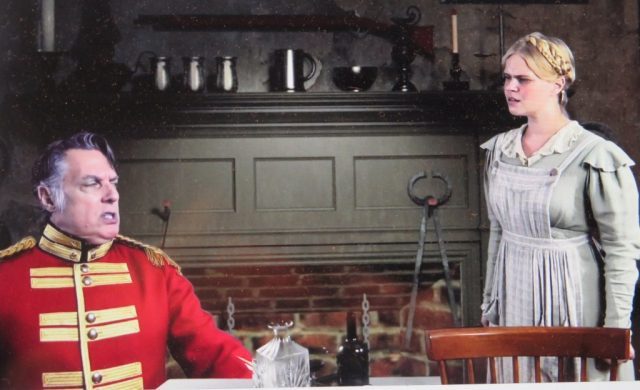
In July, the Irish Rep put on Conor McPherson’s The Weir, which takes place in a pub where several characters tell ghost stories; the actors stood in front of photographed backgrounds that made it seem as if they were all together, though never in the same shot, even as they pass glasses of beer and whiskey to each other. The company takes it to the next level in A Touch of the Poet; not only does it use images of Corcoran’s set, which had already been built in the its West Twenty-Second St. home, but director and Irish Rep cofounder Ciarán O’Reilly and video editor Sarah Nichols, who served in the same capacities for The Weir, have worked magic in Poet, making it appear that the actors are not only in the same tavern but sit at the same table and, yes, engage in a fight or two. There’s also a door a few characters go through that leads to the bar.

The Irish Rep pushes the boundaries of virtual theater in its adaptation of Eugene O’Neill’s A Touch of the Poet (photo courtesy Irish Rep)

Originally meant to kick off a nine-play cycle, Poet is not one of O’Neill’s finest hours — or in this case, two hours and forty minutes, which is an uncomfortable amount of time to be sitting in front of your computer watching a dour drama. There’s way too much exposition at the beginning, there’s repetition galore, and it takes too long for the obvious parts of the plot to unfold. Still, you’ll be glued to the monitor because of the solid acting and technical innovation.

The play is set in 1828 in a Boston tavern owned and operated by the Melody family (pronounced mell-OH-dee), who emigrated from Ireland many years before. Cornelious “Con” Melody (Tony nominee Robert Cuccioli) is a mean-spirited drunk living in the past, reveling in his heroism at the Battle of Talavera in July 1809 during the Peninsular War between Spain and Portugal. He blames his wife, Nora (Kate Forbes), for trapping him into marriage by getting pregnant on purpose, and he shows no love for the result of that union, their daughter, Sara (Belle Aykroyd). While Con drinks, complains, and spends their food and rent money on his treasured mare, Nora runs the tavern and reaffirms her undying affection for him, and Sara dreams of a better life, perhaps with Simon Hartford, a young man who lives nearby amid nature. A Thoreau-like figure from a wealthy family, Simon is currently in a room upstairs at the tavern because of an illness, and Sara is taking care of him. His mother (Mary McCann) makes a surprise visit to check out the Melody clan, and it goes pretty much how one would expect. But Con is more attuned to the upcoming Talavera reunion scheduled for that evening, when he can put on his uniform and revel in past glory.

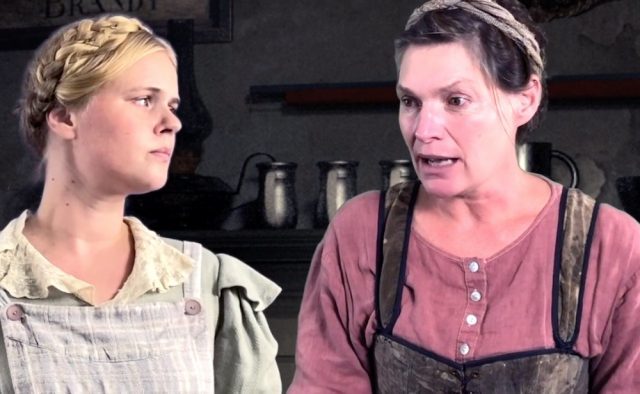
Belle Aykroyd and Kate Forbes star as daughter and mother in Irish Rep “performance on screen” (photo courtesy Irish Rep)

The mostly fine cast, led by a terrific Forbes, also features Andy Murray as Con’s best friend, Jamie Cregan; John C. Vennema as Nicholas Gadsby; and Ciaran Byrne, David O’Hara, and David Sitler as a trio of barflies buzzing around for free drinks. (The 1977 Broadway production starred Geraldine Fitzgerald, Milo O’Shea, Kathryn Walker, and a Tony-nominated Jason Robards, while Timothy Dalton and Vanessa Redgrave were in a 1988 adaptation in London, and Gabriel Byrne, Emily Bergl, Byron Jennings, and O’Reilly appeared in a 2005 version at Studio 54. O’Neill wrote a sequel called More Stately Mansions; neither work was performed during his lifetime.) There are some clunky video cuts, mostly when switching to single shots of a character in the midst of a conversation with another, but otherwise the Irish Rep has come the closest during the Covid-19 crisis to capturing the feeling of seeing a stage performance in real life. The company’s next “performance in screen” (that’s not a typo) will be Bill Irwin’s one-man show, On Beckett, which should not have the same logistical complications as The Weir and A Touch of the Poet.

FIRE WILL COME

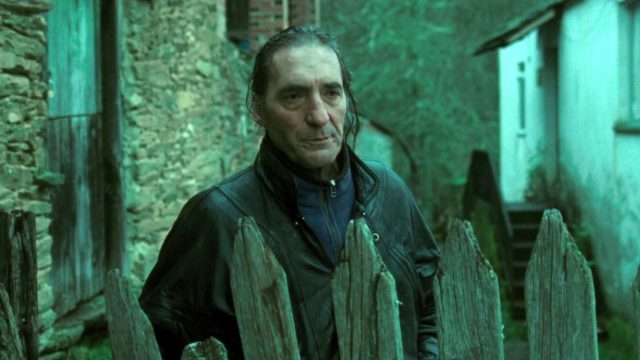
Amador Arias makes a gripping film debut in Oliver Laxe’s Fire Will Come

WILL COME (O QUE ARDE) (Oliver Laxe, 2020)
Metrograph Virtual Cinema
October 30 – November 5, $12
metrograph.com
www.kimstim.com

“What fire does not destroy, it hardens,” Lord Henry says in Oscar Wilde’s The Picture of Dorian Gray. There’s no disaster quite like a fire; as Californians can attest, it’s one of our greatest fears, that one’s home will suddenly and irrevocably be obliterated in a blaze. But there’s also something beautiful about watching a fire, listening to it crackle, bathing in its light and warmth. Such is the case with Oliver Laxe’s Fire Will Come, a hypnotic and mesmerizing slow burn of a film, equipped with an ever-present fuse that threatens to detonate at any moment.

Winner of the Un Certain Regard Jury Prize at Cannes, the film starts ominously in the dark woods, silent until bare trees start falling down. After a minute, we see yellow bulldozers moving through the forest, knocking them down, but not for logging; it is as if these mechanical monsters are eliminating an enemy before it can strike. The sounds of the bulldozers pushing through the trees soon vanish, replaced by menacing music as the camera floats from a close-up of tree bark to one of the bulldozers, like it’s a large, malicious creature, its two top lights shutting off like a pair of eyes closing after a long day of killing.

Benedicta (Benedicta Sanchez) surveys her land shortly after her son returns from prison in Fire Will Come

The story moves to a small, tight-knit rural village in the mountains of Galicia, where Amador Coro (Amador Arias) has returned to live with his mother, Benedicta (Benedicta Sanchez), after having spent time in prison for starting a wildfire. He cares for their three cows, is followed around by his loyal dog, and carries with him an unspoken but heavy guilt, a melancholy that overwhelms his every gesture. He says little, enduring taunts from his former friends in town, who tease him by asking for a light, when they speak to him at all. “If they make suffer, it’s because they are suffering,” his mother assures him. She also tells him, “I’m really happy that you’re home,” but there is little evidence of any contentment, few smiles to be had.

We never learn exactly what Amador might have done and what its effects were, but the blame clearly runs deep. This is no obvious situation in which a gender-reveal party led to devastation; instead, it’s more about humanity’s relationship with nature and the planet, about our responsibilities to the land and to the animals, which include ourselves. Like California, Galicia is a place where wildfires run rampant, among the worst in Europe, the result not only of climate change or accidents but of controlled burns that erupt out of control, in part due to invasive eucalyptus trees. The fires have become political because of their economic ramifications as much as for the havoc they wreak.

Water plays a key role in the film alongside fire. During a rainstorm, Benedicta finds shelter in the nook of a large tree. Later, when Amador takes one of the cows, Parda, to bathe in a dirty pond surrounded by greenery, the animal is uneasy, unwilling to leave the safety of the muddy water. After getting help from the local vet, Elena (Elena Fernandez), he rides back with her in her truck as she plays Leonard Cohen’s “Suzanne,” Cohen singing, “And Jesus was a sailor when he walked upon the water / And he spent a long time watching from his lonely wooden tower / And when he knew for certain only drowning men could see him / He said all men will be sailors then until the sea shall free them.” Elena tries to become friends with Amador, but he, broken and feeling forsaken, pushes her away.

His loneliness is palpable, plagued with a conscience that burdens him with shame, a big, strong man now sad and fragile, not interested in seeking redmption. It’s as if he exists on a different plane, dourly wandering through a world that he no longer belongs in, that he feels he doesn’t deserve. In his first film, Arias, a former forest warden who now works with animals, is brutally honest, his craggy face etched in strife, his gait constantly troubled. Fire Will Come is steeped in reality, from the use of nonprofessional actors to the fires themselves. Laxe (You All Are Captains, Mimosas), the French-born son of Galician parents, shot the film in his grandparents’ village, among people he knows. He did not use CGI; instead, he had his cast and crew wait for real forest fires, then filmed actual firefighters battling them. You can almost feel the heat coming off the screen; the film is gorgeously photographed by Mauro Herce, through foggy landscapes, stunning vistas, and claustrophobic interiors, accompanied by natural sounds captured by Sergio da Silva, Xavier Souto, and Amanda Villavieja and a soundtrack that features Vivaldi and Haas in addition to sparse but effective incidental music by Xavi Font. It all comes together in one scene in which Amador is driving in his car, the camera following him from outside, reflections of trees passing over the front windshield as classical music plays. Editor Cristóbal Fernandez maintains a deliberate, almost reluctant pace.

The opening and closing scenes are stark reminders of our connection to the earth and the frightening potential for one to destroy the other. The Galician title of the film, O que arde, means “What burns,” which is not as sinister as “Fire will come,” a warning of what lies ahead. In 1969, Peggy Lee sang, “I remember when I was a very little girl, our house caught on fire / I’ll never forget the look on my father’s face as he gathered me up / in his arms and raced through the burning building out to the pavement / I stood there shivering in my pajamas and watched the whole world go up in flames / And when it was all over I said to myself, is that all there is to a fire.” In his third feature film, Laxe shows us that there is so much more.

[Fire Will Come is streaming at Metrograph October 30 to November 5; each rental comes with access to a conversation between Laxe and master cinematographer Ed Lachman (Far from Heaven, Light Sleeper.)]

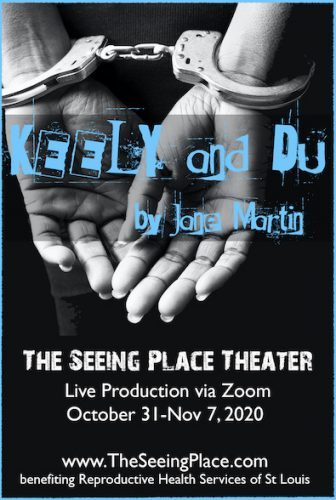
RIPPLE FOR CHANGE: KEELY AND DU BENEFIT READING AND PANEL DISCUSSION

Who: The Seeing Place Theater
What: Livestreamed benefit readings and panel discussions
Where: The Seeing Place Theater Zoom
When: Saturday, October 31, and Sunday, November 1, $10-$50, 7:00 (available on YouTube November 3-7)
Why: The Seeing Place Theater continues its “Ripple for Change” series with two live, virtual readings of the pseudonymous Jane Martin’s 1994 Pulitzer Prize finalist, Keely and Du, a powerful work about a pregnant rape victim and an antiabortion activist. The drama premiered at the Humana Festival of New American Plays at the Actors Theatre of Louisville in March 1993 and continues to be popular, given the subject matter, especially as the Supreme Court becomes more conservative and Roe v Wade and other aspects of health care are in danger. The reading is directed by Brandon Walker and Erin Cronican and features Cronican as Keely, Audrey Heffernan Meyer as Du, Walker as Walter, and Olivia Hanna Hardin as the guard; it will be performed live October 31 and November 1 at 7:00, in honor of Domestic Violence Awareness Month, with proceeds benefiting the Reproductive Health Services of Planned Parenthood of Saint Louis; it will be available for viewing on YouTube November 3-7.

“Rather than tell audiences what to think, this play poses deep questions to get to the heart of the debate over who governs women’s bodies,” Cronican said in a statement. “It asks us to reflect on an individual’s rights, a community’s responsibilities, and the difference between one person’s expectations and another’s reality.” Each performance will be followed by “Action Steps for Protecting Women’s Choices,” a panel discussion with Dr. Colleen McNicholas, an OB-GYN who became Planned Parenthood’s first-ever chief medical officer in July 2019. “I don’t want to get comfortable talking to you,” Keely tells Du at one point. Unfortunately, it’s part of a conversation that is not going away any time soon.

THE ROCKY HORROR SHOW MUSICAL LIVESTREAM

Who: Tim Curry, Wilmer Valderrama, Lance Bass, Rosario Dawson, Jason George, Nell Campbell, Seth Green, Jason Alexander, David Arquette, the Dresden Dolls, Miss Peppermint, Eiza Gonzalez, Josh Gad, Ben Barnes, Jenna Ushkowitz, Rachel Bloom, Karen Olivo, Marissa Jaret Winkour, Madison Uphoff, Kalen Chase, Rumer Willis
What: Livestreamed Halloween political fundraiser
Where: WisDems Zoom
When: Saturday, October 31, suggested donation $31, 10:00
Why: America is in danger of going through a perilous time warp if the current administration gets another four years in office, further setting back gains that have been made over decades toward freedom and equality for all. With that in mind, the Wisconsin Democratic Party has been on a fierce and furious drive to flip the swing state blue on election day with virtual cast reunions of Happy Days, The Princess Bride, Veep, and Superbad that have each raised hundreds of thousands of dollars. Next up is a celebration of the 1975 midnight cult classic The Rocky Horror Picture Show, a film that celebrates individuality and daring to be different. We might not be able to touch-a, touch-a, touch-a, touch one another, but we can reach out and come together online, and joining in the fun on Halloween night will be Dr. Frank N. Furter himself, Tim Curry, along with Wilmer Valderrama, Lance Bass, Rosario Dawson, Jason George, Nell Campbell, Seth Green, Jason Alexander, and David Arquette, with musical performances by the Dresden Dolls, Miss Peppermint, Eiza Gonzalez, reunion champ Josh Gad, Ben Barnes, Jenna Ushkowitz, Rachel Bloom, Karen Olivo, Marissa Jaret Winkour, Madison Uphoff, Kalen Chase, and Rumer Willis. The suggested donation is $31 for the one-time-only live event, but you can give any amount to watch the festivities and submit your own question, so as far as change goes, don’t just dream it, be it.

RESOUNDING LIVE: DRACULA

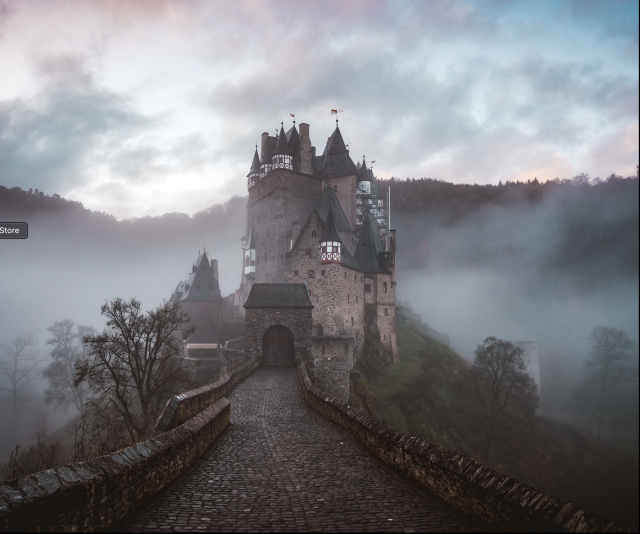
Audiences will have to imagine what castle looks like in audio adaptation of Dracula

Who: Norm Lewis, Lindsay Nicole Chambers, Siho Ellsmore, Chris Renfro, Dick Terhune, Stuart Williams, John Stimac
What: Virtual, immersive audio presentation of Dracula
Where: Resounding Live
When: Friday, October 20, and Saturday, October 31, $20, 8:00
Why: Because of the pandemic lockdown, theater creators have been looking at innovative ways to bring storytelling into people’s homes. One method that is making a comeback is the radio play. On October 30, Keen Company is performing Orson Welles’s iconic 1938 War of the Worlds radio script. Welles’s legacy also plays a part in Resounding’s audio production of Bram Stoker’s Dracula, inspired by Welles’s 1938 radio adaptation and utilizing cutting-edge proprietary technology that promises “to create a live 360-degree soundscape of howls, bats, screams, creaky floors, slamming doors, and everything that goes bump in the night.” Tony nominee Norm Lewis dons the cape as the bloodsucking count, with Lindsay Nicole Chambers as Mina Murray, Siho Ellsmore as Lucy Westenra, Chris Renfro as Jonathan Harker, Dick Terhune as Prof. Van Helsing, Stuart Williams as Dr. Seward, and John Stimac as Renfield, all performing live from wherever they’re sheltering in place.

“I’ve been thinking for the better part of a decade about how to leverage the internet to increase audience and participation in the theater in America and the world,” Resounding creative director Steve Wargo said in a statement. “My initial ideas were to re-create the style and substance of the broadcasts that Orson Welles and his Mercury Theatre performed live on the radio in the late ’30s. Time passed, other projects came and went, then the pandemic hit, and this idea became front and center. We have an amazing team and now we have some fancy patent-pending new technology on our hands, something potentially revolutionary. And what better way to launch that with the great Norm Lewis as Dracula for Halloween.” In addition, New York City bartender Jena Ellenwood has curated cocktails to accompany the fifty-five-minute show; the audience is also encouraged to dress up for the event and post images to a virtual photo booth on Pinterest to form a unique community. Next up for Resounding are an adaptation of Robert Louis Stevenson’s Treasure Island November 27-28 and the world premiere of The Fantastical Tale of the Nutcracker and the Mouse King December 18-19.