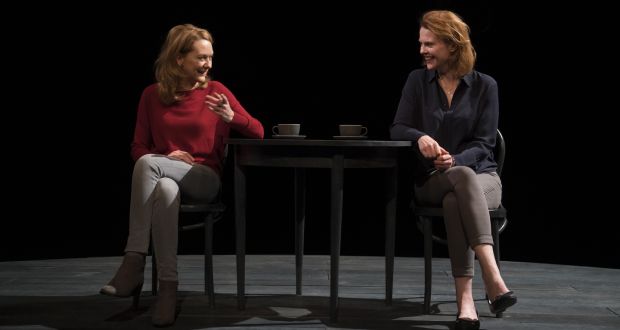
Mark O’Rowe’s The Approach will be streamed live from Dublin for three performances (photo by Patrick Redmond)
Who: Cathy Belton, Derbhle Crotty, Aisling O’Sullivan What: Livestreamed production of Mark O’Rowe’s The Approach from Dublin Where:St. Ann’s Warehouse When: January 21 (2:30 am), 23 (2:30 am), 24 (4:00 pm), €25-€50 (live), January 25-31 on demand, €20 Why: As theater companies continue to adapt to presenting works during the pandemic lockdown, audiences have had to adapt as well. Most of the online productions have been either previously recorded versions of pre-coronavirus stage productions or Zoom readings, which lack the urgency of live theater. But some shows, primarily from across the pond, have been performed live from indoor theaters, resulting in a joyous excitement as people from all over the world experience the work in real time, together, with no pausing or rewinding, a story unfolding as it happens. On January 21, 23, and 24, St. Ann’s Warehouse and Landmark Productions have teamed up to stream three live performances of Mark O’Rowe’s 2018 sold-out Edinburgh Fringe Festival hit, The Approach, broadcast from the Project Arts Centre stage in Dublin; the play will then be available for on-demand viewing January 25-31.
The hourlong show is also directed by O’Rowe (DruidShakespeare,Howie the Rookie), who wrote the emotion-packed play specifically for Irish stars Cathy Belton (The House,Women in Arms), Derbhle Crotty (DruidShakespeare,The Home Place), and Aisling O’Sullivan (The Beauty Queen of Leenane,Big Maggie), who have reunited for this virtual revival. They portray two sisters and a best friend who have drifted apart but reexamine their relationships through three conversations over five years, which can feel particularly relevant while we are all sheltering in place, having Zoom calls with friends and family, including those we might not have seen in a long time. “It takes a crisis of some sort sometimes, or an upheaval, for people to really evaluate how they feel about one another, doesn’t it?” one character says. The production features set and lighting by Sinead McKenna, costumes by Joan O’Clery, and sound by Philip Stewart, attempting to bring as much of the real theater experience as possible to our small screens. (The January 23 show will be followed by a talkback with members of the cast and crew.)
CAFÉ La MaMa LIVE: La MaMa MOVES! ONLINE
January 19-20, 26-27, $5-$25 (pay what you can) lamama.org/moves
The annual La MaMa Moves! dance festival has moved online this year, presenting works by four choreographers over four livestreamed programs January 19-20 and 26-27, each showing two of the quarantine-created pieces, followed by a Q&A. Curated by Nicky Paraiso for Café La MaMa Live, the festival features puppeteer Kevin Augustine and Lone Wolf Tribe’s Body Concert, a minimalist exploration of life, death, and nature across a series of vignettes set to a score by Mark Bruckner and inspired by Butoh, with life-size puppets and no text; Kari Hoaas’s Heat — the distant episodes, four dance haikus (“Pond,” “Fall,” “Branch,” “Leaves”) about time, space, and isolation based on her 2015 Be Like Water, which was scheduled to run at La MaMa in May 2020; Tamar Rogoff’s The Yamanakas at Home, a collaboration with Mei Yamanaka about an older couple living in Japan who confront an intruder; and Anabella Lenzu’s The night that you stopped acting (La noche que dejaste de actuar), which Lenzu describes as a “one-woman show which confronts the absurdity and irony of life while being an artist and a spectator in today’s world. My work reflects my experience as a Latina/European artist living in New York and comes from a deep examination of my motivations as a woman, mother, and immigrant.” La MaMa’s digital platform also currently includes Peggy Shaw and Lois Weaver’s Last Gasp WFH through January 21 and “In Process with Bobbi Jene Smith” through January 24, with “Downtown Variety: Brazil Edition” scheduled for January 22 and “Reflections of Native Voices” January 25 – February 7.
Who: Alexandra Pelosi, Sheila Nevins What: Live discussion (preregister to watch film in advance) Where:The Temple Emanu-El Streicker Center online When: Tuesday, January 19, free with RSVP, 6:00 Why: Documentary filmmaker Alexandra Pelosi turns her camera lens on the country in her latest work, American Selfie: One Nation Shoots Itself. Over the course of one year, Pelosi journeyed across the United States, filming citizens, immigrants, and tourists as they gathered for various causes (abortion, gun rights, BLM, masks) and took pictures with their phones of themselves and others, bitterly fighting over hot-button issues or waiting online for the latest iPhone, cheering people like heroes as they emerged from the store with the treasured item under their arm. “I think phones are much more dangerous than guns,” Pelosi, the daughter of Speaker of the House Nancy Pelosi, told the Guardian last October.
Pelosi, who has previously made such nonfiction films as Journeys with George, Right America: Feeling Wronged – Some Voices from the Campaign Trail, Fall to Grace, and Goodbye, Congress, clearly chooses her targets, but even so she reveals an America that we are all aware of but don’t always get to see so directly. Unsurprisingly, the film has gotten mostly good reviews from critics, but its online rating is low, perhaps because Americans on all sides of the political spectrum are not so fond of what they really look like these days. On January 19 at 6:00, Pelosi will speak with MTV Studios documentary films head Sheila Nevins in the program “American Selfie: One Nation Divisible through the Lens of Alexandra Pelosi.” The film ends prior to the 2020 election, so it should be fascinating to see what Pelosi has to say about what has happened since. Free registration is required and comes with access to the film.
Multiple venues
January 17-18, free – $15 www.mlkday.gov
The Rev. Dr. Martin Luther King Jr. would have turned ninety-two years old on January 15; he was only thirty-nine when he was assassinated. In 1983, the third Monday in January was officially recognized as Martin Luther King Jr. Day, honoring the birthday of the civil rights leader who was shot and killed in Memphis on April 4, 1968. You can celebrate his legacy on Monday by participating in the twenty-sixth annual Martin Luther King, Jr., Day of Service or attending one of numerous special events taking place online, from concerts and film screenings to panel discussions and BAM’s annual tribute. Below are some of the highlights.
Sunday, January 17 Celebrating MLK Day: Reclaiming the Beloved Community, with Sweet Honey in the Rock and special guests, the Town Hall, $15 per concert, $50 for bundle including conversation with the group, 3:00 & 8:00
Soul to Soul: A Celebration in Honor of MLK Day, advance screening benefit, with Lisa Fishman, Magda Fishman, Elmore James, Zalmen Mlotek, Tony Perry, and Tatiana Wechsler, free – $250 (pay-what-you-can), 6:00
Monday, January 18 Cinematters: NY Social Justice Film Festival, “Pursuing Justice: Strategies for Families Committed to Racial Justice,” interactive workshop with Megan Pamela Ruth Madison and Adina Alpert, free with RSVP, 11:00 am
Hear Our Voices: Free MLK Day Celebration, Stop the Hate Essay Writing Workshop 11:00 am, March Toward Freedom, an Interactive Family Event 1:00, Race, Racism, and the Jim Crow Museum: A Discussion with Dr. David Pilgrim 3:00, Maltz Museum of Jewish Heritage, free with RSVP
The Thirty-fifth Annual Brooklyn Tribute to Dr. Martin Luther King Jr., BAM, with Eric L. Adams, Sing Harlem!, Tarriona “Tank” Ball, Laurie A. Cumbo, Ashley August, Timothy DuWhite, Letitia James, Charles E. Schumer, Bill de Blasio, Chirlane McCray, Kirsten Gillibrand, Corey Johnson, Eric Gonzalez, Scott Stringer, Hakeem Jeffries, Jumaane D Williams, PJ Morton, and keynote address by Alicia Garza, free with RSVP, 11:00 am
Theater of War: The Drum Major Instinct, reading of MLK sermon and panel discussion with Jamaal Bowman, Ayanna Pressley, Nina Turner, Jumaane Williams, Moses Ingram, and soloists De-Rance Blaylock, Duane Foster, and John Leggette, free with RSVP, 7:00
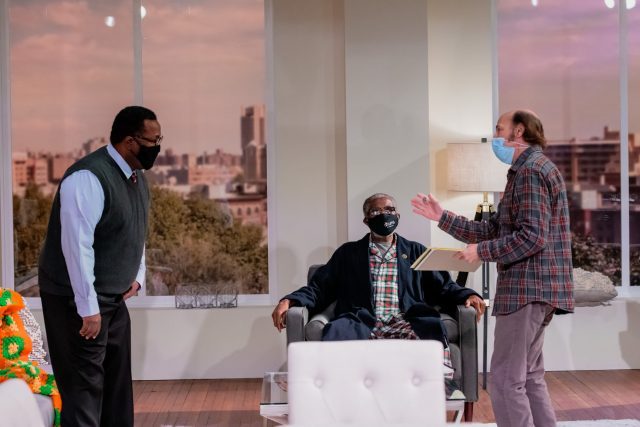
Son (Wendell Pierce) and father (Charlie Robinson) fight it out in James Anthony Tyler’s Some Old Black Man
SOME OLD BLACK MAN
UMS Digital Presentation
Through January 18, free with RSVP ums.org
Back in early 2018, I was supposed to see the off-Broadway premiere of Berkshire Playwrights Lab’s Some Old Black Man, but it didn’t work out because one of the actors in the two-character play, Tony winner Roger Robinson, had taken ill; the August Wilson regular passed away later that September. But his costar, Wendell Pierce, has carried on with the show, now bringing it to the University of Michigan’s UMS as part of his digital artist residency, dedicated to presenting works following all Covid-19 protocols during the pandemic lockdown.
In the play, written by James Anthony Tyler and directed by Joe Cacaci, Calvin Jones (Pierce) has just moved his elderly father, Donald (Charles Robinson), from the family home in Greenwald, Mississippi, to Calvin’s Harlem penthouse, since the son thinks his ailing father is unable to take care of himself anymore. Donald resents his son’s assumption and is ornery and disagreeable, while the even-keeled Calvin tries to manage this rearrangement of his household. It’s a kind of twist on the classic Odd Couple setup (coincidentally, Pierce was a regular in the 2015 Odd Couple reboot, as a friend of Oscar Madison’s); when Donald tosses a vibrantly colored afghan onto a couch so he can watch television comfortably, Calvin argues that it ruins the subdued décor of the living room. When Calvin prepares breakfast, he makes a healthy dish, which Donald refuses to touch. Their verbal battles bring up both good and bad memories along with some long-hidden secrets, impacted by pride, systemic racism, downright stubbornness, and misconceptions that might not be easy to heal.
Costars Wendell Pierce and Charlie rehearse Some Old Black Man with director Joe Cacaci
Pierce (The Wire,Treme) and Robinson (Sugar Hill, Mac in Night Court) — both of whom recently portrayed Willy Loman in Death of a Salesman onstage, the former in London, the latter at South Coast Rep in California — are completely in tune with one another in Some Old Black Man, their deep, distinct voices rattling your bones as if you were in the theater with them, not watching at home on a screen. There are plenty of laugh-out-loud lines amid the growing tension, and the intimacy is palpable; it doesn’t feel like you’re watching a movie but a live broadcast. The actors enhanced their emotional connections through personal touches; Pierce spent time sheltering in place with his father in New Orleans, while Robinson uses a picture of his adoptive mother as the photo of his character’s late wife, the prop placed on the piano so he can always see it.
To put on the play, which Pierce has called a “public health case study” for how to make theater amid the coronavirus crisis (you can watch a cool behind-the-scenes video here), Pierce, Robinson, Tyler, Cacaci, and stage manager Tiffany Robinson quarantined together in a home in west Ann Arbor, with plans to travel to the Jam Handy performing arts center in Detroit and rehearse in masks. They had to hold the start of those rehearsals on Zoom when Cacaci tested positive for the virus, but they eventually were able to move to the Jam Handy and ultimately film three complete performances over three days in November on Justin Lang’s elegant set, using multiple cameras but, of course, no audience. The result is a powerful, poignant piece of theater that, although written in 2010, resonates with what’s happening with today’s social justice movement as America takes a long, hard look at the continuing, devastating effects of racism. Available on demand through January 18, the play is followed by an illuminating talkback with the cast and crew. For more on Tyler (Artney Jackson,Dolphins and Sharks), you can catch a work-in-progress reading of his Talkin’ to This Chick Sippin’ Magic Potion performed by Theaterworks Hartford streaming February 7–26.
Halley Feiffer offers a new twist on an old story in Between the Two Humps
Who:MCC Theater What: LIVELABS: One Acts Where:MCC Theater online When: Through January 17, $10 (free to subscribers) Why: Playwright Halley Feiffer and director Trip Cullman, who previously teamed up on Moscow Moscow Moscow Moscow Moscow Moscow, an uproarious version of Chekhov’s Three Sisters, return to MCC virtually with the eighteen-minute LIVELABS presentation Between the Two Humps, a different take on the story of Mary and Joseph. The Zoom production features Noah Robbins as Joseph, Kara Young as Mary, Peppermint as the angel Gabriel, and Portia as the voice of God. Instead of a reverent look at the birth of Jesus, in this case the foul-mouthed parents-to-be are dealing with teen pregnancy and questioning their faith as they make their way through the desert, accompanied by live set drawing courtesy of Clint Ramos. The show, which was written before the pandemic and has been reimagined for virtual viewing, also comes with a thirty-three-minute talkback with the cast and crew and is available on demand through January 17.
The New York Jewish Film Festival might not be celebrating its thirtieth anniversary in quite the style it was hoping, but it’s still hosting a stylish two weeks of fiction and nonfiction shorts and features as well as panel discussions and Q&As. Presented by the Jewish Museum and Film at Lincoln Center, the festival kicked off January 13 with Nir Bergman’s Here We Are (available through January 16), about divorced parents dealing with their grown autistic son; Bergman will participate in a free talk on January 14 at 2:00.
The 2021 centerpiece selection is Anders Østergaard and Erzsébet Rácz’s Winter Journey (available January 21), starring the great Bruno Ganz in his final role, playing flutist Günther “George” Goldschmidt, father of radio commentator Martin Goldsmith, who portrays himself in the film, based on his memoir, The Inextinguishable Symphony: A True Story of Music and Love in Nazi Germany. Østergaard and Martin Goldsmith will discuss the film in a free talk on January 22 at 2:00.
The virtual festival concludes with another family affair, Susan Fanshel and Veronica Selver’s documentary Irmi (January 26), about German Jewish refugee Irmi Selver, Veronica’s mother, with Hanna Schygulla reading narration from Irmi’s memoirs. There will be a free talk with the directors January 27 at 2:00.
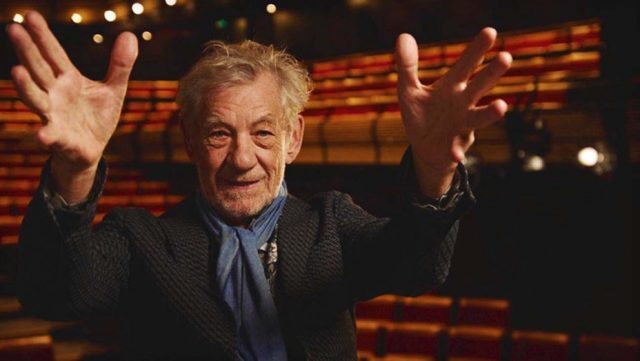
Among the other films to look out for are Judith Helfand’s Love & Stuff and Absolutely No Spitting (January 22), about the director’s adoption of a daughter when she was fifty, followed by the death of her mother; Ruthy Pribar’s Asia (January 15), with Unorthodox breakout star Shira Haas playing a teenager living with her single mother (Alena Yiv); and Oren Jacoby’s On Broadway (January 22), honoring the Great White Way with archival footage and interviews with Ian McKellen, Helen Mirren, Hugh Jackman, Christine Baranski, John Lithgow, and others. (You can watch Jacoby’s On Broadway: Give My Regard to Broadway, a short about Covid-19’s impact on theater, for free here.)
In addition, the festival has teamed up with the Marlene Meyerson JCC Manhattan for a special MLK Day event, a live Q&A on January 18 at 2:00 with Dr. Shari Rogers about her documentary Shared Legacies, part of the JCC’s Cinematters: NY Social Justice Film Festival, which runs January 14-18. The film can be accessed beginning January 16 at 10:00 am here. Keep watching this space for select reviews as NYJFF 2021 continues.
THE SIGN PAINTER (CITY ON THE RIVER) (Viestur Kairish, 2020)
Available January 19 (ticket comes with director Q&A) virtual.filmlinc.org
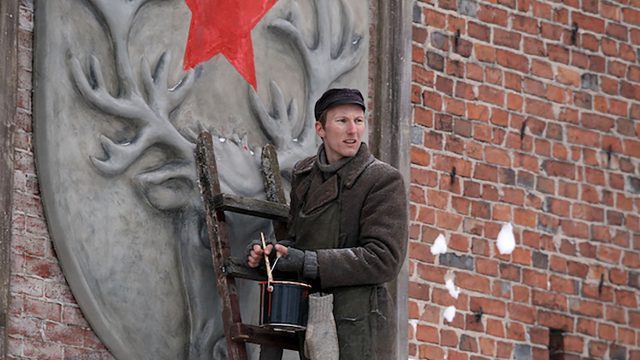
Latvian theater, opera, and film director Viestur Kairish’s The Sign Painter is in some ways a miniature Little Big Man meets Forrest Gump, where the audience watches history unfold through the eyes of a person who doesn’t really take an active part in what’s happening around him. Dāvis Suharevskis stars as Ansis, a tall, thin, gangly young man who works as a sign painter in a small Latvian village during the tumultuous decade before and during World War II, a town that changes leadership and primary color from the green of authoritarian dictator Kārlis Ulmanis to the red of Stalin’s Soviet Union to the black of Nazi Germany. Ansis has steady work: Each time a new regime takes over, he has to update street names and symbols, and he does so with a calm expertise, avoiding any personal political involvement. However, his true love, Zisele (Brigita Cmuntová), the daughter of pharmacist Bernshtein (Gundars Āboliņš) and who is reading Alexandra Kollontai’s Free Love, does get caught up in the tumult, taking up with German soldier Andreas (Aidas Jurgaitis) while Ansis is pursued by Naiga (Agnese Cīrule), as blond and Christian as Zisele is brunette and Jewish.
Ansis (Dāvis Suharevskis) is ever on the lookout for the next regime in The Sign Painter
Early on, aboard the small boat the White Swan, Ansis asks the captain, “May I steer?” It’s the only time he actively asserts being in charge of his direction. He wants to be a fine artist, and he is extremely talented at landscapes and portraits, but he carries on with his sign painting as revolution swirls about him.
Kairish (aka Viesturs Kairišs), who has made numerous documentaries in addition to the features Leaving by the Way,The Dark Deer, and The Chronicles of Melanie, and cinematographer Gints Bērziņš shoot nearly the entire film at a skewed angle, as if the characters can just fall off the screen in this continually upended world. They frame each shot with an artist’s eye; in one scene, Ansis speaks with Bernshtein while holding an empty picture frame, a spatial void that Zisele walks into. The story combines forbidden romance with religious, political, and military upheaval as one man continues to survive in dangerous times essentially despite himself, reminiscent of Jack Crabb in Little Big Man and Forrest Gump, who keep on keeping on. Based on a novel by Finnish-Latvian writer Gunars Janovskis, The Sign Painter is a beautifully rendered film about European collaboration, true love, regime change, and simple, everyday life.
Jewish Austrian American auteur Edgar G. Ulmer is most well known for his atmospheric horror and crime films, including 1934’s satanic The Black Cat, which pits Boris Karloff against Béla Lugosi, 1944’s Bluebeard, with John Carradine as the multiple wife murderer, and 1945’s cult noir Detour, a genre favorite that was added to the Library of Congress’s National Film Registry in 1992. But Ulmer, who apprenticed with F. W. Murnau, also made a series of Yiddish shtetl films (Green Fields, The Singing Blacksmith) about life in poor Jewish communities in Eastern Europe, and the NYJFF is presenting the world premiere of one of them, the National Center of Jewish Film’s new 4K digital restoration of 1939’s The Light Ahead, beginning January 25.
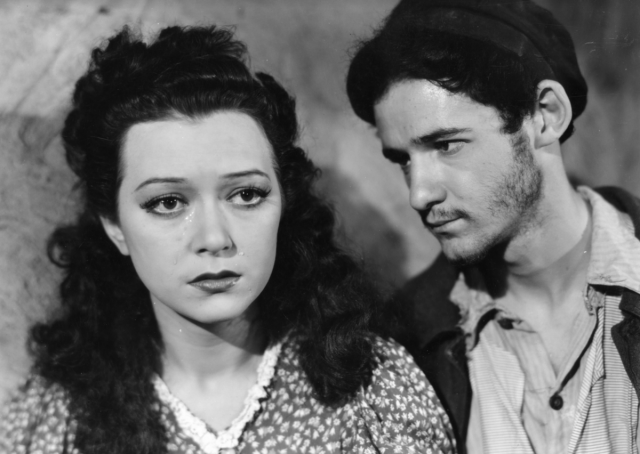
The film is a heart-tugging melodrama about the fraught romance between a young blind woman, Hodel (Helen Beverley), and the lame Fishke (David Opatoshu), who earns a pittance by calling people to the baths in the tiny village of Glupsk. The town is thriving, with a fat surplus that the community leaders are deciding how to spend, but Reb Mendele (Izidore Cashier) and others have their own suggestions. The youngsters’ dream is to live in Odessa, the big city, but there’s not much chance of a bright future and times are dark, as is J. Burgi Contner and Edward Hyland’s cinematography, cast in a shadowy black-and-white.
Hodel (Helen Beverley) and Fishke (David Opatoshu) dream of a better future in The Light Ahead
The Light Ahead begins with a vaudeville-like comedy scene between Reb Mendele, Reb Alter (Leon Seidenberg), and Reb Isaak (Yudel Dubinsky) before turning serious. Most of the film depicts the people barely getting by as they deal with cholera, God’s will, prayer, and Galaganska chickens.
“What, I ask you, is the Jew’s life, anyway? An old story repeated over and over,” Mendele soliloquizes. “The form changes in every age. But the story remains the same. All the calamities, adversities, hardships, curses. All the troubles, afflictions, miseries, disasters. Every village has its rich, its paupers, its wise men, scholars, fools, ignoramuses, its stirrers of pots, its leading citizens, its innocent lambs and insolent ruffians. But always it’s the same old story.” It’s a story — inspired by a tale by Mendele Mokher Sforim, the Grandfather of Yiddish Literature — that Ulmer tells in charming, bittersweet ways, with intimate camerawork that sometimes makes it feel like a silent film.
The Light Ahead was made just before the start of WWII and the Holocaust, which destroyed so much of Eastern European shtetl life, so to watch it now is to experience a piece of erased history. The cast, made up of members of New York’s Artef and Yiddish Art Theaters, is led by Opatoshu in his first film; he would go on to appear in dozens of movies and television shows as well as on Broadway, including memorable TV roles on The Twilight Zone,The Alfred Hitchcock Hour,Star Trek, and The Outer Limits. There will be a members-only discussion about the film with J. Hoberman and Dan Sullivan on January 26 at 6:00; you can find out more here.