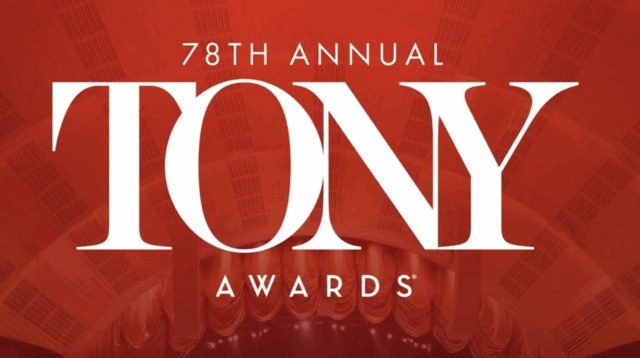
Who:Simon Jones,David Barbour,Martha Wade Steketee, and Mark Rifkin, plus Steve Ross What:Tony Awards preview and cabaret concert Where:The Coffee House Club at the Salmagundi Club, 47 Fifth Ave. between Eleventh & Twelfth Sts. When: Wednesday, June 4, free for members, $10 for nonmembers, 5:30 Why: The seventy-eighth annual Tony Awards take place Sunday, June 8, at Radio City Music Hall, but you can get a sneak peek at who the winners might be when the prestigious Coffee House Club hosts its popular Tony Awards preview on June 4. Discussing the shows nominated in the major categories will be the inimitable Martha Wade Steketee, the incomparable David Barbour, and me, moderated by the wonderful actor and raconteur Simon Jones. You can read our bios below.
The event begins at 5:30 at the Salmagundi Club and will be followed at 6:30 by “Steve Ross & Friends: Cole Porter, Sung & Unsung,” in which the legendary Crown Prince of New York Cabaret will perform favorite and surprise Porter tunes. Admission is free for members and $10 for guests; everyone is invited to an a la carte dinner afterward to continue the party with advance RSVP.
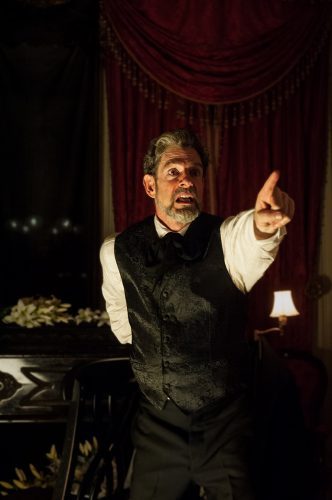
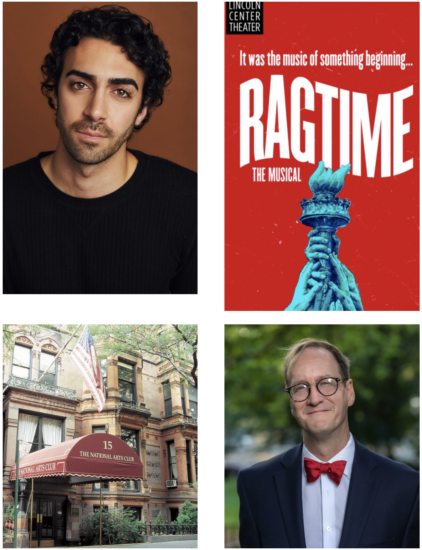
Simon Jones will moderate Tony Awards preview at the Coffee House Club on June 4 (photo by Conrad Blakemore)
Simon Jones has starred opposite Joan Collins, Lauren Bacall, Rex Harrison, Claudette Colbert, and Angela Lansbury over thirteen productions on Broadway. His most recent appearance was in Trouble in Mind at the Roundabout Theatre in 2021–22. He has recorded more than two hundred audio books. He played King George V in the first Downton Abbey movie, and his other film credits include Miracle on Thirty-Fourth Street,Twelve Monkeys,Brazil, and Monty Python’s The Meaning of Life. In a TV career spanning forty years, he remains well known for his performances as Arthur Dent in The Hitchhiker’s Guide to the Galaxy, Bridey in Brideshead Revisited, and Sir Walter Raleigh in Blackadder, and currently he is one of the stars of The Gilded Age on HBO/MAX, as Bannister the butler. Season three begins June 22.
Martha Wade Steketee is a theater-loving public policy researcher who currently practices in the fields of dramaturgy, criticism, and theater research. She serves as chair of the Drama Desk nominating committee and on several play prize committees, is a member of the Henry Hewes Design Awards Committee and past chair of the American Theatre Critics/Journalists Association, and author of the Women Count report series analyzing gender in hiring trends off Broadway since 2010.
David Barbour is editor-in-chief of Lighting & Sound America, which covers design and technology in live entertainment. He is also copresident of the Drama Desk and a member of the New York Drama Critics Circle and the Henry Hewes Design Awards Committee.
Mark Rifkin is a member of the Drama Desk and the American Theatre Critics/Journalists Association and has been running the online newsmagazine This Week in New York since 2001, covering art, film, theater, literature, dance, music, food, and anything else that requires someone to leave their apartment in the five boroughs. You can follow his “mad transit” adventures on Substack.
CONEY ISLAND BOOK FAIR
Coney Island USA
1208 Surf Ave.
Saturday, May 10, fair free, panels $20, variety show $25, $40 for both www.coneyislandbookfair.org
Coney Island has been a poignant location in such books as Lawrence Ferlinghetti’s A Coney Island of the Mind, Sol Yurick’s The Warriors, Joseph Heller’s Now and Then: From Coney Island to Here: A Memoir, Billy O’Callaghan’s My Coney Island Baby, and Alice Hoffman’s The Museum of Extraordinary Things.
The Brooklyn home of the Cyclone, the Wonder Wheel, Luna Park, and the New York Aquarium is now taking the next step in its literary history with the inaugural Coney Island Book Fair, done in its usual style, with more than a touch of freaky entertainment. On May 10, there will be four panel discussions, books for sale, art vendors, jewelry, food and drink, and a concluding variety show with special guests. Below is the full schedule.
Sip, Search, and Swap Stories!, Freak Bar, noon – last call
Writing the City: New York as Muse, with Eddie McNamara, John Strausbaugh, and Laurie Gwen Shapiro, moderated by Heather Buckley, 1:00
Writing the Creepy: Books That Go Bump in the Night, with Leila Taylor, S. E. Porter, Colin Dickey, Alix Strauss, and Sadie Dingfelder, moderated by Laetitia Barbieri, 2:00
Writing the Shimmy: The Politics of Pasties and Performance, with Jo Weldon, Linda Simpson, and Elyssa Goodman, moderated by Ilise S. Carter, 3:00
Writing the Bally: Sideshow as a Main Character, with James Taylor, Jim Moore, and Dawn Raffel, hosted by Trav S.D., 4:00
Body of Work: A Literal Literary Variety Show, with Jo Weldon, Johnny Porkpie, Fancy Feast, Victoria Vixen, Garth Schilling, and more, hosted by journalist, author, writer, sword swallower, fire-eater and straitjacket escape artist the Lady Aye, $25, 7:00
[Mark Rifkin is a Brooklyn-born, Manhattan-based writer and editor; you can follow him on Substack here.]
Japan Parade and Street Fair returns to NYC May 10 (photo courtesy Japan Parade)
Who: Masaharu Morimoto, Sayaka Yamamoto, Sandra Endo, the cast of ATTACK on TITAN: The Musical, Koji Sato, Soh Daiko, COBU, Taiko Masala Dojo, Harlem Japanese Gospel Choir, Japanese Folk Dance Institute of NY, Yosakoi Dance Project — 10tecomai / KAZANAMI, IKO Kyokushinkaikan, New York Kenshinkai, Anime NYC, Miyabi Koto Shamisen Ensemble, more What:Japan Parade and Street Fair and Japan Night concert Where: Parade: Central Park West between Sixty-Eighth & Eighty-First Sts.; concert: Edison Ballroom, 240 West Forty-Seventh St. When: Concert: Friday, May 9, $81.88-$108.55, 5:30; parade and street fair: Saturday, May 10, free, 11:00 – 5:00 Why: The fourth annual Japan Parade and Street Fair takes place on May 10, celebrating the long friendship between the United States and Japan. Among the many participants in the parade, which kicks off at 1:00 at Central Park West and Eighty-First St. (the opening ceremonies are set for 12:30 at West Seventy-First St.), will be the cast of ATTACK on TITAN: The Musical, Hello Kitty, My Melody, Kuromi, taiko drummers, Japanese dance troupes, martial arts organizations, language schools, a gospel choir, singer-songwriter Sayaka Yamamoto, and members of Anime NYC. The grand marshal is Iron Chef restauranteur and author Masaharu Morimoto, the community leader is JAANY president Koji Sato, the honorary chairman is Ambassador Mikio Mori, and the emcee is television news correspondent Sandra Endo. In addition, there will be a street fair from 11:00 to 5:00 on West Seventy-Second St. between CPW and Columbus Ave., featuring food and drink, calligraphy, Yukata, origami, tourist and cultural information, a donation tent, prizes, and more.
“I am deeply honored to be appointed the grand marshal of this year’s Japan Parade in New York City,” Chef Morimoto said in a statement. “This role gives me a unique opportunity to celebrate and share the rich, dynamic culture of Japan with the heart of one of the world’s most vibrant cities.”
The parade will be preceded on May 9 by Japan Night at the Edison Ballroom in the Theater District, with performances by the cast of ATTACK on TITAN: The Musical, Miyabi Koto Shamisen Ensemble with Masayo Ishigure, and Sayaka Yamamoto, the former captain of NMB48, in addition to a sake tasting and a crafts presentation by ASP Group. The event will be hosted by NBC News correspondent Emilie Ikeda; tickets are $81.88-$108.55.
“The Japan Parade, a community-wide effort, represents the interwoven cultural and economic ties between Japan and New York, reflecting — and deepening — the strong alliance between Japan and the US,” Ambassador Mori added. “And right now, with the world in considerable need of unity, goodwill, and hope, Japan–US relations are more vital than ever, demonstrating what can be accomplished by working together towards common goals. So, by extension, the Japan Parade is also vital — the greater the celebration, the greater our cooperation!”
[Mark Rifkin is a Brooklyn-born, Manhattan-based writer and editor; you can follow him on Substack here.]
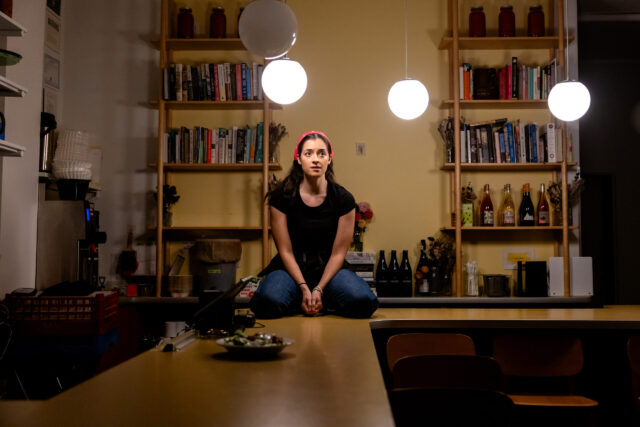
Who:Sierra Boggess,Laura Bell Bundy,Nicole Ryan What: Live, unscripted conversation with drinks, snacks, shopping, and cocktail gathering Where:Shine by Randi Rahm pop-up boutique, 501 Madison Ave. between Fifty-Second & Fifty-Third Sts. When: Wednesday, April 2, free with RSVP, 5:30 Why: Randi Rahm’s Fashion Talks at Shine kicked off March 5 with Bachelor Night, featuring Golden Bachelorette Joan Vassos, Bachelorette Charity Lawson, and moderator Nicole Ryan from SiriusXM, followed by Music Night with Jillian Hervey of Lion Babe on March 19. The third edition of the live podcast takes place April 2 with Broadway Night, when Ryan will be joined by actor, singer, and figure skater Sierra Boggess, who has starred in such shows as The Little Mermaid,The Phantom of the Opera,School of Rock, and Harmony, and actor, singer, and Tony nominee Laura Bell Bundy, whose Great White Way career includes Hairspray,Legally Blonde, and The Cottage.
“I always say, I’m in the art of fashion. To me, that means creating something that tells a story — something that moves people,” Rahm said in a statement. “These talks are an extension of that. They’re about connection, creativity, and the courage it takes to share who you really are. Laura Bell and Sierra embody all of that. They’re not only incredible artists but women who lead with heart, humor, and authenticity — and I’m so honored to have them join me in this space.”
Randi Rahm is hosting a series of fashion talks at Shine pop-up boutique
The intimate, candid conversation will be preceded by a chance to explore Rahm’s new ready-to-wear Shine collection and followed by a cocktail reception and more shopping; tickets are free with advance RSVP.
[Mark Rifkin is a Brooklyn-born, Manhattan-based writer and editor; you can follow him on Substack here.]
THERE WILL BE CAKE!
Asylum NYC
123 East Twenty-Fourth St. between Lexington & Park Aves.
December 12-14, $10-$35, 1:30 www.operapraktikos.org asylumnyc.com
Will there be cake at There Will Be Cake! Yes indeed, there will be cake at the two afternoon mono-operas taking place December 12-14 at 1:30 at Asylum NYC, presented by Opera Praktikos (OPrak).
The pair of related works are set in the same kitchen fifty years apart; Bon Appetit!, by Lee Hoiby, Julia Child, and Mark Shulgasser, features mezzo-soprano Hailey McAvoy singing the role of the beloved host of the breakthrough cooking program The French Chef, while OPrak’s first commission, Fluffernutter, by composer-lyricist Spicer Carr and librettist-playwright Marianna Mott Newirth, features Zwisenfach Shanley Horvitz as Sarah Karmichael and piano arrangements by Patrick Tice-Carroll.
The works, which deal with memory and food, are directed by Gwynn MacDonald, with music direction by Calvin Hitchcock. The December 14 performance is already sold out, although it is also available via livestream.
As Child once said, “Drama is very important in life: You have to come on with a bang. You never want to go out with a whimper. Everything can have drama if it’s done right. Even a pancake.”
And certainly cake.
[Mark Rifkin is a Brooklyn-born, Manhattan-based writer and editor; you can follow him on Substack here.]
A mother (Essie Davis) and her young son (Noah Wiseman) must get past terrible tragedy in The Babadook
THE BABADOOK (Jennifer Kent, 2014)
Industry City, Courtyard 5/6, 51 Thirty-Fifth St., Brooklyn
Tuesday, September 17, $22.15, 7:45 rooftopfilms.com www.ifcfilms.com
A hair-raising sleeper hit at Sundance that was named Best First Film of 2014 by the New York Film Critics Circle, The Babadook will be celebrating its tenth anniversary with a special Rooftop Films screening in Industry City on September 17, followed by a Q&A with director Jennifer Kent and a vodka-infused afterpaty.
The Babadook is a frightening tale of a mother and her young son — and a suspicious, scary character called the Babadook — trapped in a terrifying situation. Expanded from her 2005 ten-minute short, Monster, writer-director Kent’s debut feature focuses on the relationship between single mom Amelia (Essie Davis), who works as a nursing home aide, and her seemingly uncontrollable six-year-old son, Samuel (Noah Wiseman), who is constantly getting into trouble because he’s more than just a little strange. Sam was born the same day his father, Oskar (Ben Winspear), died, killed in a car accident while rushing Amelia to the hospital to give birth, resulting in Amelia harboring a deep resentment toward the boy, one that she is afraid to acknowledge. Meanwhile, Sam walks around with home-made weapons to protect his mother from a presence he says haunts them. One night Amelia reads Sam a book that suddenly appeared on the shelf, an odd pop-up book called Mister Babadook that threatens her. She tries to throw it away, but as Sam and the book keep reminding her, “You can’t get rid of the Babadook.” Soon the Babadook appears to take physical form, and Amelia must face her deepest, darkest fears if she wants she and Sam to survive.
Writer-director Jennifer Kent explores classic horror tropes in her feature debut, the sleeper hit The Babadook
The Babadook began life as a demonic children’s book designed by illustrator Alex Juhasz specifically for the film — and one that was initially available for purchase from the movie’s official website, although anyone who bought the book hopefully thought twice before inviting the twisted tome into their house. The gripping film, shot by Polish cinematographer Radek Ladczuk in subdued German expressionist tones of black, gray, and white with bursts of other colors, evokes such classic horror fare as Stanley Kubrick’s The Shining, Roman Polanski’s Repulsion, and Edgar Allan Poe’s The Fall of the House of Usher, where place plays such a key role in the terror. The Babadook itself is a kind of warped combination of the villains from F. W. Murnau’s Nosferatu, Robert Wiene’s The Cabinet of Dr. Caligari, and Hideo Nakata’s The Ring. Kent, a former actress who studied at Australia’s National Institute of Dramatic Art with Davis and has made one other feature, 2018’s The Nightingale, lets further influences show in the late-night television Amelia is obsessed with, which includes films by early French wizard Georges Méliès. But the real fear comes from something that many parents experience but are too ashamed or embarrassed to admit: that they might not actually love their child, despite trying their best to do so. At its tender heart, The Babadook is a story of a mother and son who must go through a kind of hell if they are going to get past the awful way they were brought together.
Curator and cultural historian John T. Reddick will give a talk on Tin Pan Alley on September 11 at the Society of Illustrators (photo by twi-ny/mdr)
ILLUSTRATING TIN PAN ALLEY: FROM RAGTIME TO JAZZ
Society of Illustrators
128 East Sixty-Third St. between Park & Lexington Aves.
Wednesday – Saturday through October 12, $10-$15
Tin Pan Alley Talk & Reception: Wednesday, September 11, $10-$15. 6:30
212-838-2560 societyillustrators.org
Longtime Harlem resident and Yale University School of Architecture graduate John T. Reddick is into bridge building — but in this case, the bridges aren’t physical structures but those that involve the lesser-known history of Tin Pan Alley. The birthplace of American popular music, Tin Pan Alley flourished in the late nineteenth and early twentieth centuries, when dozens of music publishers and businesses lined the streets of what is now Chelsea, in the West Twenties.
Born and raised in the integrated Philadelphia neighborhood of Mount Airy, Reddick got involved in trying to save Tin Pan Alley when five buildings on West Twenty-Eighth St. were in danger of being demolished by their owner/developer. In 2019, the Landmarks Preservation Commission designated them historic landmarks.
A founding member of Harlem Pride and the director of community engagement projects for the Central Park Conservancy, Reddick has been an avid collector of sheet music art, focusing on songs composed and/or performed by Black and Jewish entertainers. What began as a curiosity and hobby has blossomed into a dazzling exhibition at the Society of Illustrators, “Illustrating Tin Pan Alley: From Ragtime to Jazz,” on view through October 12.
“I felt like these artists were groundbreakers. I see in them many parallels to hip hop, in that ragtime’s innovation for its time was as jarring as hip hop’s,” he said of the composers and performers of the era during a tour of the show. “My journey began after I went to a talk on the Lower East Side given by Jeffery Gurock, who lectured on the period when Harlem was Jewish. That was a revelation to me, that Harlem had once been the second largest Jewish community in New York City. From that point I went to the library, did research, and started buying items on eBay. It was just shocking; as I bought sheet music or got to see the names, I realized they all lived in Harlem during the same time period.”
Arranged chronologically, the exhibit focuses on sheet music and its accompanying art, which reveals the developing connections between American Black and white music, beginning with the cakewalk, a Black dance that originated in America but became a craze when introduced in Europe, advancing its popularity as a hit in the United States. Several photographs and illustrations depict the cakewalk being performed, including two works by French artist Georges-Bertin Scott, sheet music covers for the songs “Darktown Is Out To-Night” and “Cake Walk Neath the Dixie Moon,” and a drawing in which Uncle Sam relaxes while watching dancers’ cakewalk around a tree.
On a nearby wall is the sheet music for “All Coons Look Alike to Me,” a popular 1898 song composed by Ernest Hogan that sold more than a million copies. Hogan, a prominent Black composer and performer, appeared in shows with the leading African American performers of the day. However, the song’s sheet music art, which featured unflattering caricatures of Black men and women, became such a crippling definer of Hogan as an artist that it led to his demise.
Reddick noted, “All of a sudden, this ragtime music is popular, and you want to show and sell us more. What do you use to image that music?” Reddick grouped together the sheet music covers for “Who Dat Say Chicken in Dis Crowd” by Paul Laurence Dunbar and Will Marion [Cook], “Cotton: A Southern Breakdown” by Albert Von Tilzer, and “Watermelon Am Good Enough for Mine” by G. Barker Richardson and Von Tilzer. “I have three things in there: cotton, chicken, and watermelon. They’re in the lyrics; they’re in the titles,” Reddick said. “A lot of the signifying, I feel, is coming out of music publishers just trying to meet the commercial market where its mind is at. You don’t cartoon something unless its understanding is pervasive. For me it’s the beginning of bridge building to some identity that’s beyond that becomes an American music.”
Other excellent groupings juxtapose two different sheet music covers for Lew Pollack’s “Vamping Sal the Sheba of Georgia” and three for Shelton Brooks’s “Darktown Strutters’ Ball.”
Pointing out that a lot of sheet music was dedicated to songwriter and journalist Monroe Rosenfeld because the performers knew he could talk them up in the newspaper, Reddick zeroed in on the team of Bert Williams and George Walker.
“Rosenfeld has this bridge relationship, so you see a lot of people pandering to him, even Williams and Walker, who coined themselves ‘the two real coons.’ They claimed the tag and the stage to establish their own authenticity and artistry. I realized in many ways it’s just like hip hop. You could have been the greatest hip-hop singer in the world, but if you went to amateur night at the Apollo and started singing in a tuxedo, you would be booed. You wouldn’t even get your mouth open because there’s a certain kind of drag they expect you to be in to perform. Williams and Walker knew they were good, but they realized that more whites were blacking-up and playing Blacks onstage than actual Black performers. It was so much more sophisticated. They could show that there’s parody and all this irony in lot of stuff they did.”
Every element, even the way the show is hung, carries some kind of weight. Reddick explained that for most of the works, a black frame indicates the song was written by a Black composer, a white frame by a white composer.
Perhaps not accidentally, the cover sheet for Jean Schwartz’s 1908 “The Whitewash Man,” depicting a smiling Black man carrying a paint bucket and a broom, is placed over a water fountain, evoking the “Whites Only” signs of the Jim Crow era.
Among the other composers and performers Reddick discussed were James Reese Europe and Ford T. Dabney, Noble Sissle and Eubie Blake, Irene and Vernon Castle, Irving Berlin, George Gershwin, Ethel Waters, Cab Calloway, Duke Ellington, Miss Aida Overton Walker, drummer Buddy Gilmore, Fats Waller, Sophie Tucker, Josephine Baker, and W. C. Handy as well as the Clef Club, the Ziegfeld Follies, the Cotton Club, Connie’s Inn, and Al Hirschfeld and Sydney Leff, two Jewish artists who attended the Vocational High School for the Arts on 138th Street in Harlem.
“Think of the names of Motown groups,” Reddick said. “The Supremes, the Marvelettes, the Temptations. Nobody’s a gangster. They’re claiming we deserve to be on the other side. Now we have a credential. . . . When the Central Park jogger case happened [in 1989], the term ‘wilding,’ it was just a term for young people being in nature and the park, not being there in the park to victimize people. But that was the first time it crossed over as a term from the Black community to the broader public. . . . So, I always think, what if bling had crossed over, associated with a jewelry store robbery as opposed to the fashions of hip-hop artists. Again, the word already had that meaning in my culture. Bling and jewelry. You got bling on, but at a certain point it crossed over, right? Maybe a hip-hop person, whatever. What was the bridge that made it happen?”
Tin Pan Alley exhibition winds down narrow hallway (photo courtesy of Society of Illustrators)
One of the most striking works is E. Simms Campbell’s gorgeously detailed 1932 “Night-Club-Map of Harlem,” which locates such hot spots as Smalls Paradise, Club Hot-Cha (“where nothing happens before 2 a.m.”), “the nice new police station,” Gladys’ Clam House, the Lafayette Theatre, the Radium Club, and the Savoy Ballroom, with cartoon vignettes of people dancing the lindy hop and the snakehips, men purchasing “marijuana cigarettes,” Bill “Bojangles” Robinson tapping away, and Tillie’s offering “specialties in fried chicken — and it’s really good.”
Reddick, who will give a lecture at the Society of Illustrators on September 11 at 6:30, followed by a reception with pianist/preservationist Adrian Untermyer, then told a story about American composer and violinist Will Marion Cook, who had studied with and influenced Antonín Dvořák’s take on America’s “Negro Music.”
“He performed and got a review that said he was one of the nation’s best colored violinists. And he took his violin to the critic and broke it and said, ‘I’m the best violinist.’ He wanted to start writing for Black shows and other Black players. He wrote with [poet and novelist] Paul Laurence Dunbar. But his family was so embarrassed for writing that ‘n—er’ music that in his first productions, he didn’t use his last name. However, Cook-associated shows such as 1898’s Clorindy and 1903’s In Dahomey served to bring a more diverse African American identity to the stage. What does that mean politically? If people are liking you, then they are seeing you in another light. What’s that going to mean on the political landscape?”
He added, “Now they could be voters. Picking cotton, you weren’t a voter. They’re playing at Madison Square Garden, so they’re at this elevated level. They’re having a life that was unimaginable for most Blacks.”
Above “All Coons Look Alike to Me” is a quote by W. E. B. Du Bois from his 1903 book The Souls of Black Folk: “It is a peculiar sensation, this double-consciousness, this sense of always looking at one’s self through the eyes of others . . . one ever feels his two-ness, an American, a Negro; two souls, two thoughts, two un-reconciled strivings.”
In “Illustrating Tin Pan Alley: From Ragtime to Jazz,” Reddick is reconciling those strivings and more, building bridges across race and class through a unique moment in New York City musical history.
[On September 19, the Society of Illustrators will host a happy hour from 5:00 to 9:00, with free admission, drink specials, and live music by Charlie Judkins, Miss Maybell, and Robert Lamont. Mark Rifkin is a Brooklyn-born, Manhattan-based writer and editor; you can follow him on Substack here.]