On January 29 and 30, Weems will be at Alice Tully Hall for her latest gathering, “Contested Sites of Memory.” Produced in collaboration with Shore Art Advisory and Lincoln Center, it will feature live music, video art screenings, spoken word, and more, with trombonist, composer, sonic shaman, and musical director Craig Harris, British-born Brooklyn-based playwright, radio host, author, and Armah Institute of Emotional Justice CEO Esther Armah, singer, songwriter, producer, and activist Nona Hendryx, Grammy-winning violinist Jennifer Koh, poet, playwright, novelist, essayist, composer, pianist, professor, and writer Vijay Iyer, and recording artist Carl Hancock Rux, and emcee, trumpeter, composer, producer, educator, and social activist Jawwaad Taylor. The focus is on the purpose and meaning of American monuments and how they relate to the past, present, and future of the country.
Born in Portland, Oregon, and based in Syracuse, Weems is best known for such highly influential photographic projects as “The Kitchen Table Series,”“Family Pictures and Stories,”“The Louisiana Project,”“Constructing History,” and “Museums.” A National Academician and MacArthur Genius, she was busy during the pandemic, making the hypnotic short film The Baptism with Rux and hosting a podcast for the Whitney, “Artists Among Us,” in which she spoke with a wide range of artists, curators, and writers, including Glenn Ligon, Bill T. Jones, Lucy Sante, Jessamyn Fiore, An-My Lê, and Adam Weinberg.
“Contested Sites of Memory” should be another unique and fascinating high point in the career of one of America’s genuine treasures, who has been documenting the shape of things for more than four decades.
[Mark Rifkin is a Brooklyn-born, Manhattan-based writer and editor; you can follow him on Substack here.]
Anat Maltz’s Real Estate screens January 21 at the New York Jewish Film Festival
THIRTY-FIFTH ANNUAL NEW YORK JEWISH FILM FESTIVAL
Walter Reade Theater, Film at Lincoln Center
165 West 65th St. between Broadway & Amsterdam Aves.
January 14-28 www.filmlinc.org thejewishmuseum.org
The New York Jewish Film Festival is now celebrating its thirty-fifth year of bringing narrative features, documentaries, and shorts dealing with Judaism, Israel, and the Jewish diaspora, from romantic comedies and poignant dramas to hard-hitting looks at the state of the world amid ever-growing antisemitism. As I’ve noted before, it sometimes feels like a political statement just to attend the festival.
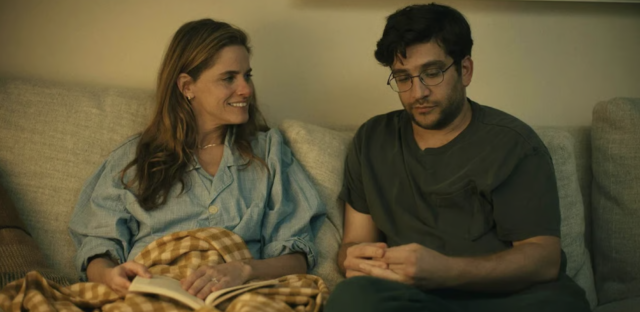
A joint production of the Jewish Museum and Film at Lincoln Center, the 2026 edition runs January 14-28, consisting of twenty-nine works from the United States, France, Germany, Spain, Belgium, Argentina, the Netherlands, Switzerland, Poland, Canada, Denmark, Uganda, and Israel, including many New York premieres. The festival opens with Ken Scott’s Once Upon My Mother, about a Moroccan family in Paris with a matriarch determined to ensure her son lives a happy life, based on an autobiographical novel by Roland Perez, who will participate in Q&As following both screenings. The centerpiece selection is Guillaume Ribot’s All I Had Was Nothingness, which follows director Claude Lanzmann during his twelve years making Shoah. NYJFF26 concludes with actor Matthew Shear’s writing and directing debut, Fantasy Life, in which a schlubby but endearing schlemiel/schlimazel/shmegege/shmendrik becomes a manny for an actress, her rock musician husband, and their three young daughters, starring Amanda Peet, Judd Hirsch, Andrea Martin, Bob Balaban, Alessandro Nivola, Jessica Harper, and Zosia Mamet.
Among the other highlights are Abby Ginzberg’s Labors of Love: The Life and Legacy of Henrietta Szold, about the founder of Hadassah; Marisa Fox’s My Underground Mother, who finds out that her mother was a spy and freedom fighter against the Nazis; Anat Maltz’s Real Estate, which takes place over the course of one day as a young couple about to have a baby are forced out of their Tel Aviv apartment; and a restoration of Aleksander Marten’s 1936 I Have Sinned, the first Yiddish sound film made in Poland. And this year’s winner for best title is Emily Lobsenz’s A Bit of Everything and Matzoh Balls Too.
Below are several films to watch out for; most screenings throughout the festival will be followed by a discussion with directors, producers, subjects, cast members, or experts.
All I Had Was Nothingness follows Claude Lanzmann as he makes Shoah
ALL I HAD WAS NOTHINGNESS (Guillaume Ribot, 2025)
Walter Reade Theater
Thursday, January 22, 2:30 & 7:45 www.filmlinc.org mk2films.com
In 1985, Claude Lanzmann’s extraordinary nine-and-a-half-hour epic, Shoah, changed the discussion surrounding the Holocaust, as Lanzmann, a French Jew, traveled around the world interviewing survivors, witnesses, collaborators, and perpetrators. In honor of the fortieth anniversary of Lanzmann’s award-winning magnum opus, French director and photographer Guillaume Ribot, who is not Jewish, has made All I Had Was Nothingness, a remarkable documentary, produced by Claude’s widow, Dominique Lanzmann, that follows Lanzmann on his journey, filled with self-doubt, doors slammed in his face, and a lack of funds that constantly threaten the project. Ribot and editor Svetlana Vaynblat went through two hundred hours of unused footage to put the film together, with Ribot adding narration taken directly from Lanzmann’s writings, primarily from his 2009 memoir, The Patagonian Hare. Even though we know that Shoah gets released to widespread acclaim — and is followed by such other Holocaust films as Sobibor, 14 October 1943, 4 p.m.,The Last of the Unjust, and Shoah: Four Sisters before Lanzmann died in 2018 at the age of ninety-two — the story plays out like a gripping, intimate thriller.
“Making Shoah was a long and difficult battle,” Lanzmann (voiced by Ribot) says early on. “I wanted to film, but all I had was nothingness. The subject of Shoah is death itself. Death and its radicality. On some evenings it felt like senseless suffering, and I was ready to give up. But during those twelve years of work, I always forced myself to stare relentlessly into the black sun of the Shoah.”
Among the people Lanzmann meets are Abraham Bomba, who survived Treblinka, where he was forced to cut the hair of women who were gassed to death; Simon Srebnik, a Chelmno survivor whose father was killed in the Łódź Ghetto and whose mother was murdered in a gas van in the concentration camp; SS commander Gustav Laabs; convicted Treblinka exterminator Franz Suchomel; locals who lived next to concentration camps and claim to have not known what was going on inside; Treblinka train engineer Henryk Gawkowski; Heinz Schubert from the Einsatzgruppen; Treblinka survivor Richard Glazar; Einsatzgruppe Obersturmführer Karl Kretschmer; and Yitzhak “Antek” Zuckerman, deputy commander of the Warsaw Ghetto Uprising. “Daily, we tackled a new prey,” Lanzmann notes as he attempts to “deceive the deceivers.”
Along the way, Lanzmann obtains a fake passport under the name Claude-Marie Sorel, quarrels with his cameraman William Lubtchansky (whose father was gassed in Auschwitz), wonders what the overall message of the film will be, uses a special hidden camera, and is unable to raise a single dollar from potential American investors. He also smokes a lot of cigarettes.
Ribot, whose previous films include Le Cahier de Susi, inspired by the discovery of a notebook by an eleven-year-old girl who was murdered in Auschwitz, and Treblinka, je suis le dernier Juif, about camp survivor Chil Rajchman, turns the focus on Lanzmann and the lengths documentarians will go to tell their stories. All I Had Was Nothingness is a valuable addition to films about the Holocaust, but it is much more than that in its search for the truth, which can be so easily hidden, while providing a behind-the-scenes look at the making of a masterpiece.
“I could have been one of the victims. I knew nothing of it, truly,” Lanzmann says about his knowledge of the Holocaust prior to doing his research for the film. “My knowledge was nil. Nothing but a statistic, an abstract figure.” Through such necessary films as Shoah and, now, All I Had Was Nothingness, the world knows.
Lanzmann often lingers on his own eyes and the eyes of his subjects, penetrating shots that are emotionally and psychologically powerful. “My journey has led me to capture eyes that have seen horror. The eyes that saw, I saw them too,” he says. And now we can seem them as well, bearing witness.
(All I Had Was Nothingness is screening January 22 at 2:30 and 7:45, with Vaynblat on hand for Q&As.)
Actor, writer, director, activist, and family man Charles Grodin is subject of fascinating documentary
CHARLES GRODIN: REBEL WITH A CAUSE (James L. Freedman, 2025)
Walter Reade Theater
Sunday, January 25, 6:15, and Monday, January 26, 1:00 www.filmlinc.org charlesgrodinfilm.com
James L. Freedman’s Charles Grodin: Rebel with a Cause reveals that the man best known to the general public for the Beethoven movies and his oddball, awkward, but hilarious talk-show appearances was in fact a deeply beloved, respected, and humble husband, father, and grandfather, a hugely successful actor, director, and writer on the big screen, the small screen, and the stage, and a fierce fighter of injustice.
“Robert Kennedy once said, ‘Each time a man stands up for an ideal, or strikes out against injustice, he sends forth a tiny ripple of hope,’” writer, director, producer, and narrator Freedman says at the beginning of the documentary. “Charles Sidney Grodin, inspiring, cajoling, and annoying people every step of the way, unleashed a tidal wave of hope.”
Grodin was born in Pittsburgh in 1935 to Orthodox Jewish parents; his maternal grandfather was a talmudic scholar from Belarus, and he was estranged from his difficult father. He was impeached as fifth-grade class president and thrown out of Hebrew school. Deciding to become an actor after seeing George Stevens’s 1951 classic A Place in the Sun, Grodin left college and moved to New York City, where he worked as a cabdriver and a nightwatchman while studying acting with Uta Hagen and Lee Strasberg. By the late 1950s, he was appearing on episodic television, including numerous Westerns, made his Broadway debut in 1962, and starred in the long-forgotten Sex and the College Girl in 1964; his big breaks came in 1968, when he played Dr. Hill in Roman Polanski’s Rosemary’s Baby and directed Lovers and Other Strangers on the Great White Way. In archival interviews, he talks about turning down the role of Benjamin Braddock in The Graduate, battling Polanski on set, being fired three times from Candid Camera, directing the controversial television special Simon & Garfunkel: Songs of America, and the failure of his first marriage.
Then, in the 1970s, he made it big with such films as Catch-22,The Heartbreak Kid, and Heaven Can Wait and the Broadway hit Same Time, Next Year. Among those singing his praises as a performer and friend are Robert De Niro (Midnight Run), Marlo Thomas (Thieves), Martin Short (Clifford), Ellen Burstyn (Same Time, Next Year), Lewis Black (Madoff), Jon Lovitz (Last Resort), Carol Burnett (Fresno), Alan Arkin (Catch-22), Art Garfunkel, and director Martin Brest (Midnight Run).
“He was a phenomenal actor. There is no actor better than him,” says Elaine May, who directed Grodin in The Heartbreak Kid. Marc Maron calls him a “cranky comedic genius.” Steve Martin (The Lonely Guy) points out, “None of us could do what he did.” Richard Kind (Clifford) explains, “Chuck was the most caring, loving narcissist.” Television executive Henry Schlieff and producer Julian Schlossberg discuss their positions on Grodin’s ever-changing top-ten-friends list. Grodin’s second wife, Elissa, a journalist he met when she was doing a story on him, notes, “He was unbelievably annoying, and I adored him.” Freedman also speaks with Grodin’s son, Nick, and daughter, Marion.
The documentary takes a fascinating shift when it turns its attention to Grodin’s extensive work for unjustly imprisoned people serving long sentences because of the Felony Murder Rule and the Rockefeller Drug Laws. He helped free Elaine Bartlett, June Benson Lambert, Randy Credico, and Jan Warren, all of whom participate in the film. “He rescued me,” Warren states. Elissa Grodin says, “He was always defending underdogs.” He brought his activism to The Charles Grodin Show, which ran on CNBC from 1995 to 1998; he was hired by Roger Ailes, who later founded Fox News.
Freedman and editor Frank Laughlin interweave new interviews with home movies, news reports, and lots of film clips of Grodin — who died in 2021 at the age of eighty-six — in films and on talk shows (Jon Stewart declares him “the best talk show guest ever . . . ever!”). It’s a joyful celebration of an extraordinary human being, a supremely talented and endlessly inventive individual whose impact on everyone he met was profound.
De Niro sums it all up when he says, “Chuck was a very special person.”
(Charles Grodin: Rebel with a Cause is screening January 25 at 6:15 and January 26 at 1:00, both followed by Q&As with Freedman.)
Amanda Peet and Matthew Shear star in Shear’s Fantasy Life, the closing night selection of NYJFF26
FANTASY LIFE (Matthew Shear, 2025)
Walter Reade Theater
Wednesday, January 28, 1:15 & 7:15 www.filmlinc.org
After losing his job, Sam (Matthew Shear) becomes a manny for actor Dianne (Amanda Peet), rock bassist David (Alessandro Nivola), and their three young girls (Riley Vinson, Romy Fay, Callie Santoro), and a touching hilarity ensues as Sam contemplates his future, not always making the best choices. Judd Hirsch and Andrea Martin play David’s parents, Bob Balaban and Jessica Harper are Dianne’s father and mother, and Holland Taylor makes a cameo as a therapist. Peet is in top form, building a gentle and tender chemistry with Shear, in his debut as a writer-director. Fantasy Life closes the festival on January 28 at 1:15 and 7:15, preceded by Jack Feldstein’s six-minute Animated New Yorkers: Joel and followed by a Q&A with Shear and Peet.
[Mark Rifkin is a Brooklyn-born, Manhattan-based writer and editor; you can follow him on Substack here.]
Young and old march through the streets, forming blockades and human chains. Signs denounce globalization and corporatization. Angry farmers and union workers demand they be heard. Cries of fascism ring out. Local police, state troopers, and the National Guard douse protesters with pepper spray and tear gas, toss flash-bang grenades, and shoot the crowd with rubber bullets. Mysterious agitators in all black smash store windows. Donald Trump and Roger Stone weigh in on free trade and tariffs.
A documentary about government intervention into blue cities in 2025? A “No Kings” rally gone bad? Clips from the Rodney King and George Floyd protests?
No, Ian Bell’s riveting WTO/99 is composed exclusively of archival footage of the Battle of Seattle, when, beginning on November 30, 1999, tens of thousands of local, national, and international men and women took to the streets to protest the WTO Ministerial Conference being held in the largest municipality in the State of Washington. Bell includes no talking heads, no experts, no eyewitnesses, only film and video taken by news organizations and individuals. No one is identified by name, and occasional interstitial text notes the time and day, with just little bits of information.
Two early exchanges set the tone. After buying a gas mask, a pair of twentysomethings are preparing to head into Seattle. “I know we are all hoping this is gonna be peaceful, but do you think that the police will use tear gas?” the man asks. The woman answers, “I’m gonna say that, no, they’re not going to use tear gas.” The man says, “What do you think would make them go to that extreme?” The woman responds, “They would go to those extremes if there was a need for it. That’s the positive attention that I want to set out there for them, that they would do it if there’s a need, and I don’t think that there will be.”
On the TV show Seattle Police: Beyond the Badge, a law enforcement official explains, “We’re not looking to provoke anything; in fact, Seattle has a long and well-deserved history of working well with demonstrators, regardless of their views.”
Both sides might have been hoping for peace, but violence escalates as the WTO has to rearrange its schedule. Mayor Paul Schell proclaims, “The city is safe,” despite evidence to the contrary.
Among the familiar faces getting in sound bites are Bernie Sanders, Bill Clinton, Al Gore, Roger Stone, Michael Moore, Amy Goodman, Tom Hayden, Ralph Nader, Howard Schultz, and Alan Keyes. At a club, a supergroup consisting of Dead Kennedys leader Jello Biafra, Soundgarden guitarist Kim Thayil, Nirvana bassist Krist Novoselic, and Sweet 75 drummer Gina Mainwal rock out for the cause.
In his feature documentary directorial debut, Seattle native Bell and co-editor Alex Megaro weave in events coming from both sides in a fury that matches what is happening on the ground; much of the footage is jerky and low-tech, adding to the chaos. “I think we all need to thank the inventor of video cameras,” one man says.
The film evokes such other poignant works about protests and rallies as Stefano Savona’s Tahrir: Liberation Square, David France’s How to Survive a Plague, and Daniel Lindsay and T. J. Martin’s LA 92, but WTO/99 feels particularly relevant now, given what is happening with ICE and the National Guard in cities all across the country.
“I’ve never seen the United States come to this,” another man says, but now it seems to be happening every week, available for everyone to watch on their smartphones as the discord unfolds in real time.
WTO/99 runs December 5-11 at DCTV Firehouse Cinema, where eight screenings will be followed by Q&As with various combinations of Bell, Megaro, producer Laura Tatham, and archival producer Debra McClutchy, moderated by Goodman, Steve Macfarlane, Krishna Andavolu, Isabel Sandoval, Deborah Schaffer, and David Osit.
[Mark Rifkin is a Brooklyn-born, Manhattan-based writer and editor; you can follow him on Substack here.]
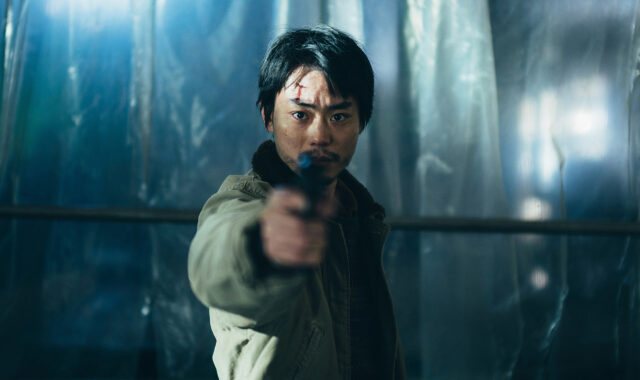
MoMA has deemed Kiyoshi Kurosawa’s revenge thriller Cloud one of the best films of 2025
THE CONTENDERS 2025
MoMA Film, Museum of Modern Art
11 West 53rd St. between Fifth & Sixth Aves.
Series runs through January 7 www.moma.org
Every year, MoMA screens what it considers the best films of the past twelve months from all over the world, in a series called “The Contenders.” Occasionally, directors are on hand for discussions after. Last month, MoMA showed such 2025 favorites as Ryan Coogler’s Sinners, Jafar Panahi’s It Was Just an Accident, Richard Linklater’s Nouvelle Vague and Blue Moon, and Yorgos Lanthimos’s Bugonia. Among December’s best are Noah Baumbach’s Jay Kelly, Luca Guadagnino’s After the Hunt, Kelly Reichardt’s The Mastermind, and Ira Sachs’s Peter Hujar’s Day.
Below is a look at some of the other upcoming class of 2025 contenders; keep watching this space for more reviews.
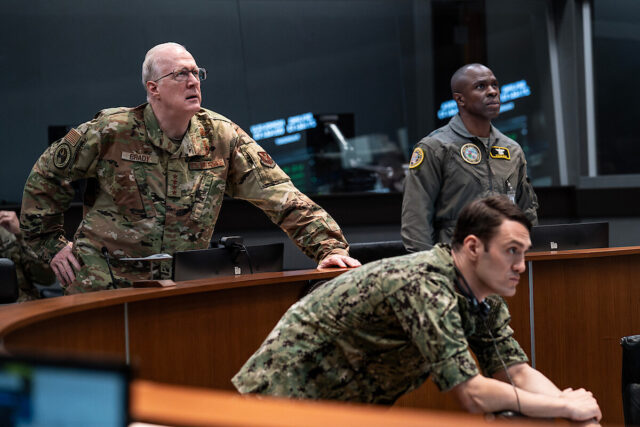
The United States is under a mysterious attack in Kathryn Bigelow’s A House of Dynamite
In A House of Dynamite, director Kathryn Bigelow and screenwriter Noah Oppenheim meld John Badham’s 1983 War Games with Stanley Kubrick’s 1964 Dr. Strangelove and Sidney Lumet’s 1964 Fail Safe in a gripping thriller told from three perspectives as an unidentified ICBM makes its way to America. On the case are Captain Olivia Walker (Rebecca Ferguson), General Anthony Brady (Tracy Letts), and the president (Idris Elba), who are desperately trying to figure out who launched it — and, even more important, how to stop it. The cast also features Anthony Ramos as Major Daniel Gonzalez, Jason Clarke as Admiral Mark Miller, Gabriel Basso as Deputy National Security Advisor Jake Baerington, Renée Elise Goldsberry as the First Lady, Greta Lee as National Intelligence Officer for North Korea Ana Park, Jonah Hauer-King as Lieutenant Commander Robert Reeves, and, practically stealing the show, Jared Harris as Secretary of Defense Reid Baker. Bigelow pulls no punches as the film builds to a sensational finale. The screening will be followed by a conversation with Bigelow, whose previous movies include Zero Dark Thirty,The Hurt Locker, and the original Point Break.
Danish-born Norwegian filmmaker Joachim Trier follows up one of the best films of 2022, two-time Oscar nominee The Worst Person in the World, which concluded his impressive Oslo Trilogy, with Sentimental Value, one of the best films of 2025 — and the decade, if not the century. Written by Trier and longtime collaborator Eskil Vogt, the intimate drama begins with a poetic house stating its raison d’être, establishing itself as a character all its own, then cutting to one of the most tense, uncomfortable, and stirring examples of stage fright ever put on celluloid. Renate Reinsve is spectacular as Nora Borg, an actress who, along with her sister, Agnes (Inga Ibsdotter Lilleaas), must confront their estranged father, Gustav (Stellan Skarsgård), who wants to come back into their lives upon the death of their mother, his ex-wife. Gustav is a famous filmmaker who has written a deeply personal script for Nora, who refuses to work with him. He instead courts popular American actress Rachel Kemp (Elle Fanning) for the role as Nora weighs her options. Sentimental Value is a heart-wrenching story of family dysfunction, patriarchal manipulation, trauma, and filmmaking that you won’t soon forget.
Kobe-born suspense master Kiyoshi Kurosawa, who has made such horror faves as Cure,Pulse, and Creepy as well as such psychological dramas as Bright Future and Tokyo Sonata, is back with an intense revenge thriller that is not for the faint of heart, featuring torture and violence — and a ton of fun. In Cloud, Masaki Suda stars as Yoshii, a quiet, disengaged young man who works at a cleaning factory, supplementing his income as an online reseller, purchasing goods at cut rates — unethically taking advantage of people — and selling them online at exorbitant prices, with no care whether the items are actually legitimate or fakes. He is upset when the owner, Takimoto (Yoshiyoshi Arakawa), offers him a promotion; Takimoto sees promise in Yoshii, but Yoshii has no interest in taking on more responsibility. When one of his deals makes him a lot of money, he quits his job and dedicates all his time to reselling whatever products he can get his hands on, from designer handbags to anime figures. Yoshii alienates his business partner, Muraoka (Masataka Kubota), and moves with his girlfriend, Akiko (Kotone Furukawa), to a house in a small, faraway town, where a young local man, Sano (Daiken Okudaira), insists on being his assistant. As his deals get more and more lucrative and dangerous, Yoshii builds a well-deserved bad reputation as a ruthless operator, and soon a group of men, armed to the hilt, come after him, determined to get even.
Cloud is a fierce, propulsive trip down the internet rabbit hole, where anonymity might feel safe but reality threatens to blow it all up. Yoshii ruins every relationship he has, with clients, customers, Sano, Akiko, Takimoto, et al., seemingly without any care or regard; he spends hours staring at his computer screen, waiting for his items to start selling, with more concern and passion than he has for any human being. And when the posse finds him, he has no understanding why they want him dead. Suda (Kamen Rider,Cube) is terrific as Yoshii; we are initially offput by his herky-jerky movement and disengagement from society, but as everything closes in on him, we also feel compassion for his potential fate. The film is beautifully shot by Yasuyuki Sasaki and expertly directed by Kurosawa, who knows just how to make the audience squirm, especially at unexpected moments. “Grudges, revenge, they’ll only drag you down,” one member of the posse tells another. “Think of this as a game.” It’s a wry comment on how too many people look at the real world these days.
[Mark Rifkin is a Brooklyn-born, Manhattan-based writer and editor; you can follow him on Substack here.]
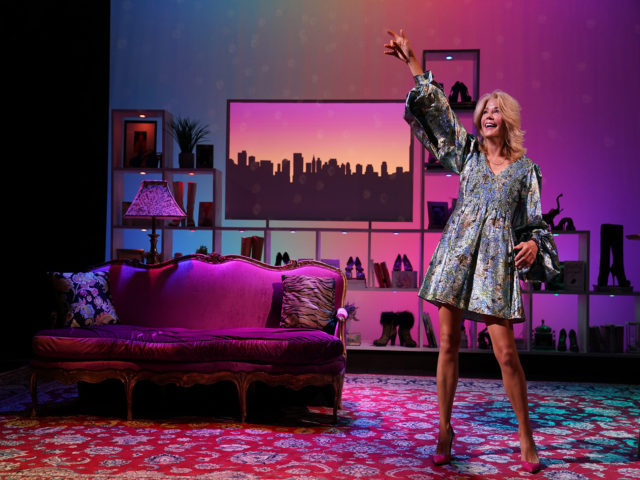
Candace Bushnell is back for a special encore presentation of her one-woman show about her life and career (photo by Joan Marcus)
CANDACE BUSHNELL: TRUE TALES OF SEX, SUCCESS, AND SEX AND THE CITY
Adler Hall at the New York Society for Ethical Culture
2 West Sixty-Fourth St. & Central Park West
Friday, December 5, $34.45- $56.06 ($187.34 for VIP meet-and-greet), 8:00 ethical.nyc candacebushnell.com
In December 2021, Candace Bushnell presented her one-woman show, Is There Still Sex in the City?, at the Daryl Roth Theatre, an endearing production in which Bushnell shared intimate details of her life and career, centering around the gargantuan success she has had with the creation of Carrie Bradshaw (Sarah Jessica Parker), Samantha Jones (Kim Cattrall), Charlotte York (Kristin Davis), and Miranda Hobbes (Cynthia Nixon), the fictional characters on the HBO smash Sex and the City, based on her series of columns and 1996 book of the same name. The run was unfortunately cut short after Bushnell contracted Covid.
I called the play “a fab treat, a funny and candid New York story that everyone can relate to in one way or another, whether you are a fan of Sex and the City or have never watched or read it.”
Bushnell, who has also written such novels as Killing Monica,Lipstick Jungle, and Rules for Being a Girl (with Katie Cotugno), is now touring the show, renamed True Tales of Sex, Success, and Sex and the City; in the spring, she’ll be taking it to Denmark, the Netherlands, Belgium, France, and California.
But first, the solo play is returning to New York City, where it all happened.
TICKET GIVEAWAY: Bushnell, who is celebrating a birthday today (December 1), will be at Adler Hall at the New York Society for Ethical Culture on December 5 at 8:00 for a special one-night-only performance of True Tales of Sex, Success, and Sex and the City, and she has gifted twi-ny with a pair of prime tickets to give away for free to see the “real life Carrie Bradshaw.” Just send your name, phone number, and favorite Sex and the City character to contest@twi-ny.com by Wednesday, December 3, at noon to be eligible. All entrants must be twenty-one years of age or older; one winner will be selected at random.
[Mark Rifkin is a Brooklyn-born, Manhattan-based writer and editor; you can follow him on Substack here.]
Award-winning filmmaker Alan Berliner explores the life and career of Benita Raphan in new documentary
BENITA (Alan Berliner, 2025)
DCTV Firehouse Cinema
87 Lafayette St.
November 28 – December 4 www.dctvny.org alanberliner.com
Shortly after learning of his friend and longtime collaborator Benita Raphan’s suicide on June 10, 2021, documentarian Alan Berliner was asked by her family if he would complete the film she was working on when she died, at the age of fifty-eight. They gave him full access to her extensive archives, comprising notebooks, outtakes, drawings, photographs, and other ephemera. Berliner spent a year doing research and ultimately decided instead to make a film about her, in an attempt to better understand Betina as a person and filmmaker and, perhaps, why she hanged herself.
“Think of this film as an experiment in collaboration,” Berliner says at the start of the aptly titled Benita. “Benita left behind thousands of pieces; my job was to splice them together, to make a mash-up of our different filmmaking styles, to do whatever it takes to bring Benita’s creative spirit to life. But as much as anything, I also just wanted the joy of being able to work with Benita, one final time.”
Berliner conducted new interviews with more than a dozen people from Betina’s private life and professional career, including her mother, Roslyn Raphan; her friends Lucy Eldridge, Shari Spiegel, Miriam Kuznets, and Eric Latzky; her former boyfriend Eric Hoffert of the Speedies; composers Hayes Greenfield and Robert Miller, and SVA chair Richard Wilde. Together they paint a portrait of an eclectic, unusual, and caring avant-garde artist who was able to charm people into participating in the creation of her films — for free. Among the numerous words they use to describe her are “complex,” “serious,” “charismatic,” “a singular soul,” “a nonconformist,” “unpredictable,” “an irregular verb,” “nervous,” “anxious,” “intense,” “incredibly humble,” “fragile,” “vulnerable,” and “a scientist in an artist’s body.”
“I want to work on fun stuff, and her stuff is fun,” sound designer Marshall Grupp says.
“I wanted to help her, I wanted her to succeed,” notes postproduction facilitator Rosemary Quigley.
Producer, director, writer, editor, and narrator Berliner incorporates scenes from about half of Benita’s thirteen short films, focusing on ones that explore creativity, intelligence, and mental illness: 2002’s 2+2 (mathematician John Nash), 2004’s The Critical Path (architect Buckminster Fuller), 2008’s Great Genius and Profound Stupidity (author Helen Keller), and 2018’s Up to Astonishment (poet Emily Dickinson).
“Benita’s films aren’t really meant to be understood,” Berliner (First Cousin Once Removed,Intimate Stranger) explains. “She’s more interested in helping you make connections and stirring up feelings about her subjects using abstraction, layering, and rapid editing, sometimes all at once, to express things that can’t always be put into words, things like dreams, stream of consciousness, or visual metaphors. When Benita takes us inside the complicated minds of her subjects, she’s also trying to show us what it’s like inside her own.”
The film excerpts reminded me of the work of experimentalists Hollis Frampton, Stan Brakhage, and Maya Deren and such surrealists as Luis Buñuel and Salvador Dalí yet wholly original. Clips in which Benita is filming her shadow as she walks down the sidewalk or crunching on ice are poetically beautiful and memorable.
A 2019 Guggenheim fellow, Benita wrote down such thoughts as “Don’t be afraid to have bad ideas,” “Mistakes are an opportunity to start again & do it right,” and “Celebrate the confusion.” However, her more recent words ranged from “afraid” and “lost” to “I’m not myself” and “falling apart.”
She spent more time by herself near the end, dedicating many of her days to her dogs, including one who had severe psychological issues and another she named Rothko, after abstract painter Mark Rothko, who committed suicide in 1970 at the age of sixty-six. “Dogs don’t repeat any of your secrets,” she wrote.
Berliner captures Benita’s inner strength and unique style, but it’s not always possible to figure out why someone chooses death over life; mental illness is too often too difficult to diagnose, especially among friends and relatives.
Benita, which had its world premiere at the recent DOC NYC festival, is screening November 28 to December 4 at DCTV Firehouse Cinema, with Berliner, the recipient of last year’s DOC NYC Lifetime Achievement Award, on hand for Q&As following one showing each night, with such guests as Firehouse Cinema’s Dara Messinger and filmmakers Deborah Shaffer, Doug Block, and Caveh Zahedi in addition to several special short films on December 1, 3, and 4.
[Mark Rifkin is a Brooklyn-born, Manhattan-based writer and editor; you can follow him on Substack here.]
David Henson (Michael Hayden) shares his story — but not his motives — with Emily (Molly Ranson) in The Honey Trap (photo by Carol Rosegg)
THE HONEY TRAP
Irish Repertory Theatre, Francis J. Greenburger Mainstage
132 West Twenty-Second St. between Sixth & Seventh Aves.
Wednesday – Sunday through November 23, $60-$125 irishrep.org
Inspired by Ed Moloney’s Belfast Project at Boston College, in which audio interviews were conducted with approximately fifty former paramilitaries involved in the Troubles in Northern Ireland in the 1970s and ’80s, Leo McGann’s The Honey Trap is a gripping thriller that explores the Troubles in a unique and compelling way.
The play begins in the dark, with snippets of dialogue heard in voiceover from former members of the IRA, the UDR, and a Scottish soldier talking about the thirty-year conflict. “They act holier than thou but they were rotten to the core. They couldn’t kill us themselves so they got their death squads to do it for them,” a Republican woman says. A former Ulster Defence Regiment man states, “I see them rarely enough but I do now and then. The post office. The big supermarket. Petrol station sometimes. I look them straight in the eye. They know what they did.”
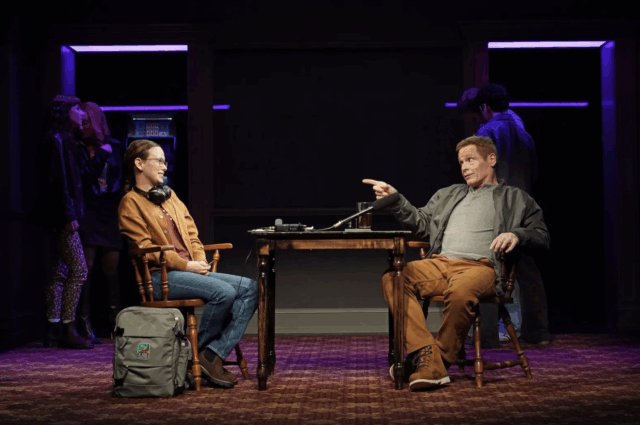
As the voiceovers fade out, we see Emily (Molly Ranson), a twentysomething American PhD candidate and researcher, sitting at a table preparing to interview David Henson (Michael Hayden), a former British soldier. He is suspicious of Emily’s possible biases, as the vast majority of her previous subjects were on the side of the IRA, but he sees this as an opportunity to set the record straight. “Okay. I mean, I know you’re more interested in talking to IRA types, but here we are. I’m glad I’m going to get a chance to tell you the truth. Because you won’t get that from them,” he says. She responds, “We’re thrilled that you’re telling your truth.” To which he shoots back, “My truth? No. The truth.”
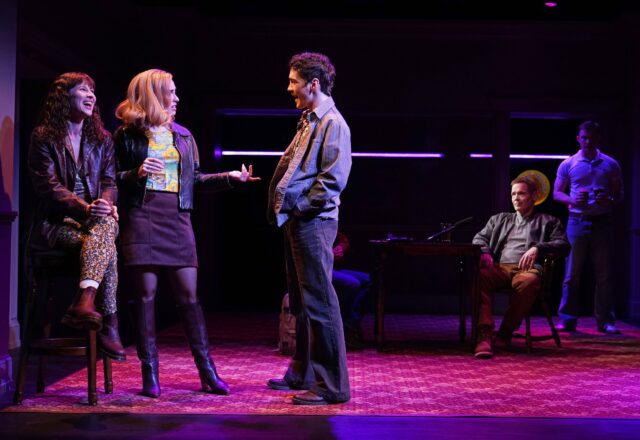
For the next two hours (with intermission), the play shifts between the present and 1979, when the young Dave (Daniel Marconi) and his friend and fellow soldier, Bobby (Harrison Tipping), had a night out that ended up with Bobby’s murder, a case that was never solved. We gradually disover that Dave is not speaking with Emily merely to share his story but also to find out who killed Bobby — and perhaps exact revenge.
In 1979, Dave and Bobby, who are both married, are at a pub after a tough day working riot control in West Belfast. As part of a game meant to embarrass Bobby, Dave forces his mate to approach two young women, Kirsty (Doireann Mac Mahon) and Lisa (Annabelle Zasowski), despite Bobby’s initial reluctance. Soon the four of them are flirting.
The action occurs in flashback around the table where Emily is interviewing Dave, who carefully watches his memories unfold as Emily continues to probe. Dave insists that he and Bobby were at the bar just to relax and have a few pints. “Did you have any idea anything was amiss?” she asks. He replies, “Not a clue.”
Dave eventually takes off, leaving Bobby with the two women. “And that was it. Last I ever saw of him,” Dave explains. “They took him to some flat just outside Belfast. We don’t know if they interrogated him first or what. Then someone shot him twice in the head. His own mum wouldn’t have recognised him. But they left his army ID in his pocket. So that made it a bit easier. Thoughtful of them, eh?”
In the second act, the modern-day Dave travels to South Belfast to meet Sonia (Samantha Mathis), who he believes knows exactly what happened to Bobby that night.
Leo McGann’s The Honey Trap at Irish Rep travels between the present and 1979 (photo by Carol Rosegg)
Every character gets more than they bargained for in The Honey Trap. McGann (Friends Like These,In the Moment) and director Matt Torney (The White Chip,Stop the Tempo), both of whom grew up in Belfast, maintain a simmering tension all the way to an explosive conclusion, with plenty of shocks and surprises, overcoming a few awkward moments. At the center of it all is the older Dave, who is onstage the entire show, either in the present day meeting with Emily and Sonia or watching his younger self on the night his life changed forever.
Tony and Olivier nominee Hayden (Judgment at Nuremberg,Carousel) is riveting as Dave, a private man on a quest while fighting off his demons; it will make you wonder what you would do if given the opportunity to watch scenes from your past unfurl before your very eyes. The rest of the cast is strong, led by a tender performance by Mathis (33 Variations,Make Believe) as a woman who thought she had escaped her past.
Master set designer Charlie Corcoran expertly integrates the different time periods and locations, from the unionist pub to a coffee shop to a bedroom, enhanced by Sarita Fellows’s casual and military costumes and Michael Gottlieb’s sharp lighting, switching between brightness and dark, shadowy interiors. James Garver’s sound ranges from the voiceovers to a loud pub and a quiet café.
The Honey Trap — which takes its name from the form of covert deception in which an operative uses seduction to lure someone into a manipulative situation — is another winner from the Irish Rep, a complex play that explores issues of guilt, responsibility, trauma, and vengeance that might be about a specific fictional event but feels all too relevant in today’s world.
[Mark Rifkin is a Brooklyn-born, Manhattan-based writer and editor; you can follow him on Substack here.]