Army and NYPD vet Corey Pegues shares his surprising tale in A Cops and Robbers Story
DOC NYC
November 11-19
DOC NYC Live! free, individual films $12, ten-film pass $80, All Access Film Pass $199
www.docnyc.net
www.ifccenter.com
Forget about TV, newspapers, magazines, and online sites; if you want to know what’s going on in the world, just check out DOC NYC, the annual festival of nonfiction films that keeps getting bigger and better every year. Instead of being held at the IFC Center as usual, the eleventh edition will be virtual, running November 11-19, consisting of nearly two hundred shorts and features that explore timely issues as only documentaries can. Individual films are $12, and many come with a prerecorded Q&A with the filmmakers. In addition, DOC NYC will be hosting free, live discussions every day on Facebook, from noon to 4:00. Below is a look at some of this year’s highlights and the full Facebook Live schedule; keep watching this space for more recommendations as the festival continues.
ASHES TO ASHES (Taylor Rees, 2020)
www.docnyc.net
Vivian Ducat’s 2011 documentary, All Me: The Life and Times of Winfred Rembert, introduced the world to the extraordinary story of outsider artist Winfred Rembert, who shares his hardscrabble life through his intimately personal leather works. In the twenty-six-minute short Ashes to Ashes, Taylor Rees focuses on Rembert’s friendship with Dr. Shirley Jackson Whitaker, as the Star Wars fanatic talks about when he was nearly lynched as a teenager and she prepares for a special memorial. The close-ups of Rembert’s tired, weathered face and exhausted eyes speak volumes about the legacy of slavery in the United States.
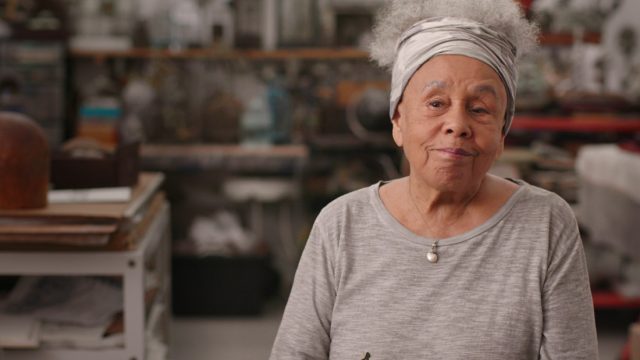
Betye Saar takes care of business in short film screening at DOC NYC
BETYE SAAR: TAKING CARE OF BUSINESS (Christine Turner, 2020)
www.docnyc.net
Last year, MoMA hosted the powerful exhibition “Betye Saar: The Legends of Black Girl’s Window,” a retrospective of the work of the California-born African American artist whose assemblages explore racism and feminism, including the controversial 1972 piece The Liberation of Aunt Jemima. Saar, who turned ninety-four this past summer, now has another moving show, “Call and Response,” that continues at the Morgan Library through January 31. In Christine Turner’s nine-minute short, Betye Saar: Taking Care of Business, made for the Los Angeles County Museum of Art, the artist discusses her process, which involves incorporating found objects into her sociopolitical constructions; several works in the documentary are on view at the Morgan, an added bonus for those in New York City.
A COPS AND ROBBERS STORY (Ilinca Calugareanu, 2020)
www.docnyc.net
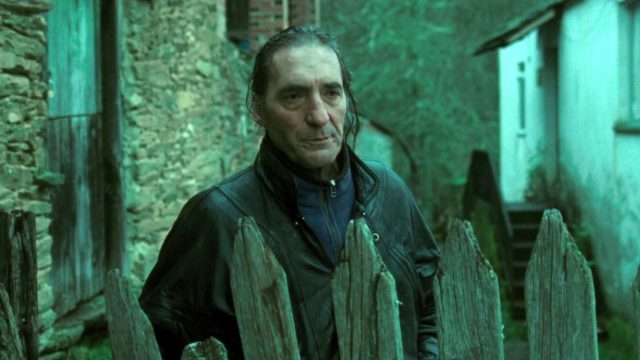
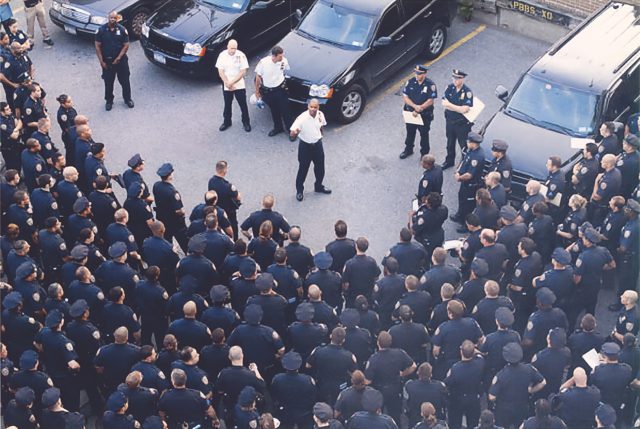
“I really wanted to tell my story,” Corey Pegues says in Ilinca Calugareanu’s A Cops and Robbers Story, making its world premiere at DOC NYC. “I was, like, people gotta know that you could make a bunch of crazy mistakes, even criminal mistakes, and then revamp and reinvent yourself. But I know I couldn’t do that.” A twenty-one-year veteran of the NYPD who believed in giving back to the community, Pegues held on to a secret that whole time: that he had previously been a street-corner drug dealer, a fact he knew would ruin everything he’d accomplished. Calugareanu speaks extensively with Pegues, his 1980s crew, and NYPD colleagues as the tale plays out one piece at a time. Be sure to stick around for the credits for a dazzling surprise about the film’s re-created 1980s scenes.
CROCK OF GOLD: A FEW ROUNDS WITH SHANE MacGOWAN (Julien Temple, 2020)
www.docnyc.net
DOC NYC is hosting the North American premiere of Julien Temple’s Crock of Gold: A Few Rounds with Shane MacGowan, a portrait of music legend Shane MacGowan, the Irish punk leader of the Pogues who is renowned for his heavy drinking. MacGowan, who will turn sixty-three on Christmas Day, is now confined to a wheelchair because of a 2015 accident in which he broke his pelvis, and his speech is so slurred, from years of alcohol and drug abuse and perhaps the worst teeth in rock-and-roll history, that the film includes subtitles whenever he speaks. He hangs out with former Sinn Féin leader Gerry Adams and actor Johnny Depp, talks about his childhood and his songwriting process, shares fabulous old footage and family photographs, and tells us how much he hates “Fairytale of New York,” which plays way too much during the documentary. I’ve seen the Pogues a few times, including a 2007 show at Roseland in which MacGowan disappeared for a while, so the band kept playing until he eventually returned, a new bottle in hand, just days after he had fallen off the stage in Boston and tore ligaments. Crock of Gold is a difficult film to watch, especially for fans who have seen Shane perform live with the Pogues or the Popes; he is now a shell of what he once was, a sad testament to what should have been a much more successful career.

Bill Shannon asks audiences to abandon assumptions in Crutch
CRUTCH (Sachi Cunningham & Vayabobo, 2020)
www.docnyc.net
in June 2010, I witnessed a mind-blowing participatory work, Bill Shannon’s Traffic: A Transient Specific Performance, in which Pittsburgh native Shannon, who has the degenerative bilateral hip deformity Legg-Calvé Perthes disease, glided through the Financial District on his specially designed crutches and skateboard as he interacted with people on the street while the audience watched from a bus that followed him. In Sachi Cunningham and Vayabobo’s Crutch, making its world premiere at DOC NYC, Shannon delves into the nature of the disease, which he contracted in childhood, explores his working methods as a dancer, choreographer, and multimedia artist, and visits a summer camp for kids with Legg-Calvé Perthese. “Everybody has crutches,” Shannon says in the feature-length film. “Some of them you can see; some of them are invisible.” (And yes, that is me on the bus….)
HER NEW YORK (David Gross, 2020)
www.docnyc.net
www.davidlgross.com
Since the 1960s, artist Jill Gill has been preserving the memory of long-gone aspects of the city in her “Lost New York” ink-and-watercolor paintings. In David Gross’s nine-minute Her New York, Gill discusses her process of photographing street corners, buildings, and movie theaters, then committing them to paper in a cartoony, playful, yet detailed style reminiscent of Red Grooms, Ben Kantor, and Roz Chast. But Gill does not lament the past; instead, she enjoys the what was as well as what is and what will be, acknowledging that things change, and not always for the worst, which is not a bad way to look at the city, and the world.
NINE DAYS A WEEK (Maliyamungu Muhande, 2020)
www.docnyc.net
Part of the DOC NYC U — New School shorts program, Maliyamungu Muhande’s Nine Days a Week is a black-and-white portrait of now-eighty-year-old street photographer Louis Mendes, who hangs around Grand Central Terminal, B&H, the Audubon Ballroom, and other locations with his vintage 1940 press camera and takes pictures of people who come up to talk to him, for a price. Mendes shares bits about his life, which includes living in shelters, and invites Muhande into his crowded studio, where he shows off his photos. The film is screened with Amrit Cheng’s OK Boomer, Lillian Xuege Li’s Parklife, and Claire Haughey’s Hidden Costs in addition to a Q&A with the directors.
THE SOCIAL DILEMMA (Jeff Orlowski, 2020)
www.docnyc.net
Available on Netflix, Jeff Orlowski’s The Social Dilemma is a frightening look into the algorithms used by such platforms as Facebook to keep users clicking away, seeing exactly what the site wants you to see. Social media experts go deep into detail, accompanied by fantastical yet goofy staged scenes that reveal how we are all trapped. No matter how bad you might have thought it was, it’s worse.
SONGS OF REPRESSION (Estephan Wagner & Marianne Hougen-Moraga, 2020)
www.docnyc.net
Part of the Winner’s Circle section of DOC NYC, Estephan Wagner and Marianne Hougen-Moraga’s Songs of Repression takes viewers inside Colonia Dignidad (Colony of Dignity), a private community in southern Chile established in 1961 by German ex-pats led by Paul Schäfer. Rebranded Villa Baviera, it is now a tourist destination, not so much for its expansive beauty, but for the horrible things that happened there, particularly the physical and sexual abuse of children, some of whom are now raising their kids there and exploiting the evils perpetrated by Schäfer for profit. One returnee and one resident decide to tell the full truth, but nearly everyone else wants to either remain silent or “forgive and forget,” resulting in a gripping tale that will often have you gasping at what you see and hear.
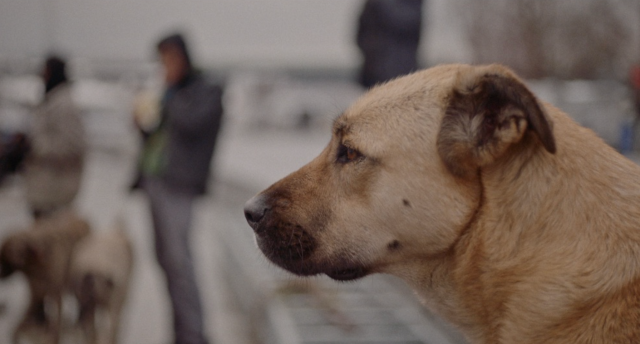
Keytin takes Elizabeth Lo on an amazing journey in Stray
STRAY (Elizabeth Lo, 2020)
www.docnyc.net/film/stray
www.magpictures.com/stray
You can have Sounder, Old Yeller, and Lassie, cheer on Balto, Benji, and Beethoven. But the best movie dog ever is Keytin, the extraordinary golden mutt who is the star of Elizabeth Lo’s masterful feature-length debut, Stray. Lo follows the remarkable canine as she wanders through the streets of Istanbul and other parts of Turkey, living a dog’s life, in a place that until fairly recently would regularly round up strays and euthanize them mercilessly. Everywhere she goes, she meets up with people she knows and who love her, from a dock to a dangerous construction site; she also plays with such puppy pals as Nazar and Kartal. Keytin scavenges for food, cuddles up with homeless kids from Aleppo, relaxes amid traffic, and chases a cat, all with a look in her eyes that reveals great depth and understanding that humans can only dream of. The soundtrack mixes a splendid score by Ali Helnwein with snippets of poignant conversation overheard on Keytin’s journeys, accompanied by occasional intertitles with relevant quotes by Diogenes and Themistius. (“Human beings live artificially and hypocritically and would do well to study the dog.”) As I said, Best. Movie. Dog. Ever.
A THOUSAND CUTS (Ramona S. Diaz, 2020)
www.docnyc.net
www.athousandcuts.film
Around the world, freedom of the press is under attack like never before, as authoritarian leaders and dictators attempt to silence their critics and control the narrative by casting the media as the enemy of the people. In A Thousand Cuts, filmmaker Ramona S. Diaz focuses on the Philippines, where President Rodrigo Duterte’s violent war on drugs has widened to include threatening journalists who do not support him: particularly Maria Ressa, the dedicated and relentless founder of the online news site Rappler, which has refused to submit to Duterte’s brutal authority. It’s a frightening film about a remarkable woman who is prepared to fight for the freedom of the press at any cost. You can read my full review here.
TINY TIM: KING FOR A DAY (Johan Von Sydow, 2020)
www.docnyc.net
www.tinytimfilm.com
“When you look at where Herbert Khaury begins and Tiny Tim ends, nothing was ever normal from top to bottom, from start to finish, Tiny Tim biographer Justin A. Martell says in Johan Von Sydow’s Tiny Tim: King for a Day. Through archival footage, interviews with friends and family, animated re-creations, and diary narration ready by “Weird Al” Yankovic, Von Sydow relates the strange tale of Tiny Tim, once the biggest star in the world, plucking away at his ukulele as he sang familiar songs in his unique vibrating falsetto. A friend of mine recently asked on his Facebook page, “Tiny Tim: Good, Bad, or Unimportant?” This documentary might change many of the responses he received.
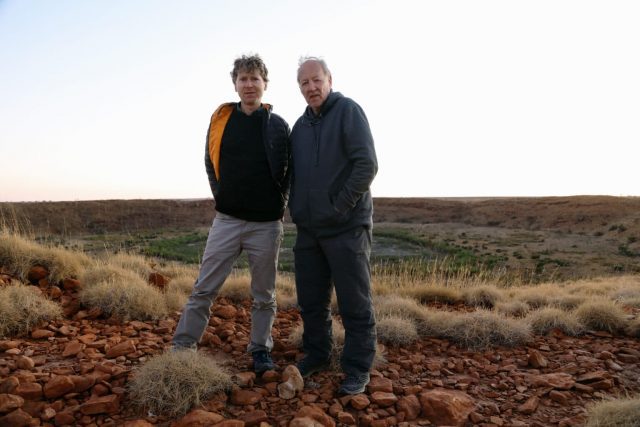
Werner Herzog and Clive Oppenheimer will discuss Fireball: Visitors from a Darker World live on Facebook on November 11
CONVERSATIONS WITH FILMMAKERS
During the festival, there will be free live half-hour discussions on Facebook, featuring filmmakers, subjects, and other experts digging into the issues explored in the works.
Wednesday, November 11
Fireball: Visitors from a Darker World, with Werner Herzog and Clive Oppenheimer, 1:00
Inside the DOC NYC Short List, with Thom Powers, Basil Tsiokos, and Opal H. Bennett, 2:00
Focus on Shorts, with Opal H. Bennett and Samah Ali, 3:00
Thursday, November 12
Truth to Power: Barbara Lee Speaks for Me, with U.S. Congress members Rep. Barbara Lee (CA), Rep. Karen Bass (CA), and Rep. Ayanna Pressley (MA), moderated by Abby Ginzberg, noon
Los Hermanos/The Brothers, with violinist Joshua Bell, Harlem Quartet member Ilmar Gavilán, and filmmakers Marcia Jarmel and Ken Schneider, 1:00
Zappa, with filmmaker Alex Winter and film editor Mike J Nichols, 2:00
Dope Is Death, with acupuncturist Juan Cortez and filmmaker Mia Donovan, 3:00
Friday, November 13
The Reason I Jump, with novelist David Mitchell and filmmaker Jerry Rothwell, noon
The Walrus and the Whistleblower, with Phil Demers, Jeff Ventre, and Natalie Bibeau, 1:00
Television Event, with filmmaker Jeff Daniels, 3:00
Saturday, November 14
The Dissident, with chess grandmaster Garry Kasparov and filmmaker Bryan Fogel, noon
Through the Night, with director Loira Limbal and Stanley Nelson, 1:00
Restaurant Hustle 2020: All on the Line, with restaurateurs Antonia Lofaso, Marcus Samuelsson, Maneet Chauhan, and Christian Petroni and filmmakers Guy Fieri and Frank Matson, 3:00
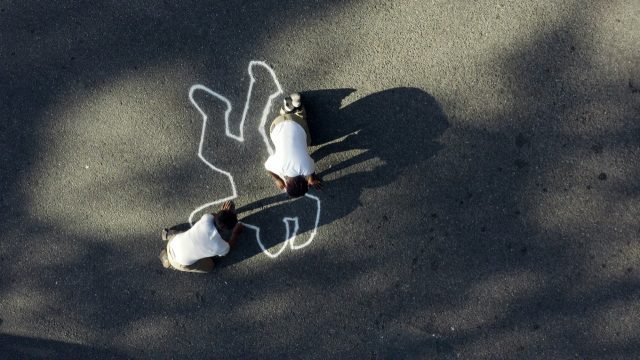
Since I Been Down explores incarceration, mandatory sentences, trauma, and rehabilitation through the case of Kimonti Carter
Sunday, November 15
Chasing Childhood, with Long Island superintendent of schools Dr. Michael Hynes, author and Let Grow cofounder Lenore Skenazy, clinical psychologist Catherine Steiner-Adair, and filmmaker Eden Wurmfeld, 1:00
A La Calle, with Acting Americas deputy director of Human Rights Watch Tamara Taraciuk Broner and the Promise Institute for Human Rights executive director Kate Mackintosh, 2:00
Since I Been Down, with philosopher Angela Davis, prosecuting attorney Dan Satterberg, and filmmaker Gilda Sheppard, 3:00
Monday, November 16
The Big Scary “S” Word, with philosopher Cornel West, filmmaker Yael Bridge, and author Astra Taylor, noon
The Mole Agent, with filmmaker Maite Alberdi, producer Marcela Santibáñez, executive producers Julie Goldman and Christopher Clements, and Carolyn Hepburn, 1:00
The Meaning of Hitler, with writer Francine Prose, Hannah Arendt Center head Roger Berkowitz, and filmmakers Michael Tucker and Petra Epperlein, 2:00
No Ordinary Man, with filmmakers Aisling Chin-Yee and Chase Joynt and memoirist Thomas Page McBee, 3:00
Tuesday, November 17
Calendar Girl, with fashion designer Nicole Miller, New York Fashion Week creator Fern Mallis, former InStyle editor Eric Wilson, director Christian Bruun, and producer Natalie Nudell, noon
Beautiful Something Left Behind, with Joe Primo, Vivian Nunez, Rebecca Soffer, and Carole Geithner, 2:00
Medicine Man: The Stan Brock Story, with Remote Area Medical CEO Jeff Eastman, healthcare reform activist Wendell Potter, and filmmaker Paul Michael Angell, 3:00
Beyond Resilience, with Sahar Driver, Chloe Walters-Wallace, Madeleine Lim, and Miriam Bale, 4:00
Wednesday, November 18
DOC NYC Awards Presentation, noon
Harlem Rising: A Community Changing the Odds, with Harlem Children’s Zone founder Geoffrey Canada, CEO Kwame Owusu Kesse, graduate Amber Deas, board member Stanley Druckenmiller, and senior manager and executive producer Marlene Fox, 1:00
Nasrin, with journalist Jason Rezaian, Reza Khandan, and filmmakers Jeff Kaufman and Marcia Ross, 2:00
Love & Stuff, with filmmaker Judith Helfand, 3:00
Thursday, November 19
IDFA / DOC NYC Dialogue, with Thom Powers and Orwa Nyrabia, noon
Landfall, with filmmaker Cecilia Aldarondo, 1:00
The Last Out, with filmmakers Sami Khan and Michael Gassert, 2:00
In My Own Time: A Portrait of Karen Dalton, with musician Peter Stampfel and others, 3:00
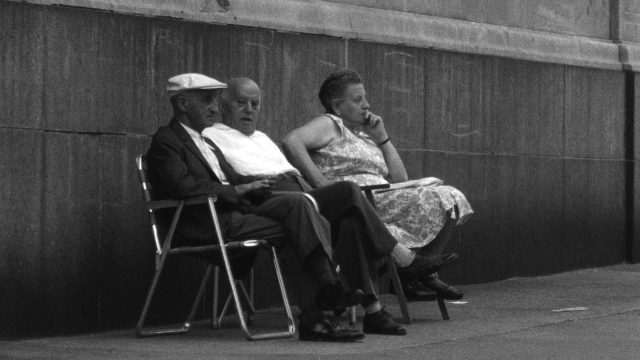
 In 2019, eighty-eight-year-old Manfred Kirchheimer was at Lincoln Center’s Francesca Beale Theater to screen and discuss his latest work, the subtly dazzling Free Time, which had its world premiere in the Spotlight on Documentary section of the fifty-seventh annual New York Film Festival. The German-born, New York-raised Kirchheimer has taken 16mm black-and-white footage he and Walter Hess shot between 1958 and 1960 in such neighborhoods as Hell’s Kitchen, Washington Heights, Inwood, Queens, and the Upper East Side and turned it into an exquisite city symphony reminiscent of Helen Levitt, Janice Loeb, and James Agee’s classic 1948 short In the Street, which sought to “capture . . . an image of human existence.” Kirchheimer does just that, following a day in the life of New York as kids play stickball, a group of older people set up folding chairs on the sidewalk and read newspapers and gossip, a worker disposes of piles of flattened boxes, laundry hangs from clotheslines between buildings, a woman cleans the outside of her windows while sitting on the ledge, a fire rages at a construction site, and a homeless man pushes his overstuffed cart.