“What must be done so a woman will not be a victim of war?” twenty-one-year-old human rights activist Nadia Murad, a member of the Yazidi religious minority, asks in Alexandria Bombach’s award-winning 2018 documentary, On Her Shoulders. Murad’s question is not rhetorical; she was brutalized as a sex slave herself when Daesh (ISIS) attacked the Yazidi, followers of a small, ancient monotheistic religion. Swedish-Kurdish filmmaker Hogir Hirori explores the horrors further in the real-life thriller Sabaya, which opens July 30 at Film Forum.
On August 3, 2014, Daesh stormed Yazidi villages in Sinjar province in northern Iraq, murdering men, women, and children while also kidnapping thousands of girls and young women, who were beaten, raped, and forced to convert to Islam. The abused women are known as sabaya, or sex slaves, who serve multiple terrorist husbands and have their babies. Over eighteen months, Hirori made six visits to Syria, embedding himself with a handful of volunteers from the Yazidi Home Center as they attempt to rescue sabaya, one at a time.
Armed with a cellphone and a gun, Mahmud, Ziyad, and a few others make dangerous sojourns at night into the Al-Hol camp in Syria, where more than seventy-three thousand Daesh live, guarded by Kurdish troops. Mahmud and Ziyad track down specific girls and young women using information from their family and female infiltrators who have been placed on the inside, risking their own lives to save these sabaya. At one point, Mahmud goes into Hassake Prison, where fifteen thousand Daesh captives are piled into rooms, as he searches out someone who will talk.
When Mahmud and Ziyad succeed, they drive the women back to the center, a ramshackle structure in a deserted area where Mahmud’s wife, Siham, and mother, Zahra, try to help the traumatized women adjust and eventually reunite them with their loved ones who, if they’re still alive, are ready to welcome them back with open arms, a refreshing difference from other religions in which they are more likely to be murdered in an honor killing or shunned from society. These sabaya are often engulfed in shame and sometimes suicidal, preferring death to a life haunted by the memories of their experiences.
“You are safe now. No one is going to hurt you,” Zahra tells a newly freed Leila, who shares her story, tears in her eyes. “We were happy in our previous lives,” Leila says. “Even though we were poor, we were happy. Then they came and killed all the men. They took us women to the city of Mosul. I can’t . . . take any more.” Meanwhile, Mahmud and Siham’s young son, Suleyman, plays, smiles, and laughs, unwittingly bringing hope and joy to the women.
Winner of the Directing Award for World Cinema Documentary at Sundance, Hirori (The Deminer) directed, edited, and photographed the film, mostly working alone or with one assistant, venturing into harm’s way as Mahmud and Ziyad head into the darkness and are shot at and threatened, undeterred from their mission to bring back as many of the missing sabaya, numbering more than two thousand, some as young as seven, as they can. Sabaya is a powerful, gripping reminder of what is happening to women and religious minorities around the world every day, and that there are quiet, unrecognized heroes like Mahmud toiling away in the shadows as well as public advocates like Murad, risking their own safety to do something about it. It’s also a harrowing chronicle of the innate cruelty of too much of humanity.
“We’re gonna do something, we’re gonna create . . . whatever it is, it gotta be good,” choreographer Rennie Harris says at the beginning of Ailey. The American Masters documentary, which opens July 23 at the Angelika and Lincoln Center, is good but sometimes overshadowed by how it could have been better.
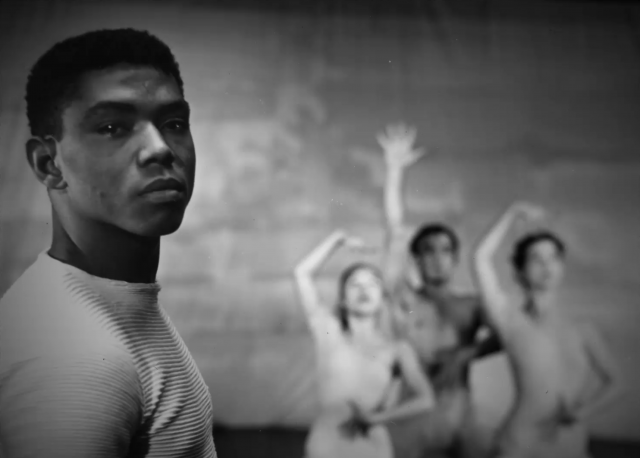
Directed by Jamila Wignot’s (Town Hall,Walt Whitman) and edited by Annukka Lilja, the film cuts back and forth between rare archival footage of Alvin Ailey, who was born in Texas in 1931 and died from AIDS in 1989 at the age of fifty-eight; new interviews with former members of the Alvin Ailey American Dance Theater; and Harris and the company rehearsing Lazarus, the Philadelphia-born choreographer’s specially commissioned 2018 ballet celebrating the life and legacy of Ailey. “Mr. Ailey talked about blood memories — what his parents went through, what his parents’ parents went through, what his folk went through. And that was a major key for me — memory. That was the anchor,” Harris, the troupe’s inaugural artist-in-residence, explains about his motivation in creating the company’s first two-act ballet.
The film focuses on how Kennedy Center Honoree Ailey’s personal experiences directly impacted his work, from being raised by a single mother in difficult circumstances, to his homosexuality, to fighting racial injustice and being an important influence on the Black community, incorporating traditional African movement and American jazz to construct pieces unlike any ever seen before. “Alvin entertained my thoughts and dreams that a Black boy could actually dance,” former AAADT company member George Faison remembers. “It was a universe that I could go into, I could escape to, that would allow me to do anything that I wanted to.”
In a 1988 interview, Ailey says, “You have to be possessed to do dance,” and he was from an early age. The documentary includes clips from such works as 1958’s Blues Suite, a party set to traditional songs performed by Brother John Sellers; 1969’s Masekela Langage, which takes on racial violence and the prison system; 1971’s Cry, a solo for Judith Jamison that was a birthday present for Ailey’s mother; 1971’s Flowers, inspired by the life of Janis Joplin; 1979’s Memoria, a tribute to his late friend and colleague Joyce Trisler; and 1983’s Fever Swamp, Bill T. Jones’s athletic piece for six male dancers. The film also digs deep into Ailey’s most famous ballet, Revelations, the 1960 masterpiece that explores the richness of Black cultural heritage. “We didn’t have to go out on the street and protest; our protest was on the stage,” Faison says. “This was our march to freedom.”
In addition to Jones, Jamison, and Faison, also sharing stories about Ailey are current AAADT artistic director Robert Battle, original company member Carmen de Lavallade, former rehearsal directors and associate artistic directors Mary Barnett and Masazumi Chaya, stage manager and executive director Bill Hammond, and former company dancers Don Martin, Linda Kent, Sylvia Waters, Hope Clark, and Sarita Allen. Barnett calls Ailey’s dances “a reenactment of life,” while de Lavallade, who is shown dancing with Ailey back in the 1950s, notes, “Sometimes your name becomes bigger than yourself. Alvin Ailey — do you really know who that is, or what it is?”
The film would have benefited by Wignot (Town Hall,Walt Whitman) spending more time with Harris and the current Ailey dancers preparing Lazarus, which premiered in 2018 as part of the “Ailey Ascending” sixtieth anniversary season. The scenes were shot at the company’s home studio on West Fifty-Fifth St., a sharply white, brightly lit space with windows on two sides, in contrast to the grainy black-and-white videos and personal photographs tracing Ailey’s life and career that are spread throughout the film.
Last week, Rosalynde LeBlanc and Tom Hurwitz’s Can You Bring It: Bill T. Jones and D-Man in the Waters opened at Film Forum, a thrilling look at the 1989 dance by Bill T. Jones/Arnie Zane Company that dealt with the AIDS crisis; the documentary details the original conception of D-Man in the Waters while also following Loyola Marymount dancers as they get ready to perform the piece in 2016, as the directors zero in on humanity’s evolving relationship with tragedy and art across generations. In Ailey, that connection is much less clear, and the contemporary rehearsal scenes feel out of place, especially without the grand finale of a fully staged production of Harris’s homage. (You can watch a brief excerpt of Lazarus made during the pandemic here. AAADT will also be performing August 17-21 at the BAAND Together Dance Festival on Lincoln Center’s Restart Stage at Damrosch Park, featuring Lazarus and Revelations, and the company just announced that its annual New York City season will take place December 1-19 at City Center.)
Even so, Ailey offers a compelling portrait of one of the most important choreographers of the twentieth century, an extraordinary man who changed the way we look at dance and Black culture. Wignot will be at the Angelika for Q&As at the 7:30 screening on July 23 and the 12:45 show on July 24; she will also be at the Howard Gilman Theater at Lincoln Center for a Q&A with Battle, moderated by National Black Justice Coalition executive director David Johns, on July 23 at 6:15 and with Waters, moderated by author, professor, and Shubert board member Pamela Newkirk, on July 24 at 6:15.
Who:Brian Stokes Mitchell, Vanessa Williams, Daniel J. Watts, Marc Shaiman, Bernadette Peters, Kristin Chenoweth, David Hyde Pierce, more What: Ticket giveaway for Crossovers Live! with Brian Stokes Mitchell Where:Stellar When: Premiering monthly July 26 – December 20, $15-$100 per show, six-show bundle $49-$500; use code BBS10 to save $10 on any six-show bundle through July 21 (benefiting the Actors Fund) Why: Brian Stokes Mitchell was already a Broadway and television star when he reached a new stratosphere of fame for his nightly renditions of “The Impossible Dream” early in the 2020 pandemic lockdown in New York City. Delivered from the window of his Upper West Side apartment after the 7:00 pm clap for health-care workers, Stokes’s performances were part of his vocal retraining after a serious bout with Covid-19. He sang one of the hit songs from Man of La Mancha, a show that earned him a 2003 Tony nomination for Best Actor in a Musical, an award he had won in 2000 for Kiss Me Kate. The Seattle-born Mitchell, who has appeared in such other Broadway musicals as Jelly’s Last Jam, Kiss of the Spider Woman, and Ragtime and such TV series as Mr. Robot, Glee, and Trapper John, M.D. (in addition to a ton of voiceovers on animated programs), is now hosting his own online talk show, Crossovers Live!, which will stream live monthly July through December and be available on demand for a limited time.
In a promotional video, Mitchell — who has also been nominated for a Grammy, formed Black Theatre United in June 2020 with Audra McDonald, LaChanze, Billy Porter, Anna Deavere Smith, and others, and received the key to the city for his extensive work during the coronavirus crisis as chairman of the board of the Actors Fund — asks, “Do you like movies? TV shows? Miniseries? How about theater? Do you like theater? Like, really like theater? Do you like any medium that actors, composers, singers, writers, dancers could be on? We asked Vanessa Williams, Marc Shaiman, Bernadette Peters, Kristin Chenoweth, David Hyde Pierce, and more to talk about crossing over from stage to screen. And they all accepted because they love audiences, and audiences love them, and we all just love each other. You get it.” The show premieres July 26 with Williams (Soul Food, Kiss of the Spider Woman) and Daniel J. Watts (Tina: The Tina Turner Musical, The Last O.G.), followed August 30 with composer Shaiman (Hairspray, Mary Poppins Returns), September 27 with Peters (Annie Get Your Gun, The Jerk), October 25 with Chenoweth (Wicked, Glee), November 22 with Hyde Pierce (Spamalot, Fraser), and December 20 with a Holiday Finale. A minimum of ten percent of the net proceeds will benefit the Actors Fund.
TICKET GIVEAWAY: Tickets for Crossovers Live! with Brian Stokes Mitchell are $15 each, $25 for the show and access to the VIP chat room, and $100 for the Super VIP Livestream, which adds in signed merchandise. The six-show bundle is $49/$99/$500.
However, twi-ny is giving away two standard six-show bundles ($49) and one VIP bundle ($99) for free. In order to be eligible, you must like Crossovers Live! on Facebook and Instagram and, in addition, send your name, phone number, and favorite play, television show, or movie with Brian Stokes Mitchell in it to contest@twi-ny.com by Thursday, July 22, at 3:00 pm. All entrants must be twenty-one years of age or older; three winners will be selected at random. As Mitchell sings, “And the world will be better for this / Oh, that one man, scorned and covered with scars / Still strong with his last ounce of courage / To reach the unreachable, the unreachable / The unreachable star.”
Nobuhiko Obayashi’s beautifully told tale, Seven Weeks, is part of Japan Society online tribute
TRAGEDIES OF YOUTH — NOBUHIKO OBAYASHI’S WAR TRILOGY: SEVEN WEEKS (NO NO NANANANOKA) (Nobuhiko Obayashi, 2014)
Japan Society virtual cinema
Available on demand through August 6, seven-day rental $10 per film, $24 for all three japansociety.org
In December 2015, Japan Society presented the two-weekend, ten-film series “Nobuhiko Obayashi: A Retrospective,” which revealed that the Japanese auteur was so much more than just the director of the 1977 cult classic House. In commemoration of the recent death of the iconoclastic, eclectic writer-director, who passed away in April 2020 from lung cancer at the age of eighty-two, Japan Society is hosting a special monthlong online screening of his War Trilogy, consisting of 2012’s Casting Blossoms to the Sky, set in the aftermath of the devastating 2011 Tōhoku earthquake and tsunami, 2017’s Hanagatami, an adaptation of Kazuo Dan’s 1937 novella about a group of students falling in and out of love in prewar Japan, and the 2014 epic family drama Seven Weeks.
A tribute to Obayashi’s late friend and colleague Hyoji Suzuki, who started an independent film workshop in Ashibetsu in 1993 and died of pancreatic cancer four years later at the age of thirty-six, Seven Weeks was shot in and around that Hokkaido village over the course of five weeks. Ninety-two-year-old patriarch Mitsuo Suzuki (Toru Shinagawa), a local retired doctor who now runs the Starry Cultural Center gift shop (a nod to Suzuki’s Hoshi no Furusato Ashibetsu Eiga Gakko, or Starry Beautiful Home Ashibetsu Film School), is on his deathbed, and various relatives are arriving to say goodbye and participate in the nanana no ka Buddhist ritual, in which they will hold memorials once a week for seven weeks following his death. The mourners include Mitsuo’s sister, Eiko (Tokie Hidari), grandchildren Fuyuki (Takehiro Murata), Haruhiko (Yutaka Matsuhige), Akito (Shunsuke Kubozuka), and Kanna (Saki Terashima), and great-granddaughter Kasane (Hirona Yamazaki), in addition to his nurse, Nobuko Shimizu (Takako Tokiwa). During the seven weeks, family members relive the past, uncovering surprising secrets about the young Mitsuo (Shusaku Uchida), his harmonica-playing friend Ono (Takao Ito), and the woman they both admire, Ayano (Yumi Adachi), as Obayashi weaves together past and present through flashbacks, the appearance of dead characters, and painting and poetry (several of the characters share a love of the poems of Nakahara Chuya).
But the film, shot in lush, fairy-tale-like colors by cinematographer Hisaki Mikimoto and featuring a sweeping score by Kôsuke Yamashita and a kind of Greek chorus embodied by the unusual Japanese band the Pascals, is not merely about the travails of one extended family; it is also very much about the rebuilding of Japanese society in the wake of WWII, the earthquake and tsunami of March 11, 2011, and the ensuing Fukushima nuclear disaster. In fact, all of the clocks and watches in Seven Weeks are perpetually stopped at 2:45 pm, the exact time the horrific 3/11 events began. Obayashi also investigates the Soviet invasion of Sakhalin Island in August 1945 and the abuse of Korean migrant workers in Japanese mines as he explores the complex issue of the meaning of home. Seven Weeks is a beautifully told tale of memory and loss, of art and war, a summing up not only of Obayashi’s career but of twentieth-century Japan, with plenty of the director’s unique trademark style. “How do I paint the world?” Mitsuo asks at one point, something Obayashi has achieved in this deeply involving and wonderfully mysterious film. Fortunately for all of us, Obayashi was not quite done painting the world, continuing a legacy that is at last being celebrated here in the West.
TRAGEDIES OF YOUTH — NOBUHIKO OBAYASHI’S WAR TRILOGY: CASTING BLOSSOMS TO THE SKY (KONO SORA NO HANA: NAGAOKA HANABI MONOGATARI) (Nobuhiko Obayashi, 2014) japansociety.org
“If people made pretty fireworks instead of bombs, there wouldn’t have been any wars,” says journalist Reiko Endō (Yasuko Matsuyuki), quoting wandering artist Kiyoshi Yamashita at the start of Nobuhiko Ōbayashi’s Casting Blossoms to the Sky. The first of the eclectic Japanese auteur’s War Trilogy, the film, based on actual experiences, is essentially an audiovisual essay, “Reiko Endō’s Wonderland: A Journey of Emotions to Nagaoka,” detailing Endō’s trip to Nagaoka in Niigata Prefecture, as the local citizenry share true tales of WWII and the 2011 Tōhoku earthquake and tsunami. (Nagaoka took in more than a thousand evacuees from Fukushima.) Ōbayashi goes back and forth between the past and the present, from the summer in 1945 when Nagaoka was bombed by the United States to the latest edition of the city’s annual fireworks display, which honor the victims of Pearl Harbor, the bombings of Nagaoka, Hiroshima, and Nagasaki, and the 2011 disaster.
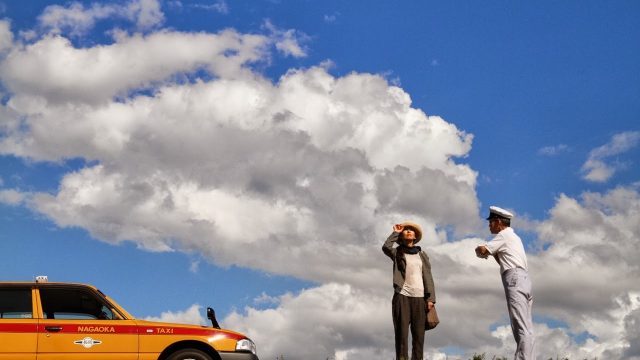
With the day of the fireworks show approaching, Endō rides with wise cabdriver Akiyoshi Muraoka (Takashi Sasano), as she, and we, discover the city’s history of war and remembrance. Endō meets with her ex-boyfriend, Kenichi Katayama (Masahiro Takashima), who is in charge of the school play at Chuetsu High and chooses There’s Still Time Until a War by a mysterious girl named Jana Motoki (Minami Inomata) who rides a unicycle through the halls and down the streets of the neighborhood. Endō learns from the inhabitants themselves, including military history researcher Takashi Mishima (Akiyoshi Muraoka) and triathlete and potato farmer Goro Matsushita (Toshio Kakei), who built a memorial using a fragment from one of the incendiary bombs dropped on Nagaoka; war veteran and local fireworks legend Seijiro Nose (Akira Emoto); reporter Wakako Inoue (Natsuka Harada), who walks Endō through important parts of the city; Yoshie Yamafuji, who lost much of her family in the bombings; artist Yasunari Honmura, who uses his paintings as reminders of the horrors of war; and numerous other survivors and relatives of the dead.
Journalist Reiko Endō (Yasuko Matsuyuki) goes on quite a ride with cabdriver Akiyoshi Muraoka (Takashi Sasano) in Nobuhiko Ōbayashi’s Casting Blossoms to the Sky
Casting Blossoms to the Sky is made in Obayashi’s unique style, with visually stunning backdrops (real and green-screened), bright, brash color schemes, professional and nonprofessional actors, and computer-generated imagery that can feel rather goofy. The film was imaginatively shot by Yûdai Katô and Hisaki Sanbongi, with lovely, often garishly beautiful production design by Kôichi Takeuchi and playful editing by Obayashi and Hisaki Sanbongi, using cute cinematic techniques. The characters sometimes turn and speak directly into the camera, further establishing the film as a cautionary tale.
“I don’t know anything about war and it’s never crossed my mind,” a young student named Ryo says to Katayama, who replies, “It’s the citizens’ duty to tell the story. There are adults who think war is necessary but not the children. That’s why it’s up to the children to make peace.”
In one of the most moving scenes, a black-and-white flashback to 2009 during a fierce storm, Endō’s mother (Shiho Fujimura) says to her, “Life is connected,” a statement that is at the heart of Obayashi’s message. But no matter how didactic some of the dialogue is and how silly the visuals can get, accompanied by Joe Hisaishi’s emotional score, Casting Blossoms to the Sky has an innate charm that is so endearing you will forgive its flaws. At one point Katayama explains, “The fireworks are a prayer.” So is Casting Blossoms to the Sky, which, like fireworks, is quite a sight to behold.
Isabelle Huppert is luminous once again, even in the hokey comic thriller Mama Weed (La Daronne), opening July 16 at the Village East. The French grand dame stars as Patience Portefeux, a widow with two grown daughters who is out of money, threatened with eviction by her tough landlord, Mrs. Fo (Jade Nadja Nguyen). Patience works as a French-Arabic translator for the police, currently enmeshed in stopping a major drug deal that secretly involves Khadidja (Farida Ouchani), the nurse who cares for Patience’s elderly mother (Liliane Rovère).
In order to protect Khadidja and her son, Choca (Mourad Boudaoud), who is in on the deal with his friend Scotch (Rachid Guellaz), Patience warns her in advance. The deal goes bad, the drugs disappear, but Patience decides to track them down herself, and when she finds them she concocts a plan to become a local drug lord so she can once again live life in the high style to which she was accustomed. While Choca and Scotch are minor leaguers who are easily manipulated, Patience has to be more careful with the extremely dangerous Cherkaoui brothers (Youssef Sahraoui and Kamel Guenfoud), who want their hash stash back. She does all this under the nose of the determined police chief, Philippe (Hippolyte Girardot), who is in charge of the case and whom she just happens to be dating.
Liberally adapted by director Jean-Paul Salomé (Les Braqueuses,Playing Dead) and Hannelore Cayre from Cayre’s novel The Godmother with the participation of Huppert, Mama Weed can’t quite figure out what it wants to be, treading the line between comedy, police procedural, romance, thriller, and widow in a man’s world trying to rise above adversity. Looking better than ever in her late sixties, Huppert is mesmerizing to watch, especially as Marité Coutard’s costumes get more and more colorful and complex, but you’ll run out of, er, patience as the plot grows more and more absurd. Patience is neither Walter White (Bryan Cranston) from Breaking Bad nor Nancy Botwin (Mary-Louise Parker) from Weeds; her success relies on too much plain luck that stretches the bounds of credulity.
Winner of the Jacques Deray Prize for best detective film and nominated for a César for Best Adapted Screenplay, Mama Weed has its moments, especially in Patience’s evolving relationship with Mrs. Fo, but the hole-ridden story feels like smoking weed of questionable quality — you’re never sure it’s truly getting you where you want to be.
Who: Lin-Manuel Miranda, Quiara Alegría Hudes, Jeremy McCarter What: Book signing Where:The Drama Book Shop, 266 West Thirty-Ninth St. between Seventh & Eighth Aves. When: Wednesday, July 21, 2:00 (tickets on sale Friday, July 16, 10:00 am) Why: In 2002, a theater group started rehearsing a new musical in the tiny Arthur Seelen Theatre in the basement of the Drama Book Shop, which was founded in 1917 by the Drama League and was bought by Arthur and Rozanne Seelen in 1958. With the future of the beloved store in jeopardy, it was purchased in January 2019 by two of the primaries involved with that rehearsal, director Thomas Kail and writer Lin-Manuel Miranda, along with producer Jeffrey Seller and theater impresario James L. Nederlander. The production was In the Heights, cowritten by Quiara Alegría Hudes, the Broadway smash that was nominated for thirteen Tonys and won four, including Best Musical. Delayed by the pandemic lockdown, the new store, designed by David Korins, opened June 10 on West Thirty-Ninth St., and it is celebrating with its first in-store book signing, a rather big one.
On July 21 at 2:00, composer-lyricist-star Miranda, librettist Hudes, and theater writer Jeremy McCarter will be signing copies of their new tome, In the Heights: Finding Home (Penguin Random House, June 2021, $40), following up on the virtual launch that took place last month. The book opens with an introduction by McCarter that begins, “The actors took their bows, the crowd finished cheering, and everybody headed for the doors. Spotting a friend, I cut across the lobby. I asked, Did you just see what I just saw? Or words to that effect. It’s been fourteen years, so I can’t remember exactly what I said that night. But I do remember exactly how In the Heights made me feel.” The show was turned into a major motion picture that was released on June 10, in theaters and on HBO Max, to wide acclaim and a casting controversy. Limited tickets for the bookstore event, in which the authors will not sign anything other than the books and no photos with them are allowed, go on sale July 16 at 10:00 am, and they’re likely to go fast, so don’t hesitate if you want to keep sharing that feeling.
Documentary explores the creation and legacy of Bill T. Jones/Arnie Zane Company’s D-Man in the Waters (photo courtesy Rosalynde LeBlanc)
CAN YOU BRING IT: BILL T. JONES AND D-MAN IN THE WATERS (Rosalynde LeBlanc & Tom Hurwitz, 2020)
Film Forum
209 West Houston St.
Opens Friday, July 16
212-727-8110 www.d-mandocumentary.com filmforum.org
In 1989, the Bill T. Jones/Arnie Zane Company presented the world premiere of D-Man in the Waters at the prestigious Joyce Theater in New York City, a physically demanding, emotional work born out of the AIDS crisis, dealing with tragedy and loss in the wake of the death of Zane, Jones’s personal and professional partner, at the age of thirty-nine in 1988. Directors Rosalynde LeBlanc and Tom Hurwitz take a deep dive into the history of the dance and its lasting impact more than thirty years later in the captivating documentary Can You Bring It: Bill T. Jones and D-Man in the Waters, opening July 16 at Film Forum.
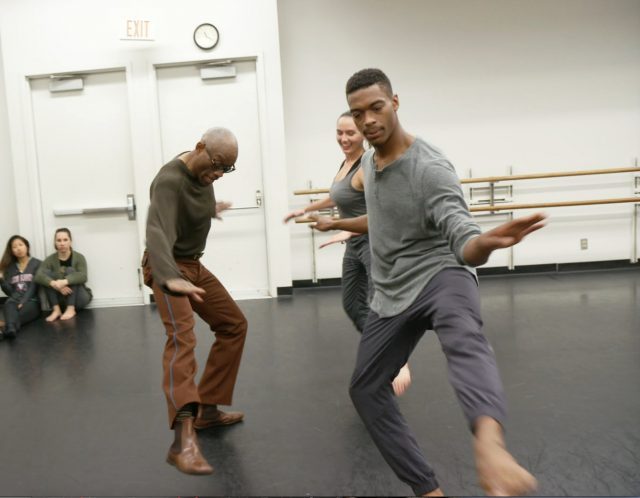
“What is D-Man? Is it alive now? Is it a cautionary tale? Is it one of inspiration?” Jones tells fifteen Loyola Marymount dancers who are staging the piece under the direction of LeBlanc, a former company member who runs the Jones/Zane Educational Partnership at the school, where she is an associate professor in the Department of Dance. Jones continues, “Makes you want to get all your shit together, your community together, take responsibility, be beautiful, be fierce — is that what it is? I don’t know what it is. . . . What do they share that is so big, so tragic that you need a piece like this to move it and give it body?”
LeBlanc, who also produced the film, and two-time Emmy-winning cinematographer Hurwitz, the son of longtime Martha Graham dancer, choreographer, and teacher Jane Dudley, talk to most of the original cast of D-Man, many of whom have gone on to form their own companies: Arthur Avilés, Seán Curran, Lawrence Goldhuber, Gregg Hubbard, Heidi Latsky, Janet Lilly, and Betsy McCracken, who, along with Jones and his sister Johari Briggs, share intimate stories of working with Jones and Zane and the importance of the piece as the arts community was being ravaged by AIDS. Sometimes holding back tears, they speak lovingly of Zane and Demian Acquavella, nicknamed “D-Man,” who died at the age of thirty-two in 1990. “He was always a boy, but always a bit of a devilish boy, and the dancing was also that way,” Jones remembers.
Through new and old interviews, home video and archival photographs, and exciting footage from the dance’s original rehearsals and Joyce premiere, LeBlanc, Hurwitz, and editor Ann Collins choreograph a gracefully flowing, compelling narrative as the documentary participants discuss specific movements — Latsky’s attempts at a jump and Curran’s memories of a duet with Acquavella in which their foreheads have to keep touching are wonderful — and LeBlanc tries to reach inside the Loyola Marymount performers to motivate them. They might have the movement down, but D-Man requires more than that to be successful. “Do you dare to let the stakes really be high?” she asks as they search for contemporary issues that impact them similarly to how AIDS affected the creation of the work, which is set to Felix Mendelssohn’s 1825 Octet for Strings, which the German composer wrote at the age of sixteen. “There was some healing, cathartic ritual in the making and the doing of this dance that sustained us,” Curran says, a feeling LeBlanc wants to instill in the college students.
“This work is not about anybody’s epidemic,” Jones, a Kennedy Center Honoree, MacArthur Grant awardee, and Tony winner who is the artistic director of New York Live Arts, said in a statement about the film. “It is about the dark spirit of what is happening in the world and how you push back against it.” Can You Bring It: Bill T. Jones and D-Man in the Waters gets to the heart of that spirit by revealing the legacy, and the future, of a seminal dance piece that continues to find its place on an ever-evolving planet.
LeBlanc and Hurwitz will be at Film Forum to discuss the film at the 7:00 shows on July 16 and 17 and will participate in a live, virtual Q&A with Jones at 8:00 on July 21. Jones, whose riveting Afterwardsness at Park Avenue Armory in May explored the Covid-19 pandemic, isolation, and racial injustice, will return to the space this fall with Deep Blue Sea, a monumental work for more than one hundred community members and dancers that begins with a solo by Jones and incorporates texts by Martin Luther King Jr. and Herman Melville, with water again playing a critical role.