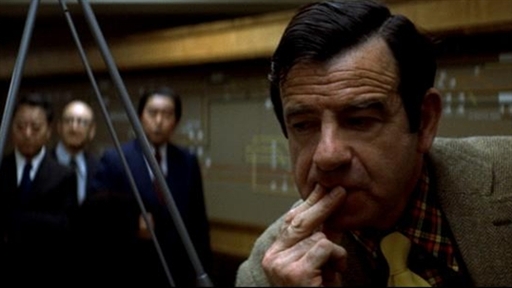
Walter Matthau tries to get to the bottom of a bizarre subway heist in THE TAKING OF PELHAM ONE TWO THREE
THE TAKING OF PELHAM ONE TWO THREE (Joseph Sargent, 1974)
Film Forum
209 West Houston St.
October 1-2
Series runs through October 21
212-727-8110
www.filmforum.org
 Loosely adapted from the book by John Godey, THE TAKING OF PELHAM ONE TWO THREE wonderfully captures the cynicism of 1970s New York City. Four heavily armed and mustached men — Mr. Blue (Robert Shaw), Mr. Green (Martin Balsam), Mr. Gray (Hector Elizondo), and Mr. Brown (Earl Hindman), colorful pseudonyms that influenced Quentin Tarantino’s RESERVOIR DOGS — hijack an uptown 4 train, demanding one million dollars in one hour from a nearly bankrupt city or else they will kill all eighteen passengers, one at a time, minute by minute. The hapless mayor (Lee Wallace) is in bed with the flu, so Deputy Mayor Warren LaSalle (Tony Roberts) takes charge on the political end while transit detective Lt. Zachary Garber (a great Walter Matthau) and Inspector Daniels (Julius Harris) of the NYPD team up to try to figure out just how in the world the criminals expect to get away with the seemingly impossible heist. Directed by Joseph Sargent (SYBIL), the film offers a nostalgic look back at a bygone era, before technology radically changed the way trains are run and police work is handled. The film also features a very funny, laconic Jerry Stiller as Lt. Rico Patrone and the beloved Kenneth McMillan as the borough commander. The film was remade as a television movie in 1998, starring Edward James Olmos, Vincent D’Onofrio, and Lorraine Bracco, and as an embarrassingly bad big-budget bomb in 2009 by Tony Scott, who we’re hoping won’t ruin his upcoming remake of THE WARRIORS as well.

Robert Redford, Paul Sand, and George Segal form an offbeat band of crooks in Peter Yates’s THE HOT ROCK (courtesy Photofest)
THE TAKING OF PELHAM ONE TWO THREE, which is being shown as part of a double feature October 1-2 with Don Siegel’s underrated CHARLEY VARRICK, in which Matthau stars as a small-time crook who gets a little too lucky, kicks off the three-week series “The Heist” at Film Forum, an exciting collection of thirty-seven films featuring unique attempts at stealing audience’s hearts and minds. Who doesn’t love a good caper movie? Programmer extraordinaire Bruce Goldstein certainly does, as seen by the awesome lineup he has put together, which includes Jules Dassin’s classics TOPKAPI (1964) and RIFIFI (1955); Sidney Lumet’s suspenseful THE ANDERSON TAPES (1971), screening with William Friedkin’s fluffy but fun THE BRINK’S JOB (1978); an inspired double bill of Norman Jewison’s THE THOMAS CROWN AFFAIR (1968) and Peter Yates’s very funny THE HOT ROCK (1972), in which Robert Redford, Geoge Segal, Paul Sand, and Ron Leibman break into the Brooklyn Museum; Quentin Tarantino’s violent bloodbath RESERVOIR DOGS (1992); a double play of the great Sterling Hayden in John Huston’s THE ASPHALT JUNGLE (1950) and Stanley Kubrick’s THE KILLING (1956); and a Nouvelle Vague pairing of Jean-Luc Godard’s BAND OF OUTSIDERS (1964) and Jean-Pierre Melville’s BOB LE FLAMBEUR (1955). Keep watching twi-ny for select reviews and further recommendations as the series continues.
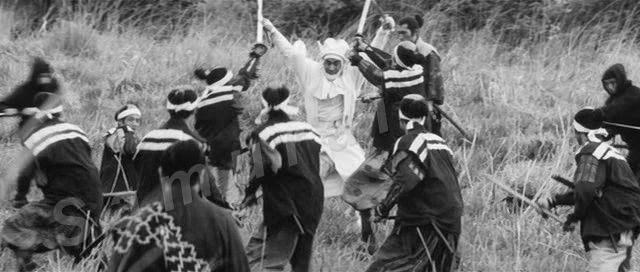
 It’s fourteen years after the Battle of Sekigahara, and the Tokugawa is still battling the Toyotomi as spies cross the land, leaving paths of blood in their wake. Caught in the middle is Sartobi Sasuke (Koji Takahashi) of the Sanada clan, who is after the truth. This is not your average samurai flick — there’s a little sex, nudity, Christianity, dismemberment, and even leprosy, although the plot is plenty confusing; good luck trying to figure out who is on which side, but always keep a look out for those men in the mysterious masks, as well as Sakon (Tetsuro Tamba), the dude in the silly white costume. The minimalist, noirish score by Toru Takemitsu is right on. SAMURAI SPY is part of the NYFF Masterworks section of the forty-eighth New York Film Festival, in the series “Elegant Elegies: The Films of Masahiro Shinoda,” which honors the genre-bending Japanese New Wave auteur with screenings of such works as THE ASSASSIN, KILLERS ON PARADE, MOONLIGHT SERENADE, and PALE FLOWER.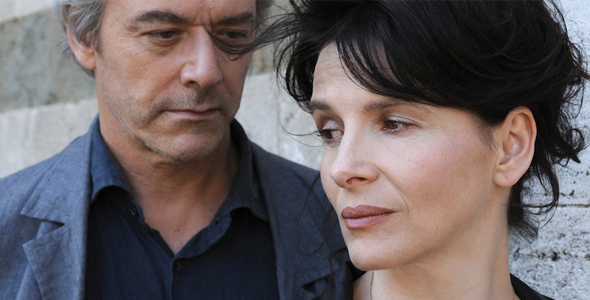
 Writer, director, poet, photographer, editor, graphic designer, and painter Abbas Kiarostami has been one of Iran’s leading filmmakers for nearly forty years, compiling a resume that includes such important international films as UNDER THE OLIVE TREES (1994), TASTE OF CHERRY (1997), and THE WIND WILL CARRY US (1999). His latest film, CERTIFIED COPY, is his first feature made outside of his home country, a dreadfully boring and annoying art-infused romantic comedy set in Italy. Juliette Binoche was named Best Actress at Cannes this year for her starring role as an unnamed single mother and antiques dealer who is obsessed with English author James Miller’s (British opera star William Shimell) book on the history and meaning of art replicas, CERTIFIED COPY. Inexplicably, the two strangers are soon on a bizarre sort-of date, driving through Tuscany and becoming involved in a series of vignettes about love and marriage, literature and art, and other topics. Both characters are seriously flawed and emotionally unstable in ways that make them unattractive to watch, especially in obvious set-ups that either go nowhere or exactly where you think they’re going. While Julie Delpy and Ethan Hawke made the somewhat similar BEFORE SUNRISE (1995) and BEFORE SUNSET (2004), in which two strangers from different countries spend a day together (but mostly by themselves), the sexual tension and excitement always building, CERTIFIED COPY is more reminiscent of Hans Canova’s ridiculous CONVERSATIONS WITH OTHER WOMEN (2005), in which Aaron Eckhart and Helena Bonham Carter star as wedding guests with a past whom viewers can’t wait to just shut up and get off the screen. Don’t let the supposed adult dialogue of CERTIFIED COPY fool you into thinking it’s an intelligent, mature look at believable relationships; instead, it feels like a staid copy of other, better films you think you’ve seen but can’t remember — and won’t care.
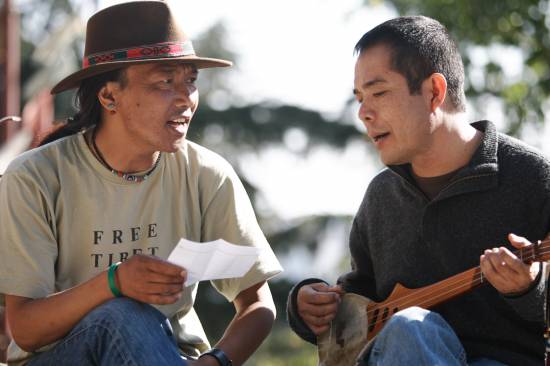
 Ngawang Choephel wrote, directed, produced, narrates, and composed the score for the fascinating, intensely personal documentary TIBET IN SONG. Born in western Tibet in 1966, Ngawang set out in 1995 to capture the dying folk music of Tibet, a critical part of the country’s tradition and yet another aspect of their culture being buried by the Chinese takeover that had begun in 1959. Risking his life as well as his family’s — he also wanted to find the father he had not seen in decades — Ngawang, who grew up in a South Indian refugee camp, started to record Tibetan folk music to preserve its heritage, leading to his arrest on espionage charges. But he let nothing stop him, especially when he came upon Tibetans who were using native melodies to sing propaganda lyrics supplied by the Chinese government. But TIBET IN SONG, which has won awards at the Sundance Film Festival, the One World International Human Rights Film Festival, the Asian American International Film Festival, and others, is more than just one person’s private struggle; it is an important document about human rights, particularly when Ngawang speaks with Tibetan exiles in India who are not afraid to tell the truth.
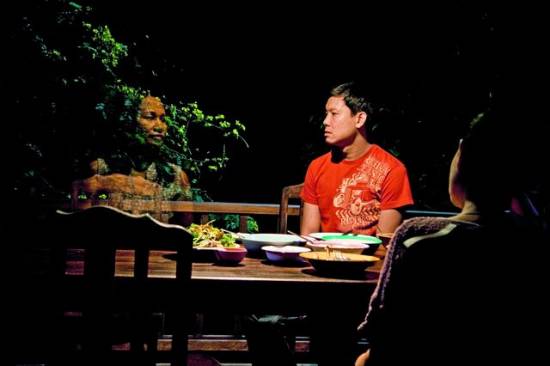
 Winner of this year’s Palme d’Or at Cannes, Thai writer-director Apichatpong Weerasethakul’s UNCLE BOONMEE WHO CAN RECALL HIS PAST LIVES is an elegiac meditation on memory, transformation, death, and rebirth, a fascinating integration of the human, animal, and spirit worlds. Uncle Boonmee (Thanapat Saisaymar) is dying of kidney failure, being tended to by his Laotian helper, Jaai (Samud Kugasang). Boonmee is joined by his dead wife’s sister, Jen (Jenjira Pongpas), in his house in the middle of the jungle. Boonmee and Jen have nearly impossibly slow conversations that seem to go nowhere, just a couple of very simple people not expecting much excitement out of what’s left of their lives. Even when Boonmee’s long-dead wife, Huay (Natthakarn Aphaiwonk), and his long-missing son, Boonsong (Geerasak Kulhong), now a hairy ghost monkey covered in black fur and with two laserlike red eyes, suddenly show up, Boonmee and Jen pretty much just go with the flow. Weerasethakul maintains the beautifully evocative pace whether Jaai is draining Boonmee’s kidney, the characters discuss Communism, Tong (Sakda Kaewbuadee) questions his monkhood, a princess (Wallapa Mongkolprasert) has sex with a catfish, or they all journey to a cave in search of another of Boonmee’s past lives. The film, which was shot in 16mm and was inspired by a 1983 book called A MAN WHO CAN RECALL HIS PAST LIVES, is part of the Primitive Project, Weerasethakul’s multimedia installation that also includes the short films A LETTER TO UNCLE BOONMEE and PHANTOMS OF NABUA. Weerasethakul, who gained a growing international reputation with such previous works as BLISSFULLY YOURS (2002), TROPICAL MALADY (2004), and SYNDROME AND A CENTURY (2006) and has a bachelor’s degree in architecture from Khon Kaen University and an MFA in filmmaking from the Art Institute of Chicago, is a master storyteller who continues to challenge viewers with his unique visual language and subtly effective narrative techniques.