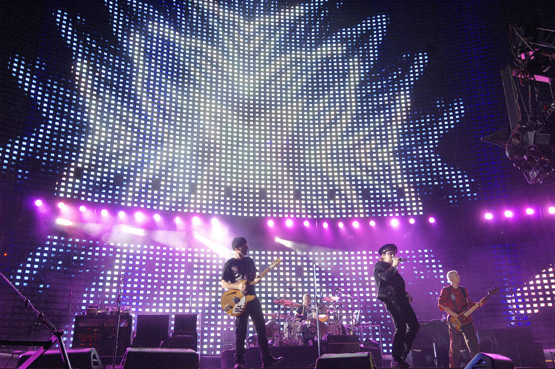
U2 3D will screen in Midnight Rock Docs section of DOC NYC (©3ality Digital / photo by C. Taylor Crothers)
U2 3D (Catherine Owens & Mark Pellington, 2008)
DOC NYC
IFC Center
323 Sixth Ave. at Third St.
Friday, November 5, 11:59 pm
Festival runs November 3-9
www.docnyc.net
www.U23Dmovie.com
 When we caught U2’s Vertigo Tour at the Garden in June 2006, we were up in the rafters, looking down at tiny dots that just happened to be drummer Larry Mullen Jr., bass player Adam Clayton, guitarist the Edge, and singer Bono. But the World’s Most Important Band is front and center for everyone to see in U2 3D, the first-ever full-length film shot in Digital 3-D, directed by Catherine Owens and Mark Pellington. Using as many as eighteen specially equipped digital cameras and recording decks, Owens, who has been U2’s visual content director since ZooTV, captures the Irish band during stadium shows in South America and Mexico, focusing on the March 1-2 concerts at Estadio la Plata in Buenos Aires. The new technology, previously used for sporting events, has a fascinating layered effect that sucks in viewers — yes, who are wearing special glasses (not unlike the specs Bono used to wear as the Fly) — placing them right in the middle of the action as the band powers through an exultant setlist that, if not quite ideal, includes “Vertigo,” “New Year’s Day,” and “Pride (In the Name of Love).” You can’t help but reach out for Bono as he seemingly jumps out of the screen while singing “Touch me” during “Beautiful Day,” and then you’ll swear he’s reaching out only to you when he stares into the camera during “Sunday Bloody Sunday” and promises to “wipe your tears away.” And when tens of thousands of fans all bop up and down in unison to “Where the Streets Have No Name,” forming a propulsive wave, you’ll feel a rush beneath your seat that moves up into your gut. Owens and Pellington (ARLINGTON ROAD) incorporate the band’s hypertextual stage show into the new format, as digitized figures, words, symbols, and letters from the large screens behind the band seem to float right in front of your face. The concert footage is supplemented with extreme close-ups shot onstage without an audience, and the energy level severely drops at these times, although Mullen’s drum kit looks amazing in 3-D. As straight-ahead concert movies go, U2 3D is among the best ever made, a unique theatrical experience that will blow you away. The film is part of the Midnight Rock Docs section of the DOC NYC festival, which also includes D. A. Pennebaker’s ZIGGY STARDUST AND THE SPIDERS FROM MARS: THE MOTION PICTURE, screening at 11:59 on Saturday night.
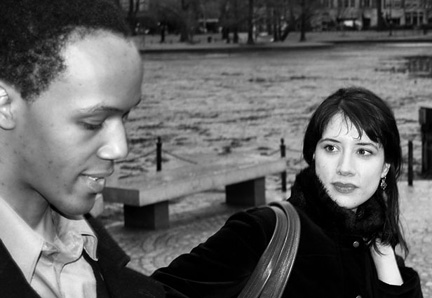
 Twenty-three-year-old writer-director Damien Chazelle expanded his senior thesis at Harvard into an unusual black-and-white musical that mixes John Cassavetes’s SHADOWS and FACES with Jacques Demy’s THE UMBRELLAS OF CHERBOURG (and a little French Nouvelle Vague) as seen through the modern lens of mumblecore. An accomplished jazz drummer, Chazelle (who makes a cameo in the film behind the kits) casts real-life jazz trumpeter and first-time actor Jason Palmer as Guy, a jazz trumpeter in a relationship with Madeline (Desiree Garcia), whom he met on a Boston park bench. But when Guy strays following a chance encounter on a train with a stranger named Elena (Sandha Khin) — an electrifying scene filled with heat and passion — Madeline leaves him, instead dreaming of making a new life for herself in New York. But as the two of them go their separate ways, they still imagine what could have been. The film features such actual musicians and dancers as Andre Hayward of the Jazz at Lincoln Center Orchestra, tap-dancer Kelly Kaleta, and teenage saxophone prodigy Grace Kelly. (Look for Chazelle’s father, Benard, as Paul.) Justin Hurwitz wrote the music for five of the original songs, with Chazelle supplying the lyrics. A slow-paced, heartfelt drama, GUY AND MADELINE ON A PARK BENCH has the improvisational feel of a quiet jazz solo, a soft, tender film about love and loss and how fragile meaningful relationships can be.